Ablelife is a biotech and water-treatment startup pitching a proprietary technology called MAJEC, which claims to deactivate 99.9% of harmful microorganisms in water and air without electricity or waste by-products. Seeking $5 million in funding, the company targets five distinct multi-billion dollar markets, including countertop water treatment ($2.4B) and pool filtration ($2.0B). The deck relies heavily on the management team's deep industry experience—totaling over 100 years combined—and ambitious five-year financial projections that see revenue scaling from $110,000 to over $35 million. W…
Key takeaways
- The company claims its MAJEC technology is 99.9% effective at killing microorganisms in water and air (Slide 2).
- The management team features four members with significant experience, including a CSO who is a co-inventor of 20 issued patents (Slide 4).
- Ablelife identifies a massive total addressable market across five sectors totaling $8.8 billion (Slide 9).
- The funding request is for $5 million, with 47% allocated to working capital and 45% to R&D and QA (Slide 10).
- Financial projections estimate a jump from $110,000 in Year 1 revenue to $35.87 million by Year 5 (Slide 11).
- The business model relies on a razor-and-blade approach: a one-time apparatus cost followed by filter replacements every 6 months (Slide 14).
- The deck explicitly acknowledges barriers to entry, including the need for 'proof of concept' for an unknown technology and potential lobbying from competitors (Slide 13).
- The ultimate social impact goal stated is saving 1.2 million lives per year (Slide 15).
Executive Summary and Mission
Slides 1-2: The Hook and the Promise
Ablelife opens its pitch with a high-stakes mission statement: "We Save Lives." Slide 1 establishes the brand identity with a clean, geometric logo and a teal-heavy color palette. Slide 2 immediately follows up with a value proposition, claiming their technologies offer an "innovative, strategic approach" to controlling water and air contaminants. The most significant claim on this slide is that the method is "99.9% Effective" at killing microorganisms. This sets a high bar for the technical evidence required in the subsequent slides.
The Leadership Team
Slides 3-4: Management Expertise
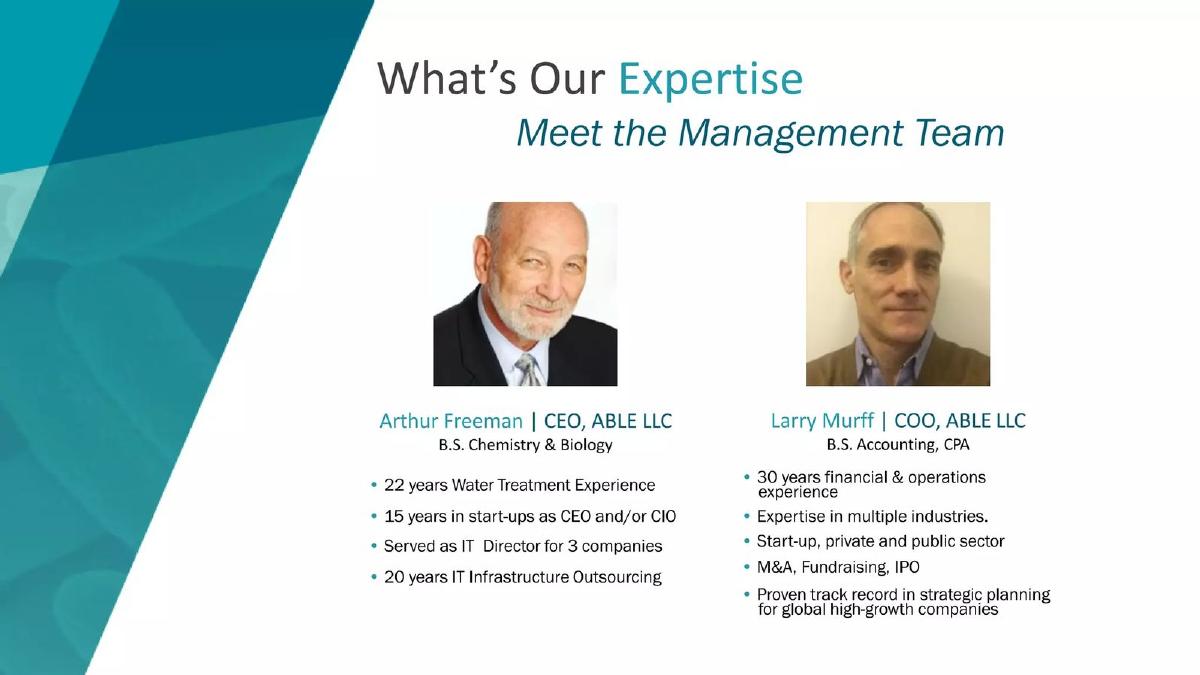
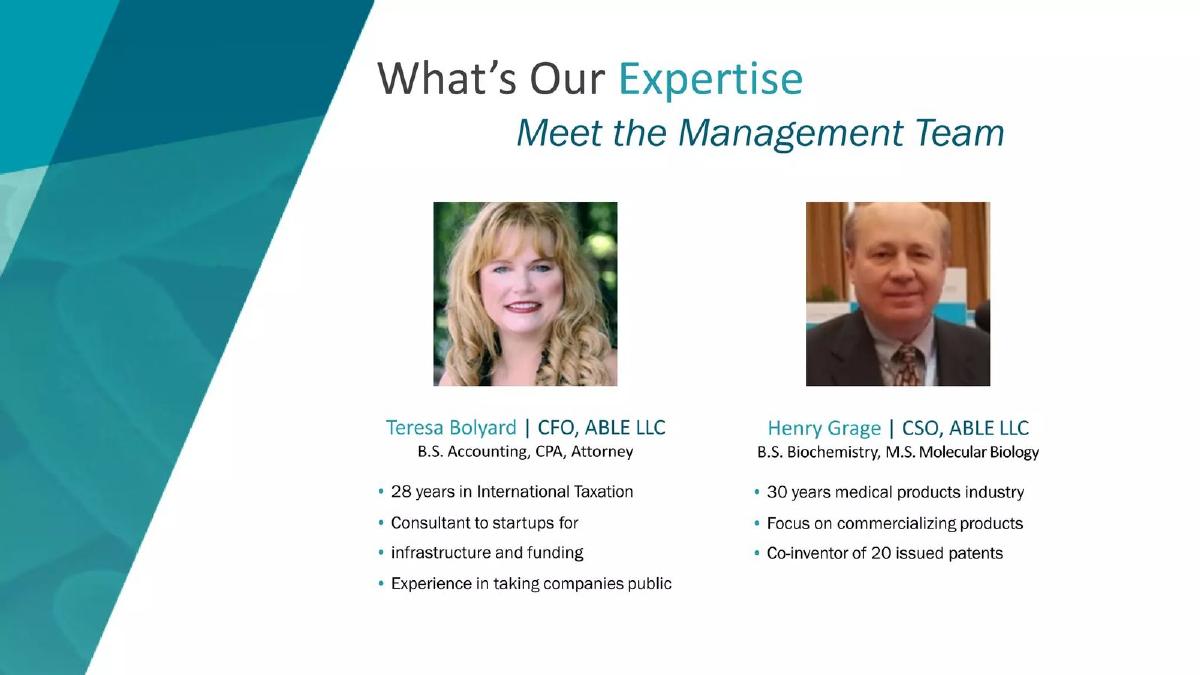
The deck leans heavily on the pedigree of its leadership. Slide 3 introduces Arthur Freeman (CEO) and Larry Murff (COO). Freeman brings 22 years of water treatment experience and 15 years in startups, while Murff offers 30 years of financial and operations experience, including M&A and IPOs. Slide 4 introduces Teresa Bolyard (CFO) and Henry Grage (CSO). Bolyard is an attorney and CPA with experience in international taxation and taking companies public. Grage is perhaps the most critical team member for a deep-tech pitch, cited as a co-inventor of 20 issued patents with 30 years in the medical products industry. Collectively, the team presents over a century of relevant professional experience, which is a strong signal for a seed or Series A stage company.
Problem and Solution
Slides 5-7: The Pathogen Problem and the MAJEC Solution
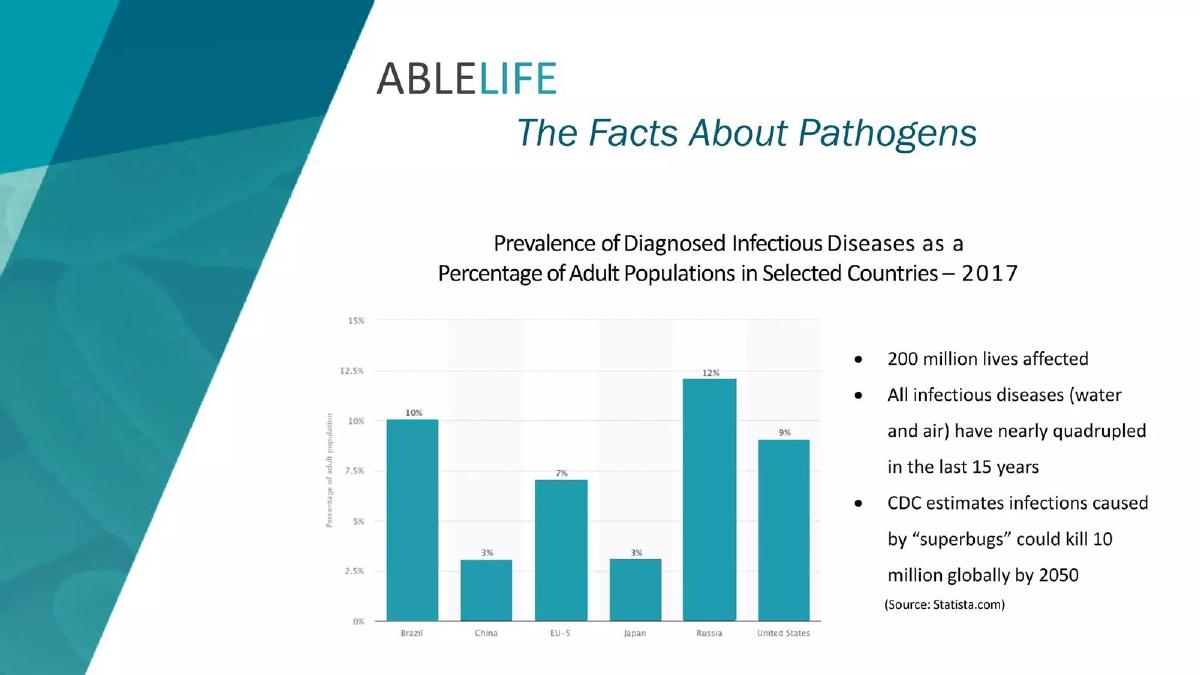
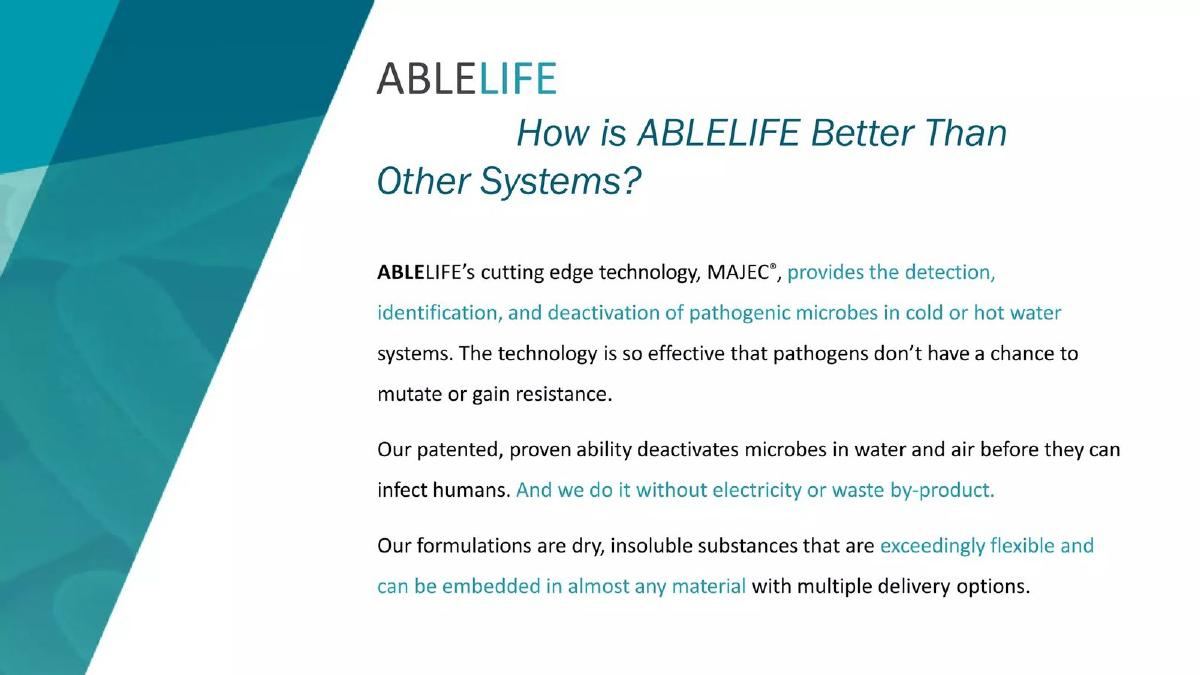
Slide 5 uses Statista data to highlight the prevalence of infectious diseases, noting that they have "nearly quadrupled in the last 15 years." It sets a grim backdrop, mentioning that "superbugs" could kill 10 million people globally by 2050. Slide 6 introduces the solution: MAJEC technology. The deck claims this technology provides detection, identification, and deactivation of pathogens in both cold and hot water systems. A key differentiator mentioned is that it functions without electricity or waste by-products. Slide 7 explains the mechanism of action: a catalytic reaction that disrupts cell membranes on contact. It also notes that the formulations meet or exceed EPA Drinking Water Standards, a crucial regulatory milestone.
Market Opportunity
Slides 8-9: Market Needs and Global Targets
Slide 8 narrows the focus to four high-impact areas: Water Purification, Trauma Wounds, Pool & Spa, and Legionella in hot water systems. It positions the current "old-school" treatments as ineffective against antibiotic-resistant superbugs. Slide 9 quantifies the opportunity, mapping out a total addressable market of $8.8 billion across five segments. The largest segments are Countertop Water Treatment ($2.4B) and Pool/Spa Filtration ($2.0B). By spreading across these diverse sectors, Ablelife suggests that their core IP is highly versatile, though it also raises questions about focus for a small startup.
Financials and Funding
Slides 10-12: The $5M Ask and Projections
Slide 10 is the "Ask" slide. Ablelife is seeking $5 million. The breakdown is heavily weighted toward growth and development, with 92% of the funds going to Working Capital and R&D/QA. Slide 11 provides a detailed 5-year financial snapshot. The revenue growth is aggressive, starting at $110k in Year 1 and reaching $35.8M by Year 5. Interestingly, the company expects to be EBITDA positive by Year 4 ($1.97M). Slide 12 visualizes this growth with a "Revenue vs Expenses" chart, showing the lines crossing between Year 3 and Year 4, which is a standard expectation for venture-backed startups.
Execution and ROI
Slides 13-16: Barriers, Returns, and Contact
Slide 13 is a rare and refreshing "Barriers to Entry" slide. Instead of claiming no competition, the founders acknowledge that their technology is unknown and will face lobbying from incumbents. Slide 14 outlines the business model and ROI for customers. It describes a recurring revenue model where filters are replaced every 6 months. It provides specific profit estimates for institutional clients: a two-story nursing home could bring in ~$78k per year, while a hospital could return ~$290k in profits. Slide 15 reiterates the social impact—1.2 million lives saved per year—before Slide 16 provides contact information, notably using a ".org" domain (biogone.org), which may suggest a non-profit origin or a specific branding choice for their environmental mission.
What Works in the Ablelife Deck
1. Strong Team Pedigree: The management slides are excellent. They don't just list titles; they list specific years of experience, relevant degrees (B.S. Chemistry, M.S. Molecular Biology, CPA, Attorney), and tangible achievements like the number of patents held by the CSO. This builds immediate credibility for a complex technical product.
2. Clear Value Proposition: The claim of 99.9% effectiveness without electricity or waste is a powerful "hook." It addresses common pain points in water purification (energy costs and chemical by-products) directly.
3. Realistic Risk Assessment: Including a slide on barriers to entry shows maturity. Acknowledging that incumbents will lobby against them and that they need to provide "proof of concept" shows investors that the founders are not naive about the challenges of market adoption.
What is Missing from the Ablelife Deck
1. Competitive Landscape: While the deck mentions "old-school treatments," it does not name specific competitors or provide a feature-by-feature comparison. Investors need to know why a customer would choose MAJEC over established players like 3M, Pentair, or specialized biotech firms.
2. Go-to-Market Strategy: The deck identifies five massive markets but doesn't explain which one they will tackle first or how. Selling to hospitals is vastly different from selling countertop filters to consumers. A "beachhead market" strategy is missing.
3. Technical Validation: While the deck mentions "multiple lab results," it doesn't show any data, charts, or third-party certifications. For a $5M ask in a science-heavy field, a slide dedicated to a specific case study or lab trial result would be highly beneficial.
Founder Takeaways
Quantify the ROI for the Customer: Ablelife does a great job on Slide 14 by breaking down what a hospital or nursing home stands to gain financially. Founders should always translate their technical specs into dollars saved or earned for the end-user.
Align the Ask with the Plan: The $5M ask is clearly tied to R&D and working capital. However, founders should ensure their financial projections (Slide 11) reflect the headcount and infrastructure that $5M will buy. In this deck, the jump from Year 1 to Year 2 revenue is nearly 10x, which requires a very specific sales and marketing plan that isn't fully detailed here.
Use a Professional Design Language: The deck uses a consistent, professional template. While not overly flashy, the clean layout and clear headings make the information easy to digest, which is critical when presenting complex biological data.
Frequently asked questions
- What is the core technology behind Ablelife?
- The core technology is called MAJEC. According to Slide 6 and 7, it consists of targeted anti-microbial formulations that deactivate bacteria, protozoa, fungi, and certain viruses via a catalytic reaction. This reaction disrupts the cell membrane on contact. The technology is described as dry, insoluble substances that can be embedded in various materials and works without electricity or creating waste by-products.
- How does Ablelife plan to spend the $5 million investment?
- Slide 10 breaks down the $5 million funding requirement into three categories. The largest portion, 47% ($2,233,783), is designated for Working Capital. Nearly as much, 45% ($2,127,650), is allocated to Research & Development (R&D) and Quality Assurance (QA). The remaining 8% ($355,313) is earmarked for Equipment.
- What are the projected financial outcomes for the company?
- Slide 11 provides a 5-year snapshot. Year 1 shows modest revenue of $110,000 and an EBITDA loss of $610,000. By Year 5, the company projects total revenue of $35,870,000 (combining ABLEFilters and a Legionella JV) with an EBITDA of $4,840,000. The cumulative cash need is expected to peak at $4,870,000 in Year 4 before beginning to recover.
- Which markets is Ablelife targeting?
- Slide 9 identifies five specific global market targets: Countertop Water Treatment ($2.4 Billion), Pool, Spa and Jacuzzi Filtration ($2.0 Billion), Water Purification Systems ($1.9 Billion), Antimicrobial Additives ($1.5 Billion), and Medical Wound Treatment ($1.0 Billion). Slide 8 also mentions a specific focus on Legionella in hot water systems.
- What are the primary risks or barriers mentioned in the deck?
- Slide 13 lists three 'Barriers to Enter the Market.' First, the technology is unknown and requires 'proof of concept' for users. Second, site reviews by experts are required for building plumbing before installation. Third, the company anticipates lobbying efforts by existing companies whose business models might be negatively impacted by Ablelife's technology.