Accel Club’s Series A deck is a masterclass in presenting a 'roll-up' or aggregator strategy within a specific, high-growth ecosystem. By focusing on the $295 billion Amazon third-party seller market, the company positions itself as a sophisticated operator capable of turning fragmented small businesses into a consolidated, high-margin portfolio. The deck relies heavily on the concept of multiple arbitrage—buying at 3-4x EBITDA and aiming for the 20x-60x multiples seen in the D2C and FMCG sectors. With a team boasting significant exits and M&A experience from Yandex, BCG, and KPMG, the narrat…
Key takeaways
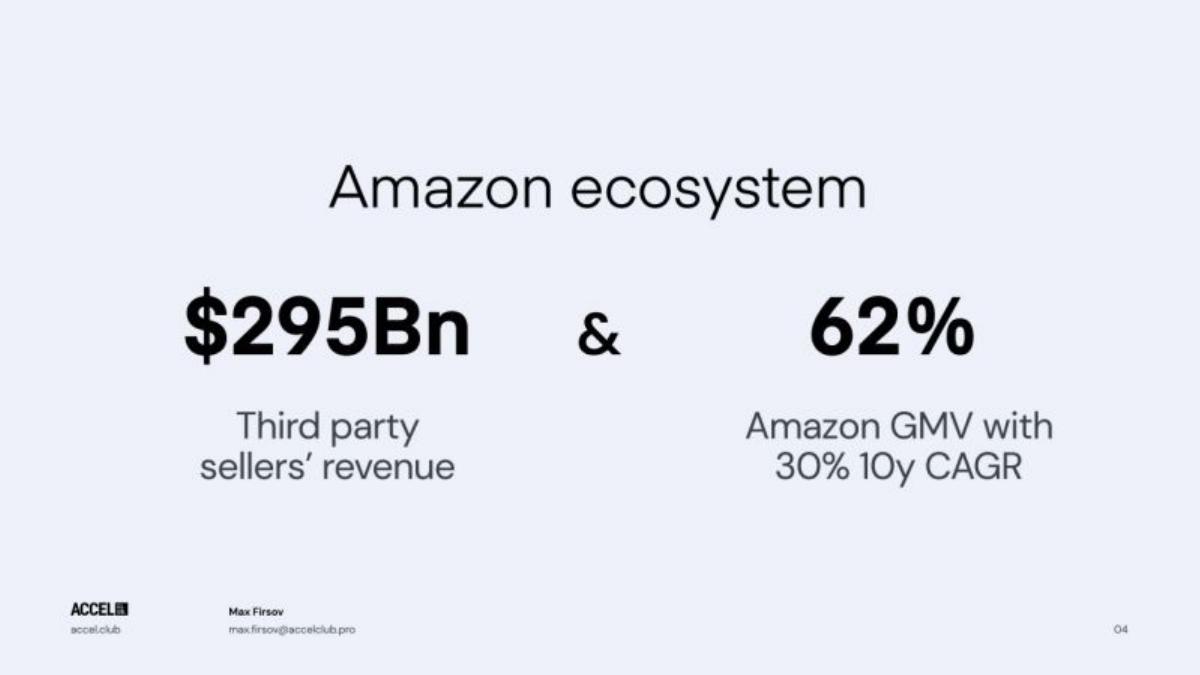
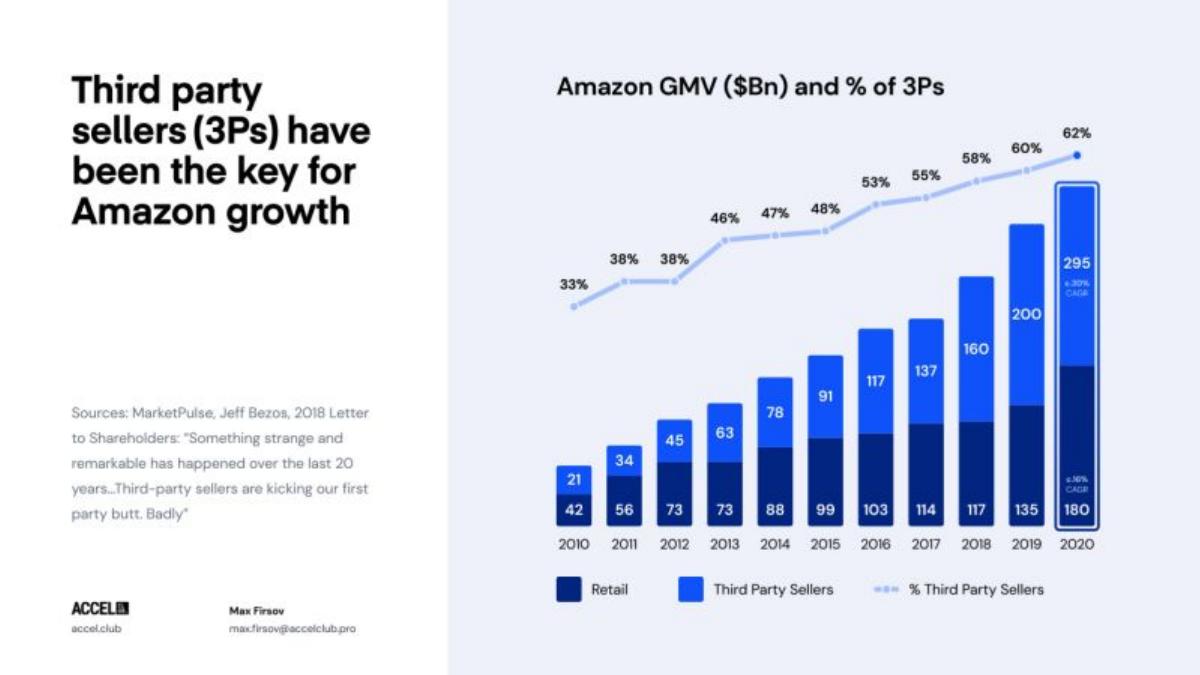
- The Amazon third-party seller ecosystem represents a $295 billion revenue opportunity with a 30% 10-year CAGR (Slide 4).
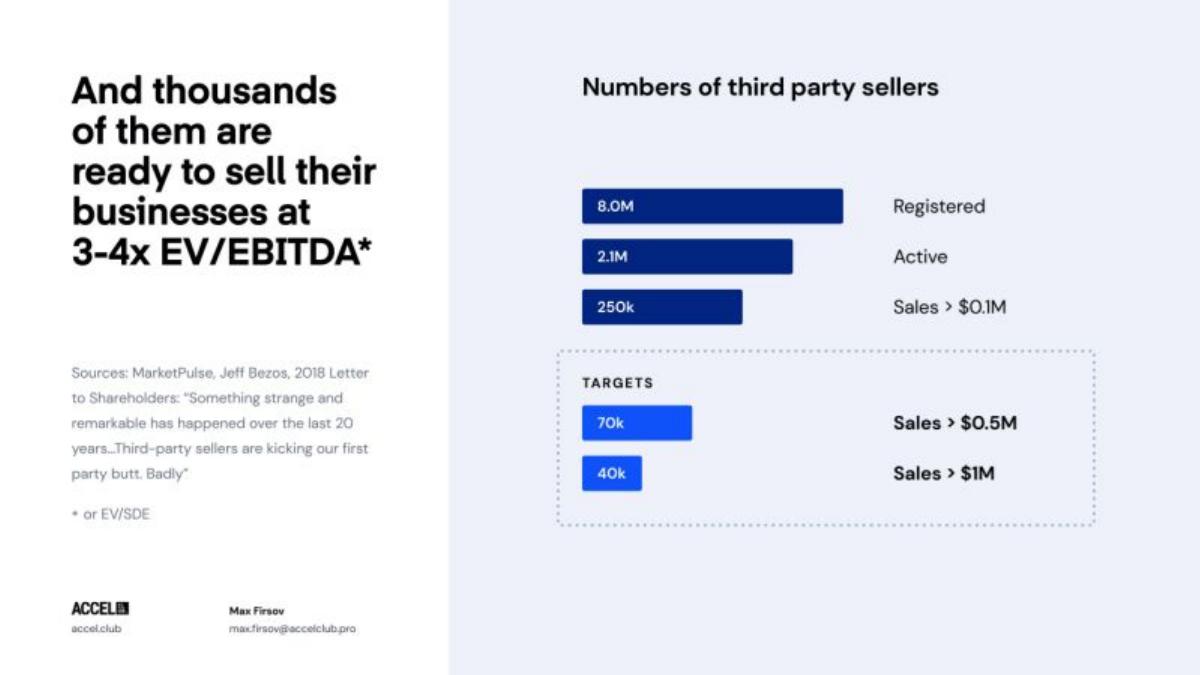
- Accel Club targets a specific segment of the market: the 40,000 sellers with sales exceeding $1 million (Slide 5).
- The core financial thesis is buying businesses at 3-4x EV/EBITDA and scaling them through a tech-enabled platform (Slide 5, 10).
- Growth is achieved post-acquisition through five pillars: risk hedging, economies of scale, long-term growth re-focus, multichannel expansion, and tech-enabled management (Slide 10).
- The team features deep operational and M&A expertise, including a former CEO of Yandex Food-tech and a Managing Director from Busfor (Slide 15).
- Multiple arbitrage is a primary value driver, contrasting the 3x entry multiple of sellers with the 40x+ multiples of successful D2C companies (Slide 22).
- The company utilizes a structured conversion funnel where they expect a deal conversion rate of approximately 10% from their long list of targets (Slide 24).
- The deck outlines a clear path to a 5x increase in Enterprise Value through revenue improvements, cost reductions, and financing leverage (Slide 26).
The Macro Opportunity: The Amazon Giant
Slides 1-4: Setting the Stage
The deck opens with a minimalist title slide (Slide 1) featuring the Accel Club logo and contact information for CEO Max Firsov. This sets a professional, corporate tone that persists throughout the presentation. By Slide 4, the company immediately establishes the scale of their playground: the Amazon ecosystem . They cite $295 billion in third-party seller revenue and note that this segment represents 62% of Amazon's Gross Merchandise Volume (GMV), growing at a 30% 10-year CAGR . This slide is critical because it justifies the 'aggregator' model by showing that the underlying market is both massive and expanding rapidly.
Slide 5: The Target Market
Slide 5 provides a funnel of the seller universe. It notes there are 8 million registered sellers, but only 2.1 million are active. Accel Club narrows its focus significantly, identifying 250,000 sellers with sales over $0.1M. Their primary targets are even more exclusive: the 70,000 sellers with >$0.5M in sales and the 40,000 sellers with >$1M in sales. The slide explicitly states that thousands of these sellers are ready to exit at 3-4x EV/EBITDA . This introduces the core financial incentive of the deck: the availability of profitable targets at relatively low entry valuations.
The Solution: A Tech-Enabled Scaling Platform
Slides 8-10: The Value Proposition
Slide 8 is a simple transition statement: "We acquire, build and scale e-commerce businesses by integrating them into our platform." This is followed by Slide 10, which outlines the five levers of growth post-acquisition. These include hedging of risks through a product portfolio, economies of scale on back-end operations, a shift in focus toward long-term growth , multichannel and geographical expansion , and tech-enabled management . This slide is intended to convince investors that Accel Club isn't just a holding company, but an operational platform that adds tangible value to the brands it buys.
Slide 12: Financial Logic
Slide 12 makes a bold claim: "Business model implies exponential scaling with positive EBITDA ." This is a key differentiator from many high-growth tech startups that burn cash for years. In the aggregator model, every acquisition brings in immediate cash flow, allowing the company to use debt and reinvested profits to fuel further acquisitions. This 'profitable growth' narrative is a strong selling point for Series A investors looking for de-risked returns.
The Team: Operators and Dealmakers
Slide 15: Leadership Profiles
The team slide is perhaps the strongest in the deck. It features four key executives with deep pedigrees. Max Firsov (CEO) is noted as the former CEO of Yandex Food-tech, which managed $1B+ in GMV. Nick Tuzenko (Managing Director) comes from Busfor (acquired by BlaBlaCar for $100M+) and BCG. Askar Bagaviev (VP Acquisitions) and Daria Mash (Head of M&A) bring consulting and investment banking experience from BCG, KPMG, and Dentsu Aegis. This combination of high-level operational experience and M&A expertise is essential for a business that relies on both running brands and executing frequent deals.
Slide 17: Investor Backing
Slide 17 serves as a placeholder for their early backers, titled "Backed by world-class early investors." While the specific logos are not shown in this version of the deck, the catalogue facts confirm they successfully raised $170M , indicating that the 'world-class' claim was validated by the market.
The Appendix: Deep Dives into Strategy
Slide 22: The Multiple Arbitrage Thesis
Slide 22 is the most important financial slide in the deck. It visualizes the Multiple Growth Opportunity . It shows that while current third-party sellers trade at a 3x multiple, successful D2C companies like Glossier and Dollar Shave Club have seen multiples of 30x to 60x . Even traditional FMCG companies like P&G and Unilever trade at 13x to 17x. The implication is clear: by consolidating small 3x businesses into a large, branded portfolio, Accel Club can unlock massive valuation increases simply through the change in how the market perceives the entity.
Slide 24: Sourcing and Conversion
Slide 24 details how they find deals. They categorize leads into 'Warm' (brokers like EmpireFlippers, PPC agencies) and 'Cold' (forums, LinkedIn, Amazon category parsing). They disclose a conversion rate into deals of c.10% , citing Thras.io interviews as a benchmark. This transparency regarding the 'deal flow' mechanics shows a disciplined approach to M&A.
Slide 26: The Path to 5x EV
Slide 26 uses a waterfall chart to show how a business's Enterprise Value (EV) can grow 5x from start to exit. The growth is driven by revenue improvements (marketing, geographic expansion), cost improvements (supply chain, production), financing of working capital (leverage), and finally, multiple arbitrage. This provides a roadmap for how they intend to generate returns on the $170M raised.
Slides 28-34: Operational Nuance
The final slides (28, 30, 32, 34) provide more granular detail on the acquisition lifecycle and the Amazon marketplace. Slide 28 emphasizes that the growth of the portfolio permanently increases leverage capacity , allowing for larger and more frequent acquisitions. Slides 32 and 34 dive into the technical differences between 1P (Vendor) and 3P (Seller) models and the use of specialized data tools for scouting. This demonstrates that the team understands the technical 'under the hood' aspects of the Amazon platform, not just the high-level financials.
What Accel Club Does Well
Clarity of the Financial Thesis: The deck does an excellent job of explaining multiple arbitrage. By comparing the 3x entry multiple to the 40x+ D2C multiples, they make the investment opportunity feel like an inevitable mathematical outcome rather than a speculative bet.
Team-Market Fit: The founders aren't just 'entrepreneurs'; they are seasoned operators from massive platforms like Yandex. This gives investors confidence that they can handle the logistical complexity of managing hundreds of disparate SKUs and global supply chains.
Structured M&A Process: The inclusion of sourcing funnels and conversion rates (Slide 24) shows that the company treats acquisitions as a repeatable, industrial process rather than a series of one-off negotiations.
What Is Missing
Portfolio Performance: There is a notable lack of data on existing brands they have already acquired. While this is a Series A deck and they may be in the early stages of the roll-up, showing even one 'case study' of a brand they improved would have added significant credibility to their 'scaling' claims.
Unit Economics: While they mention 'positive EBITDA,' the deck lacks a breakdown of the unit economics of a typical brand acquisition. Investors would want to see the contribution margin, CAC (Customer Acquisition Cost) on Amazon, and the payback period on the acquisition capital.
Competitive Landscape: The Amazon aggregator space was highly crowded in 2021 (with competitors like Thrasio, Perch, and Heyday). The deck does not explicitly address how Accel Club wins deals against these well-funded rivals or if they are focusing on a specific niche (e.g., European sellers) to avoid direct competition.
What Other Founders Should Copy
The Waterfall Chart (Slide 26): This is a brilliant way to show how value is created. Instead of just saying "we make things better," Accel Club breaks down the specific levers (marketing, supply chain, leverage) that lead to a 5x exit. Any founder in a roll-up or private equity-style startup should use this format.
The Funnel Visualization (Slide 5): By starting with 8 million and ending with 40,000, the founders show they have a 'Total Addressable Market' (TAM) that is both large enough to be interesting and narrow enough to be actionable. It prevents the 'boiling the ocean' critique.
Minimalist Design: The deck uses a clean, high-contrast aesthetic that feels more like a McKinsey report than a typical startup pitch. For businesses involving large sums of capital and M&A, this 'grown-up' look helps build trust with institutional investors.
Frequently asked questions
- What is Accel Club's primary business model?
- Accel Club operates as an e-commerce aggregator. They identify, acquire, and scale third-party sellers on the Amazon platform. Their goal is to integrate these independent brands into a centralized management platform to improve operational efficiency, expand into new geographies, and achieve higher valuation multiples through consolidation.
- How much did Accel Club raise with this deck?
- According to the catalogue facts, Accel Club raised $170 million in a Series A round in 2021. This substantial capital injection is typical for the aggregator model, which requires significant debt and equity to fund the acquisition of multiple revenue-generating businesses simultaneously.
- What is the 'Multiple Arbitrage' mentioned in the deck?
- Multiple arbitrage is the practice of buying a business at a low valuation multiple (e.g., 3x EBITDA) and eventually being valued at a higher multiple (e.g., 15x-40x) as part of a larger, more stable, and faster-growing entity. Slide 22 illustrates this by comparing small Amazon sellers to major FMCG and D2C brands.
- Who are the key members of the Accel Club team?
- The leadership includes CEO Max Firsov, formerly of Yandex Food-tech; Managing Director Nick Tuzenko, formerly of Busfor and BCG; VP of Acquisitions Askar Bagaviev, formerly of BCG; and Head of M&A Daria Mash, with experience at Mindrock Capital and KPMG. The team is built specifically for high-volume deal execution and operational scaling.
- What specific market segment does Accel Club target?
- While there are 8 million registered sellers on Amazon, Accel Club focuses on the 'top of the pyramid.' Slide 5 shows they target the 70,000 sellers with over $0.5M in sales and the 40,000 sellers with over $1M in sales, where the businesses are established enough to have proven product-market fit.