Quahog Life Sciences presents a 15-slide deck (8 provided for review) centered on an AI-based Healthcare Decision System designed to reduce diagnostic errors. The company positions itself as a technical solution provider using Recursive Neural Networks to analyze structural and functional patterns of cells. Their value proposition is built on efficiency, claiming a 70% faster 'Time to Insight' and a 50% reduction in the 'Cost of Insights' compared to traditional platforms. The management team features significant corporate experience from IBM and Indegene. However, the deck is notably light o…
Key takeaways
- The platform's primary goal is to solve the problem of diagnostic errors in medicine using machine learning (Slide 2).
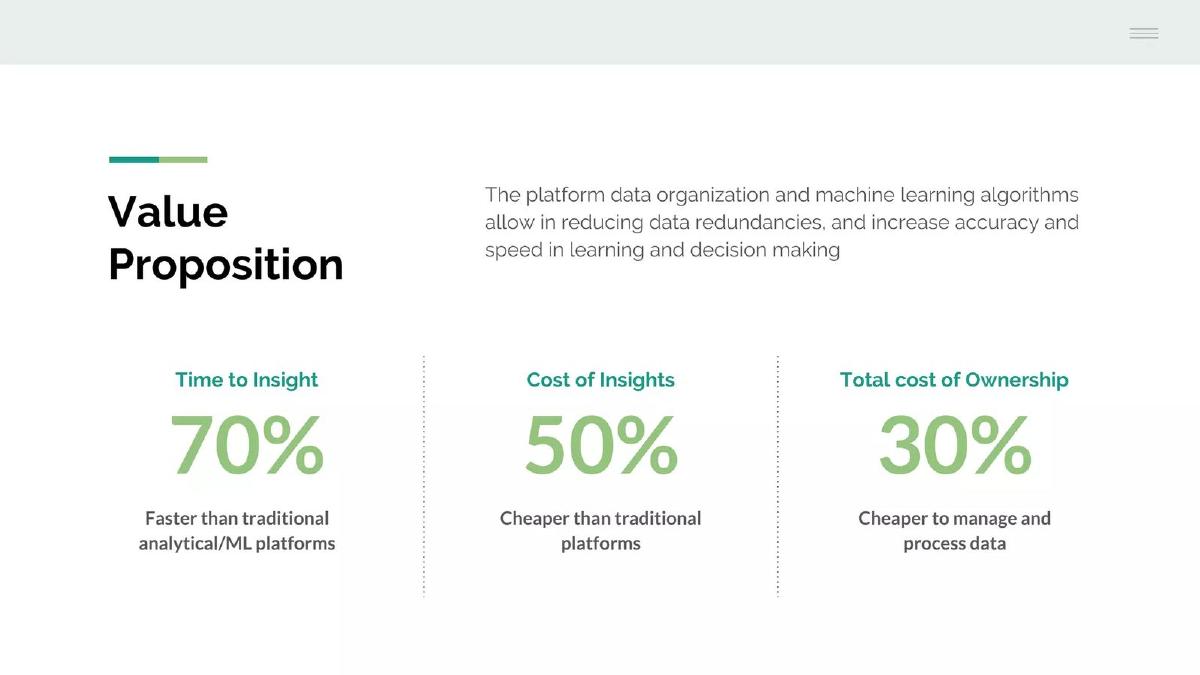
- Quahog claims a 70% faster 'Time to Insight' compared to traditional analytical/ML platforms (Slide 3).
- The company estimates a 30% reduction in the total cost of ownership for managing and processing data (Slide 3).
- The technical 'Secret Sauce' involves a Recursive Neural Network capable of time and space-based analysis of cell patterns (Slide 4).
- The business model includes three distinct offerings: an ML Platform, ML Services, and Add-on Apps featuring focused bots (Slide 5).
- Target audiences are broad, spanning Hospitals, Clinics, Pharmaceutical Enterprises, BioResearch Agencies, and Diagnostic Centers (Slide 6).
- The management team includes former employees of IBM and Indegene, and a founder of Plumb5 (Slide 7).
- The company is headquartered in Hampshire, U.K., as indicated by the contact information (Slide 8).
Company Overview and Mission
Quahog Life Sciences Pvt. Ltd. presents itself as a specialized player at the intersection of artificial intelligence and biotechnology. The deck, dated 2019 on the cover slide, focuses on the deployment of advanced machine learning to improve clinical decision-making. The overarching narrative is one of efficiency and error reduction in a field where diagnostic accuracy is paramount.
Slide 1: Title Slide
The deck opens with the tagline "Enhancing Healthcare Decisions." The visual theme uses a DNA double-helix rendered in a liquid/digital style, set against a background of neural network nodes. The top left corner identifies the company as Quahog Life Sciences Pvt. Ltd. and the top right dates the deck to 2019 . This slide establishes a professional, clinical tone but lacks a specific mission statement or one-sentence pitch.
Slide 2: Overview
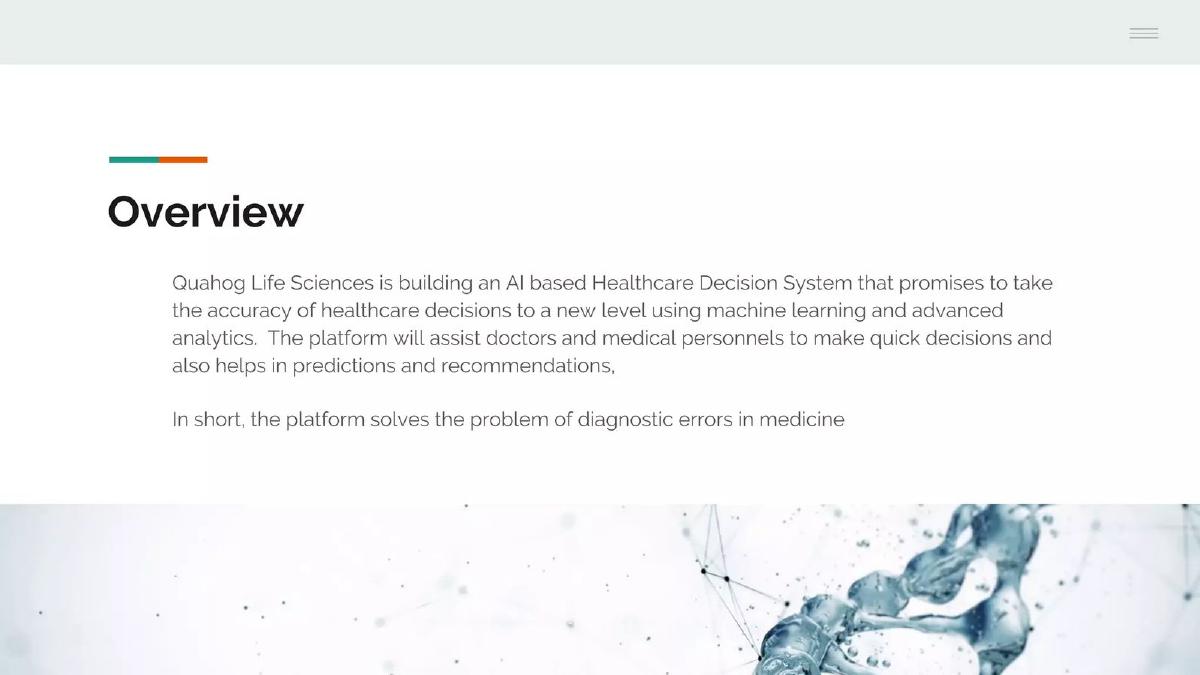
Slide 2 defines the product as an "AI based Healthcare Decision System." The text explains that the platform uses machine learning and advanced analytics to assist doctors and medical personnel. The most critical takeaway from this slide is the explicit problem statement: "the platform solves the problem of diagnostic errors in medicine." By framing the solution around diagnostic accuracy, the company targets a high-value pain point in healthcare, though it does not yet specify which diseases or medical fields it prioritizes.
Slide 3: Value Proposition
This slide attempts to quantify the impact of the platform using three key metrics. First, it claims a 70% improvement in "Time to Insight," stating it is faster than traditional analytical/ML platforms. Second, it cites a 50% reduction in the "Cost of Insights." Finally, it notes a 30% reduction in the "Total cost of Ownership" regarding data management and processing. While these figures are impressive, the slide lacks footnotes or data sources to explain how these percentages were calculated or what specific "traditional platforms" are being used as a baseline.
Slide 4: Secret Sauce
Slide 4 dives into the technical architecture. The company identifies its core differentiator as a Recursive Neural Network . The text specifies that the model incorporates "backpropagation through structure" and is capable of "time and space based analysis." The ultimate goal of this technology is to learn the "structural and functional patterns of a cell." This indicates that Quahog is operating at the cellular level, likely involving pathology or cytological data, rather than just high-level patient records.
Slide 5: Offerings
ML Platform: A tool for bringing together data from various sources for unified learning. · ML Services: A service-based offering focused on data preparation and model integration, acknowledging that healthcare data requires "scrupulous" preparation. · Add-on Apps: A future-looking offering of "focused bot applications" trained on specialized disease groups to assist both doctors and patients.
This suggests a hybrid business model combining Software-as-a-Service (SaaS) with professional consulting services.
Slide 6: Target Audience
The target audience slide lists five avenues for the platform: Hospitals, Clinics, Pharmaceutical Enterprises, BioResearch Agencies, and Diagnostic Centers. While this demonstrates a wide range of potential applications, it also suggests a lack of initial market focus. Selling to a hospital is fundamentally different from selling to a pharmaceutical enterprise, and the deck does not distinguish between these sales cycles or user requirements.
Slide 7: Management
The management slide highlights four key individuals, emphasizing their corporate pedigree. Veerendra Raju is listed as the Chief of Data Sciences and a founder of Plumb5. Dr. Kannan Mavila (Chief - Operations) brings experience from Indegene. The sales and strategy functions are led by Hasmukh Patel and Kaushik Khaund , both of whom are noted as "Ex IBM." The presence of former IBM employees suggests a team familiar with enterprise-grade technology and large-scale sales, which is a strength for a healthcare startup.
Slide 8: Contact Information
The final slide provides the company's contact details. The address is listed as Corbett House, 148C London Road, Waterlooville, Hampshire, U.K. A UK-based phone number is also provided. This confirms the company's geographic base and provides a point of contact for interested parties.
What Works in This Deck
The technical clarity on Slide 4 is a highlight. Many AI startups use "AI" as a buzzword without explaining the underlying architecture; Quahog specifically identifies Recursive Neural Networks and cellular pattern recognition, which gives technical investors something concrete to evaluate. The management team's background (Slide 7) also adds significant credibility, particularly the mix of data science leadership and enterprise experience from IBM.
What is Missing
The deck has several significant omissions that would be required for a formal funding round. There is no Market Size (TAM/SAM/SOM) slide , leaving the investor to guess the scale of the opportunity. There is no Competitor Analysis , which is a major oversight in the crowded healthcare AI space. Most importantly, there is no Financial Ask or Use of Funds slide . Without knowing how much capital the company is seeking and what milestones that capital will achieve, the deck functions more as a corporate brochure than a pitch for investment. Furthermore, there are no case studies or evidence of pilot programs to validate the 70% and 50% efficiency claims made on Slide 3.
Founder Takeaways
Founders should look at Slide 3 as a good example of how to present value propositions clearly, but also as a cautionary tale: always back up large percentage claims with a small footnote explaining the methodology. The "Offerings" slide (Slide 5) is a strong way to show how a complex technology can be productized into different revenue streams. However, founders should avoid the "Target Audience" approach seen on Slide 6; instead of listing every possible customer, it is usually more effective to identify a "beachhead market"—the one specific segment where the product will launch first.
Frequently asked questions
- What specific problem is Quahog Life Sciences trying to solve?
- According to Slide 2, the platform is designed to solve the problem of diagnostic errors in medicine. It aims to take the accuracy of healthcare decisions to a 'new level' by assisting doctors and medical personnel with machine learning, advanced analytics, predictions, and recommendations.
- What is the core technology behind their AI platform?
- Slide 4 identifies their 'Secret Sauce' as a learning model that incorporates data organization for backpropagation through structure, specifically a Recursive Neural Network. This model is designed for time and space-based analysis to learn the structural and functional patterns of a cell.
- How does the company plan to generate revenue?
- While a specific pricing model is not detailed, Slide 5 outlines three revenue-generating 'Offerings': a unified ML Platform for data integration, ML Services for data preparation and model integration, and Add-on Apps which consist of focused bot applications for doctors and patients.
- Who are the key members of the management team?
- Slide 7 lists four leaders: Veerendra Raju (Chief - Data Sciences, Founder of Plumb5), Dr. Kannan Mavila (Chief - Operations, Ex-Indegene), Hasmukh Patel (Chief - Sales, Ex-IBM), and Kaushik Khaund (Chief - Strategy, Ex-IBM).
- What are the claimed efficiency gains for healthcare providers?
- Slide 3 quantifies three main value propositions: a 70% faster Time to Insight, a 50% lower Cost of Insights compared to traditional platforms, and a 30% lower Total Cost of Ownership for data management.