ReCode Therapeutics' Series B deck is a highly technical, data-driven presentation that successfully addresses the primary bottleneck in genetic medicine: delivery. By focusing on their Selective Organ Targeting (SORT) lipid nanoparticle (LNP) platform, the company demonstrates a clear path to treating diseases beyond the liver, such as Primary Ciliary Dyskinesia (PCD) and Cystic Fibrosis (CF). The deck excels at providing visual proof of efficacy through bioluminescence imaging in mice, dogs, and non-human primates. While it lacks a traditional team slide or detailed financial breakdown in t…
Key takeaways
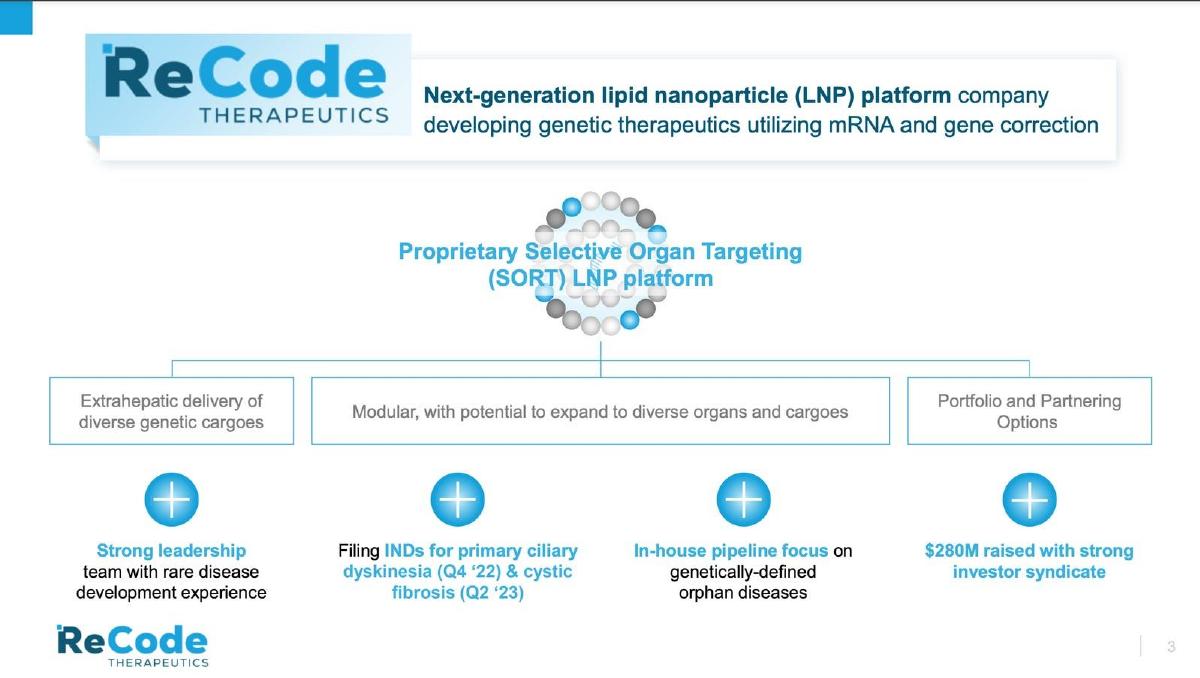
- The deck highlights a $280M total raised to date, signaling strong existing investor backing on slide 3.
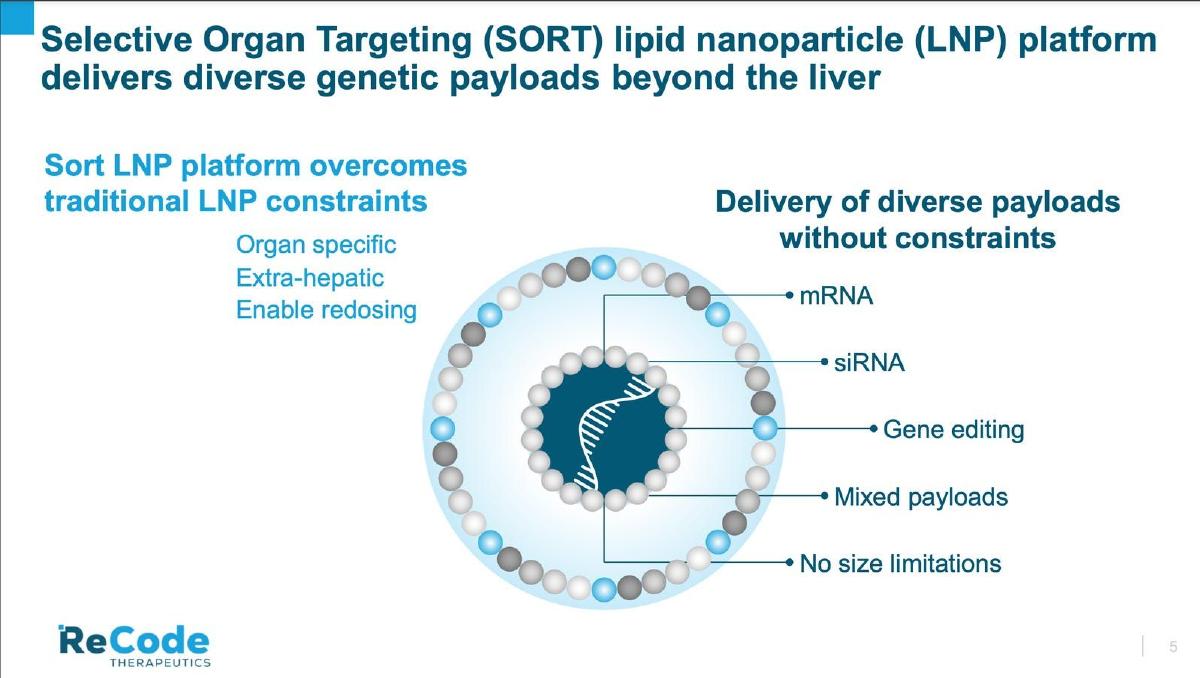
- ReCode positions its SORT LNP platform as the solution to 'traditional LNP constraints,' specifically enabling extra-hepatic delivery on slide 5.
- The technology is shown to be modular, capable of carrying mRNA, siRNA, and gene editing payloads without size limitations as noted on slide 5.
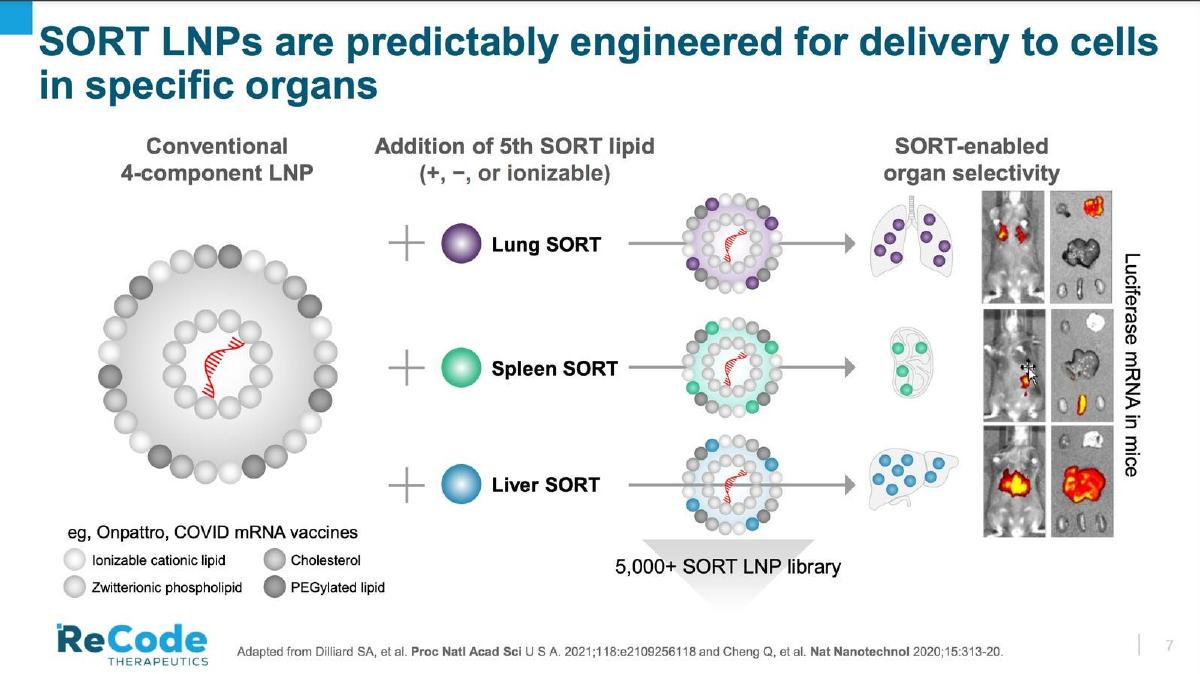
- Visual evidence of organ selectivity is provided through a 5,000+ SORT LNP library that targets the lung, spleen, and liver on slide 7.
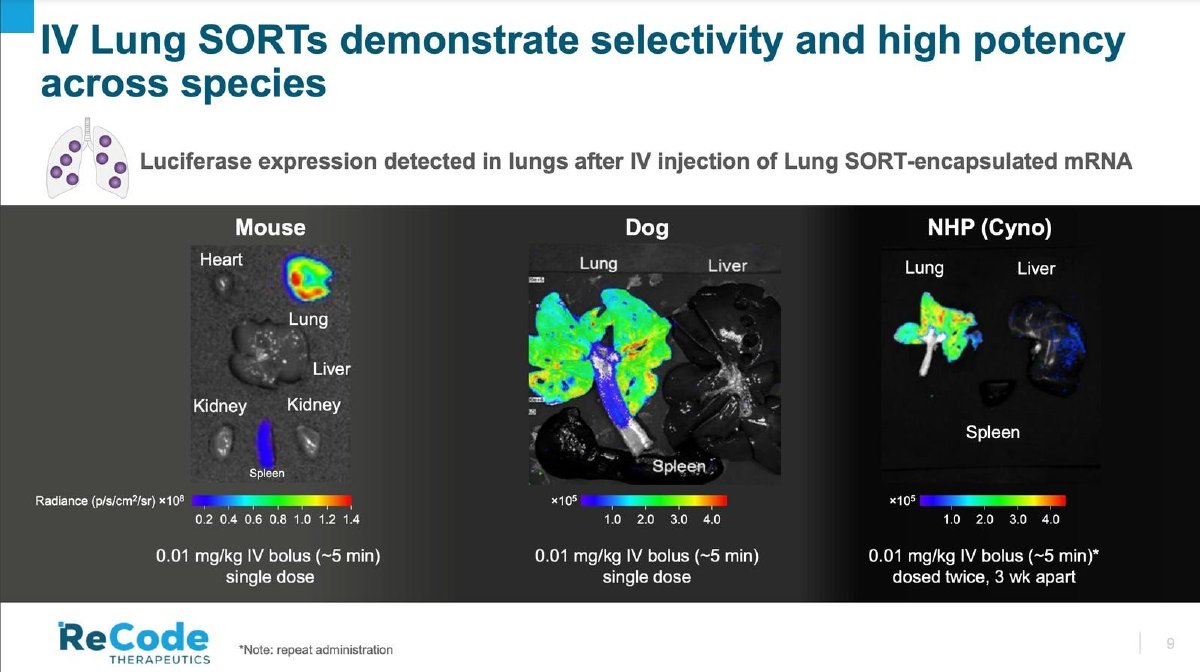
- Cross-species validation is a core pillar, with data shown for mice, dogs, and non-human primates (Cyno) on slide 9.
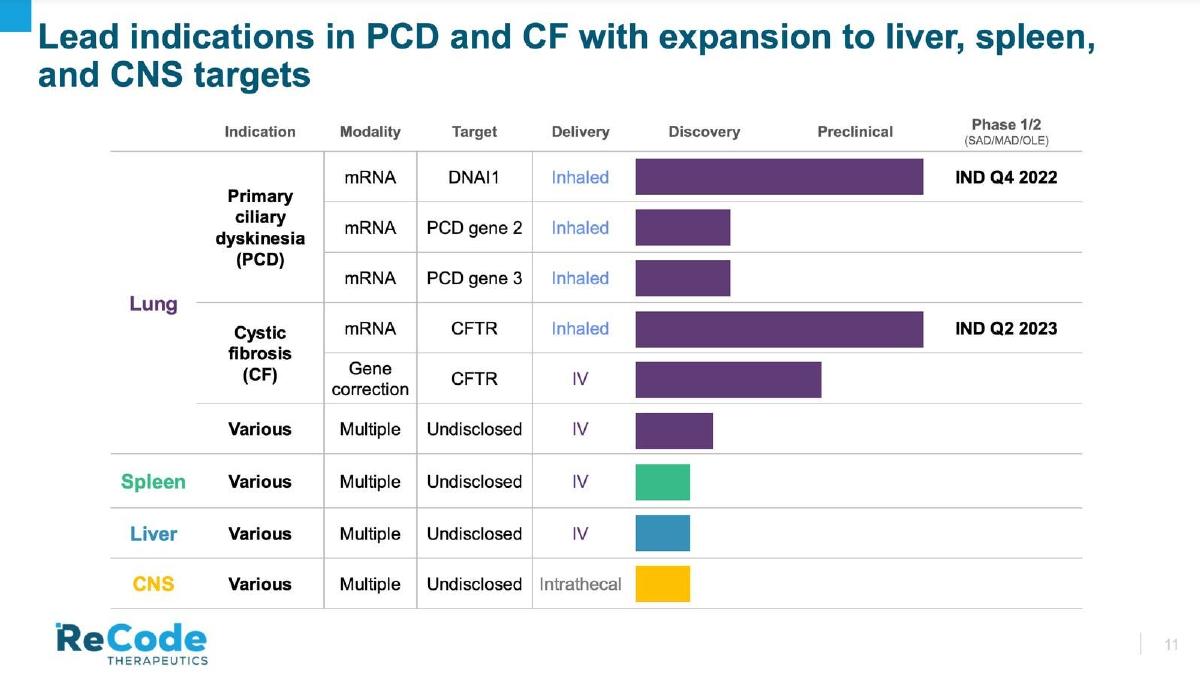
- The company sets clear near-term milestones with IND filings for PCD in Q4 2022 and CF in Q2 2023 on slide 11.
- The pipeline demonstrates a strategic expansion from lung-focused inhaled delivery to IV and intrathecal delivery for CNS targets on slide 11.
- The deck omits a dedicated team slide, though it mentions a 'strong leadership team' in the summary on slide 3.
The Platform Play: How ReCode Therapeutics Validated Extrahepatic Delivery
ReCode Therapeutics' Series B deck, dated June 2022, is a clinical and technical roadmap designed to prove one thing: they have solved the delivery problem for genetic medicines. In the biotech world, particularly for mRNA and gene editing, the ability to target organs other than the liver is the 'holy grail.' This 13-slide deck (of which 7 key slides are analyzed here) focuses heavily on the Selective Organ Targeting (SORT) LNP platform to justify a $120M raise.
Slide 1: Title and Branding
The cover slide is standard for the industry, featuring the company logo and a clear 'Non-confidential Overview' label. The date, June 2022, aligns with the lead-up to their reported Series B funding. The background imagery of a DNA helix reinforces the company's focus on genetic therapeutics.
Slide 3: The Executive Summary
Slide 3 serves as a high-level overview of the company's value proposition. It defines ReCode as a 'Next-generation lipid nanoparticle (LNP) platform company.' Key highlights include:
Extrahepatic delivery: The ability to reach organs beyond the liver. · Modularity: Potential to expand to diverse organs and cargoes. · Clinical Readiness: Filing INDs for primary ciliary dyskinesia (Q4 '22) and cystic fibrosis (Q2 '23). · Capital Position: $280M raised with a 'strong investor syndicate.'
This slide is effective because it immediately addresses the three things Series B investors care about: the technology's unique edge, the timeline to clinical trials, and the existing capitalization.
Slide 5: Overcoming Traditional Constraints
Slide 5 dives into the technical 'Why.' It explicitly states that the SORT LNP platform 'overcomes traditional LNP constraints.' The graphic illustrates a nanoparticle capable of carrying mRNA, siRNA, and gene editing payloads. The most important claim here is 'No size limitations,' which is a common bottleneck for viral delivery vectors like AAV. By positioning themselves as 'organ specific' and 'extra-hepatic,' ReCode is directly attacking the limitations of first-generation LNP companies like Moderna or Alnylam.
Slide 7: Engineering Organ Selectivity
This slide explains the 'How.' It compares a 'Conventional 4-component LNP' (used in COVID-19 vaccines) to ReCode's approach. By adding a '5th SORT lipid,' they can shift the delivery target. The slide shows three distinct paths:
Lung SORT: Using a positive, negative, or ionizable lipid to target lung tissue. · Spleen SORT: Targeting the spleen. · Liver SORT: Maintaining traditional liver targeting.
The inclusion of a '5,000+ SORT LNP library' suggests a deep moat of intellectual property and a high-throughput discovery engine, rather than a single 'lucky' discovery.
Slide 9: Cross-Species Validation
For a biotech company, data is the only currency that matters. Slide 9 presents bioluminescence data showing luciferase expression (a proxy for successful delivery and protein production) in the lungs of a Mouse, a Dog, and a Non-Human Primate (Cyno). The fact that they show a 'single dose' for the mouse and dog, and a 'dosed twice, 3 wk apart' for the NHP, demonstrates both potency and the ability to redose—another significant advantage over viral vectors which often trigger immune responses that prevent second doses.
Slide 11: The Pipeline and Milestones
Slide 11 translates the platform into a product portfolio. The lead indications are in the lung:
PCD (Primary Ciliary Dyskinesia): Targeting DNAI1 with an inhaled mRNA, with an IND planned for Q4 2022. · Cystic Fibrosis (CF): Targeting CFTR with both inhaled mRNA and IV gene correction, with an IND planned for Q2 2023.
The pipeline also shows expansion into the Spleen, Liver, and CNS (Central Nervous System) via intrathecal delivery. This 'hub and spoke' model—where one platform feeds multiple therapeutic areas—is a classic Series B strategy to show that the company isn't a 'one-trick pony.'
Slide 13: Contact and Closing
The final slide is a simple contact page with investor relations and partnering emails. It maintains the professional, clean aesthetic of the rest of the deck.
What ReCode Therapeutics Does Well
The deck is exceptionally focused. It doesn't waste time on the general 'market size' of genetic medicine, assuming the audience already knows it is a multi-billion dollar opportunity. Instead, it focuses entirely on the technical differentiation . The use of actual imaging data (Slide 9) is the strongest part of the deck, as it provides visual proof of the 'extrahepatic' claim. Furthermore, the clear labeling of IND (Investigational New Drug) dates creates a sense of momentum and provides clear valuation inflection points for investors.
What is Missing from the Deck
As a 'Non-confidential Overview,' several critical elements are omitted:
Team Slide: While 'strong leadership' is mentioned, the lack of specific names and track records is a notable omission for a teardown, even if it's standard for public-facing biotech decks. · Financials/Use of Proceeds: There is no slide detailing how the $120M will be spent. Investors would typically want to see a 'Runway' slide showing how this capital gets them through Phase 1 or Phase 2 data. · Competitive Landscape: The deck mentions 'traditional LNP constraints' but does not name specific competitors or show head-to-head data against other next-gen LNP companies. · Manufacturing: For LNPs, manufacturing and scale-up are notoriously difficult. There is no mention of their internal or external manufacturing capabilities.
Founder Takeaways
1. Lead with the Bottleneck: If your industry has a well-known technical hurdle (like liver-sequestration in LNPs), make your solution to that hurdle the centerpiece of your deck. ReCode doesn't just say they have a platform; they show exactly how it differs from the status quo (the 5th lipid).
2. Data is Universal: Showing that your technology works in mice is expected. Showing it works in dogs and non-human primates (Slide 9) is how you raise $120M. If you have cross-species data, it should be the 'hero' of your presentation.
3. Define Your 'Platform' via a Pipeline: A platform is only as valuable as the drugs it produces. ReCode uses Slide 11 to show that their SORT technology isn't just for one disease; it’s a modular system that can be applied to the lung, spleen, and CNS. This increases the 'shots on goal' for an investor.
4. Use Clear Milestones: Don't just say you are 'moving toward the clinic.' Give specific quarters for IND filings. This holds the management team accountable and gives investors a timeline for when the next value markup might occur.
5. Visual Clarity: The diagrams of the LNPs (Slide 5 and 7) are simple and easy to understand, even for a non-scientist. Founders should strive to make their complex technology visually digestible without losing scientific integrity.
Frequently asked questions
- What is the primary technological advantage ReCode claims?
- ReCode claims their Selective Organ Targeting (SORT) LNP platform overcomes the 'liver-only' limitation of traditional lipid nanoparticles. By adding a 5th SORT lipid, they can predictably engineer delivery to specific organs like the lungs and spleen, which is a significant hurdle for current mRNA and gene editing therapies.
- How does ReCode prove their technology works across different animals?
- Slide 9 provides bioluminescence imaging showing luciferase expression specifically in the lungs of mice, dogs, and non-human primates (NHPs) following an IV bolus. This cross-species data is critical for biotech investors to de-risk the transition from lab models to human clinical trials.
- What are the immediate clinical milestones mentioned in the deck?
- The deck identifies two major near-term catalysts: an Investigational New Drug (IND) filing for Primary Ciliary Dyskinesia (PCD) in Q4 2022 and an IND filing for Cystic Fibrosis (CF) in Q2 2023. These milestones provide a clear timeline for the company's transition to a clinical-stage entity.
- What types of genetic payloads can the SORT platform carry?
- According to slide 5, the platform is 'modular' and can deliver diverse payloads without size constraints. Specifically, it lists mRNA, siRNA, gene editing tools, and mixed payloads, suggesting the platform has utility across a wide range of therapeutic modalities.
- Is there information about the management team in this deck?
- Slide 3 mentions a 'strong leadership team with rare disease development experience,' but the deck lacks a dedicated slide with names, photos, or specific bios. In a Series B round, this information is usually handled in the confidential data room or via supplemental materials.