Curio’s Series A deck is a masterclass in category positioning. By framing audio in 2020 as being where 'video was in 2008,' the company successfully tapped into the investor appetite for subscription-based content platforms. The deck leans heavily on high-quality partnerships with publishers like the Financial Times and The Economist to establish immediate credibility. While the presentation is light on detailed unit economics or a specific use-of-funds breakdown, it compensates with strong engagement signals, including a 70% track completion rate and a 26% month-over-month compound monthly…
Key takeaways
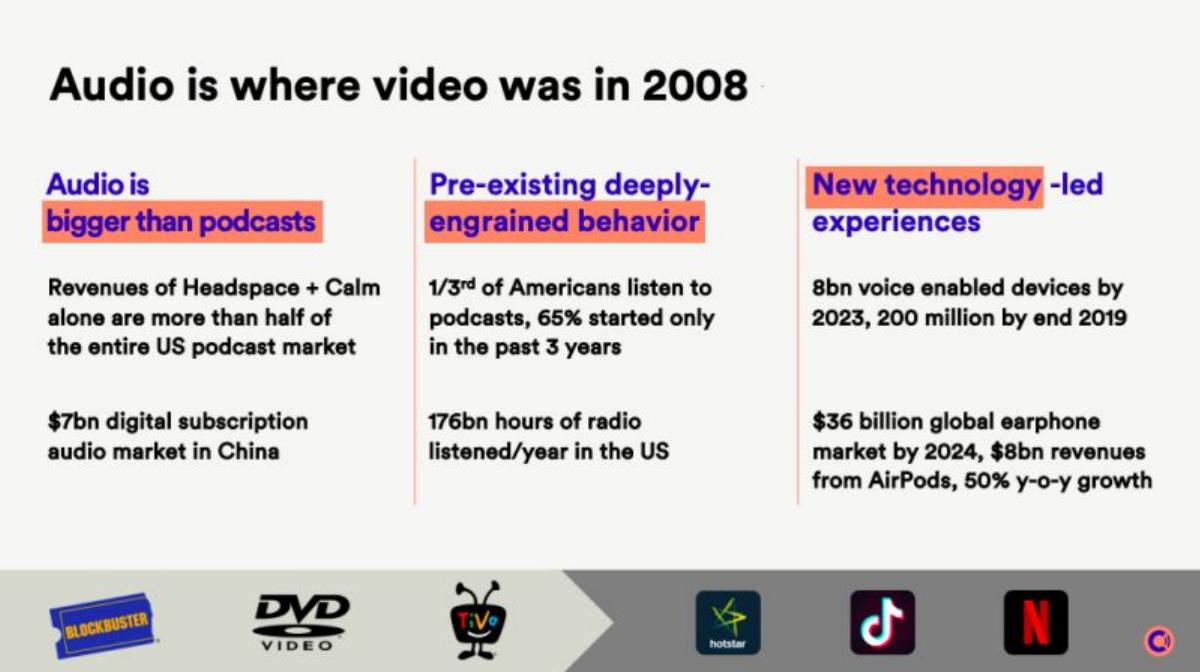
- The deck uses a historical analogy on Slide 2, claiming 'Audio is where video was in 2008,' to suggest a massive impending market shift.
- Curio reports a 26% month-over-month CMGR in subscription revenue growth on Slide 8, though specific revenue dollar amounts are redacted.
- The platform boasts a 70% average track completion rate on Slide 14, significantly higher than the 52% cited for podcasts and 20% for print.
- Engagement is a core focus, with Slide 11 stating an average session time of approximately 1 hour, with 15% of sessions lasting 2 hours.
- The company leverages high-authority logos from partners like FT, The Economist, and The Guardian on Slide 7 to establish a 'premium' moat.
- Third-party validation is highlighted on Slide 15, showing Curio being showcased at the Apple Keynote in September 2019.
- The leadership team on Slide 16 features deep domain expertise, including a CEO who led BBC News strategy and a CTO with experience at a company sold to Google.
- The deck lacks a specific 'Ask' slide detailing the exact dollar amount requested or the planned allocation of capital across departments.
Executive Summary: The Narrative Moat
Curio’s 2020 Series A deck is a focused argument for the professionalization of the audio market. At a time when the podcasting world was exploding with amateur content, Curio positioned itself as the 'full-stack' alternative—curated, narrated, and premium. The deck successfully uses a mix of high-growth traction and high-authority partnerships to convince investors that they aren't just an app, but a new category of media consumption. By raising $9M, Curio proved that investors were willing to bet on 'quality' as a defensible moat against the sheer volume of free audio content available on other platforms.
Slides 1-3: The Market Thesis
Slide 1 is a minimalist title slide featuring the Curio logo and four black-and-white photos of people in various 'on-the-go' scenarios: driving, running, commuting, and relaxing at home. This immediately establishes the use case: audio as a companion to daily life.
Slide 2 delivers the core investment thesis: "Audio is where video was in 2008." This is a classic venture capital framing technique. It suggests that just as Netflix transformed video from a physical/broadcast medium to a digital subscription powerhouse, a similar shift is imminent in audio. The slide provides supporting data: revenues from Headspace and Calm are more than half of the entire US podcast market, and there is a $7bn digital subscription audio market in China. It also notes the hardware tailwinds, citing 8bn voice-enabled devices by 2023 and $8bn in AirPods revenue.
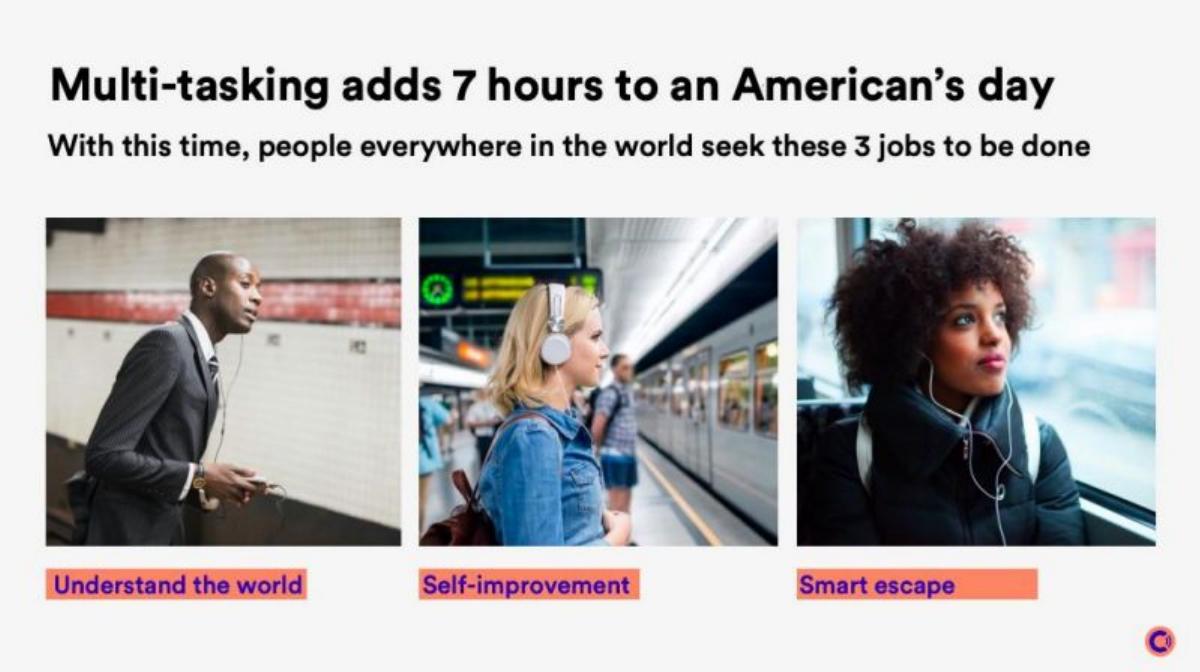
Slide 3 introduces the 'Jobs to be Done' framework. It claims that multi-tasking adds 7 hours to an American’s day, and in that time, users seek to: 1) Understand the world, 2) Self-improvement, and 3) Smart escape. This slide transitions the deck from market macro-trends to specific user psychology.
Slides 4-5: The Opportunity and Vision
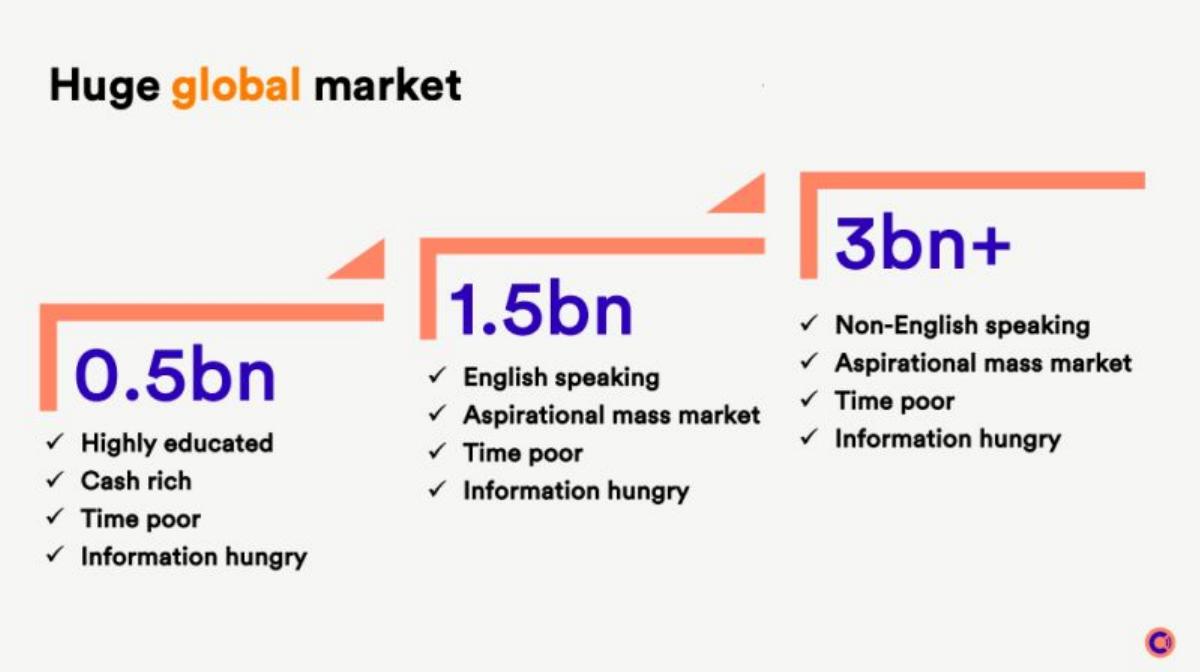
Slide 4 quantifies the 'Huge global market.' It segments the audience into three tiers: 0.5bn highly educated/cash rich, 1.5bn English speaking/aspirational, and 3bn+ non-English speaking. This slide is designed to show the 'ceiling' of the business, suggesting a multi-billion user TAM (Total Addressable Market).
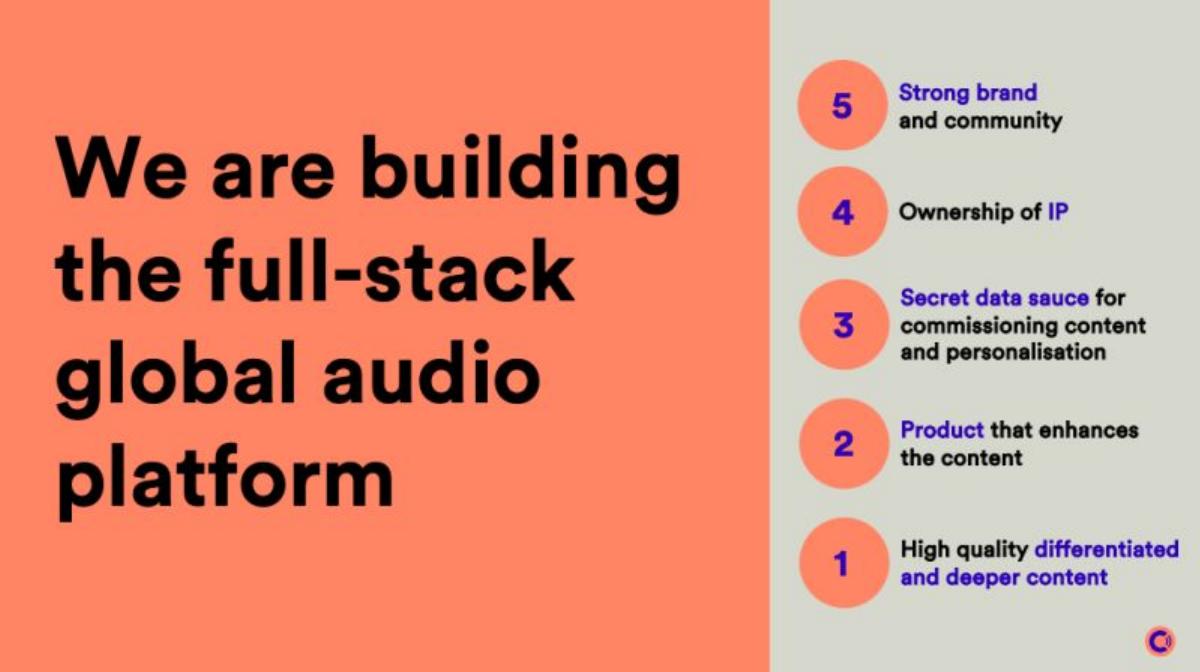
Slide 5 defines the company's ambition: "We are building the full-stack global audio platform." It lists five pillars of their strategy: 1) High quality differentiated content, 2) Product that enhances content, 3) Secret data sauce for personalization, 4) Ownership of IP, and 5) Strong brand. This is the first time the deck mentions 'Ownership of IP,' which is a critical value driver for media companies.
Slides 6-7: The Product and Partnerships
Slide 6 shows the product in situ. Three iPhone mockups display the 'For You' feed, the 'Discover' tab, and a list of publication logos. The UI is clean and mimics the aesthetic of premium news apps like the NYT or FT.
Slide 7 is a 'logo wall' of content partners. It is perhaps the most important slide for establishing credibility. Logos include the Financial Times, The Economist, The Washington Post, and Bloomberg. By associating with these brands, Curio inherits their 'premium' status without having to build a newsroom from scratch. The slide also shows various Bloomberg-branded podcasts and shows, indicating a deep integration with existing media giants.
Slides 8-11: Traction and Engagement
Slide 8 focuses on revenue growth. It claims a "26% m-o-m CMGR subscription revenue growth." While the Y-axis and specific dollar amounts are redacted with black boxes, the bar chart shows a consistent upward trend from December 2018 to October 2019. It also clearly states the pricing: $59.99/year or $7.99/month.
Slide 9 provides social proof through a user testimonial. The quote emphasizes that Curio has become a "routine part of my life" and has "reduced anxiety coming from FOMO." This speaks to the 'stickiness' of the product.
Slide 10 introduces 'Best in class retention' metrics. It states that 50% of subscribers are 'power users' who complete at least 30 tracks per month. Again, a large black box obscures the specific retention curve, which is a common practice in public-facing deck versions but likely contained cohort data for the actual pitch.
Slide 11 highlights session duration. It claims an "~1 hour average session time," with 15% of sessions lasting 2 hours. For a mobile app, these are exceptionally high engagement numbers, comparing favorably to social media or video streaming platforms.
Slides 12-15: Differentiation and Technology
Slide 12 directly compares Curio to 'Generic podcast apps.' It uses a checklist to highlight Curio’s advantages: clear 'jobs to be done,' owned IP, data-driven insights from 2m+ data points, no ads, and a global focus. This slide is meant to de-risk the 'Spotify/Apple Podcasts' threat by arguing that those platforms are too broad and ad-heavy.
Slide 13 visualizes the 'data loops.' It shows two interlocking cycles: a 'Content data loop' (Analyse -> Spot gaps -> Commission -> Listen) and a 'Personalization data loop' (Listen -> Analyse -> Curate -> Personalize). This suggests that Curio uses listener data to decide what content to produce next, a strategy famously used by Netflix.
Slide 14 shows the '70% completion rate' achieved through Machine Learning. A bar chart compares Curio (70%) to Podcasts (52%) and Print (20%). This is a powerful metric for advertisers or content partners, as it proves the audience is actually consuming the material to the end.
Slide 15 is a pure 'flex' slide titled "Apple loves Curio." It shows Curio being featured as 'App of the Day' and, most importantly, showcased at the Apple Keynote in September 2019. This provides massive third-party validation of the product’s quality and technical integration.
Slides 16-20: Team and Conclusion
Slide 16 introduces the 'Top leadership team.' The founders have impressive pedigrees: Govind (CEO) led BBC News strategy, and Srikant (COO) is a lawyer with a previous startup exit. The broader team includes alumni from Google, Dyson, and Depop. This slide is designed to show that the team has the 'right to win' in both media and technology.
Slide 17 reiterates the market opportunity with a 2x2 matrix. It places Curio in the 'On-the-go / Audio' quadrant, contrasting it with video apps like TikTok and home-based audio like Alexa. It repeats the criticisms of 'non-music' audio: variable quality, ads, and poor UX.
Slide 18 outlines the 12-18 month goal: "Position Curio for global land-grab." It lists three focus areas: Data to commission hits, Product to enhance experience, and Building for self-sustaining growth. The specific details within these categories are redacted.
Slide 19 is the 'Ask' slide, though it is more of a 'Vision' slide. It repeats the 2008 video analogy and states, "We are raising a Series A to build the full-stack global audio platform." It does not state the amount being raised, which is common in decks that are shared before a formal term sheet is signed or for public consumption.
Slide 20 is a promotional slide for the source of the deck, bestpitchdeck.com, and is not part of the original Curio presentation.
What Curio Does Well
Strong Analogy: The comparison to the 2008 video market provides a clear, exciting mental model for investors. It frames the investment as a 'time machine' opportunity. · High-Quality Traction: A 26% CMGR and a 70% completion rate are 'venture-scale' metrics that justify a Series A. · Authority by Association: The heavy use of premium publisher logos (FT, Economist) solves the 'chicken and egg' problem of content platforms. · Third-Party Validation: The Apple Keynote feature is a rare and powerful signal of product excellence that few startups can claim.
What is Missing from the Curio Deck
The 'Ask': The deck never specifies how much money they are looking for or what the valuation expectations are. · Unit Economics: There is no mention of Customer Acquisition Cost (CAC) or Lifetime Value (LTV). For a subscription business, these are the most important metrics for determining scalability. · Content Costs: The deck mentions 'commissioning' content and 'owning IP,' but it doesn't explain the cost structure of these narrations or the revenue-share models with publishers. · Detailed Roadmap: Slide 18 is very high-level. Investors usually want to see a more granular product and hiring roadmap for the next 18 months.
What Other Founders Should Copy
The 'Jobs to be Done' Slide: Slide 3 is an excellent way to ground a product in human behavior rather than just technical features. · The Differentiation Table: Slide 12 clearly and aggressively defines why the incumbent (generic podcast apps) is failing, making the startup's existence feel necessary. · Metric-Driven Narrative: Curio doesn't just say users like the app; they prove it with session times and completion rates. Founders should always lead with the 'hardest' engagement metrics they have. · Visual Consistency: The deck uses a consistent color palette and high-quality imagery that reflects the 'premium' nature of the brand they are trying to build.
Frequently asked questions
- How much did Curio raise with this deck?
- According to the catalogue facts, Curio raised $9M in a Series A round in 2020. While the deck itself mentions the intent to raise a Series A on Slide 19, it does not specify the target amount within the slides.
- What is Curio's business model?
- Curio operates a subscription-based model. Slide 8 lists the pricing as $59.99 per annum (including a 7-day free trial) or $7.99 per month. This customer model provides users with access to a curated collection of narrated articles from premium publishers.
- Who are Curio's primary content partners?
- Slide 7 displays a wide array of high-tier media logos, including the Financial Times, The Economist, Fast Company, The Washington Post, Bloomberg, The Guardian, and Aeon. These partnerships are central to their 'premium' positioning.
- What are the key engagement metrics mentioned?
- The deck emphasizes three main engagement figures: a 70% track completion rate (Slide 14), an average session time of roughly 1 hour (Slide 11), and the fact that 50% of subscribers are 'power users' who listen to at least 30 tracks per month (Slide 10).
- Does the deck include a competitive analysis?
- Yes, Slide 12 and Slide 17 compare Curio against 'generic podcast apps' and 'non-music' audio libraries. Curio differentiates itself by claiming 'IP owned content,' no ads, and a global product focus compared to the 'English centric' and 'shallow content' of competitors.