Curious Hat’s 2012 pitch deck is a masterclass in leveraging founder pedigree. By highlighting their leadership's work on Oscar-winning films like Shrek and How To Train Your Dragon, the team establishes immediate creative credibility in the crowded EdTech space. The deck focuses on 'edutainment'—apps that bridge the digital and physical worlds. While it lacks detailed unit economics or a granular competitive landscape, it compensates with strong early traction, showing a sharp spike to nearly 30,000 units by November 2012. The strategy shifts from individual app sales ($0.99–$4.99) to a subs…
Key takeaways
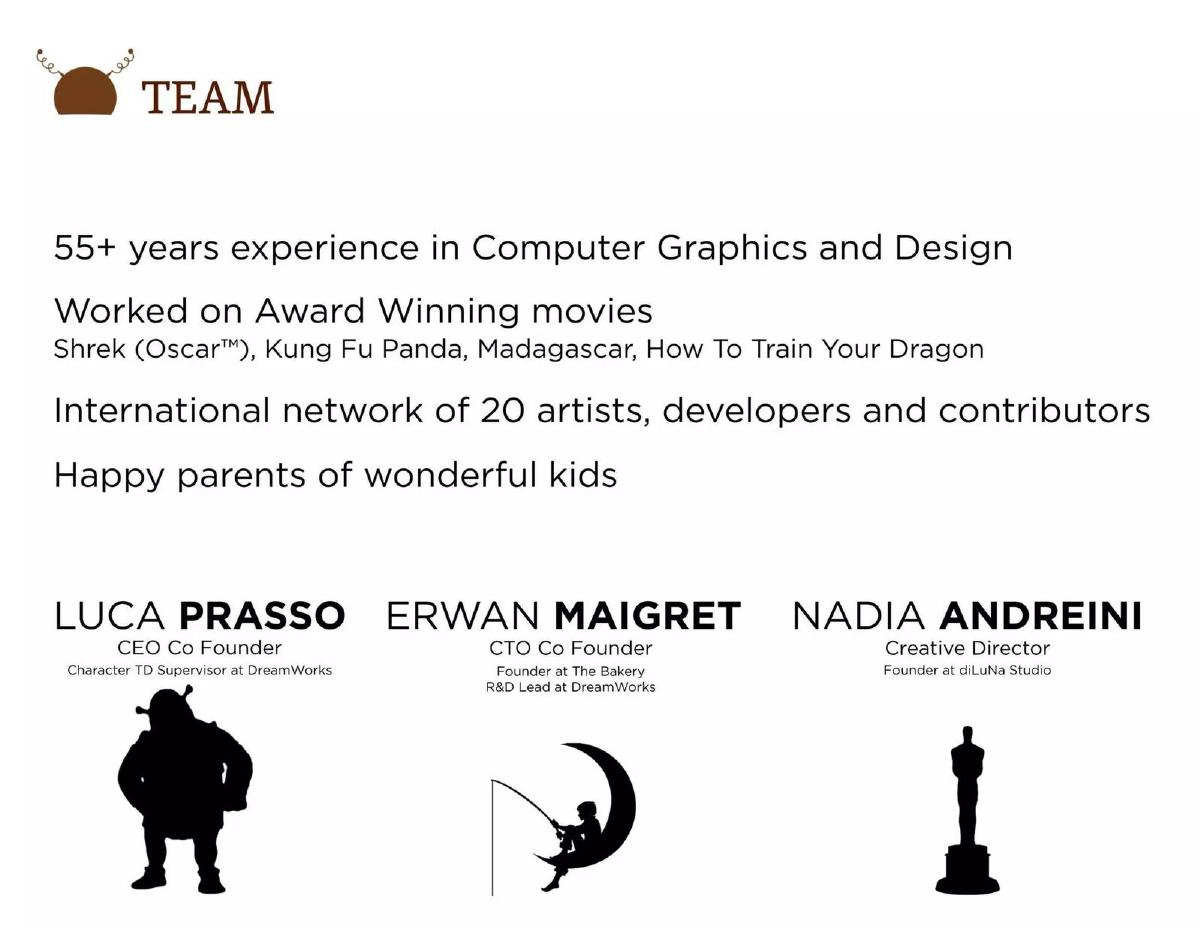
- The team slide (Slide 3) is the deck's strongest asset, citing 55+ years of experience and work on major franchises like Shrek and Kung Fu Panda.
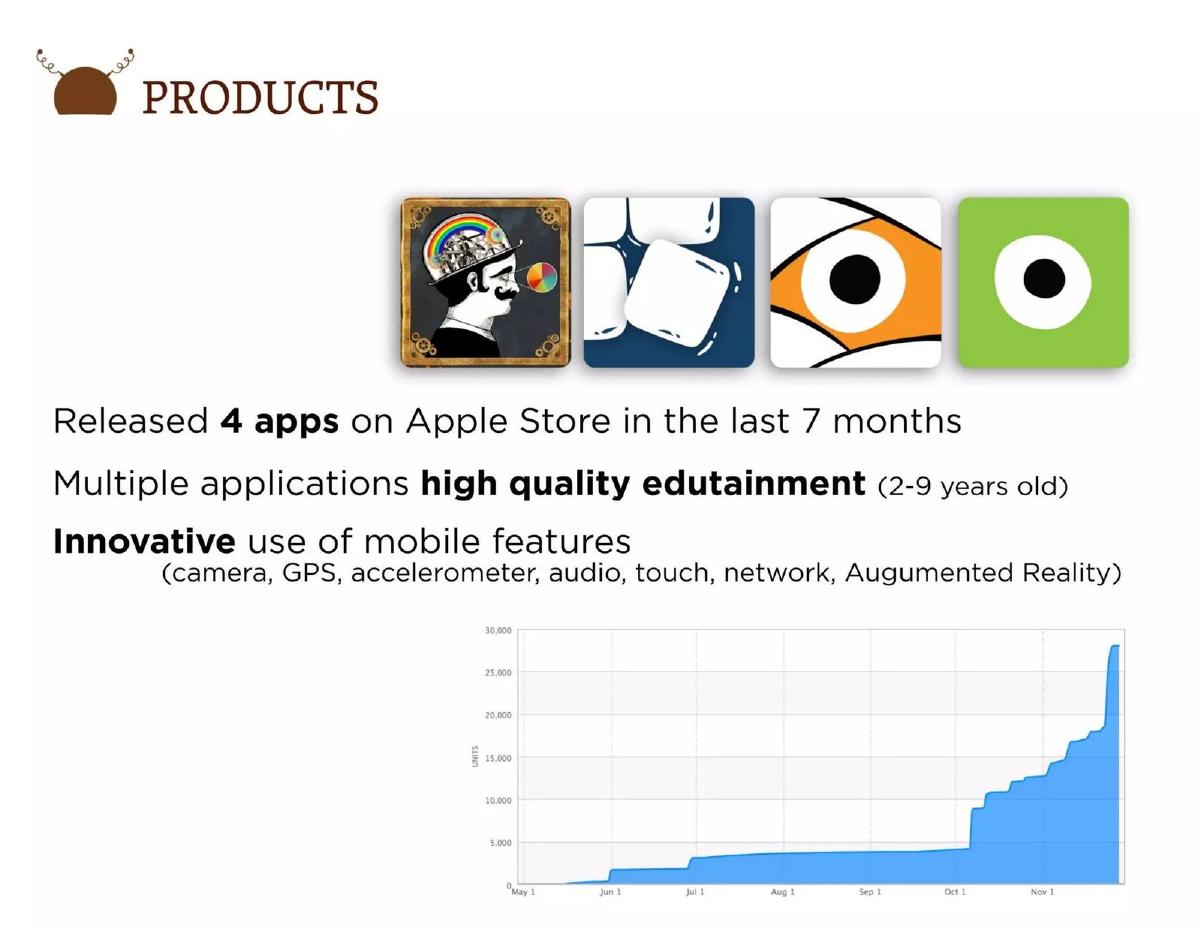
- Traction is demonstrated through a unit growth chart (Slide 4) showing a climb from near zero in May to approximately 28,000 units by November.
- The revenue model (Slide 9) proposes a hybrid approach: individual app sales between $0.99 and $4.99, plus a subscription model for the 'Curious Minds' platform.
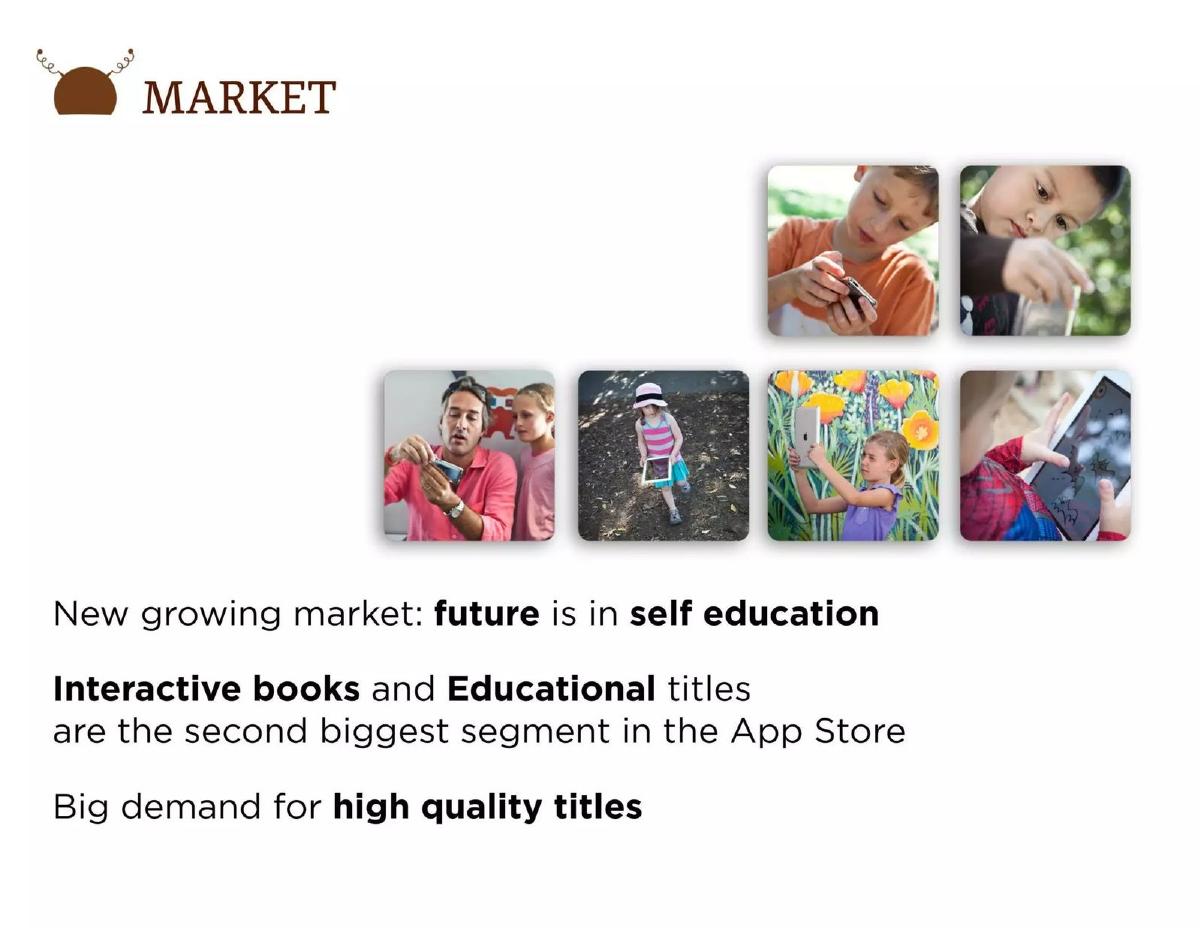
- The deck identifies 'Interactive books and Educational titles' as the second biggest segment in the App Store at the time (Slide 6).
- Curious Hat had already secured $170k in funding and was seeking an additional $250k seed investment as of January 2013 (Slide 11).
- The product roadmap (Slide 10) lists eight distinct titles released or planned between Q2 2012 and Q1 2013, indicating a high-velocity production cycle.
- The exit strategy (Slide 12) specifically targets 'Big Media Studios' like Disney and DreamWorks, aligning with the founders' professional backgrounds.
- The deck omits a formal 'Problem' slide, choosing instead to lead with 'Mission' and 'Team' to establish a vision-first narrative (Slides 2-3).
Introduction: The DreamWorks Pedigree in EdTech
Curious Hat entered the 2012 EdTech market with a distinct advantage: a founding team that helped build the modern era of computer-generated animation. This 13-slide pitch deck is a focused attempt to translate Hollywood-grade creative skills into a scalable mobile app ecosystem. Rather than focusing on a specific pedagogical problem, the deck sells a vision of 'digital exploration' and high-quality 'edutainment' during the early gold rush of the Apple App Store.
The Vision and the Team (Slides 1-3)
Slide 1: Title The deck opens with a simple, whimsical logo and the tagline: "Digital Exploration Toys for Young Minds." It establishes the brand identity immediately—playful, creative, and tech-forward.
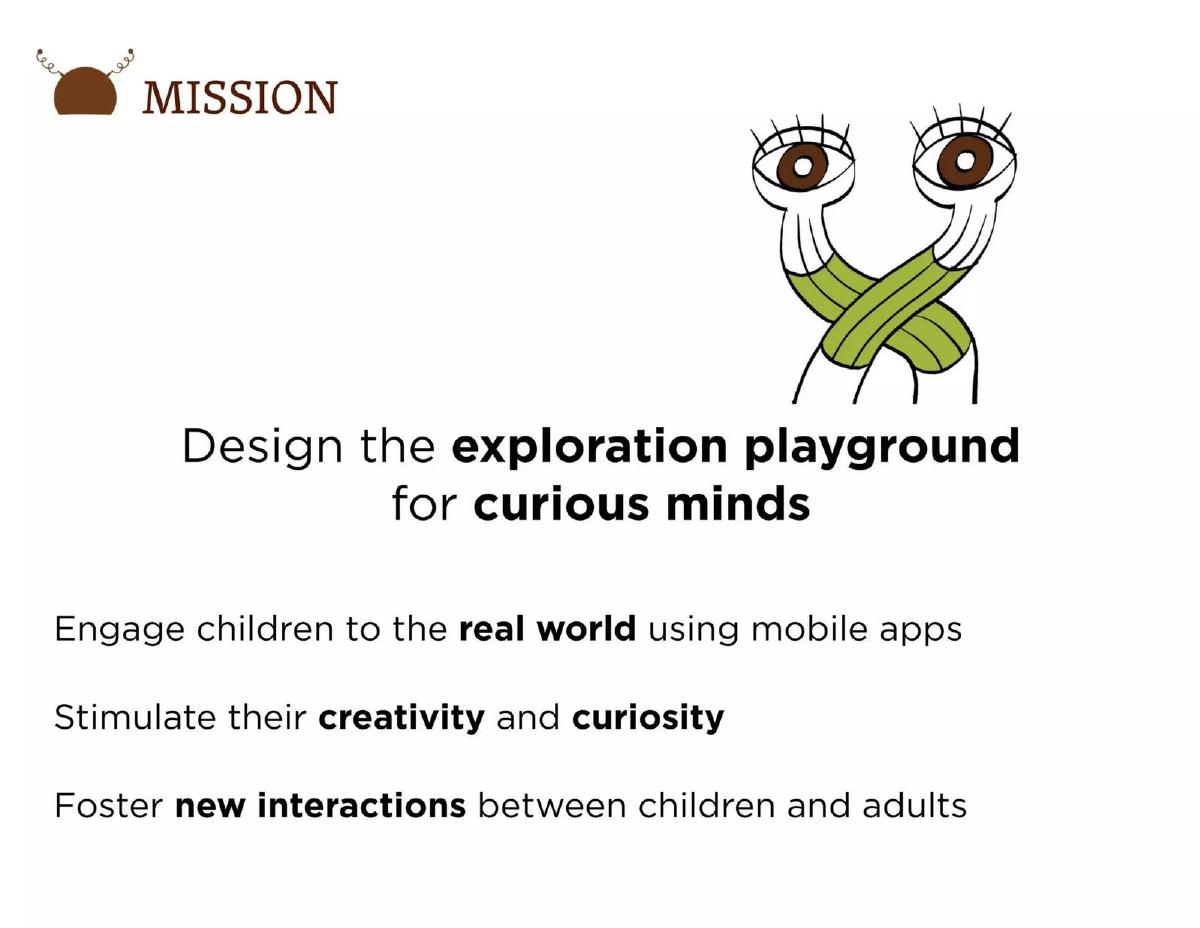
Slide 2: Mission The mission is articulated as designing an "exploration playground for curious minds." The slide lists three pillars: engaging children with the real world via mobile apps, stimulating creativity, and fostering new interactions between children and adults. This is a strategic move to address the 'screen time' anxiety of parents by suggesting the app is a bridge to the physical world, not a replacement for it.
Slide 3: Team This is the 'anchor' slide of the deck. It highlights 55+ years of experience in Computer Graphics and Design. The founders name-drop Oscar-winning movies: Shrek , Kung Fu Panda , Madagascar , and How To Train Your Dragon . Luca Prasso (CEO) was a Character TD Supervisor at DreamWorks, and Erwan Maigret (CTO) was an R&D Lead at the same studio. Nadia Andreini (Creative Director) rounds out the leadership. By using iconic silhouettes like Shrek and the DreamWorks fishing boy, they borrow massive brand equity to prove they can build products children love.
Product and Validation (Slides 4-5)
Slide 4: Products and Traction Curious Hat demonstrates speed, noting they released 4 apps in the last 7 months. They define their target demographic as 2-9 years old. A line chart shows 'Units' (presumably downloads or sales) spiking from May to November, ending near the 30,000 mark. This proves the team isn't just 'dreaming'—they are shipping and gaining users.
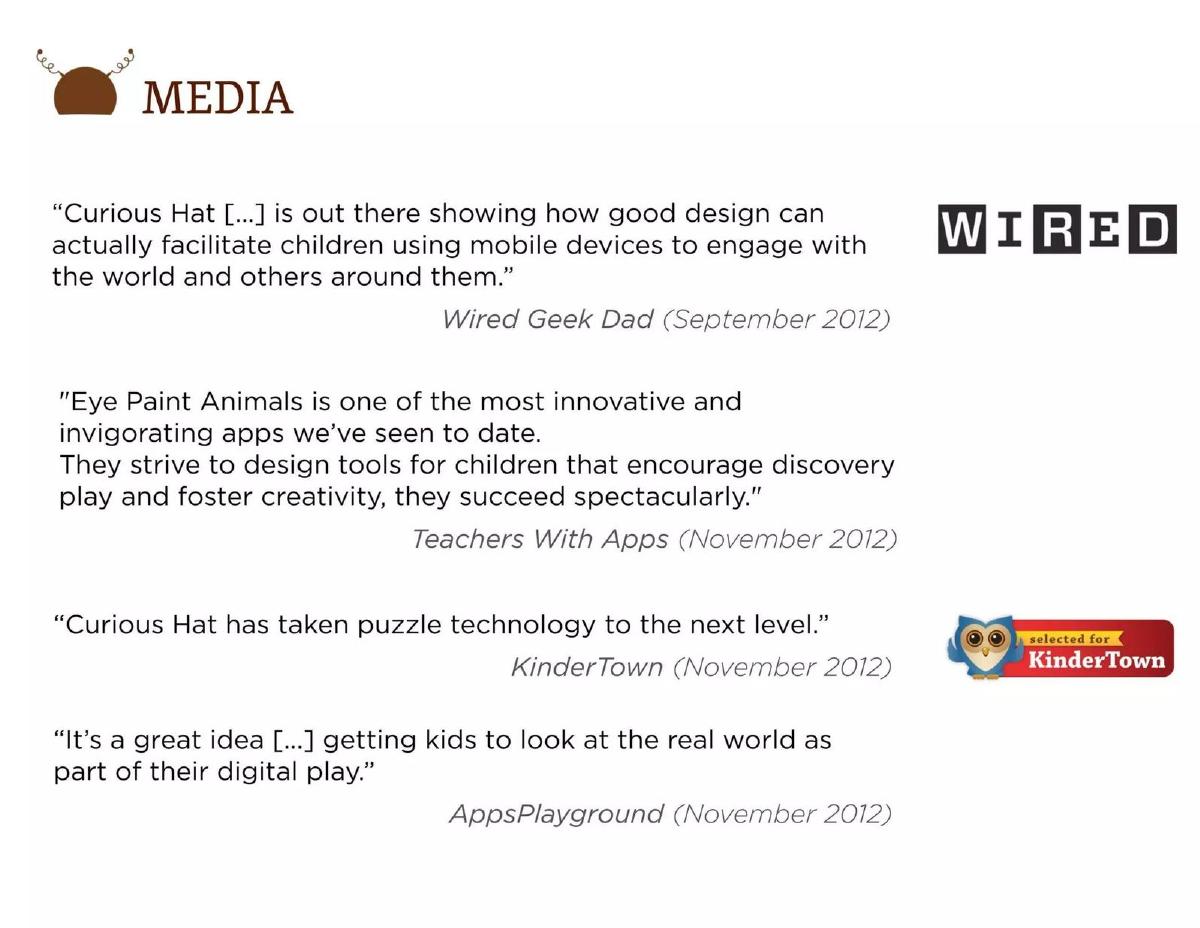
Slide 5: Media Validation comes from high-tier sources. Quotes from Wired Geek Dad , Teachers With Apps , KinderTown , and AppsPlayground are featured. The Wired quote is particularly strong, stating that Curious Hat shows how "good design can actually facilitate children using mobile devices to engage with the world." This reinforces the mission stated on Slide 2.
Market Opportunity and Backing (Slides 6-7)
Slide 6: Market The deck claims that "Interactive books and Educational titles are the second biggest segment in the App Store." They frame the market as a shift toward "self education" and highlight a "big demand for high quality titles." This slide is light on hard TAM/SAM/SOM data but relies on the visible explosion of the App Store economy in 2012.
Slide 7: Investors & Advisors The company reveals it is a 500 Startups portfolio company. Having Dave McClure’s accelerator behind them provides a 'seal of approval' for Silicon Valley investors. Advisors include Fabrizio Capobianco (President at Funambol) and Jonathan Lindo (VP at CA Technologies), adding enterprise and scaling expertise to the creative-heavy team.
Strategy and Business Model (Slides 8-9)
Slide 8: Growth Strategies The strategy is fourfold: 1) The 'Curious Minds' core playground, 2) An expanding portfolio of 'Curious Apps', 3) Cross-promotion via data sharing, and 4) IP creation through characters. This shows they are thinking about a 'Disney-style' ecosystem where characters and apps feed into one another.
Slide 9: Distribution & Revenue Model The revenue model is diversified. They list app sales ($0.99 to $4.99) on both Apple and Android stores. They also introduce the concept of a "Blockbuster app/year" to push the rest of the portfolio. Most importantly, they mention a subscription + In-App Purchase model for the 'Curious Minds' parental app, signaling a move toward recurring revenue rather than one-off sales.
Roadmap and The Ask (Slides 10-13)
Slide 10: Milestones This slide provides a chronological look at their output. It shows a rapid release schedule, moving from Color Vacuum in Q2 2012 to a projected five releases in Q1 2013, including the launch of the Curious Minds platform. This illustrates high operational efficiency.
Slide 11: Investment Opportunities The 'Ask' is clearly defined: they had raised $170k, were seeking $250k in January 2013, and projected a $2M growth round by December 2013. The funds were earmarked for establishing a core developer/design team and implementing a marketing strategy to build brand trust.
Slide 12: Exit Strategy The deck is explicit about its end-game: Acquisition by "Big Media Studios (Disney, DreamWorks)", publisher studios, or toy makers. They also mention IPO, though for a seed-stage app company, the acquisition path is clearly the primary focus given the founders' backgrounds.
Slide 13: Contact The deck concludes with contact info and a note that Curious Hat has been a US Corporation since January 3rd, 2012.
What Works in This Deck
Founder-Market Fit: The team’s background at DreamWorks is the ultimate 'unfair advantage' in a space that requires high-quality visual storytelling. · Speed of Execution: Releasing 4 apps in 7 months and planning 5 more in the following quarter shows a team that can execute, not just design. · Third-Party Validation: The inclusion of 500 Startups and Wired quotes provides immediate credibility that offsets the risks of a young startup. · Clear Revenue Transition: Moving from $0.99 apps to a subscription platform shows the founders understand the limitations of the 'paid app' model and are looking for 'LTV' (Lifetime Value).
What is Missing
Competitive Landscape: The deck does not mention Toca Boca, Disney’s own apps, or other major players in the kids' app space. Investors would want to know how Curious Hat wins against established giants. · Unit Economics: While they show unit growth, they don't disclose Customer Acquisition Cost (CAC) or the conversion rate from free to paid (if applicable). · The 'Why Now?': Beyond the general growth of the App Store, the deck lacks a specific 'inflection point' argument for why 2013 is the year this platform must exist. · Problem Slide: The deck assumes the 'problem' (low-quality kids' apps) is self-evident. A slide dedicated to the 'sea of junk' in the App Store would have made their 'high quality' value proposition even stronger.
What a Founder Should Copy
The 'Pedigree' Slide: If you have worked at world-class companies, use their logos and silhouettes. It creates an immediate psychological association with success. · Visual Consistency: The deck uses the company's own aesthetic—whimsical, clean, and illustrative. This acts as a 'product demo' in itself. · The Milestone Roadmap: Showing a history of 'shipped' products alongside 'future' products builds confidence that the future ones will actually arrive. · The Tiered Funding Ask: Showing the current round ($250k) in the context of the next round ($2M) helps investors see the 'path to the next level' and how their money acts as a bridge.
Frequently asked questions
- What is the primary product of Curious Hat?
- According to the deck and catalogue facts, Curious Hat creates 'digital exploration toys' or mobile apps for children aged 2-9. Their core product is 'Curious Minds' (referred to as Curious Playground in some descriptions), a cloud-based platform designed to connect their portfolio of apps into a single ecosystem that fosters parent-child interaction.
- How does the company plan to make money?
- Slide 9 outlines a three-pronged revenue strategy: direct app sales on Apple and Android stores priced between $0.99 and $4.99, a 'blockbuster' app strategy where one major hit drives traffic to others, and a subscription plus in-app purchase model for their 'Curious Minds' parental application.
- Who are the founders and why are they relevant?
- The founders include Luca Prasso (CEO) and Erwan Maigret (CTO), both former leads at DreamWorks. Their experience on films like Shrek and Madagascar provides the 'creative alpha' necessary to build high-quality edutainment, which the deck highlights as a key market differentiator on Slide 3.
- What kind of traction did Curious Hat have at the time of the pitch?
- Slide 4 shows significant early traction, with 4 apps released in a 7-month window. A units-sold chart indicates a growth trajectory reaching nearly 30,000 units by November 2012. Additionally, Slide 5 lists media validation from Wired, Teachers With Apps, and KinderTown.
- What was the funding 'ask' in this deck?
- On Slide 11, the company discloses they had already raised $170k. They were seeking a $250k Seed round in January 2013, with a target of a $2M Growth round by December 2013 to establish a core developer team and implement a broader marketing strategy.