Vulcan Cyber’s Series B deck is a masterclass in category repositioning. Rather than competing in the crowded vulnerability scanning market, Vulcan identifies a massive operational bottleneck: the gap between discovery and remediation. The deck highlights that 60% of breaches involve unpatched vulnerabilities, yet companies spend 443 hours per week managing the response. By positioning itself as the 'glue' between scanners, asset data, and deployment tools, Vulcan moves from a security tool to a workflow necessity. The deck leverages high-profile social proof, including a Snowflake use case a…
Key takeaways
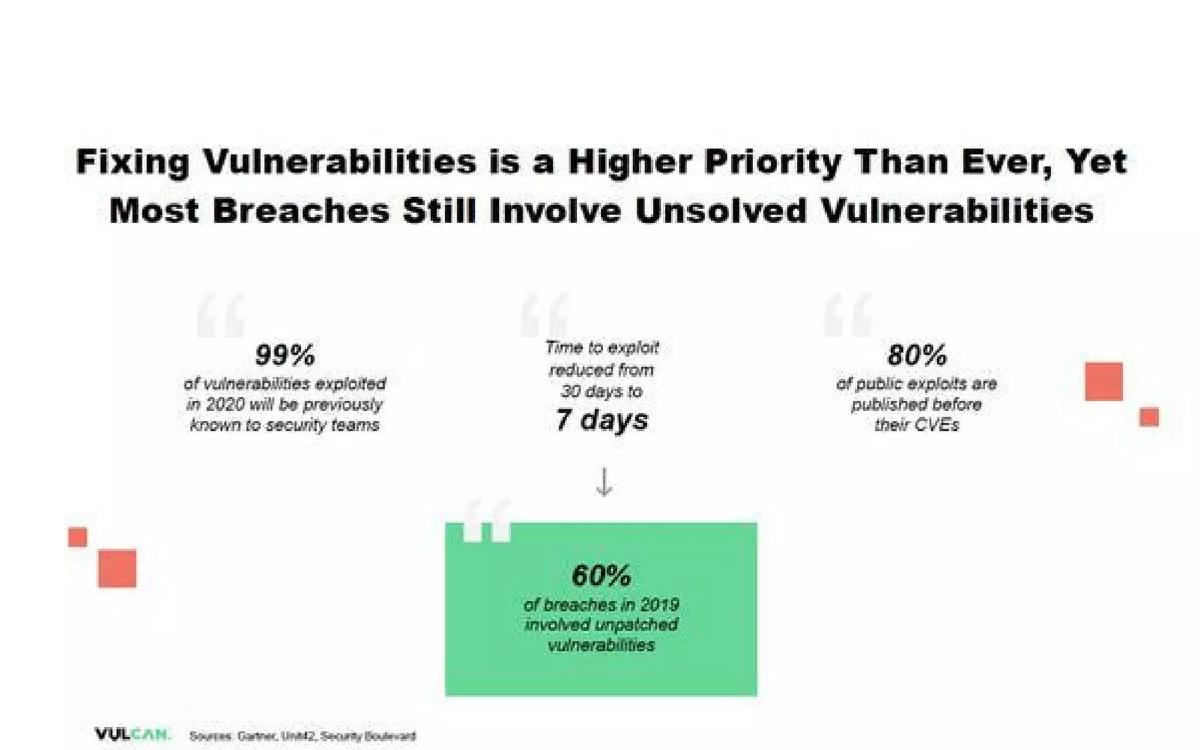
- The deck identifies a critical market gap where 99% of vulnerabilities exploited in 2020 were already known to security teams (Slide 4).
- Vulcan defines a new category called 'Remediation Orchestration' to differentiate from traditional scanners (Slide 1).
- Operational inefficiency is a core pain point, with companies spending an average of 443 hours per week on vulnerability response (Slide 7).
- The platform acts as 'the glue' by integrating with existing stacks like Tenable, AWS, Jira, and Slack (Slide 13).
- The company demonstrates significant momentum with 500% Year-over-Year ARR growth (Slide 2).
- A four-stage maturity model is used to educate prospects and investors on the transition from reactive to transformative remediation (Slide 11).
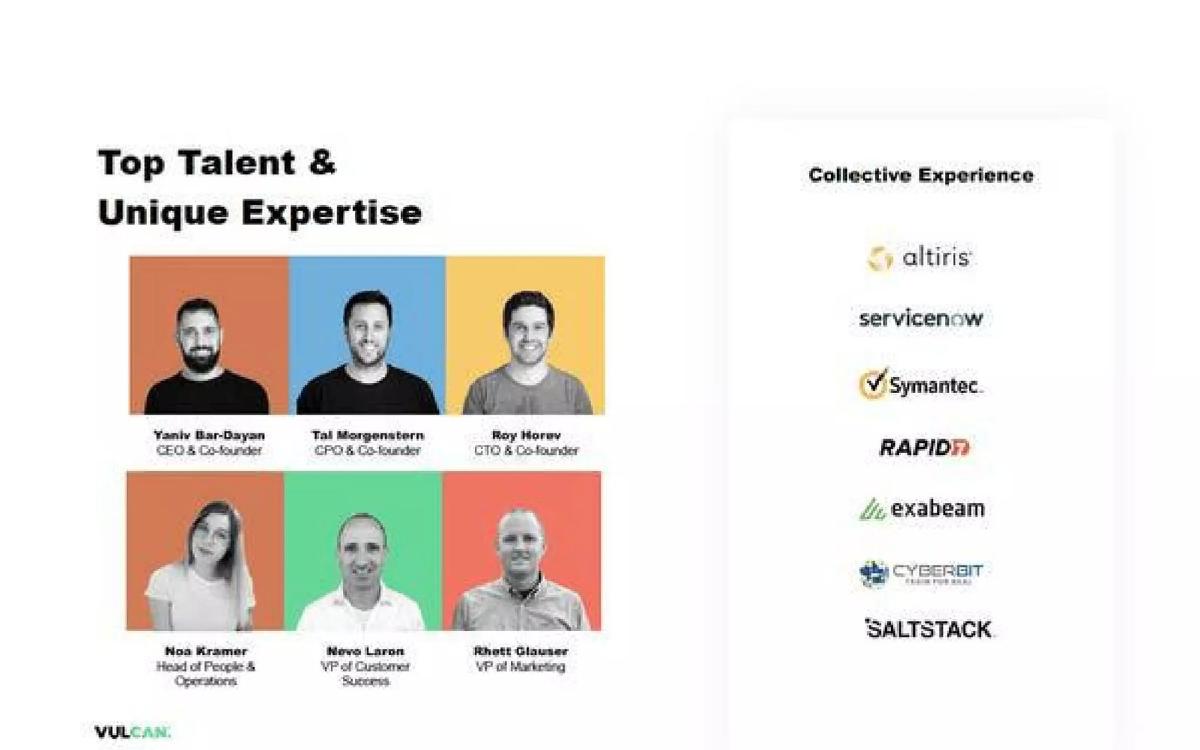
- The team slide emphasizes 'Collective Experience' from industry leaders like ServiceNow, Symantec, and Rapid7 (Slide 3).
- Social proof is anchored by a specific use case featuring Snowflake, highlighting total visibility and custom risk modeling (Slide 16).
The Vulcan Cyber Series B Teardown
Vulcan Cyber’s pitch deck is a focused argument for a shift in cybersecurity priorities. In an industry often obsessed with 'threat hunting' and 'detection,' Vulcan makes the case that the real danger lies in the 'known'—the vulnerabilities that have already been discovered but remain unpatched due to complex internal workflows. This teardown examines how they used a 17-slide deck to raise $35 million by focusing on remediation orchestration.
The Hook and Momentum (Slides 1-3)
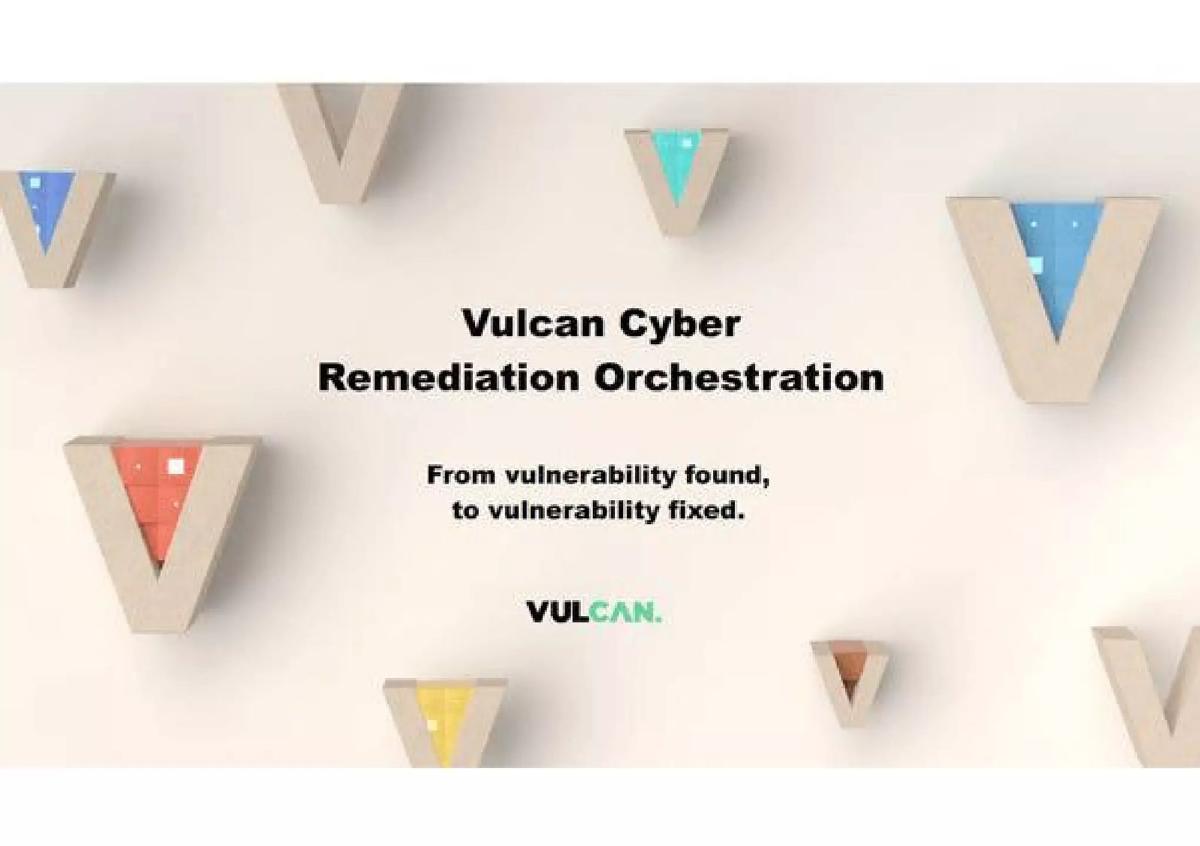
Slide 1: Title The deck opens with a clear value proposition: "Remediation Orchestration: From vulnerability found, to vulnerability fixed." The branding is clean, using a 'V' block motif that suggests building or fixing, which aligns with their mission to 'Get Fix Done.'
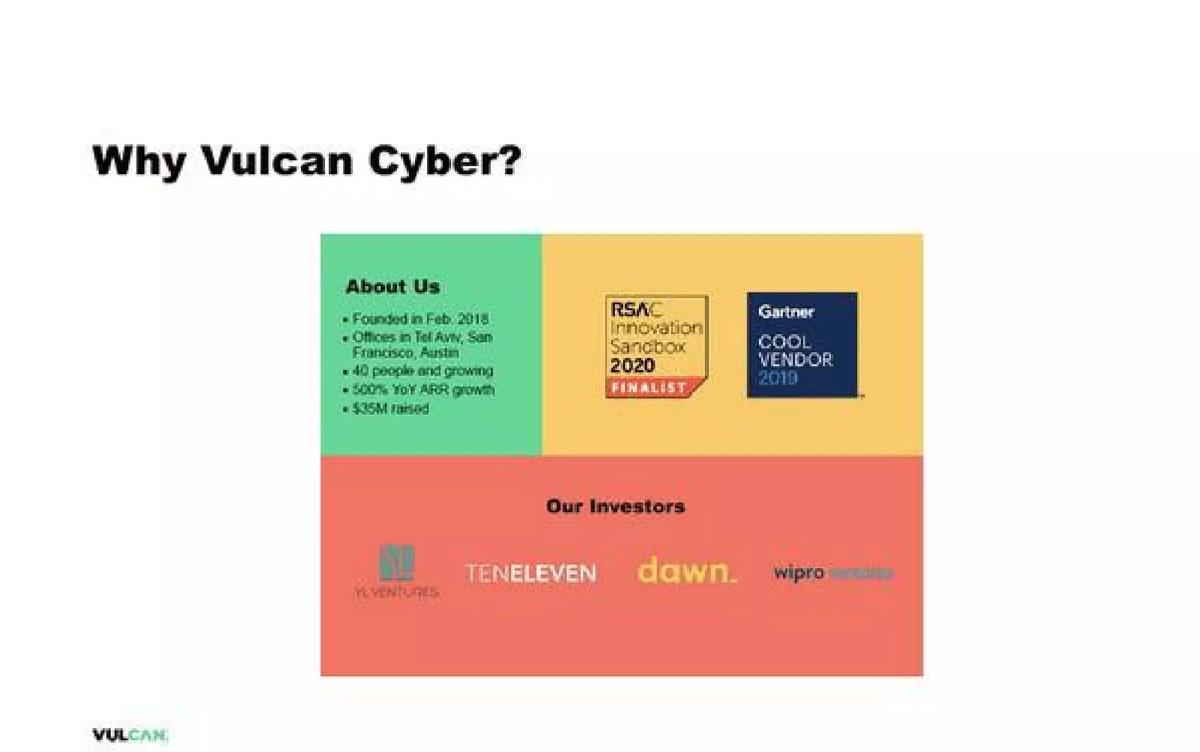
Slide 2: Why Vulcan Cyber? This is a high-impact momentum slide. It establishes the company's pedigree immediately. Key facts include:
Founded in Feb 2018. · Offices in Tel Aviv, San Francisco, and Austin. · 40 people and growing. · 500% YoY ARR growth. · $35M raised (at the time of this version). · Recognition as an RSAC Innovation Sandbox 2020 Finalist and a Gartner Cool Vendor 2019.
This slide answers the 'Why now?' and 'Why you?' questions before the problem is even fully articulated.
Slide 3: Top Talent & Unique Expertise The team slide emphasizes 'Collective Experience.' Instead of just listing names, they prominently feature the logos of companies where the team previously worked, including ServiceNow, Symantec, Rapid7, and Exabeam. This signals to investors that the founders understand the enterprise security and IT service management (ITSM) landscape intimately.
The Problem: The Remediation Gap (Slides 4-8)
Slide 4: The Vulnerability Crisis Vulcan uses industry data to create urgency. They cite that 99% of vulnerabilities exploited in 2020 were previously known to security teams. The most damning stat is that the 'time to exploit' has dropped from 30 days to just 7 days, while 60% of breaches involve unpatched vulnerabilities. This sets the stage: the problem isn't finding bugs; it's the speed of fixing them.
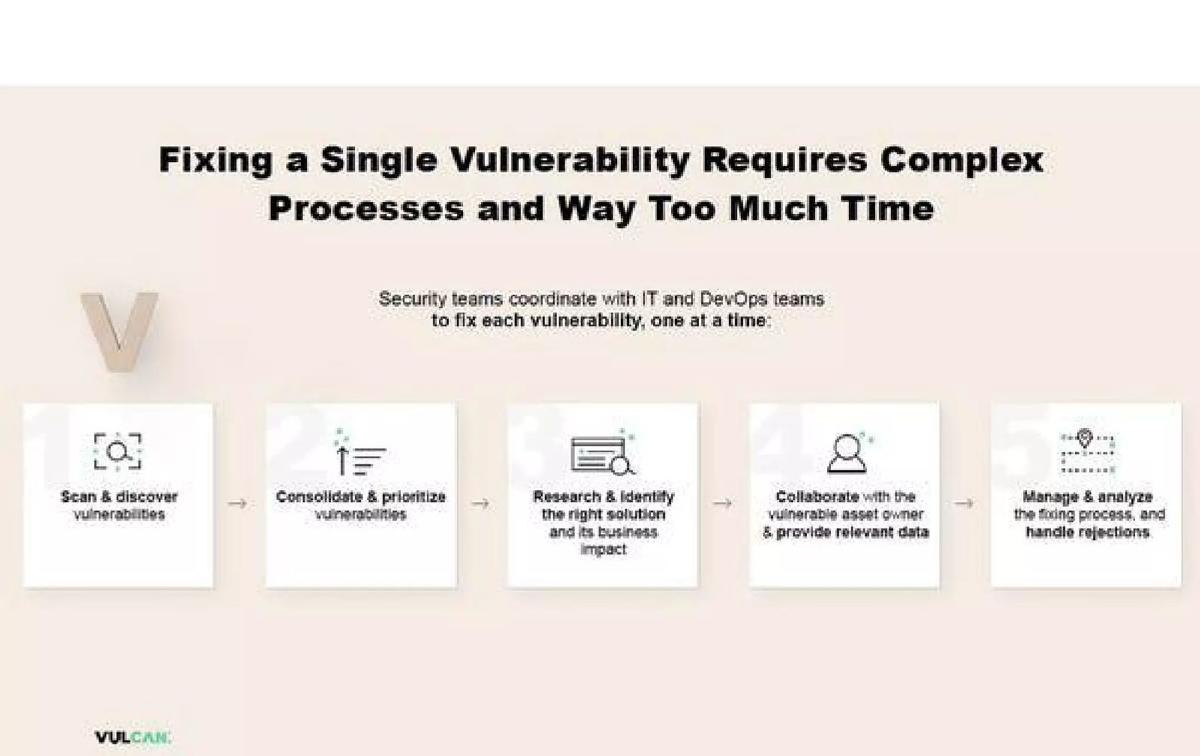
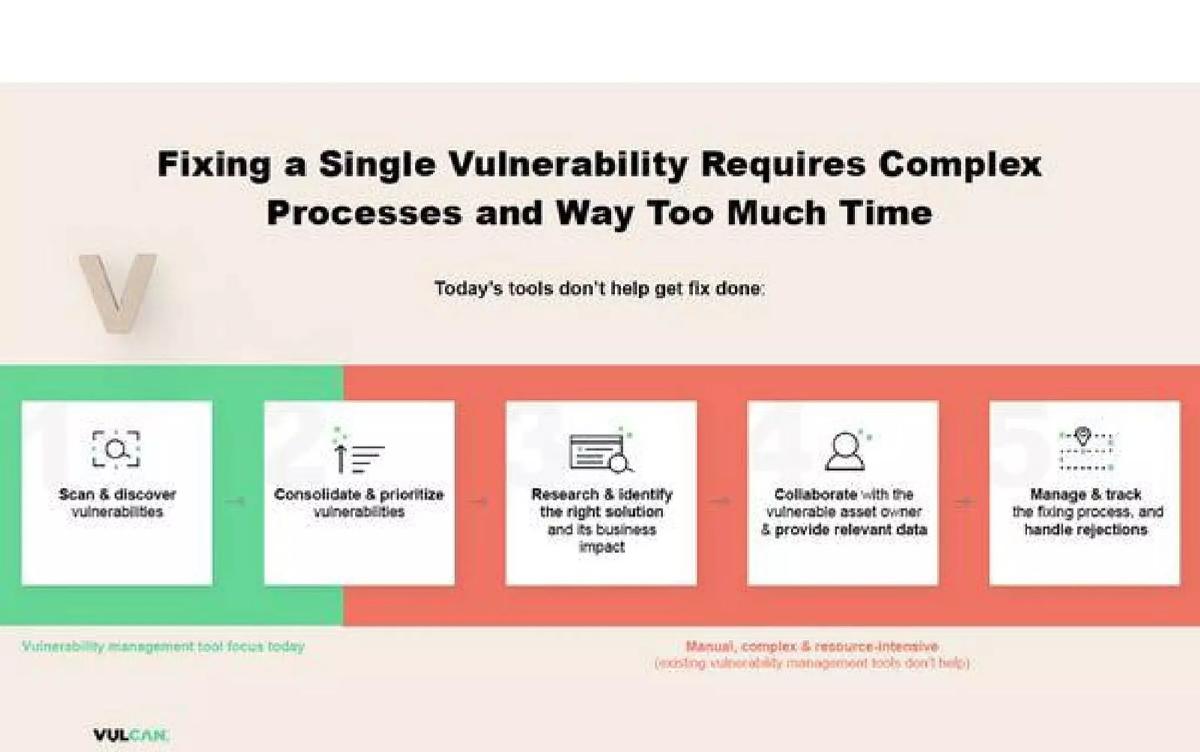
Slide 5-6: Complex Processes These slides break down the five-step process of fixing a single vulnerability: Scan, Consolidate, Research, Collaborate, and Manage. Slide 6 uses color-coding to show that current tools only focus on the first two steps (green), leaving the remaining three steps (red) as 'manual, complex & resource-intensive.'
Slide 7: The Cost of Inaction Citing the Ponemon Institute, Vulcan notes that companies spend 443 hours per week on average—equivalent to ten full-time employees—just managing the vulnerability response process. This translates the technical problem into a clear bottom-line labor cost for the enterprise.
Slide 8: The Scaling Problem The transition slide: "Now imagine trying to fix thousands of vulnerabilities... Not Possible Until We Scale Remediation." This justifies the need for an orchestration platform rather than just more security analysts.
The Solution: Orchestration and Maturity (Slides 9-13)
Slide 9-10: The Vision Vulcan introduces its vision: "Get Fix Done." Slide 10 shows a dashboard mockup, emphasizing that this is a functional platform, not just a theoretical framework. The dashboard highlights 'Risk Distribution' and 'Vulnerabilities To Fix,' moving the focus from 'threats' to 'tasks.'
Slide 11: Vulnerability Remediation Maturity This is a strategic slide. It defines four stages of maturity: Reactive, Data-Driven, Orchestrated, and Transformative. By doing this, Vulcan provides a roadmap for their customers. Most prospects will find themselves in Stage 1 or 2, and Vulcan positions itself as the vehicle to reach Stage 3 and 4.
Slide 12: The Vulcan Solution This slide visualizes the 'Prioritize, Remedy, Automate' workflow. It shows the platform taking a chaotic pile of vulnerabilities and organizing them into a streamlined, automated output.
Slide 13: The Glue This is perhaps the most important technical slide. It positions Vulcan as 'the glue' that enables end-to-end remediation. It lists integrations across five categories:
Scan Data: Tenable, Snyk, Veracode. · Asset Data: AWS, Google Cloud, ServiceNow. · Ticketing: Jira, ServiceNow, BMC. · Collaboration: Slack, GitLab, Teams. · Deployment: Chef, Microsoft Intune, Ivanti, CrowdStrike.
By showing these logos, Vulcan proves it doesn't replace the existing stack; it makes the existing stack more valuable.
Market Strategy and Social Proof (Slides 14-17)
Slide 14: Freemium Strategy Vulcan mentions 'Vulcan Free' and 'Remedy Cloud Free.' This indicates a sophisticated go-to-market strategy designed to capture the 'bottom-up' interest of security practitioners before moving to a 'top-down' enterprise sale.
Slide 15: Competitive Landscape The competition is mapped against the five-step process identified earlier. Vulcan shows that while 'Vulnerability Scanners' and 'Risk-based platforms' exist, they fail to address the 'Collaborate' and 'Manage & Analyze' phases. Vulcan claims 100% coverage across the lifecycle.
Slide 16: Use Case - Snowflake The deck concludes its evidence with a heavy hitter: Snowflake. The slide outlines the 'Snowflake Challenge' (teams didn't collaborate, scan data wasn't enough) and the 'Vulcan Benefits' (total visibility, universal translator, custom risk modeling). Using a high-growth, tech-forward company like Snowflake as a primary use case is a strong signal of product-market fit.
Slide 17: Thank You A simple closing slide with the company logo and the 'V' block graphic.
What Works in This Deck
1. Clear Category Definition: Vulcan doesn't call itself another 'security scanner.' They coined 'Remediation Orchestration.' This allows them to avoid direct feature-wars with established giants like Tenable or Qualys and instead position themselves as a necessary layer on top of those tools.
2. Quantified Pain: The use of the '443 hours per week' stat from Ponemon is brilliant. It turns a vague security risk into a specific, recurring operational expense that a CFO can understand.
3. Integration-First Approach: In Series B, investors worry about 'tool fatigue.' By positioning themselves as 'the glue' (Slide 13), Vulcan mitigates the fear that their software will be just another dashboard that nobody looks at. They show they are part of the existing workflow (Jira, Slack, AWS).
What Is Missing
1. Financial Projections: While they mention 500% ARR growth, there are no slides detailing the path to $100M ARR, gross margins, or burn rate. For a Series B, this information is usually expected, though it may have been moved to a separate data room.
2. The 'Ask' and Use of Funds: The deck does not explicitly state how much they are raising in this specific round or how they plan to spend it (e.g., hiring 20 more engineers, expanding to EMEA). This is a common omission in decks shared publicly, but it is a critical component of a live pitch.
3. Detailed Unit Economics: There is no mention of Customer Acquisition Cost (CAC), Lifetime Value (LTV), or churn rates. Given the Snowflake use case, investors would want to see if the sales cycle is shortening or if the deal sizes are expanding.
What a Founder Should Copy
1. The 'Maturity Model' (Slide 11): If you are creating a new category, use a maturity model. it helps the investor see where the market is today and where your product is taking it. It turns your product into an 'inevitable' evolution of the industry.
2. The 'Process Gap' Visualization (Slide 6): Showing a multi-step process and highlighting exactly which parts are currently 'red' (broken/manual) is a highly effective way to justify your product's existence. It makes the 'Solution' slide feel like a logical relief.
3. Social Proof via Logos: Vulcan didn't just list their team; they listed the 'Collective Experience' logos. They didn't just list their integrations; they categorized them. This use of familiar logos builds trust through association, making a young startup feel like an established enterprise player.
Frequently asked questions
- What is the primary problem Vulcan Cyber solves?
- Vulcan Cyber addresses the 'remediation gap.' While many tools find vulnerabilities, the process of fixing them is manual and slow. Slide 5 and 6 illustrate that security teams must coordinate across IT and DevOps, a process that is currently 'manual, complex, and resource-intensive.' Vulcan automates this orchestration to reduce the time-to-fix.
- How does Vulcan Cyber differentiate itself from competitors?
- The deck uses a competitive landscape grid (Slide 15) to show that vulnerability scanners and prioritization platforms only handle the first two steps of the process: scanning and consolidation. Vulcan claims to be the only solution that covers the entire lifecycle, including research, collaboration, and the actual management of the fixing process.
- What metrics did Vulcan Cyber share in this deck?
- As a Series B deck, it focuses on growth and market scale. Slide 2 mentions 500% YoY ARR growth and a team of 40 people. It also notes that the company had already raised $35M at the time this deck was finalized. However, it does not disclose specific revenue figures, CAC, or LTV.
- Who are the key investors in Vulcan Cyber?
- Slide 2 lists several prominent venture capital firms: YL Ventures, TenEleven, Dawn Capital, and Wipro Ventures. This lineup provides significant institutional validation for a Series B cybersecurity startup.
- What is the 'Remedy Cloud' mentioned in the deck?
- Slide 14 introduces 'Vulcan Free' and 'Remedy Cloud Free.' This suggests a product-led growth (PLG) strategy where the company offers a freemium collection of tools for risk-based management, patches, and configurations to build a top-of-funnel pipeline of security professionals.