VRUUM’s pitch deck outlines a direct challenge to established ride-hailing incumbents in India by focusing on two primary pain points: high surge pricing for riders and high commissions for drivers. The company proposes a lean 8% commission model—significantly lower than the 20-30% charged by competitors—and a commitment to transparent, flat-rate pricing. Their strategy relies heavily on hyperlocal penetration in the Delhi-NCR region, utilizing unconventional marketing channels like QR codes in kirana stores and partnerships with local petrol pumps. While the deck provides detailed financial…
Key takeaways
- The company identifies India's ride-hailing market as a $10 billion opportunity by 2025 (Slide 5).
- VRUUM aims to capture 1% of the $2.2 billion Delhi-NCR market in its first year, targeting $22 million in revenue (Slide 5).
- A core competitive advantage is the 8% driver commission, compared to 20-30% at Ola and Uber (Slide 19).
- The business model includes a zero-commission monthly subscription plan for drivers (Slide 9).
- Revenue diversification is planned through B2B corporate packages, in-app ad monetization, and wallet partnerships (Slide 9).
- The Go-To-Market strategy includes 'First 3 Rides Free' offers capped at ₹50 per ride (Slide 23).
- Financial projections target a break-even point within 14-16 months of launch (Slide 29).
- The seed round ask is ₹5.5 Crores for 15% equity, implying a pre-money valuation of ₹30 Crores (Slide 41).
Executive Summary and Market Positioning
Slide 1: Title Slide
The deck opens with a clean, corporate design featuring the company name, VRUUM , and the tagline 'Your Journey, Our Priority.' The URL vruum.in is prominently displayed, establishing the brand's digital presence immediately.
Slide 3: Problem Statement
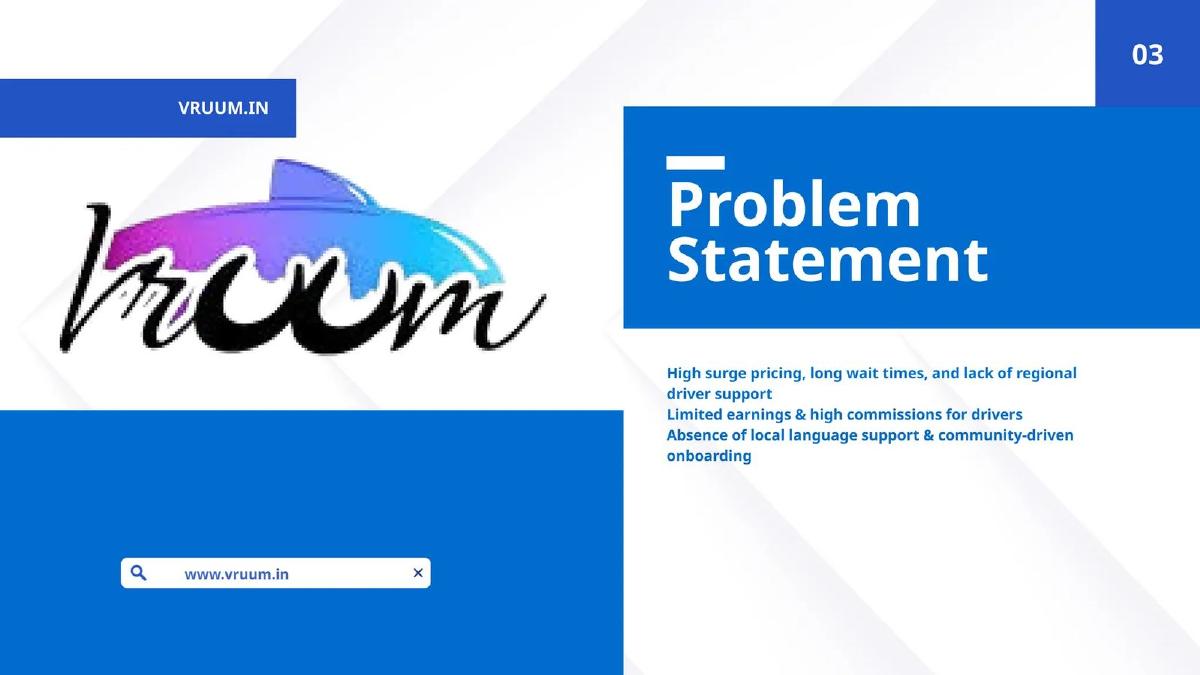
VRUUM identifies three core pain points in the current Indian ride-hailing landscape. For riders, the issues are high surge pricing and long wait times . For drivers, the deck highlights limited earnings due to high commissions . A secondary issue mentioned is the absence of local language support and community-driven onboarding, suggesting that incumbents are perceived as too impersonal or disconnected from regional needs.
Slide 5: Market Opportunity
The market sizing uses the standard TAM/SAM/SOM framework. The Total Addressable Market (TAM) for India's ride-hailing sector is projected at $10 billion by 2025 . The Serviceable Addressable Market (SAM) , focusing on Delhi-NCR and 10 major cities, is valued at $2.2 billion . The Serviceable Obtainable Market (SOM) target is to capture 1% of the SAM in the first year , which they calculate as $22 million in potential revenue, growing to 3% by the second year.
The Business Model and Revenue Strategy
Slide 7: Business Model - Value Proposition
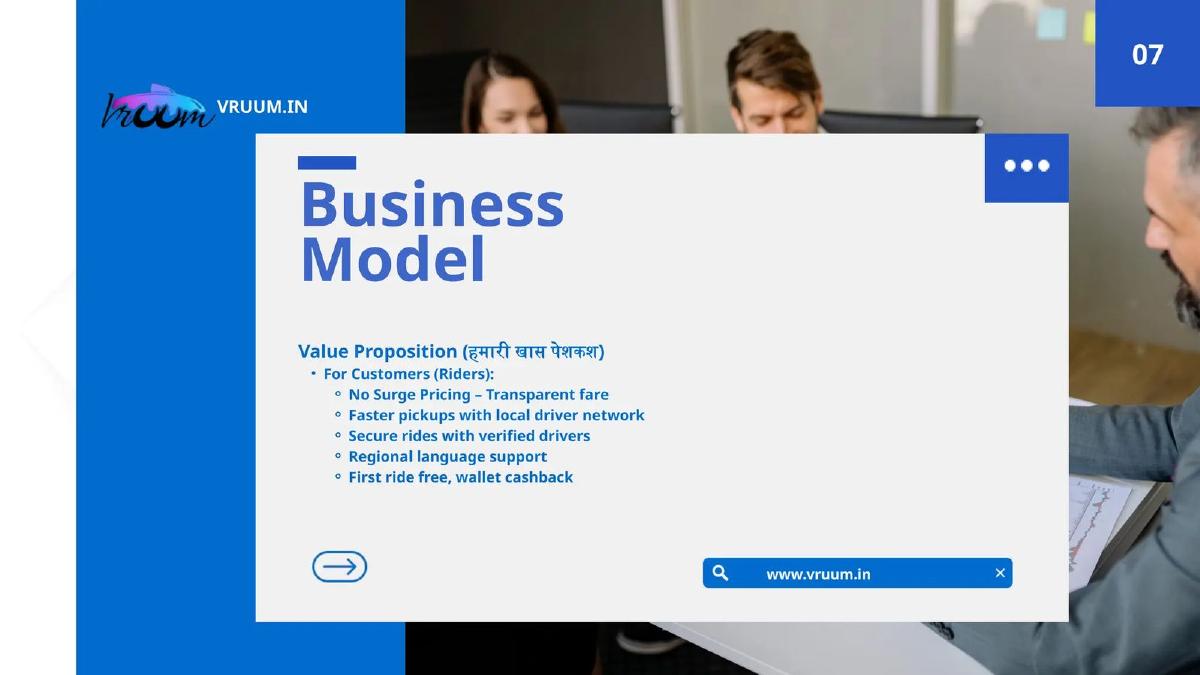
This slide breaks down the offering for customers (Riders). The key pillars are No Surge Pricing , Faster Pickups via a local driver network, Secure Rides with verified drivers, and Regional Language Support . They also mention a 'First ride free' and 'wallet cashback' incentive to drive initial adoption.
Slide 9: Business Model - Revenue Streams and Channels
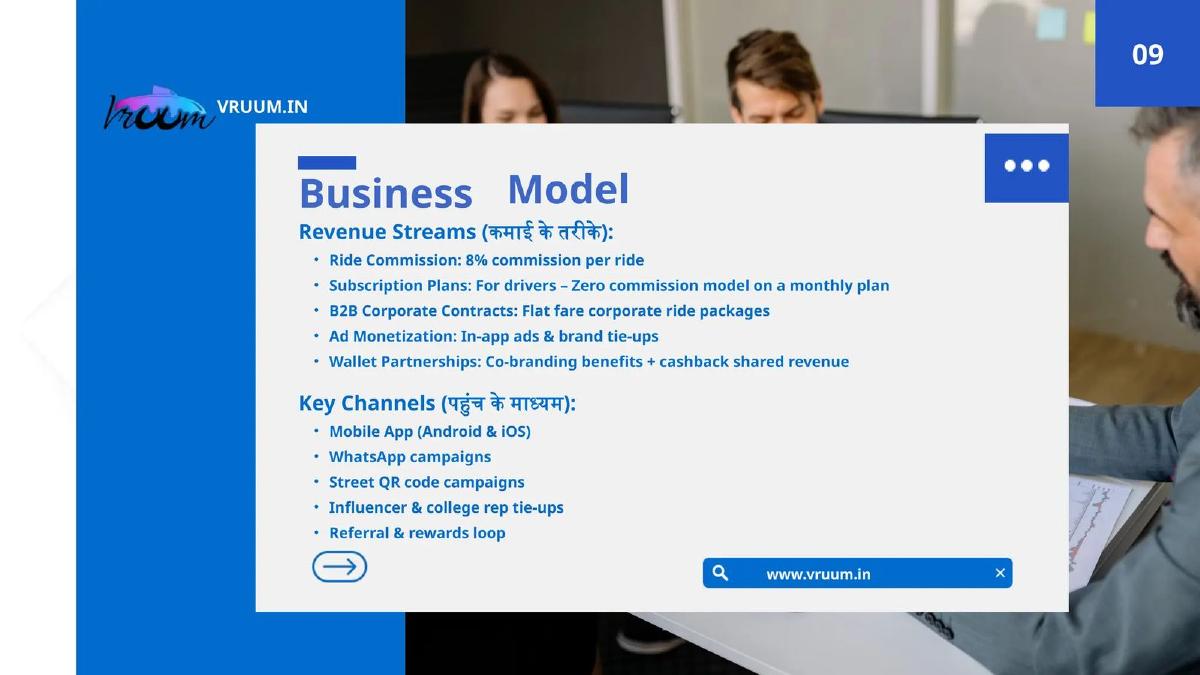
VRUUM proposes a diversified income model. The primary driver is an 8% commission per ride . They also introduce Subscription Plans for drivers (a zero-commission monthly plan), B2B Corporate Contracts for flat-fare packages, Ad Monetization , and Wallet Partnerships . Marketing channels include mobile apps, WhatsApp campaigns, street QR codes, and influencer/college rep tie-ups.
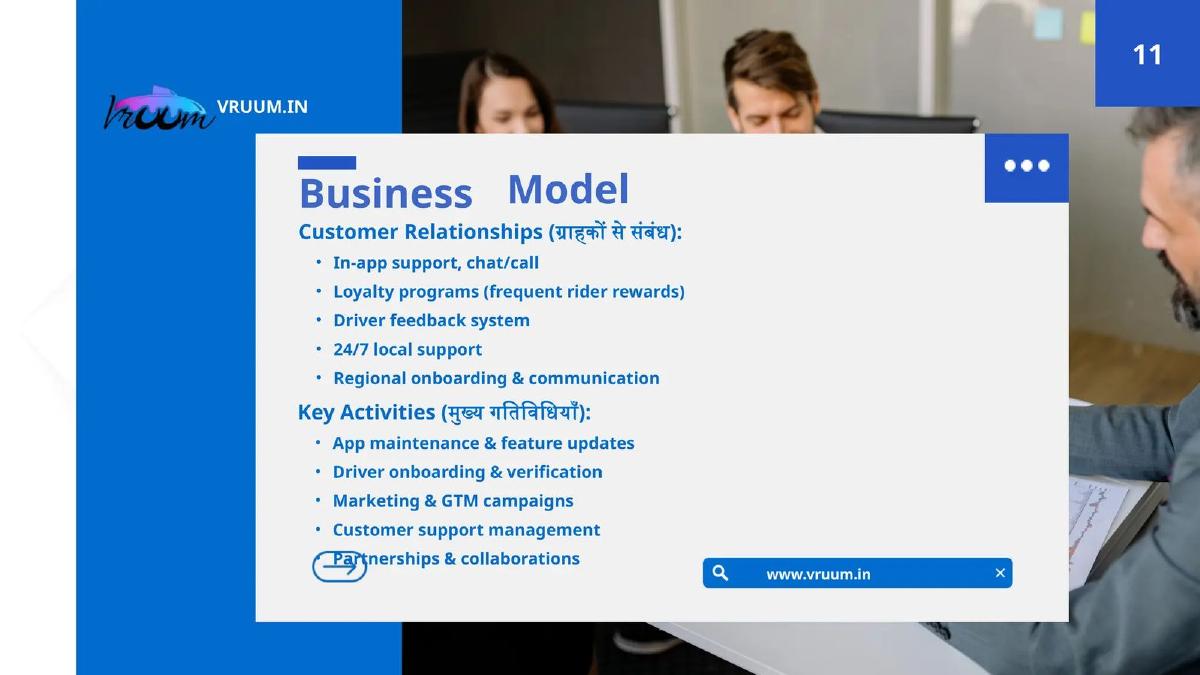
Slide 11: Business Model - Relationships and Activities
Key activities listed include app maintenance, driver onboarding/verification, and GTM campaigns. Customer relationship management is handled through in-app support, loyalty programs, and a 24/7 local support system. The mention of 'Regional onboarding' reinforces their hyperlocal strategy.
Product and Service Offerings
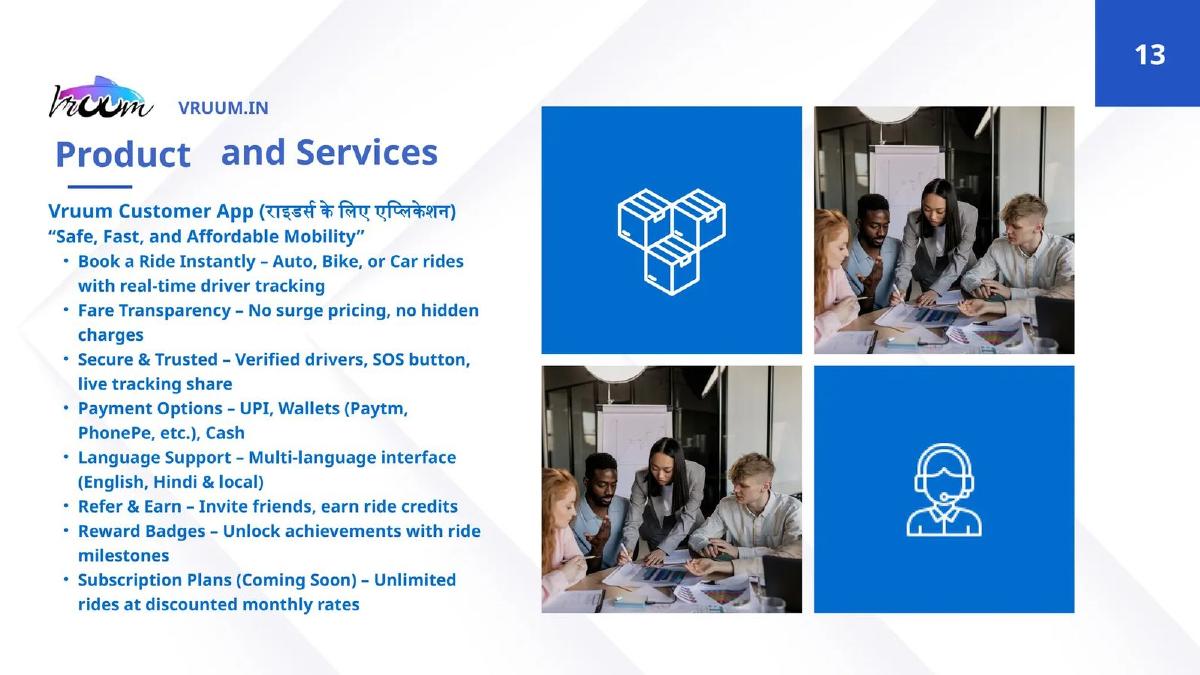
Slide 13: Product and Services - Customer App
The customer app is marketed under the banner 'Safe, Fast, and Affordable Mobility.' Features include instant booking for Auto, Bike, or Car , real-time tracking, fare transparency, and multiple payment options including UPI and Wallets (Paytm, PhonePe) . A subscription plan for unlimited rides at discounted rates is listed as 'Coming Soon.'
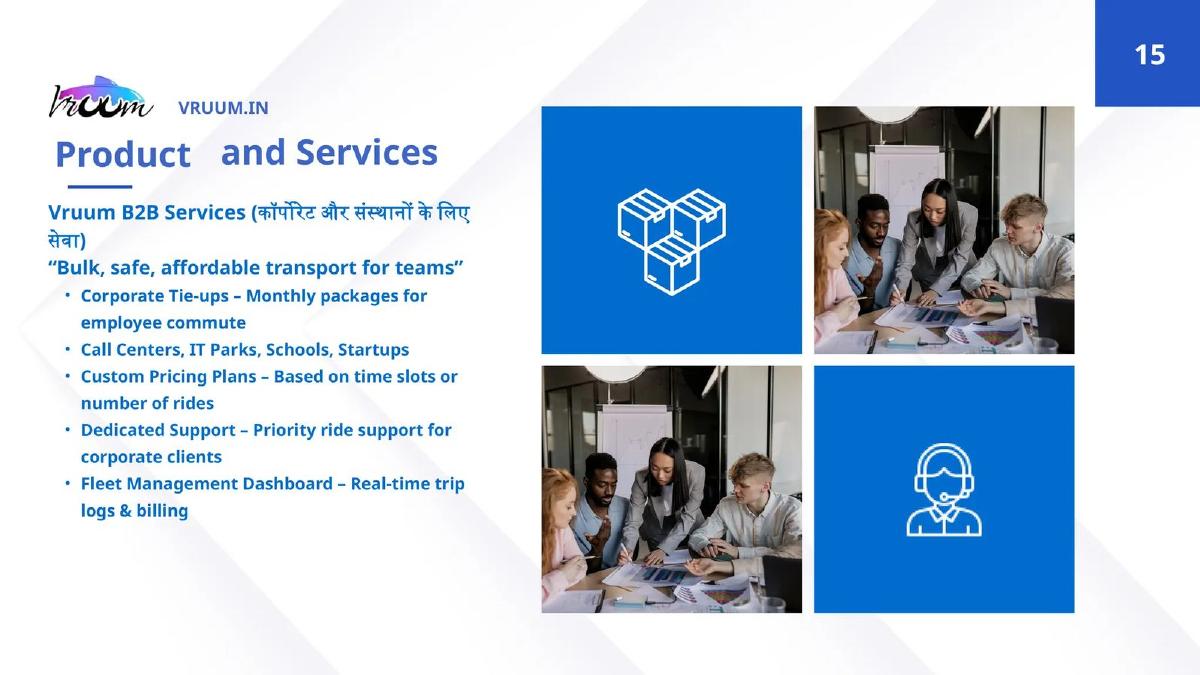
Slide 15: Product and Services - B2B Services
VRUUM targets corporate clients like Call Centers, IT Parks, Schools, and Startups . The B2B offering includes monthly packages for employee commutes, custom pricing based on time slots, and a Fleet Management Dashboard for real-time trip logs and billing.
Slide 17: Product and Services - Add-on Services
This slide outlines a 'revenue expansion roadmap.' Future services in the pipeline include Vehicle Insurance & Financing for drivers, Vehicle Leasing , E-Rickshaw integration , and a Business API for hotels and hospitals.
Competitive Landscape
Slide 19: Competitive Analysis Table
VRUUM compares itself directly against Ola, Uber, and Rapido . The most striking differentiator is the commission: 8% for VRUUM versus 25-30% for Ola/Uber and ~20% for Rapido. They also claim an advantage in ride types by offering 'Driver on Hire' services, which the others lack. The pricing model is noted as 'Transparent, No surge,' contrasting with the dynamic pricing of the two largest competitors.
Slide 21: Competitive Analysis - The Edge
This slide summarizes the 'Competitive Edge,' emphasizing that Low Driver Commission equals Higher Earning , which leads to More Driver Loyalty . They reiterate the 'Hyperlocal Penetration' strategy, aiming to target 'Real India' through street promotions and regional tuning.
Go-To-Market and Growth Strategy
Slide 23: Go-to-Market Strategy - Awareness and Onboarding
The GTM plan is highly tactical. Awareness is driven by 'First 3 Rides Free' (up to ₹50/ride) and QR codes in pan shops, hostels, and kirana stores . Driver onboarding includes a ₹500 joining bonus and 0% commission for the first month, alongside sign-up drives at local petrol pumps.
Slide 25: Go-to-Market Strategy - Incentives
This slide details the viral loop. It includes 10% cashback on wallet rides , a ₹25 off + ₹25 referral bonus for app installs, and incentives for local influencers (5k-50k followers) at ₹25 per user signup . A 'Campus Brand Rep' program is also mentioned to target younger demographics.
Slide 27: Go-to-Market Strategy - KPIs and Hyperlocal Stats
VRUUM notes that in Delhi-NCR, there are 10 lakh average daily commute users , with Ola/Uber holding only a 30% share, leaving 50% of local autos/taxis unorganized. This 'unorganized' segment is their primary target for conversion to the platform.
Metrics and Financial Projections
Slide 29: Key Metrics
The company projects an Average Ride Value (ARV) of ₹65–₹80 . At scale, they anticipate Monthly Gross Revenue of ₹50+ lakhs . Growth targets include 8-12% week-on-week user growth and expansion to 10 cities in 12 months. The target revenue for Year 2 is set at ₹4–4.5Cr (INR) .
Slide 31: Financial Projections Table
The projections cover three years. Year 1 shows a total cost of ₹1.10 Cr with a ₹0 (Break-even) net profit. Year 2 projects a ₹2 Cr profit on a 15% margin. By Year 3 , they forecast a ₹7.5 Cr profit with a ~19.5% profit margin and a 60% EBITDA margin. The largest expense in Year 1 is Operations & Salaries (₹40 Lakhs) .
Slide 33: Cash Flow Snapshot
This slide mirrors the profit projections, showing Net Cash Flow moving from ₹0 in Year 1 to a ₹7.5 Cr surplus in Year 3 . Inflows are projected to grow from ₹1.1 Cr to ₹11.15 Cr over the same period.
Slide 35: Financial Projections - Adjustments
The deck explains that they have reduced tech and marketing spend in Year 1 to ensure break-even and plan to boost ad/subscription revenue starting in Year 2. They also mention 'controlled fixed costs growth' to protect margins in the third year.
Funding Requirements and Exit Strategy
Slide 37: Funding Requirements
The headline figure is Total Funds Required: ₹5.5 Crores . This is categorized as a 'Seed + Early Growth Stage' round.
Slide 39: Breakup of Fund Usage
The ₹5.5 Cr is allocated as follows: Operations & Admin (₹0.60 Cr / 11%) , B2B Partnerships (₹0.40 Cr / 7%) , Pilot Launch & Expansion (₹0.70 Cr / 13%) , and Contingency & Buffer (₹0.30 Cr / 5.5%) . Note: These percentages do not sum to 100%, suggesting other categories were likely on slides not included in this selection.
Slide 41: Funding Ask & ROI Expectations
The specific ask for the Seed Round is ₹5.5 Crores for 15% equity , implying a Pre-Money Valuation of ₹30 Crores . The runway is estimated at 12-18 months, with a target of 15% net profit margin by Year 2.
Slide 43: Exit Strategy
VRUUM outlines three potential exit paths: a Series A round at a higher valuation, acquisition by larger mobility players , or an ESOP buyback + founder-driven secondary exit .
What Works / What is Missing
What Works
Clear Competitive Differentiator: The 8% commission vs. 25-30% for incumbents is a powerful hook for driver acquisition, which is the hardest part of the ride-hailing marketplace. · Hyperlocal Marketing Plan: The focus on offline, low-cost channels like kirana stores and auto-rickshaw panels shows a pragmatic understanding of the Indian market beyond high-burn digital ads. · Diversified Revenue: Moving beyond just ride commissions to include driver subscriptions and B2B corporate contracts provides a more stable financial foundation.
What is Missing
Team Slide: This is the most critical omission. There is no information on who is building this, their background in logistics, or their ability to manage a high-ops business. · Unit Economics: While they provide high-level projections, they do not show the breakdown of a single ride's economics (CAC, LTV, variable costs) to prove the 8% commission is sustainable. · Regulatory Strategy: Ride-hailing in India is heavily regulated. The deck does not address licensing, compliance with state transport departments, or the legal hurdles of competing with giants. · Tech Stack Detail: For a 'Next-Gen' app, there is very little information on the actual technology, AI for routing, or how they will handle the massive concurrency required for a ride-hailing platform.
Founder Takeaways
Address the Incumbent's Weakness: VRUUM does an excellent job of identifying exactly where Uber and Ola are vulnerable (commissions and surge pricing) and building a brand around those specific gaps. · Granular GTM: Instead of saying 'we will use social media,' the deck specifies 'QR codes in pan shops' and 'local radio jingles.' This level of detail makes a plan feel executable. · Be Realistic About Profitability: The deck claims break-even in Year 1. In a sector known for massive burn (Uber/Ola), this is an extremely bold claim that would require significant evidence to back up during due diligence.
Frequently asked questions
- What is VRUUM's primary value proposition for drivers?
- VRUUM focuses on increasing driver earnings through a drastically lower commission rate of 8%, whereas incumbents like Uber and Ola take 25-30%. Additionally, they offer a subscription-based model where drivers can pay a flat monthly fee for a zero-commission experience. The deck also highlights 'faster payouts' and local support as key retention tools to build driver loyalty in a competitive market.
- How does the company plan to compete with Uber and Ola on pricing?
- The strategy centers on 'Transparent Pricing' with a strict 'No Surge' policy. By removing the volatility of surge pricing, VRUUM hopes to build superior user trust. They also plan to offer 'First 3 Rides Free' (up to ₹50 each) and 10% cashback on wallet-linked rides to incentivize switching from established platforms that frequently use dynamic pricing.
- What are the specific revenue streams beyond standard ride commissions?
- VRUUM identifies five distinct revenue streams: the 8% ride commission, driver subscription plans, B2B corporate contracts for employee commutes, in-app advertising/brand tie-ups, and shared revenue from co-branded wallet partnerships. Future 'pipeline' services include vehicle insurance, financing, and leasing options for drivers, as well as an API for hotel and hospital integrations.
- What is the geographical focus of the initial rollout?
- The company is focusing its Serviceable Addressable Market (SAM) on Delhi-NCR and 10 other major Indian cities. The deck emphasizes 'Hyperlocal Penetration,' targeting 'Real India' through offline marketing like QR codes in hostels and salons, and branding on the back panels of auto-rickshaws, rather than relying solely on expensive digital acquisition.
- Is there any information about the founding team in the deck?
- No. The 23 slides provided contain no information regarding the founders, their previous experience, or the current headcount of the company. This is a significant omission for a seed-stage pitch, as investors typically place high value on the team's ability to execute a complex operational business like ride-hailing.