Include, a Croatian-based hardware startup, utilized this 14-slide deck to secure a $2M Series A round in 2019. The presentation focuses heavily on established traction, highlighting that the company had already reached 42 global markets and installed over 1,000 products by early 2019 (Slide 2). By blending high-quality product photography with concrete usage metrics—such as 1.7 million Wi-Fi users and 10,288 GB of data used (Slide 13)—Include successfully framed their 'smart benches' not just as street furniture, but as critical data-gathering and advertising nodes for modern cities. The dec…
Key takeaways
- The company demonstrated significant global reach early on, citing presence in 260 international cities across five continents (Slide 2).
- Include utilized a 'Product Usage' slide to prove their hardware wasn't just installed, but actively engaged with, citing 173,732 USB charging sessions (Slide 13).
- The deck highlights a diverse product portfolio, moving from a single initial bench to 11 high-quality products and 10 optional features (Slide 2).
- Visual storytelling is prioritized through full-bleed images of the Steora and Monna product lines in real-world urban settings (Slides 4-12).
- The 'Awards' slide serves as a massive social proof engine, listing 11 distinct honors including Forbes 30 Under 30 and Deloitte Fast 50 (Slide 3).
- Financial projections are specific, forecasting a jump to 3,400+ installed products and 30 global distributors by 2021 (Slide 14).
- The deck omits a dedicated 'Team' slide in the provided sequence, which is a notable gap for a Series A pitch.
- There is no explicit 'Ask' slide detailing how the $2M would be allocated across R&D, sales, or production.
Include Pitch Deck Teardown
Include, a European hardware startup specializing in smart city infrastructure, used this deck to raise a $2M Series A in 2019. At the time, the company was transitioning from a garage-based startup to a global manufacturer of smart benches. The deck is a masterclass in using traction and social proof to overcome the inherent skepticism investors often have toward hardware-heavy business models.
Slide 1: Title and Visual Identity
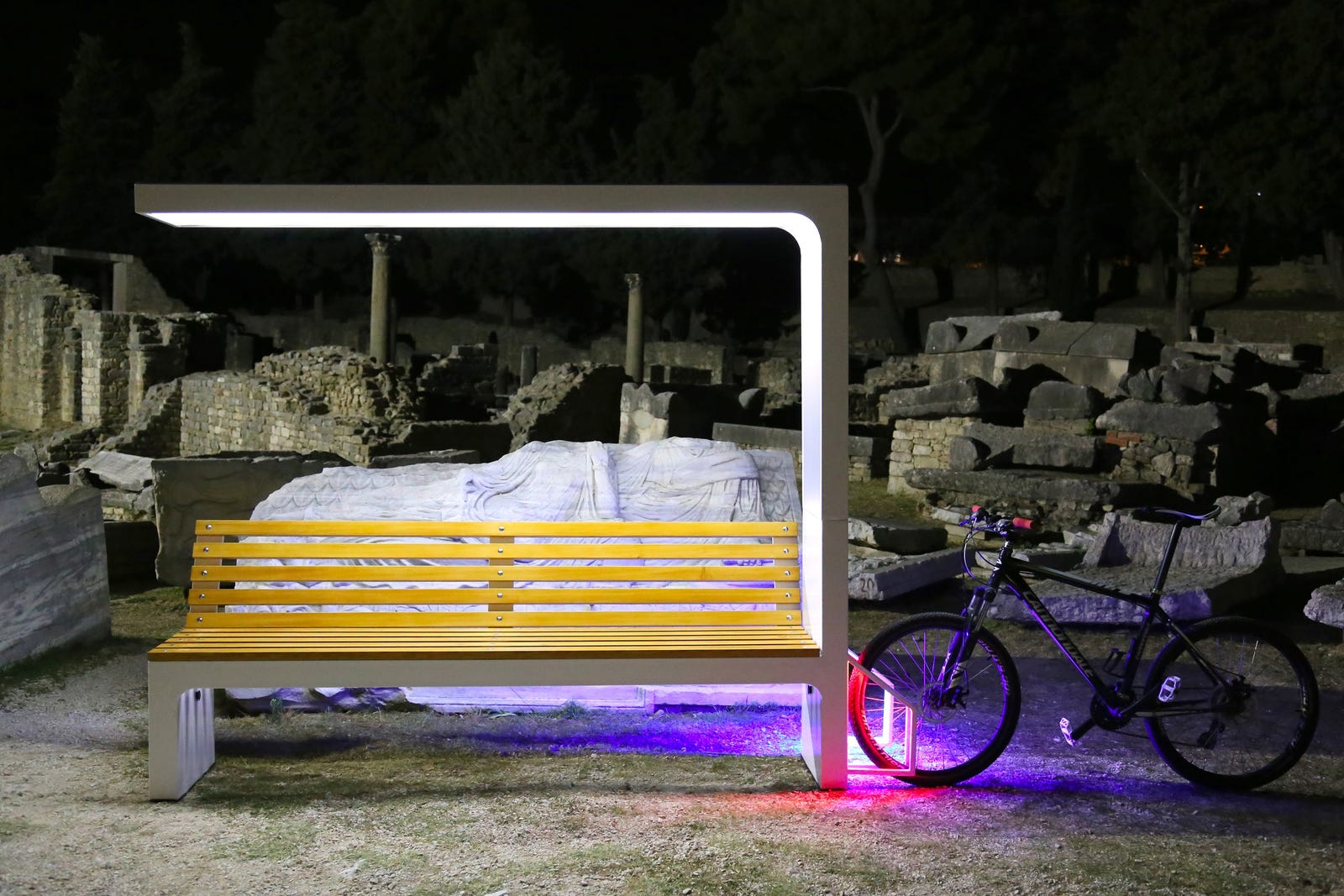
The opening slide is purely visual, featuring a high-resolution photograph of a Monna smart bench at night. The bench is illuminated with integrated LED lighting and includes a bike rack, positioned against a backdrop of ancient ruins. This immediately establishes the product's aesthetic appeal and its ability to blend modern technology with diverse urban environments.
Slide 2: About Us and Company History
Slide 2 serves as the executive summary. It outlines the company's journey from a garage in 2014 to a team of 30+ professionals. The slide is dense with 'proof points': 42 global markets, 5 continents, 260 cities, and over 1,000 products installed. By stating that their portfolio grew from one bench to 11 products in four years, Include demonstrates a rapid R&D cycle and the ability to scale production.
Slide 3: Social Proof via Awards
This slide is a wall of 11 awards, which is an unusually high number for a Series A deck. Key accolades include the Forbes 30 Under 30 Europe 2019 , Deloitte Fast 50 Rising Star 2018 , and the EU Top 50 Award 2017 . For a company based in Croatia (a non-traditional tech hub), this level of international validation from organizations like the European Parliament and Deloitte is critical for building investor trust.
Slides 4-12: Product Deep Dives (Steora and Monna)
The middle section of the deck (Slides 4 through 12) is heavily visual, focusing on the two main product lines: Steora and Monna . Slide 4 introduces the Steora bench, highlighting its sleek design and integrated digital advertising screen. Slide 12 focuses on the Monna line, which is geared toward cycling infrastructure. It shows a close-up of a 'smart' compartment containing bike tools and an air pump, alongside a digital interface showing tire pressure. These slides serve to prove that the hardware is 'real,' high-quality, and currently deployed in premium locations like waterfronts and city squares.
Slide 13: Products Usage (The Data Layer)
This is arguably the most important slide in the deck. It moves the conversation from 'we sell benches' to 'we provide a platform.' Include lists specific usage metrics: 25,946.38 Produced kWh , 173,732 USB charging sessions , 201,507 wireless charging sessions , and 1,782,386 Wi-Fi users . The fact that they have tracked 10,288.54 GB of data used suggests a robust backend software layer, which is where the long-term enterprise value of a smart city company usually resides.
Slide 14: 2019-2021 Projections
The deck concludes with a forward-looking financial slide. It features a line graph showing Revenues, Expenses, and Net Profit. The key figures are bold: 3,400+ products installed , €1.71M net profit projected for the 2020-2021 period, and an expansion to 50 global markets and 30 global distributors . This slide aims to show that the company has reached an inflection point where revenue will begin to significantly outpace expenses.
What Include Got Right
Traction Over Theory: Instead of pitching the 'future of smart cities,' Include pitched the 'reality of their 1,000+ benches.' The usage data on Slide 13 is a powerful antidote to the 'hardware is hard' stigma. · Global Footprint: Citing 42 markets and 260 cities (Slide 2) proves that the product has universal appeal and that the team understands international logistics and distribution. · Visual Quality: The photography is professional and aspirational. It helps investors visualize the product as a premium addition to a city's infrastructure rather than a clunky utility. · Social Proof: The Awards slide (Slide 3) is exhaustive. It effectively uses third-party validation to vouch for the founder and the technology.
What Was Missing
The Team Slide: In the provided 14-slide sequence, there is no dedicated slide introducing the founders or key leadership. For a Series A, investors need to know who is managing the 30+ professionals mentioned on Slide 2. · The Business Model: While the deck mentions advertising displays, it doesn't explain the revenue split. Does Include own the ad space, or do the cities? Is there a SaaS fee for the data dashboard? · Competition: There is no mention of other smart bench manufacturers or alternative outdoor advertising companies (like JCDecaux). · The Ask: The deck lacks a clear 'Use of Funds' slide. While we know from publisher reports that they raised $2M, the deck itself doesn't specify how that capital would be deployed to reach the 3,400-unit goal.
Founder Takeaways
Use data to prove utility. If you are building a physical product, don't just show the object; show how people use it. Include's breakdown of Wi-Fi users and charging sessions (Slide 13) proves there is a demand for their service, which justifies the hardware cost to a city council or an investor.
Leverage distribution partners. Include highlights '30 global distributors' on Slide 14. For hardware startups, building an internal global sales team is often too expensive. Showing that you have a network of partners who handle the 'last mile' of sales and installation is a massive de-risking factor for investors.
Focus on the 'Smart' in Smart City. By tracking energy production and data usage, Include positions itself as a data company that happens to make furniture. Founders in the IoT space should always emphasize the data collection and management capabilities of their hardware, as these carry much higher margins than the physical units themselves.
Design for the environment. The photography in this deck isn't just 'product shots'; it's 'context shots.' Showing the bench in a historic site, a modern waterfront, and a snowy park proves the hardware's durability and aesthetic versatility. If your product lives in the real world, your deck must show it thriving there.
Frequently asked questions
- What is the core product offered by Include?
- Include manufactures smart street furniture, primarily the Steora and Monna bench lines. These products integrate solar power, Wi-Fi hotspots, mobile charging (USB and wireless), and digital advertising displays. The Monna line specifically includes features for cyclists, such as integrated tools and air pumps, as shown on Slide 12.
- How much traction did Include have at the time of the 2019 raise?
- According to Slide 2, the company had installed more than 1,000 products across 260 cities in 42 global markets. They also reported significant user engagement, including over 1.7 million Wi-Fi users and nearly 26,000 kWh of solar energy produced by their installations (Slide 13).
- What are the projected financials for the company?
- Slide 14 projects a significant growth trajectory, aiming for over 3,400 installed products by 2021. The company forecasted reaching a net profit of €1.71M between 2020 and 2021, supported by an expansion to 50 global markets and 30 global distributors.
- Does the deck explain the advertising component of the business?
- While the publisher summary mentions advertising displays, the slides focus more on the hardware features and usage metrics. Slide 4 shows a bench with a digital display, but the deck lacks a specific breakdown of the advertising revenue model or the software platform used to manage these displays.
- What is missing from this pitch deck?
- The provided 14-slide sequence is missing a dedicated Team slide, a detailed Competitor analysis, and a specific 'Use of Funds' or 'Ask' slide. It also lacks a deep dive into unit economics, such as the cost to manufacture versus the sale price or recurring revenue from data and advertising.