Improvado’s Series A deck is remarkably concise, utilizing only 8 slides to secure a $30 million investment. The deck avoids traditional filler—there are no market sizing slides, no detailed financial projections, and no formal team bios. Instead, it leans heavily on the technical 'how it works' and the specific pain point of the 'MarTech' ecosystem. By highlighting a unique ability to handle both log-level and API data (Slide 6), Improvado positioned itself as a specialist alternative to horizontal ETL giants. The deck's strength lies in its clarity of purpose: it is a product-first presenta…
Key takeaways
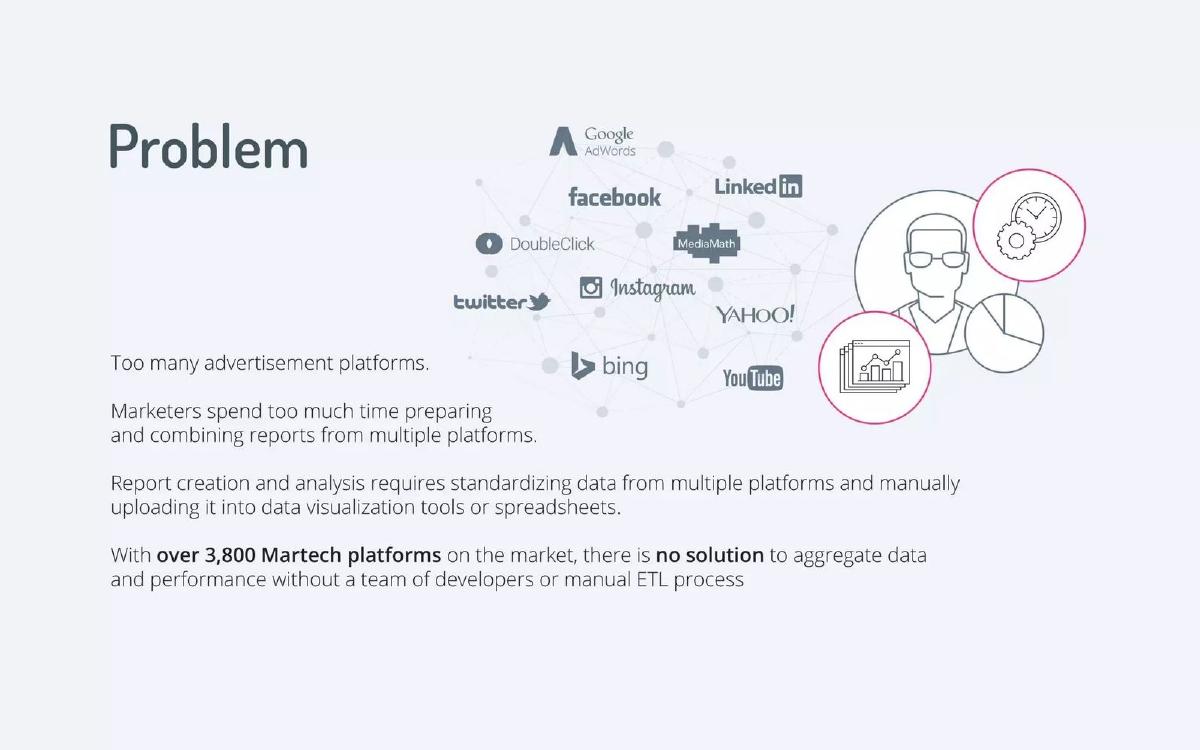
- The deck identifies a specific market friction: the existence of over 3,800 Martech platforms without a developer-free aggregation solution (Slide 2).
- Improvado positions itself as a 'MarTech Vertical Focus' ETL, contrasting itself against broad providers like Fivetran or Stitch without naming them (Slide 6).
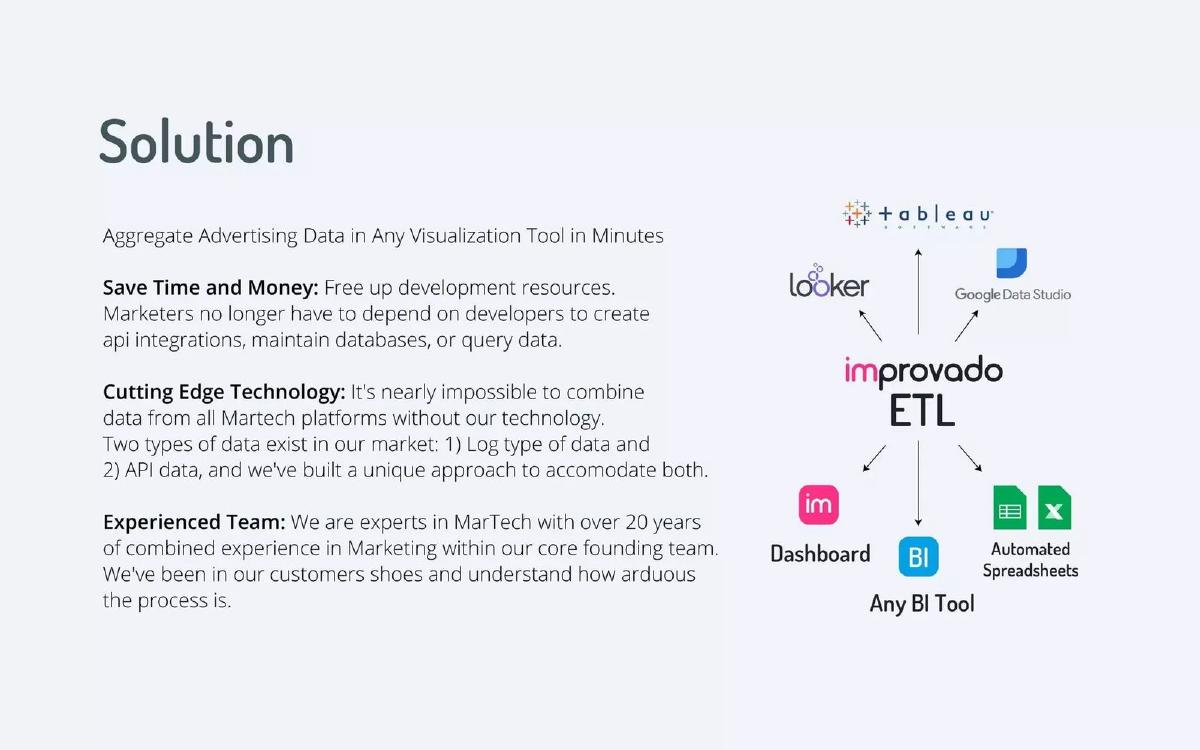
- The technical moat is defined by the ability to combine log-type data and API data, a distinction often missed by generalist tools (Slide 3 and 6).
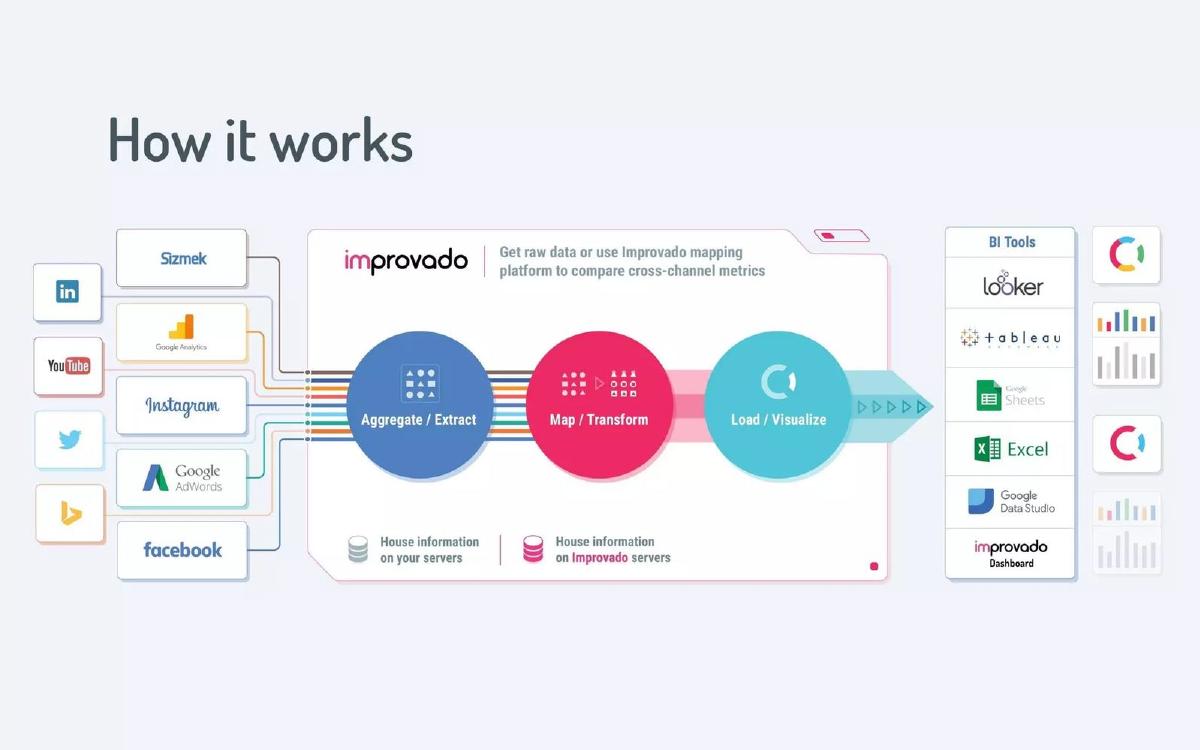
- The 'How it works' visualization clearly maps the journey from raw data sources to visualization tools like Tableau and Looker (Slide 4).
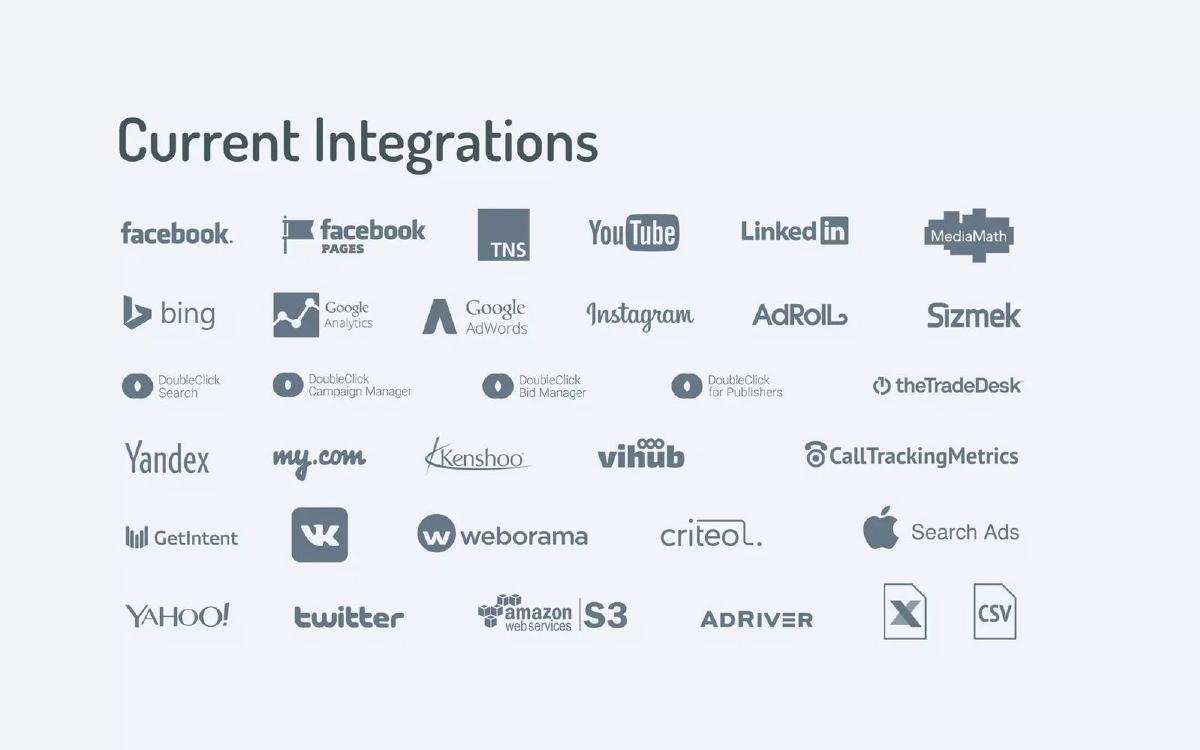
- Social proof is delivered through a logo wall of 30+ current integrations, signaling technical maturity (Slide 5).
- The team's credibility is established via a single sentence claiming over 20 years of combined MarTech experience, rather than individual bios (Slide 3).
- The deck lacks all traditional 'Business' slides, including Traction, Revenue, Competition, and the specific Investment Ask.
- The closing slide emphasizes a 'customer driven' approach, offering custom development projects to fill any product gaps (Slide 7).
The 8-Slide Specialist Strategy
Improvado’s Series A pitch deck is an anomaly in the world of $30 million rounds. While most decks at this stage are 15-20 slides deep with cohorts, CAC/LTV ratios, and expansive vision statements, Improvado opted for a lean, product-centric approach. This deck doesn't sell a dream; it sells a functional bridge between fragmented marketing platforms and business intelligence tools. It is a 'plumbing' deck, and it treats its audience as people who already know the pipes are broken.
Slide 1: The Value Proposition
The cover slide is direct. It features the logo and a clear headline: "Aggregate Advertising Data in Any Visualization Tool in Minutes." Below this, a sub-headline reinforces the 'no-code' aspect: "We help marketers aggregate data without developers." This immediately identifies the buyer (marketers) and the pain point (dependency on engineering resources). The background image of a laptop displaying a dashboard provides immediate context for the product's end-state.
Slide 2: The Problem - Martech Fragmentation
Slide 2 quantifies the chaos. It notes that there are "over 3,800 Martech platforms on the market." The slide lists three specific pain points: too many platforms, too much time spent on manual reporting, and the requirement for manual ETL (Extract, Transform, Load) processes. The visual of a human head surrounded by various ad platform logos (Facebook, LinkedIn, Google AdWords) effectively illustrates the cognitive and operational load on modern marketing teams.
Slide 3: The Solution and Team Hybrid
Instead of a dedicated team slide, Improvado integrates their 'Experienced Team' credentials directly into the Solution slide. They claim "over 20 years of combined experience in Marketing within our core founding team." The slide also introduces a key technical differentiator: the ability to handle both "Log type of data" and "API data." This is a sophisticated nod to the technical limitations of their competitors. The visual on the right shows 'Improvado ETL' as the central hub feeding into Looker, Tableau, Google Data Studio, and spreadsheets.
Slide 4: How It Works - The Pipeline
This slide is the technical heart of the deck. It visualizes the three-step process: Aggregate/Extract , Map/Transform , and Load/Visualize . Crucially, it clarifies data residency by noting that information can be housed "on your servers" or "on Improvado servers." This addresses potential enterprise security concerns regarding data sovereignty early in the conversation. The flow from source (left) to destination (right) is a standard but necessary visualization for any middleware product.
Slide 5: Current Integrations - The Logo Wall
Slide 5 serves as the primary source of social proof. It displays 30 logos, including major players like Facebook, Google Analytics, YouTube, Amazon S3, and Twitter . For an ETL company, the breadth of integrations is the product's moat. By showing they have already built the connectors for these platforms, they demonstrate that the 'hard work' of the business is already well underway. This slide replaces a traditional 'Traction' slide by showing the maturity of the platform's reach.
Slide 6: Differentiation - The Vertical Moat
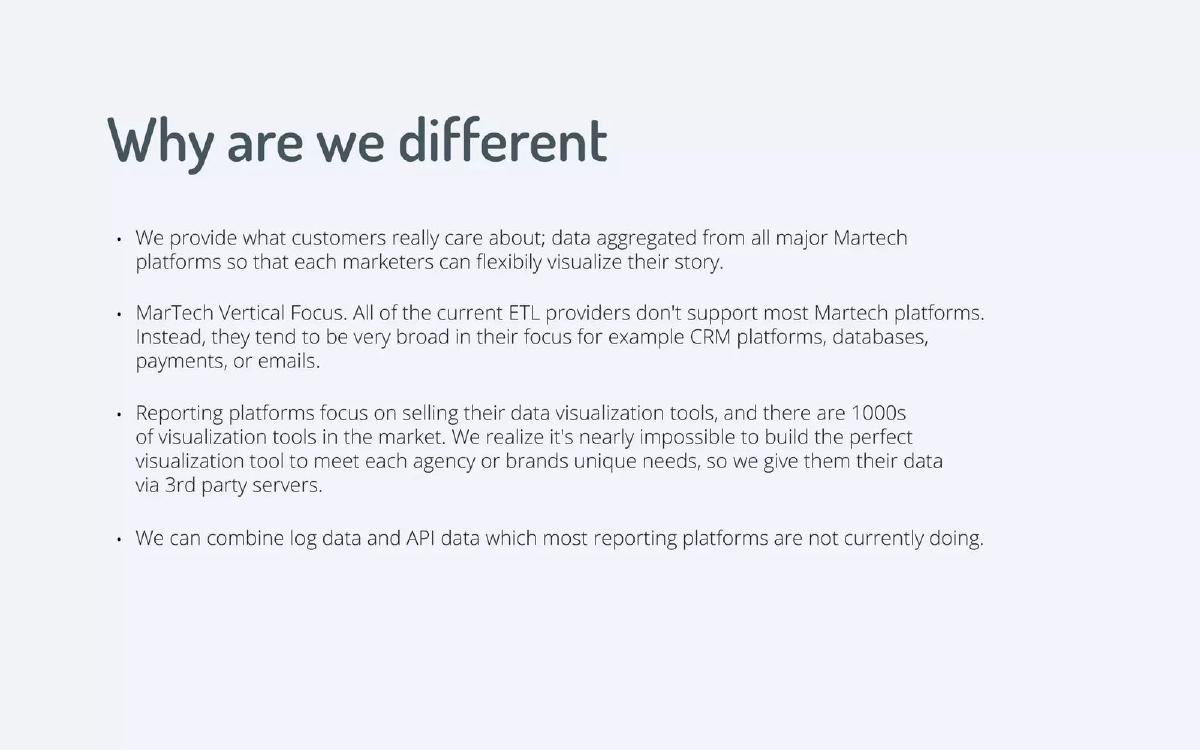
This is perhaps the most important slide for an investor. It answers 'Why you?' in a crowded market. Improvado explicitly states their "MarTech Vertical Focus." They argue that other ETL providers are too broad (focusing on CRM, payments, or databases) and that reporting platforms are too focused on their own visualization tools. Improvado positions itself as the flexible middle layer that gives data back to the brands via 3rd party servers. They reiterate their unique ability to combine log and API data, framing it as something "most reporting platforms are not currently doing."
Slide 7: Customer-Driven Philosophy
Slide 7 is a transition into the closing. It features a dark image of the Earth with the text: "We are a customer driven product and team." It offers a specific call to action: if a feature is missing, their development team will "scope out a custom project just for you." While this might raise 'scalability' red flags for some investors, at the Series A stage, it signals a 'win at all costs' attitude toward customer acquisition and product-market fit.
Slide 8: Contact and Location
The final slide provides contact information for 'Ali' (presumably the founder) and a physical address at 404 Bryant St, San Francisco . The inclusion of a Google Maps view of the building is an unusual touch, perhaps intended to ground the digital company in a physical, reputable Silicon Valley location.
What Works in This Deck
Extreme Clarity: There is zero jargon that doesn't belong to the specific domain of marketing data. A marketing director or a data engineer would understand this deck in 30 seconds. · Technical Differentiators: By mentioning 'Log data' vs 'API data' on slides 3 and 6, they signal that they aren't just another wrapper around a few basic APIs. They are solving the hard data engineering problems. · The 'Anti-Generalist' Stance: In a world of horizontal SaaS, Improvado’s commitment to being 'The MarTech ETL' is a strong positioning play that justifies their existence alongside giants like Fivetran.
What is Missing
Traction and Revenue: There are no numbers regarding ARR, growth rates, or customer count. This is a massive omission for a Series A deck and suggests this deck was used as a teaser or for a very specific type of 'insider' round. · The Ask: The deck never mentions how much money is being raised or what the funds will be used for. · Competitive Landscape: While they mention why they are different, they don't name or map out their competitors, leaving the investor to do that mental work. · Unit Economics: There is no mention of churn, LTV, or CAC, which are usually the bedrock of a Series A pitch.
What a Founder Should Copy
The 'How it Works' Diagram: Slide 4 is a perfect example of how to visualize a complex backend process simply. It shows input, internal process, and output with clear labels. · The Problem Quantification: Using the '3,800 Martech platforms' stat (Slide 2) is an excellent way to use a third-party fact to validate the necessity of your product. · Focus on the 'Unfair Advantage': If your advantage is technical (like the log data processing), mention it multiple times. Improvado mentioned it on Slide 3 and Slide 6 to ensure it wasn't missed.
Frequently asked questions
- How did Improvado raise $30M with only 8 slides?
- The deck focuses intensely on a high-value technical problem: the fragmentation of marketing data. By demonstrating a deep understanding of the 'MarTech' niche and offering a solution that handles both API and log data, they proved product-market fit to sophisticated investors. The brevity suggests the deck was likely a supplement to a much deeper due diligence process involving live demos and data rooms.
- What is missing from the Improvado pitch deck?
- Almost all standard venture capital slides are missing. There is no slide for Market Size (TAM), no Competition matrix, no Traction/Revenue growth charts, no Business Model/Pricing, and no Team slide with names and photos. Most importantly, there is no 'Ask' slide detailing how much they are raising and what the milestones are.
- Why does the deck emphasize 'Log data' vs 'API data'?
- This is a strategic technical differentiator. Many marketing platforms provide high-level metrics via API, but granular, row-level data often requires processing massive log files. By claiming to accommodate both (Slide 3), Improvado signals to investors that their ETL pipeline is more robust and useful for advanced data science teams than standard connectors.
- Is the lack of a team slide a mistake?
- In this specific case, it was clearly not a deal-breaker, but for most founders, it is a risk. Improvado summarizes their expertise in one bullet point on Slide 3. This works only if the founders have a significant reputation in the industry or if the product's technical superiority is self-evident through the integrations shown on Slide 5.
- What can other SaaS founders learn from this deck?
- The primary lesson is the power of 'Vertical Focus.' Instead of trying to be an ETL for everyone, Improvado's deck screams 'We are the data layer for Marketers.' This specificity allows them to skip general market education and dive straight into the technical nuances that their specific buyers (and investors) care about.