Pitch Deck Solution Slides: Real Examples and What Works
How real startups present the solution slide in a pitch deck: workflow, customer-side benefits, a worked customer case and proof.
Pitch Deck Solution Slides: Real Examples and What Works
Seven solution slides from real decks, shown in full, reveal four different ways to answer the same question: what exactly do you do about the problem you just described?
TL;DR
A solution slide should tell an investor what the product does, for whom, and why it removes the problem on the previous slide, in words a stranger could repeat. The strongest examples below do one of four things well: show how the product works step by step, split the benefit between both sides of a market, walk through one concrete customer case, or open with proof that customers already rely on it. Weak versions list benefits ("transparency", "efficiency") without saying what changes for anyone.
Solution slides from real pitch decks
Each example shows the exact stored slide above its analysis and links to the full teardown. Figures and quotes are the companies' own claims; we have not independently verified them. Stage and year come from our collection records where available and are marked uncertain otherwise.
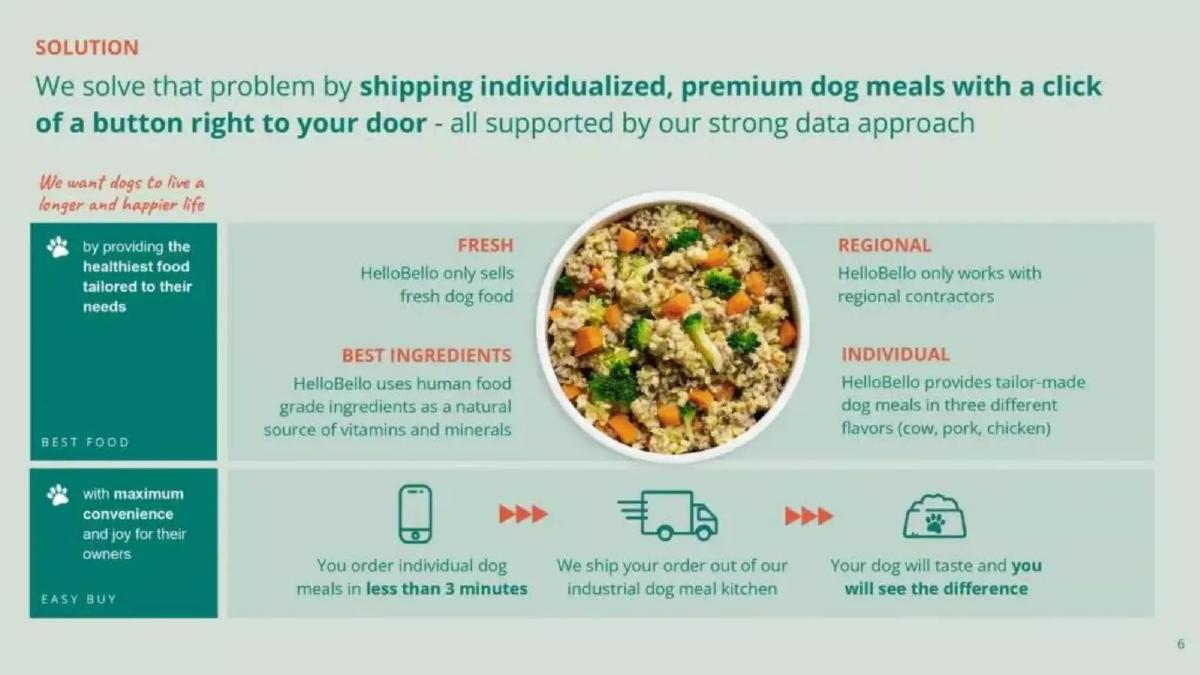
HelloBello solution slide — slide 6
Fresh, individualised dog food delivered to the door. Collection-recorded as a 2022 seed deck.
HelloBello deck, slide 6. Exact stored slide matched to this analysis.
Our analysis: A good template for consumer products where the novelty is the delivery model, not the technology.
Evidence and limitation: No figures on the slide; it is a description, not proof.
What a founder can adapt: Write your headline as "We solve [problem] by [what you do] for [who]" and follow it with the two or three steps the customer actually experiences.
Supporting analysis
What the deck claims: The headline reads "We solve that problem by shipping individualized, premium dog meals with a click of a button right to your door". Below it, four attributes (fresh, regional, best ingredients, individual: three flavours) and a three-step flow: order in under three minutes, ship from an industrial dog-meal kitchen, your dog will taste the difference.
Presentation choice: The headline alone passes the repeat test: product, customer, delivery model. The three-step strip shows the customer journey rather than internal operations.
When it does not fit: "Supported by our strong data approach" is asserted, not shown; either explain what the data does for the customer or drop it. "Your dog will see the difference" is a promise, not evidence.
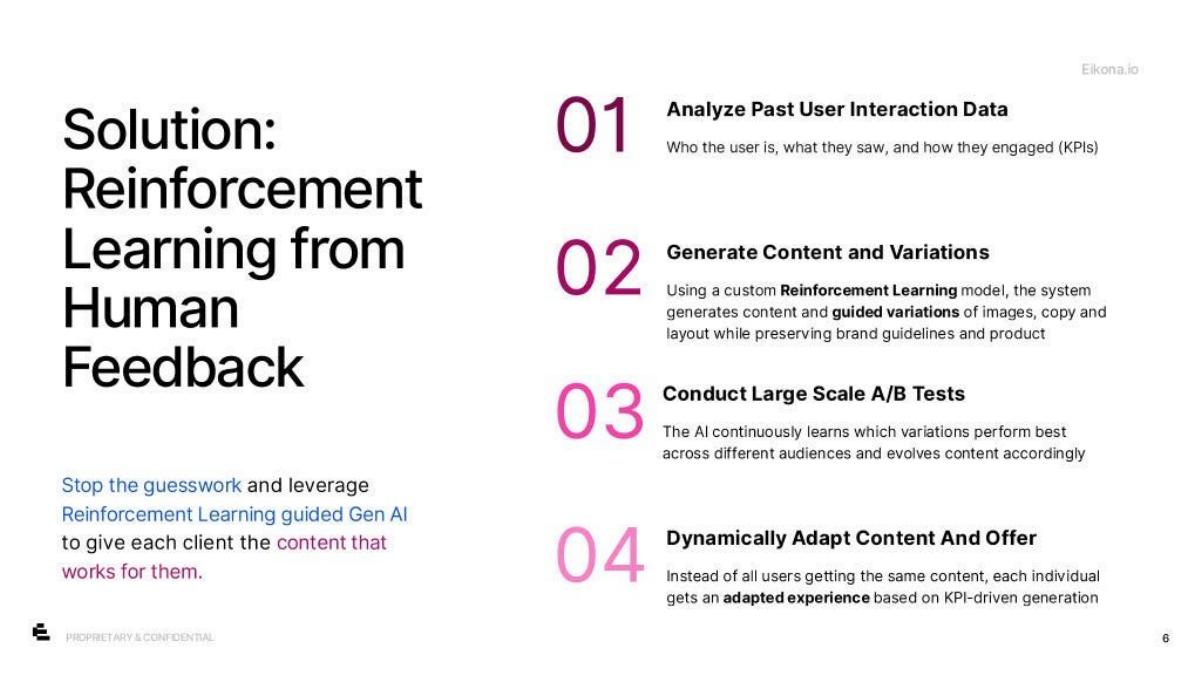
AI-generated marketing content personalised per user. Stage and year not recorded in our collection.
Eikona deck, slide 6. Exact stored slide matched to this analysis.
Our analysis: The numbered sequence turns a technical term into a process a non-specialist can follow, and ends on the customer outcome (each user gets adapted content).
Evidence and limitation: Leading the title with the technique (RLHF) rather than the customer outcome makes the slide read as technology-first. Nothing shows the improvement is measured; add one result or move proof to traction.
What a founder can adapt: If your product is a pipeline, show it as three to five verbs in order, finishing with what the customer receives.
Supporting analysis
What the deck claims: Titled "Solution: Reinforcement Learning from Human Feedback", with a one-line promise ("Stop the guesswork... give each client the content that works for them") and four numbered steps: analyse past interaction data, generate content variations within brand guidelines, run large-scale A/B tests, dynamically adapt content per individual.
Presentation choice: The numbered sequence turns a technical term into a process a non-specialist can follow, and ends on the customer outcome (each user gets adapted content).
When it does not fit: Leading the title with the technique (RLHF) rather than the customer outcome makes the slide read as technology-first. Nothing shows the improvement is measured; add one result or move proof to traction.
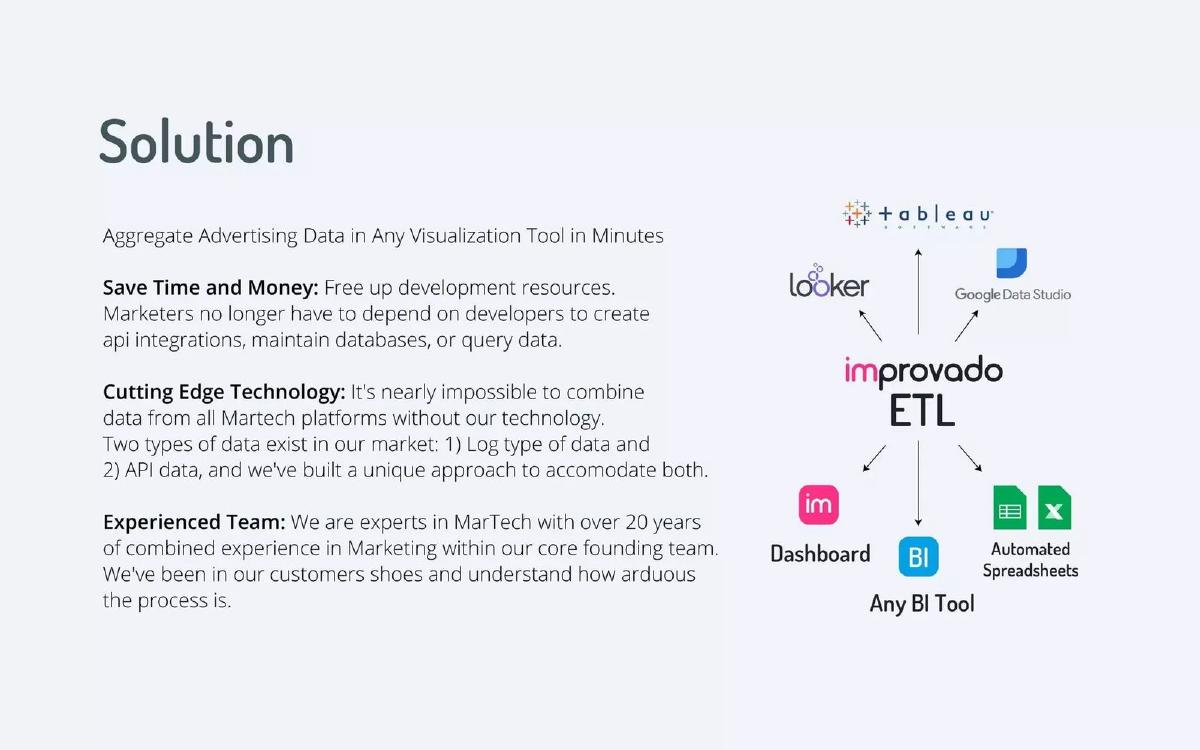
Marketing data aggregation (ETL) for marketers. Collection-recorded as a 2015 Series A deck.
Improvado deck, slide 3. Exact stored slide matched to this analysis.
Our analysis: The diagram answers "where does this sit?" instantly: between ad platforms and the tools marketers already use. Naming familiar destinations reduces adoption doubt.
Evidence and limitation: "Nearly impossible to combine data... without our technology" is an unsupported absolute, and the team block belongs on the team slide. Mixing value, technology and team dilutes the one message.
What a founder can adapt: Draw your product between the systems the customer already uses; logos of the destination tools do more than an abstract architecture.
Supporting analysis
What the deck claims: Subtitle: "Aggregate Advertising Data in Any Visualization Tool in Minutes". Three blocks: save time and money (marketers no longer depend on developers for API integrations), cutting-edge technology (handles both log and API data), experienced team (20+ years combined MarTech experience). A diagram shows Improvado ETL feeding Tableau, Looker, Google Data Studio, dashboards and spreadsheets.
Presentation choice: The diagram answers "where does this sit?" instantly: between ad platforms and the tools marketers already use. Naming familiar destinations reduces adoption doubt.
When it does not fit: "Nearly impossible to combine data... without our technology" is an unsupported absolute, and the team block belongs on the team slide. Mixing value, technology and team dilutes the one message.
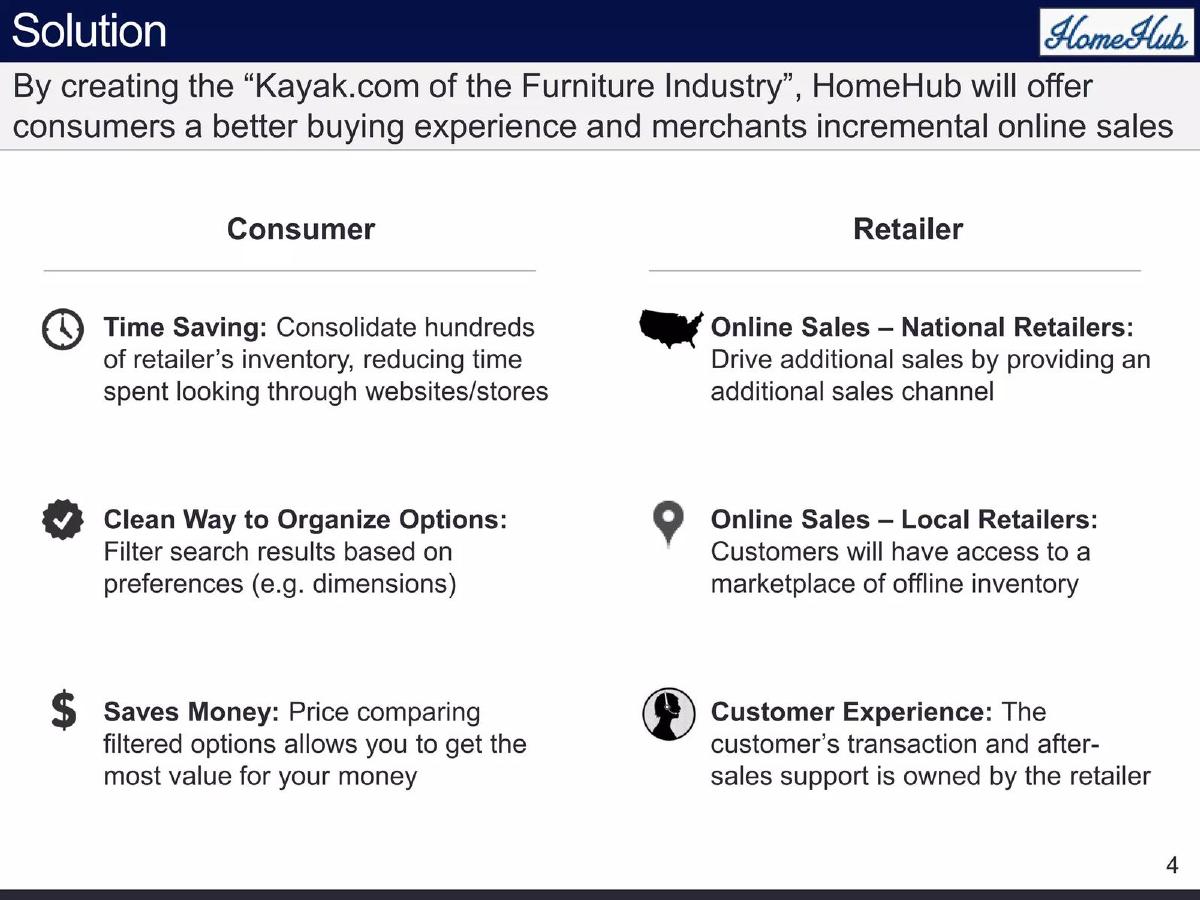
Furniture search and price comparison marketplace. Collection-recorded as a 2014 pre-seed deck.
HomeHub deck, slide 4. Exact stored slide matched to this analysis.
Our analysis: The analogy classifies the business in four words, and the two columns show that the marketplace has something for each side, including the retailer's fear of losing the customer.
Evidence and limitation: Analogies date quickly and assume the investor values the reference company. All six benefits are claims without evidence; at pre-seed that is normal, but the deck then needs early retailer commitments elsewhere.
What a founder can adapt: For a marketplace, give each side its own column and address the objection the supply side is most likely to raise.
Supporting analysis
What the deck claims: Positions the company as the "Kayak.com of the Furniture Industry" and splits benefits into two columns. Consumers: time saving, clean filtering (e.g. dimensions), saving money through price comparison. Retailers: additional online sales for national retailers, access to a marketplace for local offline inventory, and retailers keep the transaction and after-sales relationship.
Presentation choice: The analogy classifies the business in four words, and the two columns show that the marketplace has something for each side, including the retailer's fear of losing the customer.
When it does not fit: Analogies date quickly and assume the investor values the reference company. All six benefits are claims without evidence; at pre-seed that is normal, but the deck then needs early retailer commitments elsewhere.
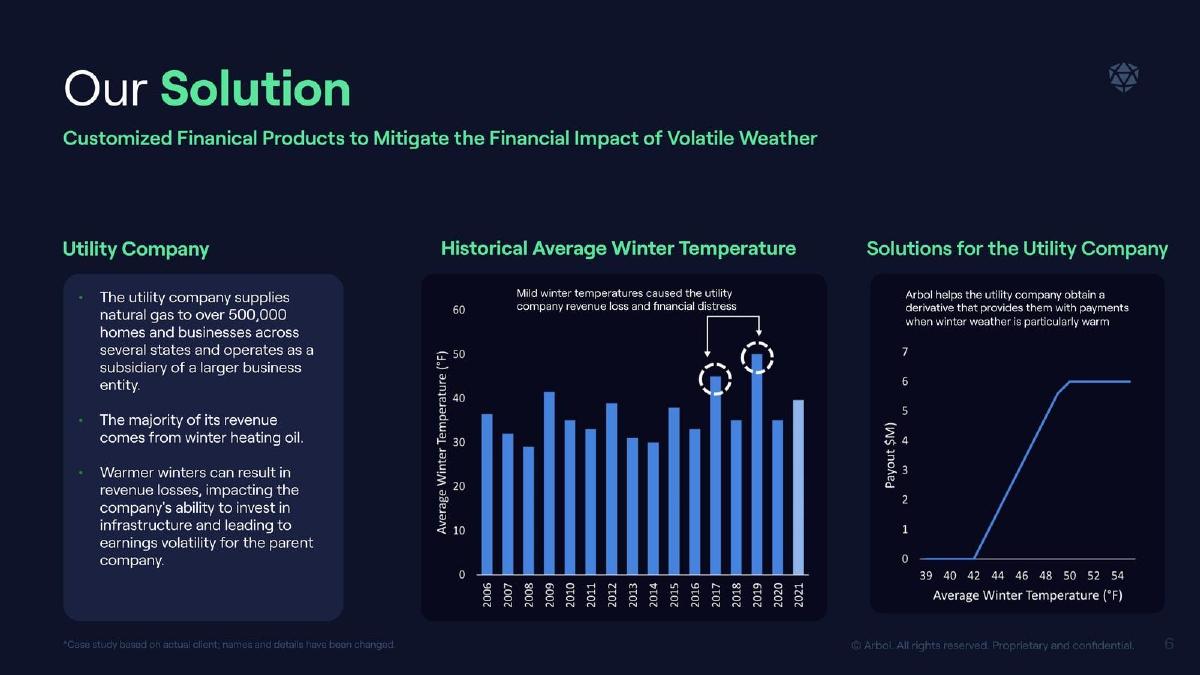
Parametric weather-risk financial products. Stage and year not recorded; the slide footnote says the case is based on an actual client with details changed.
Arbol deck, slide 6. Exact stored slide matched to this analysis.
Our analysis: Instead of describing the product, the slide makes the investor feel the customer's exposure and then shows the payout that offsets it. For a financial product, that is far clearer than a feature list.
Evidence and limitation: The charts are small and dense; in a sent deck most readers will not decode axis labels. One case also hides how broadly the product applies, so the next slide must show the range of customers.
What a founder can adapt: If your product is abstract, pick one representative customer and show their problem and your mechanism with their numbers. Label disguised cases as such, as Arbol does.
Supporting analysis
What the deck claims: "Customized Financial Products to Mitigate the Financial Impact of Volatile Weather", shown through one case: a utility supplying natural gas to over 500,000 homes and businesses, most revenue from winter heating oil, exposed to warm winters. A bar chart shows historical average winter temperature by year; a payout chart shows the utility receiving payments as average winter temperature rises.
Presentation choice: Instead of describing the product, the slide makes the investor feel the customer's exposure and then shows the payout that offsets it. For a financial product, that is far clearer than a feature list.
When it does not fit: The charts are small and dense; in a sent deck most readers will not decode axis labels. One case also hides how broadly the product applies, so the next slide must show the range of customers.
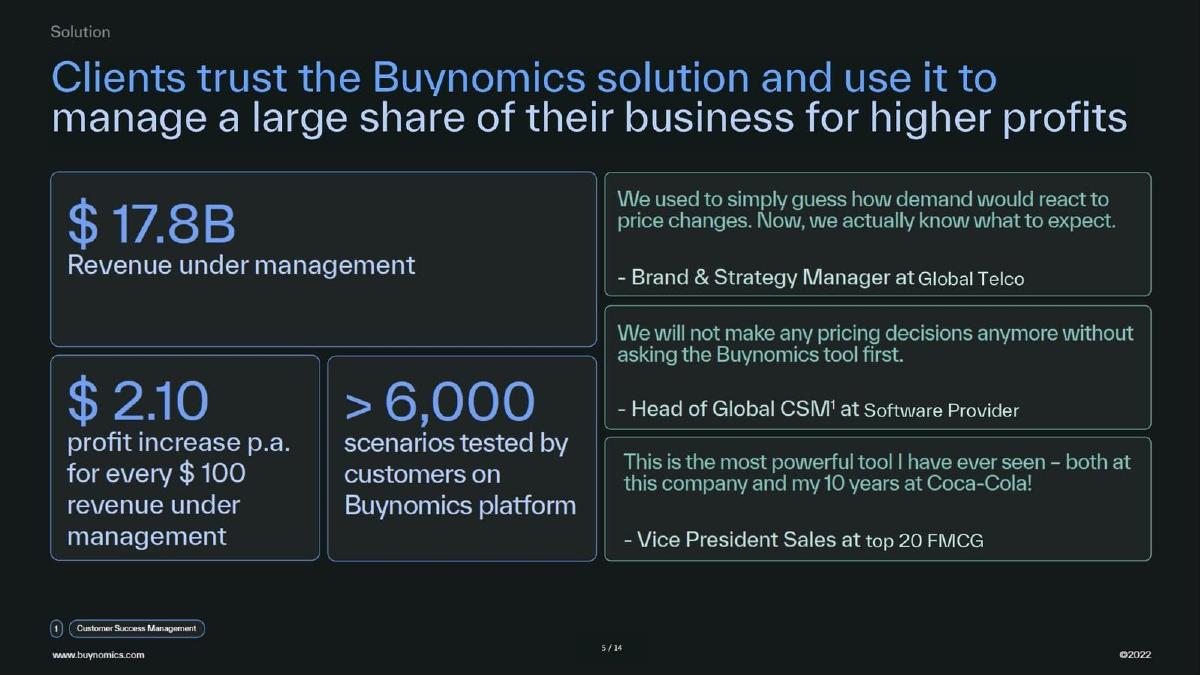
Pricing and portfolio decision software. Stage and year not recorded; the slide footer reads 2022.
Buynomics deck, slide 5. Exact stored slide matched to this analysis.
Our analysis: It answers "does it work?" on the solution slide itself, which suits a company whose product is already in use and whose mechanism is hard to show visually.
Evidence and limitation: The slide never says what the product does; a reader who skipped the previous slide would not know it is pricing software. Quotes without names and a profit figure without method invite diligence questions. Keep a plain description alongside the proof.
What a founder can adapt: If you have real usage, one outcome metric plus one customer quote can make the solution credible faster than a description.
Supporting analysis
What the deck claims: The headline claims clients "trust the Buynomics solution and use it to manage a large share of their business". Three figures: $17.8B revenue under management, $2.10 profit increase per year for every $100 of revenue under management, more than 6,000 scenarios tested by customers. Three quotes attributed by role only (Brand & Strategy Manager at a global telco, Head of Global CSM at a software provider, VP Sales at a top-20 FMCG company).
Presentation choice: It answers "does it work?" on the solution slide itself, which suits a company whose product is already in use and whose mechanism is hard to show visually.
When it does not fit: The slide never says what the product does; a reader who skipped the previous slide would not know it is pricing software. Quotes without names and a profit figure without method invite diligence questions. Keep a plain description alongside the proof.
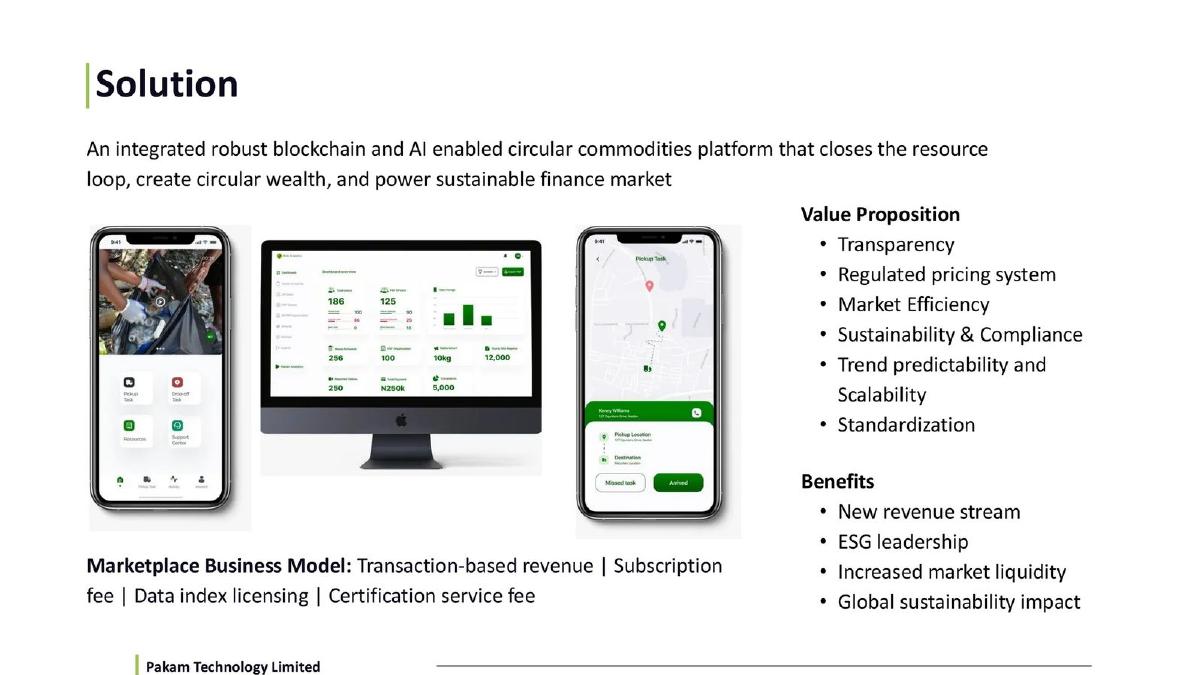
Recycling and secondary raw materials platform (Deutsche Börse Group version of the deck). Collection-recorded as 2024.
Pakam deck, slide 5. Exact stored slide matched to this analysis.
Our analysis: Included as a contrast. The screenshots prove a product exists, which is useful, but the headline stacks technologies and abstractions before saying who uses it.
Evidence and limitation: Value-proposition lists of abstract nouns and a business-model line on the solution slide crowd out the one message. Move the model to its own slide.
What a founder can adapt: Keep the product screenshots, but rewrite the headline around the user: who lists or buys material, and what becomes easier for them.
Supporting analysis
What the deck claims: "An integrated robust blockchain and AI enabled circular commodities platform that closes the resource loop, create circular wealth, and power sustainable finance market", with app and dashboard screenshots, a value-proposition list (transparency, regulated pricing, market efficiency, sustainability and compliance, trend predictability, standardisation), benefits, and a marketplace business model line.
Presentation choice: Included as a contrast. The screenshots prove a product exists, which is useful, but the headline stacks technologies and abstractions before saying who uses it.
When it does not fit: Value-proposition lists of abstract nouns and a business-model line on the solution slide crowd out the one message. Move the model to its own slide.
One column per side, including the supply-side objection
Six claims, no evidence
HomeHub
Worked customer case
Abstract or financial products
One real (or labelled disguised) customer with numbers
Too dense; may look narrow
Arbol
Proof first
Product already in use; mechanism hard to show
A measured outcome and attributable quotes
Never says what the product does
Buynomics
Key Takeaways
Lead with a sentence that names the customer and the change. HelloBello's headline (individual dog meals delivered with one click) is understandable alone; Pakam's "integrated robust blockchain and AI enabled circular commodities platform" needs the rest of the deck to decode.
Show the mechanism when the product is unfamiliar. Eikona's four numbered steps and Improvado's data-flow diagram let a reader see how the output is produced instead of trusting a category label.
A worked customer case can do more than a feature list. Arbol explains one utility's winter-revenue exposure and the payout curve that offsets it, which makes an abstract financial product concrete.
Proof on the solution slide must be clearly labelled as the company's claim. Buynomics' $17.8B revenue under management and unnamed customer quotes are persuasive but unverifiable as shown; say how figures are measured and who the quoted people are.
In a two-sided market, show both sides but keep them honest. HomeHub gives consumers and retailers three benefits each, yet none is backed by evidence at the pre-seed stage, so the next slides have to carry that proof.
Write your solution slide in four lines
Fill these in before you open slide software. If a line is empty, that is what the slide is missing.
Headline. We solve [problem from the previous slide] by [what the product does] for [specific customer].
Mechanism. Which two to four steps, or which position between existing tools, makes that possible?
Changed outcome. What is different for the customer afterwards: time, money, risk, or something they can now do?
Proof or next proof. One measured result with its method, or say which later slide carries the evidence.
Copyable framework: We solve [problem] by [product action] for [customer]. How: [step 1] → [step 2] → [step 3]. Result: [changed outcome]. Evidence: [metric and method, or 'see traction'].
Illustrative example 1 — written by us
Before: An integrated AI-enabled platform delivering transparency, efficiency and scalability.
After: We help [type of buyer] buy [material] from verified [suppliers] at a published price. How: list → match → settle. Result: [time or cost change]. Evidence: [volume traded since date].
What improved: Our illustrative rewrite, not any company's text. It replaces abstract nouns with a user, an action and a checkable result; bracketed values are placeholders.
What the solution slide has to do
Sequoia's guide to writing a business plan lists the problem and then the solution as consecutive sections: explain your value proposition, why it makes the customer's life better, and where the product physically sits. The solution slide is where the deck turns a pain into a product. If a reader finishes it unable to say what you sell, every later slide on market, traction and business model is read without a frame.
The slide is not a product tour. Screenshots, feature grids and technical architecture belong on a product or demo slide. Here the investor needs the value proposition and just enough mechanism to believe it. (Sequoia Capital)
Common mistakes
A list of abstract benefits. "Transparency, efficiency, scalability" tells an investor nothing about who changes what.
Technique before customer. Naming the model or technology first makes the slide read as a science project. Lead with the outcome.
Unsupported absolutes. "Nearly impossible without us" and "the most powerful tool" invite a challenge you cannot win on the slide.
Team, model and traction crammed in. Each belongs on its own slide. The solution slide carries one message.
Proof with no description. Metrics and quotes help only if the reader already knows what the product is.
Diagnostic checklist
The headline names the customer, the product action and the change.
It directly answers the problem on the previous slide.
The mechanism is shown as steps or a position between familiar tools, not a feature grid.
Every figure or quote says whose claim it is and how it was measured.
Superlatives and absolute claims are removed or supported.
Team, business model and detailed traction are on their own slides.
A stranger reading only this slide could say what you sell.
Frequently asked questions
How we chose these examples
Corpus: published pitch deck teardowns on StartupFundraising.com. Founder-uploaded private decks are excluded.
Selection (2026-09-24): we searched extracted slide text for slides 2–6 whose text begins with "solution" or "our solution", read the matches, and chose seven that show distinct presentation approaches across consumer, SaaS, marketplace, fintech and climate decks. Pakam is included as a contrast, not a model.
Review: all seven stored slide images were inspected on 2026-09-24 and matched to company, deck and slide number (editorial model review). No person has yet completed an editorial review of this page.
Figures and quotes are the companies' own claims on their slides; we have not verified them. Stage and year come from our collection records and have not been independently confirmed.
We make no claim that any solution slide caused a fundraising outcome.