Pakam presents a vision for a global digital circular commodities market, positioning waste as a valuable asset comparable to gold or oil. The deck outlines a platform that utilizes blockchain and AI to close the resource loop, targeting a circular economy market projected to reach $4.5 trillion by 2030. A central pillar of the presentation is the partnership with Deutsche Börse Group, suggesting a focus on institutional-grade financial infrastructure for ESG assets. While the deck provides strong macro-economic justifications for the plastic and construction waste markets—noting a $141.9 bil…
Key takeaways
- The company targets a $4.5 trillion circular economy market by 2030, citing Accenture and the World Bank as sources (Slide 2).
- Pakam identifies four core problems: lack of infrastructure, inconsistent global standards, supply chain complexity, and a fragmented ecosystem (Slide 3).
- The solution is described as an integrated blockchain and AI-enabled platform designed to create 'circular wealth' (Slide 5).
- The business model relies on four revenue streams: transaction-based revenue, subscription fees, data index licensing, and certification service fees (Slide 5).
- The plastic waste recycling and trading industry is projected to reach $141.9 billion by 2032 (Slide 6).
- The construction waste market is estimated to be a $120 billion industry by 2030 (Slide 6).
- A strategic partnership with Deutsche Börse Group is highlighted as a vehicle for global standardization and real-time trading (Slide 7).
- The founding team claims 36 years of combined experience in sustainability, waste management, and software development (Slide 8).
Executive Summary: The Financialization of Waste
Pakam's pitch deck, produced in collaboration with Deutsche Börse Group, represents a shift in the waste management narrative. Rather than focusing solely on the logistics of trash collection, the deck frames waste as a multi-trillion-dollar commodity market waiting for the right financial infrastructure. The presentation is lean at 9 slides, focusing heavily on macro trends and the technological 'bridge' the company intends to build between environmental impact and capital markets.
Slide 1: Title and Positioning
The cover slide introduces Pakam alongside the Deutsche Börse Group logo. The subtitle, "Pioneering Sustainable Finance Through Circular Economy Solution," immediately signals that this is not a traditional waste hauling company. It positions the firm at the intersection of digital technology and sustainable finance. The contact information for Wunmi Ogunde (COO) is provided, and the deck is dated 2024.
Slide 2: Market Overview
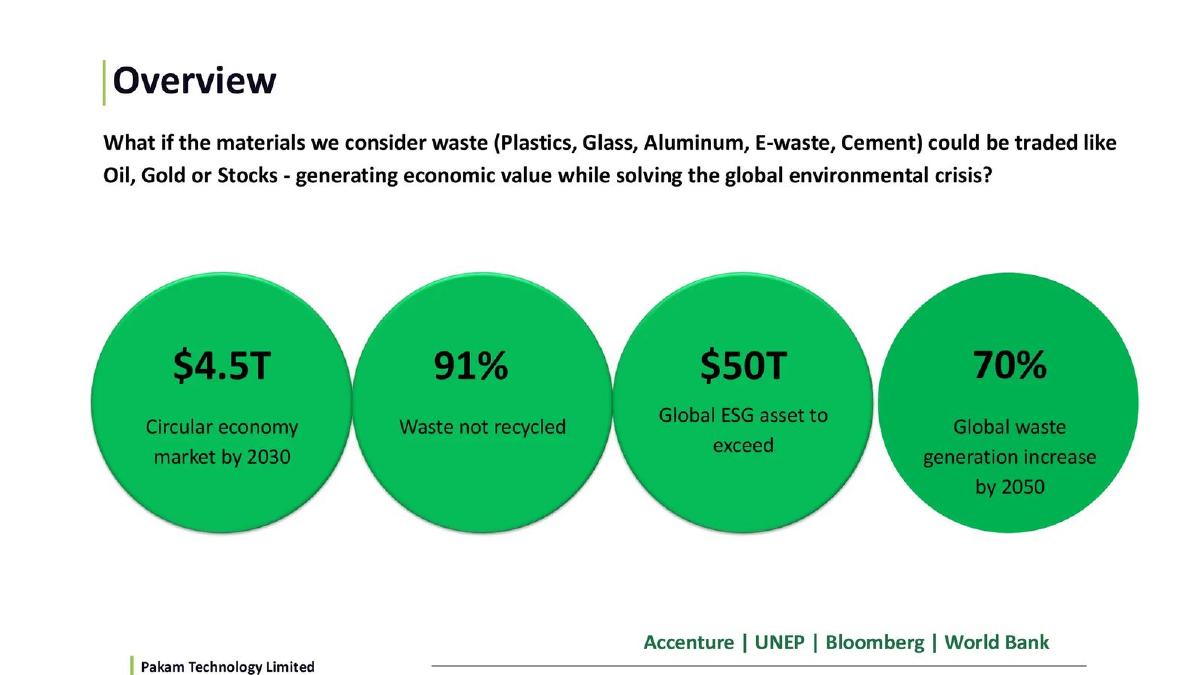
Slide 2 uses four large data points to establish the scale of the opportunity. It asks a rhetorical question: "What if the materials we consider waste... could be traded like Oil, Gold or Stocks?" The figures cited include a $4.5T circular economy market by 2030, a 91% rate of waste not recycled, $50T in global ESG assets, and a 70% projected increase in global waste generation by 2050. The slide successfully establishes a sense of urgency and massive scale, citing reputable sources like Accenture, UNEP, Bloomberg, and the World Bank.
Slide 3: The Problem Statement
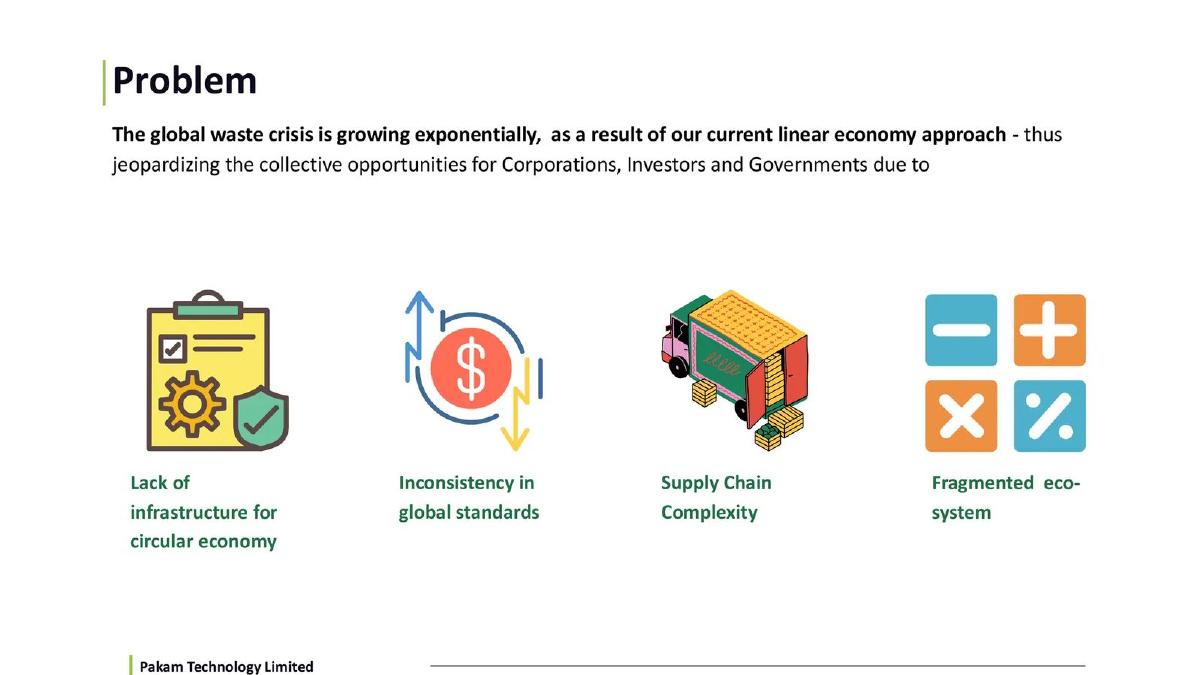
The problem is defined as a failure of the current "linear economy." Pakam identifies four specific hurdles: Lack of infrastructure for the circular economy, Inconsistency in global standards , Supply chain complexity , and a Fragmented ecosystem . By highlighting these four pillars, Pakam sets the stage for a solution that must be systemic rather than just a localized app.
Slide 4: Goal Focus - Impact Potential
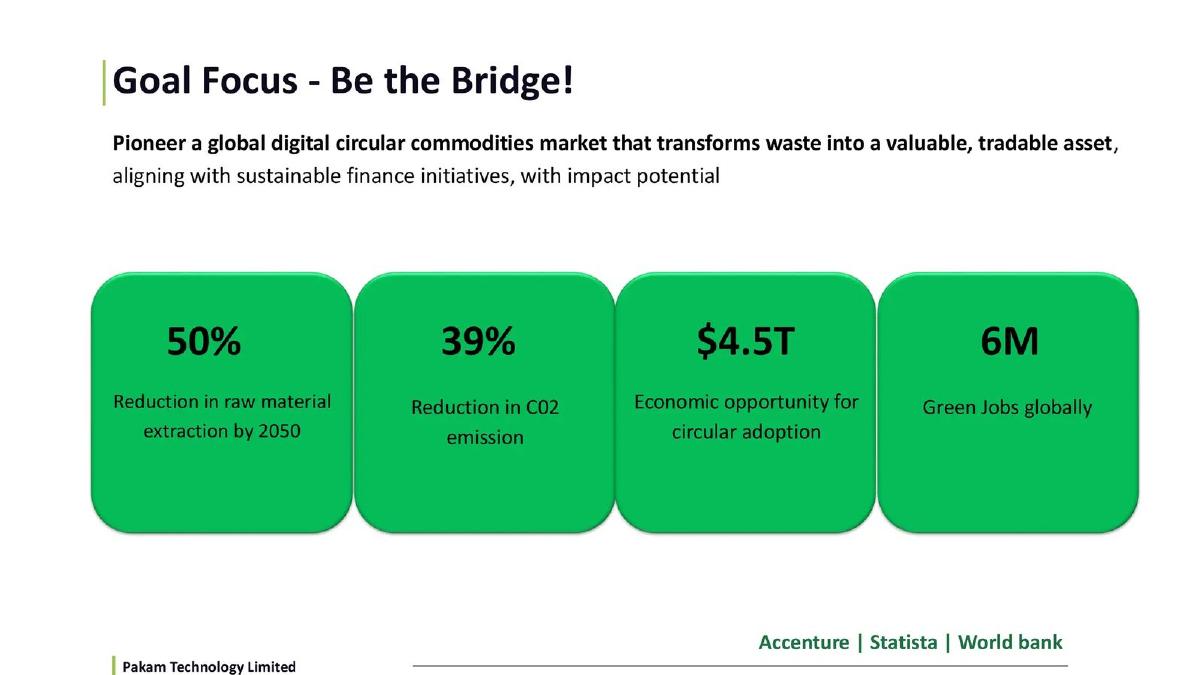
This slide transitions from the problem to the desired impact. It lists four key goals: a 50% reduction in raw material extraction by 2050, a 39% reduction in CO2 emissions , the $4.5T economic opportunity , and the creation of 6M green jobs globally. While these are high-level societal goals, they align the company's success with global sustainability targets, which is a common tactic for attracting ESG-focused investors.
Slide 5: The Solution and Business Model
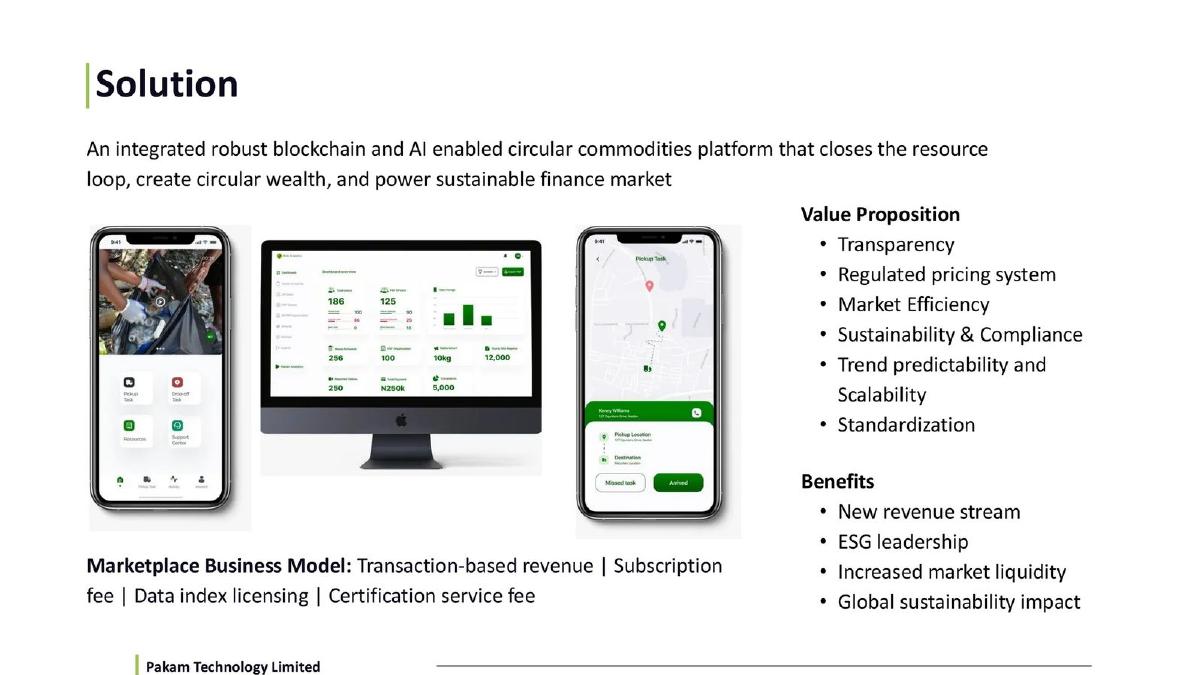
Slide 5 introduces the actual product: an "integrated robust blockchain and AI enabled circular commodities platform." The slide features mockups of a mobile app for pickup tasks and a desktop dashboard showing analytics such as "Total Users (186)," "PSP Drivers (125)," and "Total Payment (N250k)." Note: These numbers appear to be placeholder data in a mockup rather than live metrics, as they are very round and small. The slide also outlines the business model: Transaction-based revenue , Subscription fees , Data index licensing , and Certification service fees . The value proposition emphasizes transparency, regulated pricing, and market efficiency.
Slide 6: Market Justification - Plastics and Construction
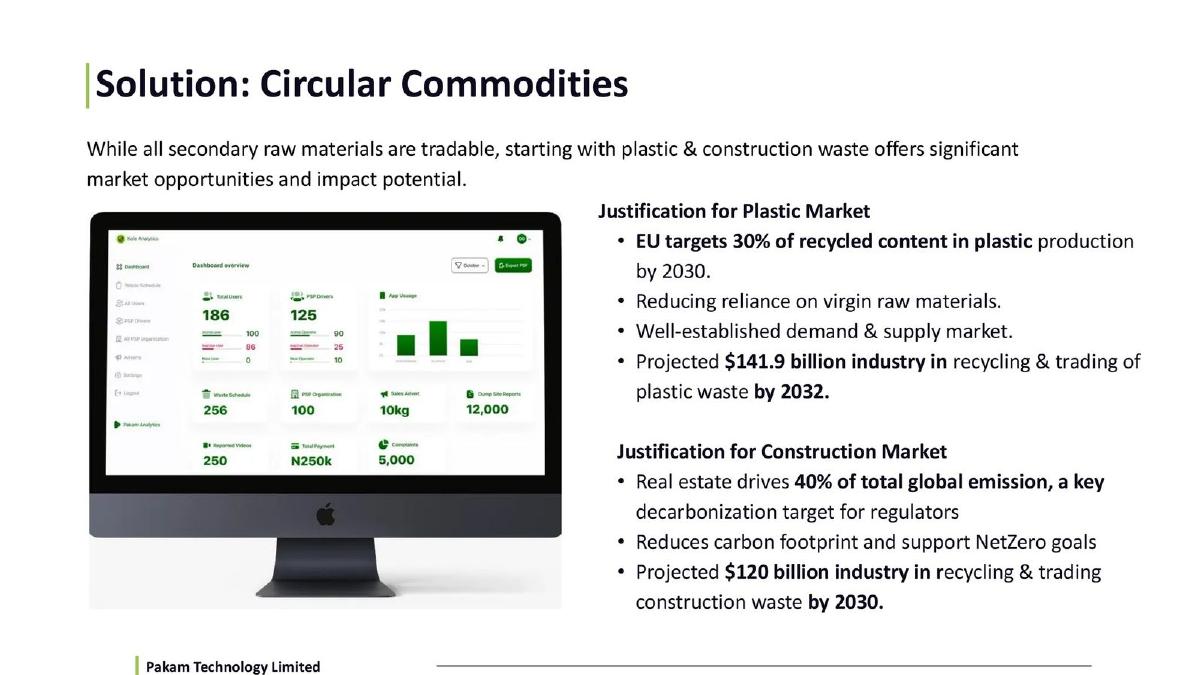
Pakam narrows its focus to two high-value verticals. For the Plastic Market , they cite a projected $141.9 billion industry by 2032 and EU mandates for 30% recycled content by 2030. For the Construction Market , they highlight that real estate drives 40% of total global emissions and project a $120 billion industry by 2030. This slide is crucial because it moves the deck from abstract concepts to specific, addressable markets with clear regulatory tailwinds.
Slide 7: The Deutsche Börse Partnership Vision
This slide is a flow chart titled "Vision - Deutsche Borse | Pakam Partnership." It breaks down the collaboration into Inputs, Activities, Outputs, and Outcomes. Inputs include the blockchain platform and capital. Activities involve tokenization of assets and data monitoring. Outputs include the creation of circular assets and incentive systems. The final Outcomes are global standardization, pricing stability, and real-time trading. This slide validates the company's ambition to be a financial market operator rather than just a software provider.
Slide 8: The Team
The team slide features three key members: Adeleye Odebunmi (CEO) with a B.Sc. in Sociology, Wunmi Ogunde (COO) with a Ph.D. in Sustainability, and James Anih (CTO) with a B.Sc. in Computer Science. They claim a combined 36 years of experience . The bottom of the slide displays logos of backing organizations, including CFA (Climate Finance Accelerator) , FMDQ , SCM Capital , and TechQuartier . This provides significant social proof, suggesting the company has already moved through several accelerator programs.
Slide 9: Conclusion
The final slide is a standard "Thank You" with contact details. It repeats the call to action: "Join Us in Pioneering the future of Circular Finance."
What Works in This Deck
Strong Strategic Partnership: The inclusion of Deutsche Börse Group throughout the deck provides immediate institutional credibility. For a startup trying to build a new commodities market, having a major exchange group as a partner is a massive competitive advantage.
Clear Market Segmentation: By focusing specifically on plastics and construction waste in Slide 6, the founders show they understand where the immediate regulatory pressure and financial value lie. They aren't trying to boil the ocean; they are targeting high-impact sectors.
Multi-Stream Revenue Model: The business model on Slide 5 is sophisticated. By including data index licensing and certification fees, they show an understanding of how to monetize the information generated by their platform, not just the physical transactions.
What Is Missing
The Ask: There is no slide detailing how much money the company is looking to raise, what the terms are, or how the funds will be allocated. This is a significant omission for a pitch deck intended for investors.
Traction and Metrics: While there are mockups with numbers, there is no slide dedicated to actual historical growth, current revenue, or volume of waste processed to date. Investors need to see the difference between a vision and a functioning business.
Competitive Landscape: The deck assumes a vacuum. It does not mention other waste-tech platforms or how Pakam differentiates itself from existing recycling marketplaces or carbon credit registries.
Founder Takeaways
Leverage Your Partners: If you have a partnership with a major industry player, make it central to your narrative as Pakam did with Deutsche Börse. It acts as a proxy for due diligence and market fit.
Connect Impact to Finance: Pakam does an excellent job of translating "saving the planet" into "market opportunity." Using terms like "circular wealth" and "tradable assets" speaks the language of the investors they are likely targeting.
Don't Forget the Basics: Even the most visionary deck needs a slide on competition and a clear funding ask. Without these, the deck functions more like a partnership proposal than a fundraising tool.
Frequently asked questions
- What is Pakam's core value proposition?
- Pakam aims to standardize and digitize the waste management sector to turn secondary raw materials into tradable commodities. By using blockchain and AI, they provide transparency, regulated pricing, and market efficiency. Their goal is to bridge the gap between physical waste collection and sustainable finance, allowing waste to be traded with the same liquidity and trust as traditional assets like stocks or gold.
- How does the partnership with Deutsche Börse Group function?
- According to Slide 7, the partnership focuses on creating a digitalized, transparent, and financially incentivized circular commodities marketplace. Deutsche Börse provides the financial infrastructure for 'Outcomes' like global standardization, pricing stability, and a unified platform for real-time trading. Pakam provides the 'Inputs' such as the integrated blockchain/AI platform and stakeholder engagement to feed the data and assets into this financial ecosystem.
- Which specific waste markets is Pakam prioritizing?
- While the platform is designed for all secondary raw materials, Slide 6 specifies that they are starting with plastic and construction waste. They justify the plastic market through EU targets for 30% recycled content by 2030. They justify the construction market by noting that real estate drives 40% of total global emissions, making it a primary target for decarbonization and carbon footprint reduction.
- What are the primary revenue drivers for the platform?
- The business model is multi-faceted, as shown on Slide 5. It includes transaction-based revenue (likely a percentage of trades), subscription fees for platform access, data index licensing (selling market insights), and certification service fees. This suggests the company views itself as both a marketplace operator and a data provider for the ESG and circular economy sectors.
- What critical information is missing from the pitch deck?
- The deck is notably missing a 'The Ask' slide, meaning there is no information on how much capital they are raising or the valuation. It also lacks a detailed financial slide showing historical revenue or burn rates. Furthermore, while it mentions 'Marketplace Business Model,' it does not provide unit economics (CAC, LTV) or a competitive analysis against other waste-tech or carbon credit platforms.