Halp’s pitch deck is a departure from standard venture presentations, opting for a document-style 'pitch memo' across seven slides. The company successfully raised $4M in 2024 by focusing on a massive, fragmented market: international student admissions. The deck highlights a waitlist growing at 45% month-over-month and a unique 'free for students' model that monetizes through downstream financial and learning products. By positioning themselves against high-fee, low-tech traditional agents, Halp emphasizes a scalable technology play. While the deck lacks a formal 'Ask' slide or detailed fina…
Key takeaways
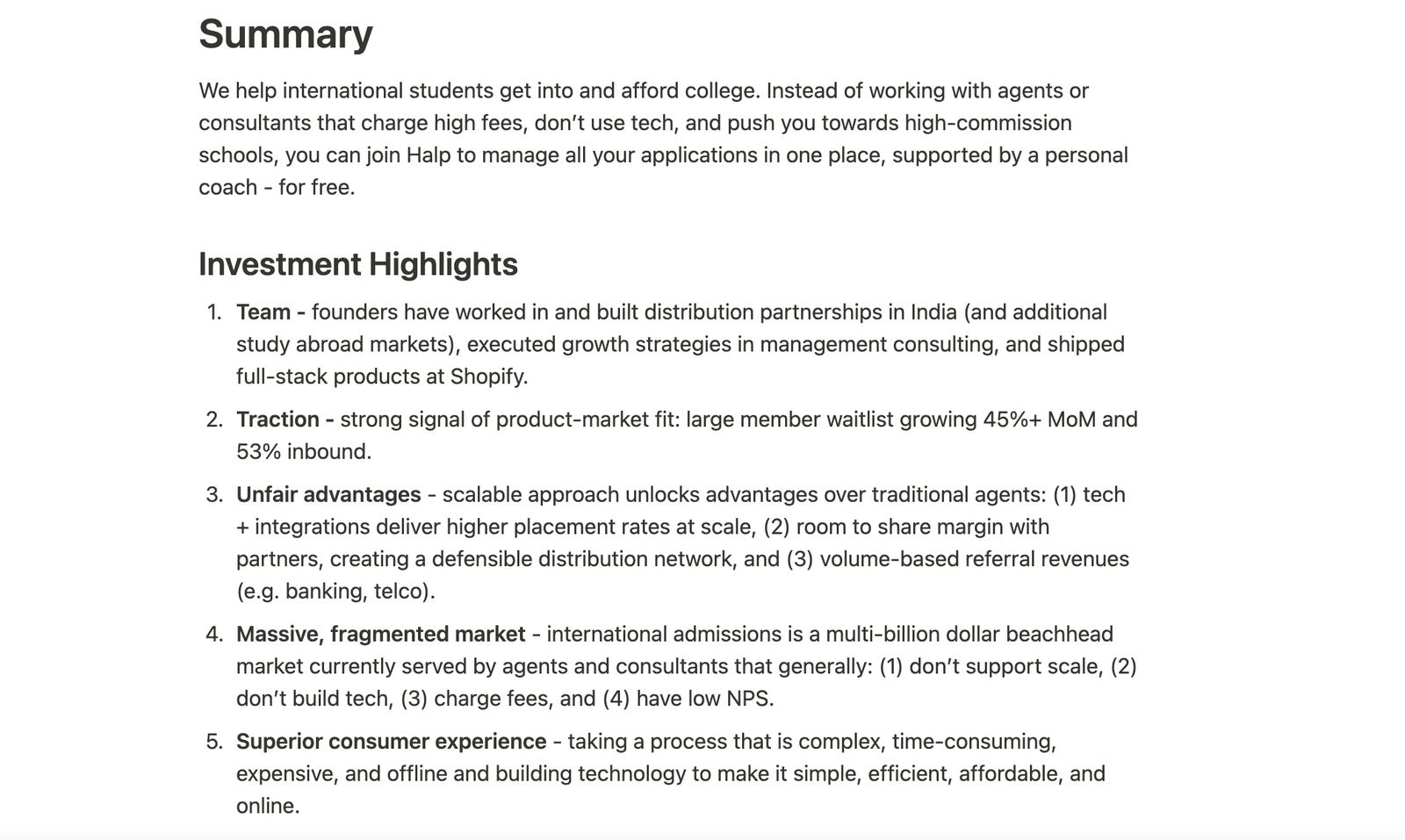
- The deck reports a member waitlist growing at 45%+ Month-over-Month (Slide 1).
- Halp identifies traditional agents as the primary competitors, citing their high fees and lack of technology (Slide 3).
- The platform is offered for free to students, with revenue generated through volume-based referrals in banking and telco (Slide 1).
- The founders leverage specific experience from Shopify and management consulting to validate their ability to ship full-stack products (Slide 1).
- The coaching app is built for scale, enabling a single coach to manage 300+ students simultaneously (Slide 6).
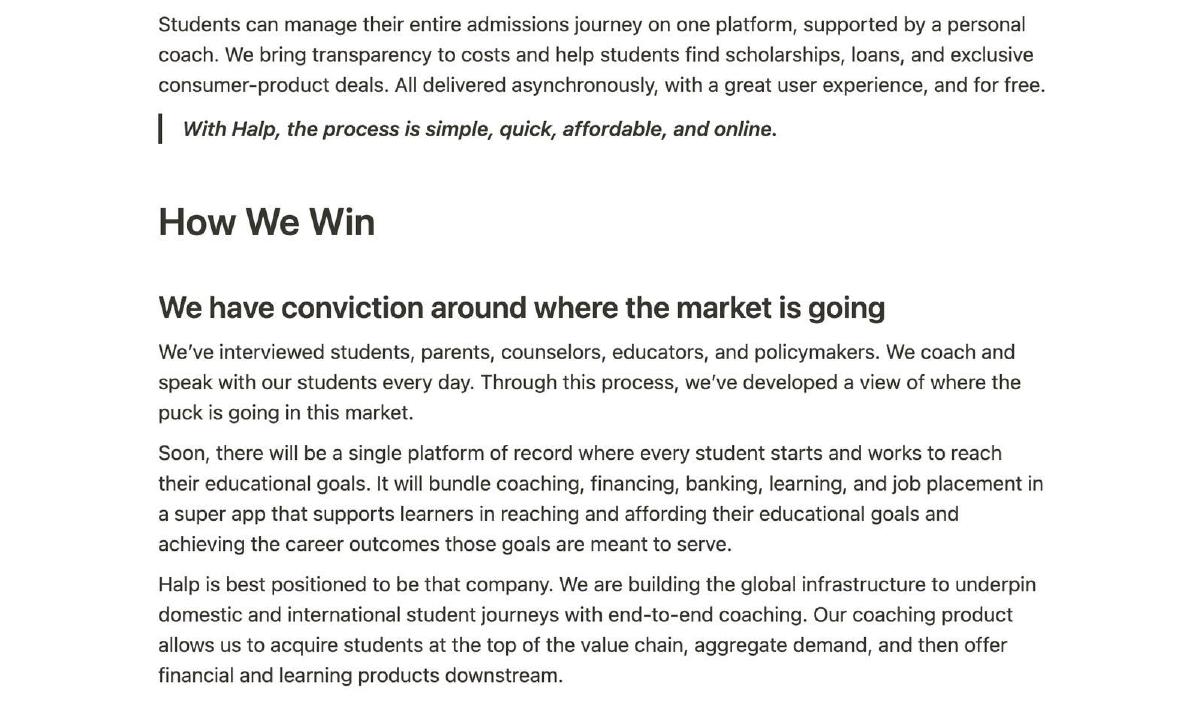
- Halp positions admissions as a 'beachhead' to eventually offer banking, financing, and job placement (Slide 5).
- The deck includes a functional UI mockup of a student dashboard featuring a task-based timeline and coach integration (Slide 4).
- Traction is further evidenced by the fact that 53% of their growth is inbound (Slide 1).
The Memo Format: A Strategic Choice for Seed Rounds
Halp’s pitch deck is not a deck in the traditional sense; it is a seven-slide pitch memo. In an era where visual storytelling often takes center stage, Halp opts for a text-heavy, document-style layout. This approach signals a focus on logic, market thesis, and clarity of thought. For a Seed round, this can be highly effective if the founders have the pedigree to back it up, as it forces the investor to engage with the business model rather than just the aesthetics.
Slide 1: Summary and Investment Highlights
The first slide acts as an executive summary. It immediately defines the value proposition: helping international students get into and afford college by replacing high-fee agents with a free, tech-supported personal coach. The slide lists five 'Investment Highlights' that serve as the foundation for the entire raise. Notably, it claims a member waitlist growing at 45%+ MoM and 53% inbound traffic. It also highlights the founders' backgrounds at Shopify and in management consulting, providing immediate technical and strategic credibility. The mention of 'volume-based referral revenues' in banking and telco provides a hint at the monetization strategy without needing a dedicated finance slide.
Slide 2: Halp Overview and Mission
This slide transitions from the 'what' to the 'why.' It frames education as a catalyst for socio-economic mobility and admits that access is currently unequal. The 'Now is the best time to act' section provides the market context: post-COVID conditions where colleges have lower marketing budgets but a higher reliance on international students. This creates a supply-demand gap that Halp intends to fill. It is a standard 'Why Now' slide, but presented in prose rather than bulleted graphics.
Slide 3: The Problem Statement
Slide 3 identifies the 'enemy' in the market: traditional agents. Halp characterizes these agents as independent, small-scale firms that lack technology and have misaligned incentives (pushing high-commission programs). The slide uses strong language, stating that 'everyone has a hand in their [the student's] pocket.' By framing the current process as 'complex, time-consuming, expensive, and offline,' Halp sets the stage for its digital-first, free solution.
Slide 4: The Solution and Product Interface
This is the only slide in the deck featuring a high-fidelity visual. It shows the 'Halp Student Dashboard,' which includes a to-do list (Create a school list, Apply for your Visa, Prepare applications), a timeline, and a direct link to a coach named David. The UI is clean and mirrors modern SaaS platforms, reinforcing the 'tech-enabled' claim made in the highlights. It demonstrates that the product is not just a concept but a functional tool that manages the 'entire admissions journey.'
Slide 5: How We Win and Market Conviction
This slide outlines the long-term vision. Halp isn't just an admissions tool; they are building a 'super app' for students. The text describes a 'single platform of record' that bundles coaching, financing, banking, and job placement. This is a crucial slide for venture investors because it moves the company from a niche service to a potential platform play. The strategy is to 'acquire students at the top of the value chain' (admissions) and then monetize through 'financial and learning products downstream.'
Slide 6: Progress to Date
Slide 6 breaks down the current state of the technology. It reveals that there are two apps: one for students and one for coaches. A key efficiency metric is buried here: the coaching app allows each coach to work with 300+ students. This is a vital data point for scalability, as it proves the model isn't just a 1:1 service business. The slide also mentions features like a school list builder and a workbook for completing activities.
Slide 7: Social Proof and User Testimonials
The final slide is dedicated to 'Happy Users.' It features quotes from students in Brazil, India, and Canada. While testimonials are standard, these specific quotes validate the 'end-to-end' claim by mentioning documentation, visa support, and interest discovery. It serves as qualitative evidence to support the quantitative growth metrics mentioned on Slide 1.
What Works in the Halp Deck
The most compelling aspect of this deck is its clarity of monetization . Many ed-tech startups struggle to explain how they will make money if the service is free. Halp explicitly states they are aggregating demand to sell high-value financial products (banking, loans) later. This 'Trojan Horse' strategy is a favorite among VCs because it solves the high Customer Acquisition Cost (CAC) problem common in fintech by using a high-utility, free tool as the entry point.
The efficiency metrics are also a standout. Stating that a coach can handle 300+ students (Slide 6) immediately addresses the concern that this is a non-scalable service business. It suggests that the 'tech' in 'tech-enabled' is doing the heavy lifting, allowing for high gross margins as the company scales.
What is Missing from the Halp Deck
Despite raising $4M, the deck is remarkably thin on financial data . There are no projections, no breakdown of the current burn rate, and no mention of the specific unit economics of a referral. While they mention 'volume-based referral revenues,' they don't disclose if they have already booked revenue or if this is purely theoretical.
The competitive landscape is also simplified. By only focusing on 'traditional agents,' Halp ignores other well-funded ed-tech competitors in the international student space. Investors usually want to see how a startup sits relative to other venture-backed players, not just the 'old way' of doing things.
Finally, the lack of an 'Ask' slide is a significant omission. A pitch deck is a tool to facilitate a transaction; failing to state how much capital is being sought and what the milestones for that capital are (e.g., reaching X number of students or launching the banking product) leaves the narrative unfinished.
Founder Takeaways: Copy the Strategy, Not the Omissions
Founders should look at Halp as a masterclass in pedigree-based pitching . If you have worked at a company like Shopify and have deep domain expertise, you can afford to use a memo format because your background provides the 'proof' that you can build. The memo format allows you to build a dense, logical argument that a slide full of icons might dilute.
However, founders should be cautious about omitting the 'Ask' and the 'Team' details. Halp likely had these in a separate document or discussed them in person, but for a cold outreach deck, these are essential. The 'super app' vision on Slide 5 is the most important slide for any founder to emulate; it shows that you aren't just building a tool for today, but an ecosystem for tomorrow.
Frequently asked questions
- What is the business model if the service is free for students?
- According to Slide 1, Halp generates revenue through volume-based referral fees from partners in sectors like banking and telecommunications. Slide 5 further explains that they use free coaching as a top-of-funnel acquisition tool to aggregate demand, allowing them to cross-sell financial and learning products downstream once the student is in their ecosystem.
- How does Halp differentiate itself from traditional education consultants?
- Slide 3 argues that traditional agents are 'broken' because they push students toward high-commission programs, lack technology, and charge high fees. Halp differentiates by offering a tech-enabled, transparent, and free platform that provides end-to-end support, including visa assistance and scholarship discovery, as noted on Slide 5.
- What specific traction metrics did Halp share in this deck?
- Halp shared three primary traction signals on Slide 1: a member waitlist growing at 45%+ month-over-month, a 53% inbound lead rate, and the internal efficiency metric that their coaching app allows one coach to manage over 300 students (Slide 6).
- Who are the founders and what is their background?
- While the deck does not list individual names, Slide 1 states the founders have experience building distribution partnerships in India, executing growth strategies in management consulting, and shipping full-stack products at Shopify. This combination of market-specific knowledge and technical execution at scale is presented as a core 'Investment Highlight'.
- What is missing from this pitch deck?
- The deck is missing several standard venture components: a specific 'Ask' slide detailing how much they are raising, a slide dedicated to the current team with names and photos, a detailed competitive landscape map, and a financial forecast or unit economics breakdown. It functions more as a high-level strategic memo than a comprehensive data room.