Waterplan's pitch deck is a masterclass in establishing authority through scientific validation. Raising $7M in 2022, the startup addressed the 'Water Crisis' not just as an environmental issue, but as a $425 billion financial risk. The deck stands out for its deep bench of advisors—including experts from NASA and the UN—and its early success in landing 10 Fortune 500 customers. While it lacks traditional financial projections or a specific use-of-funds slide, it compensates with high-fidelity product screenshots that demonstrate a ready-to-scale SaaS platform. The narrative focuses on moving…
Key takeaways
- The deck identifies a $425 billion financial value at risk due to water-related issues on slide 2.
- Waterplan leverages Y Combinator branding on every single slide to build immediate investor trust.
- The team slide (slide 3) features 12 individuals, including high-profile advisors from Microsoft, Coca-Cola, and NASA.
- Early traction is proven on slide 4, stating that 10 Fortune 500 companies already use the platform.
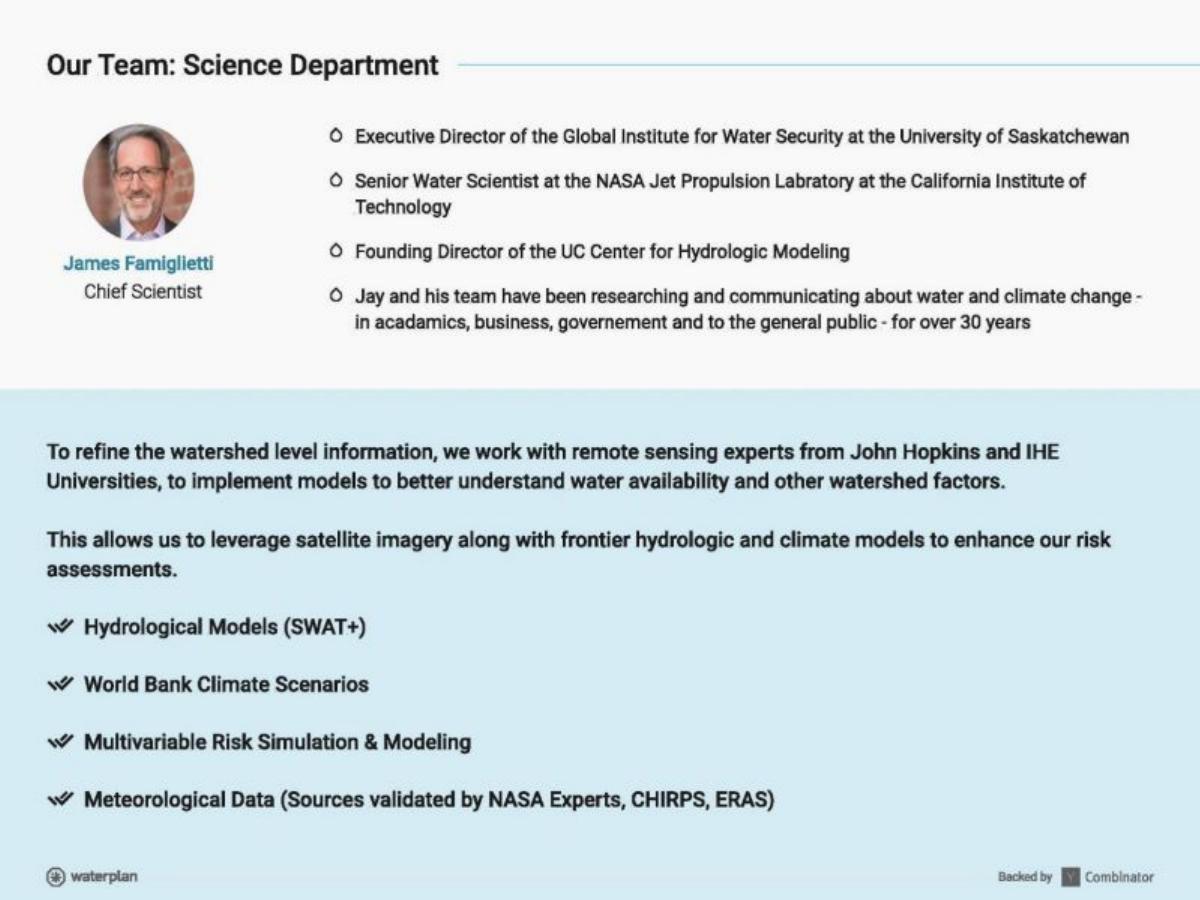
- Scientific credibility is anchored by Chief Scientist James Famiglietti, a former NASA Senior Water Scientist (slide 5).
- The product is positioned as a tool for compliance, specifically mentioning alignment with CDP reporting standards on slide 7.
- The deck utilizes four distinct 'Platform Features' slides (7, 8, 10, 11) to showcase UI and specific use cases.
- A 'Waterplan Difference' slide (slide 9) highlights automated reporting and risk quantification as competitive moats.
The Narrative: From Environmental Crisis to Financial Risk
Waterplan’s 14-slide deck is a highly professional, clinical presentation that avoids the emotional pleas often found in climate tech. Instead, it focuses on the financial imperative of water management. By the second slide, the company has already established a massive dollar-denominated problem, and by the third, they have presented a team that looks more like a global task force than a typical startup. This teardown examines how they used scientific authority to close their $7M Seed round.
Slide 1: Title and Value Proposition
The cover slide is minimalist, featuring the company logo and the tagline: Reduce Your Water Risk. Boost Business Resilience. The focus on "resilience" is a key strategic choice; it speaks to the C-suite's desire for stability rather than just corporate social responsibility. Notably, the Y Combinator logo is placed in the bottom right corner, a badge of quality that remains present on every subsequent slide.
Slide 2: The Water Crisis as a Financial Liability
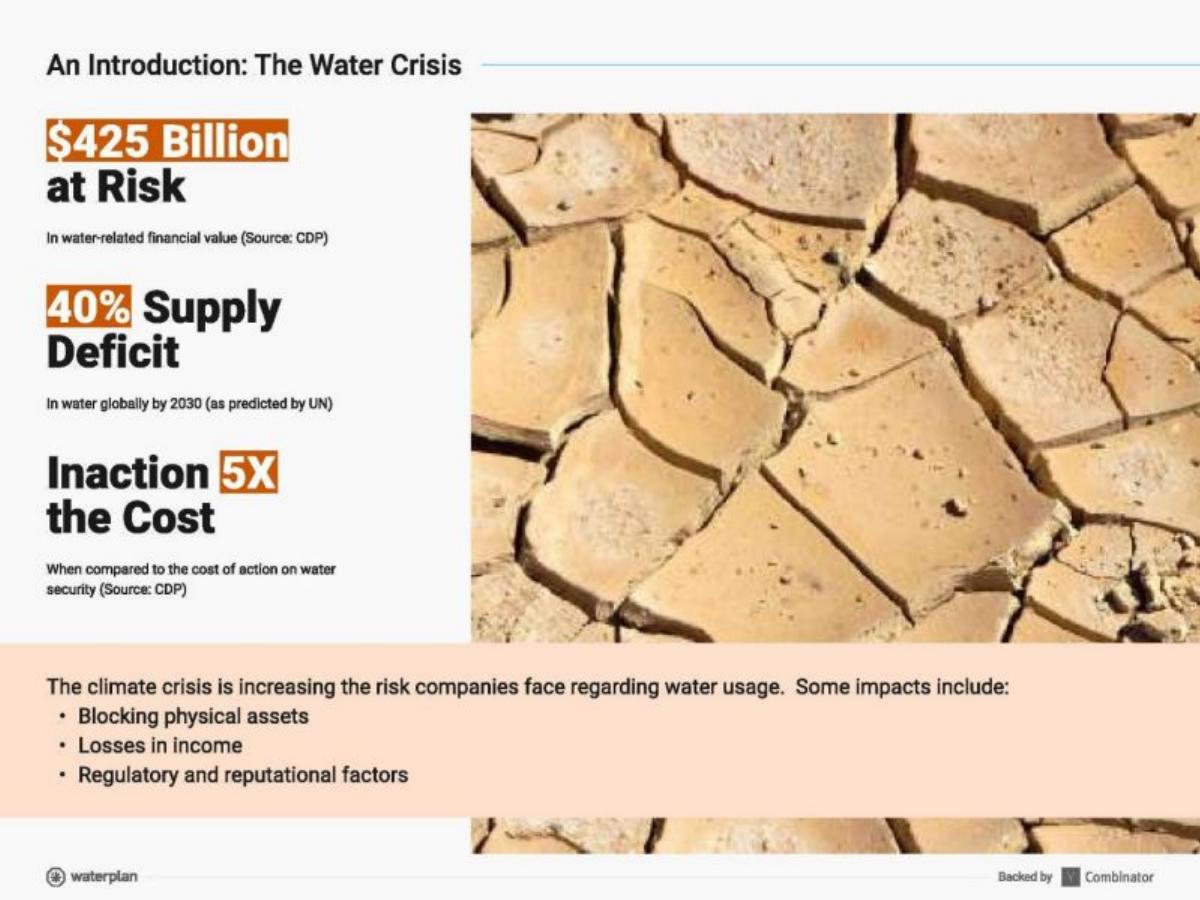
Waterplan defines the market problem through three heavy-hitting statistics. They cite a $425 Billion at Risk in water-related financial value (Source: CDP) and a 40% Supply Deficit predicted by the UN for 2030. The most compelling argument for a CFO is the claim that Inaction [is] 5X the Cost of action. This slide successfully transitions water from an ESG (Environmental, Social, and Governance) concern to a direct threat to physical assets and income.
Slide 3: The Core Team and Advisors
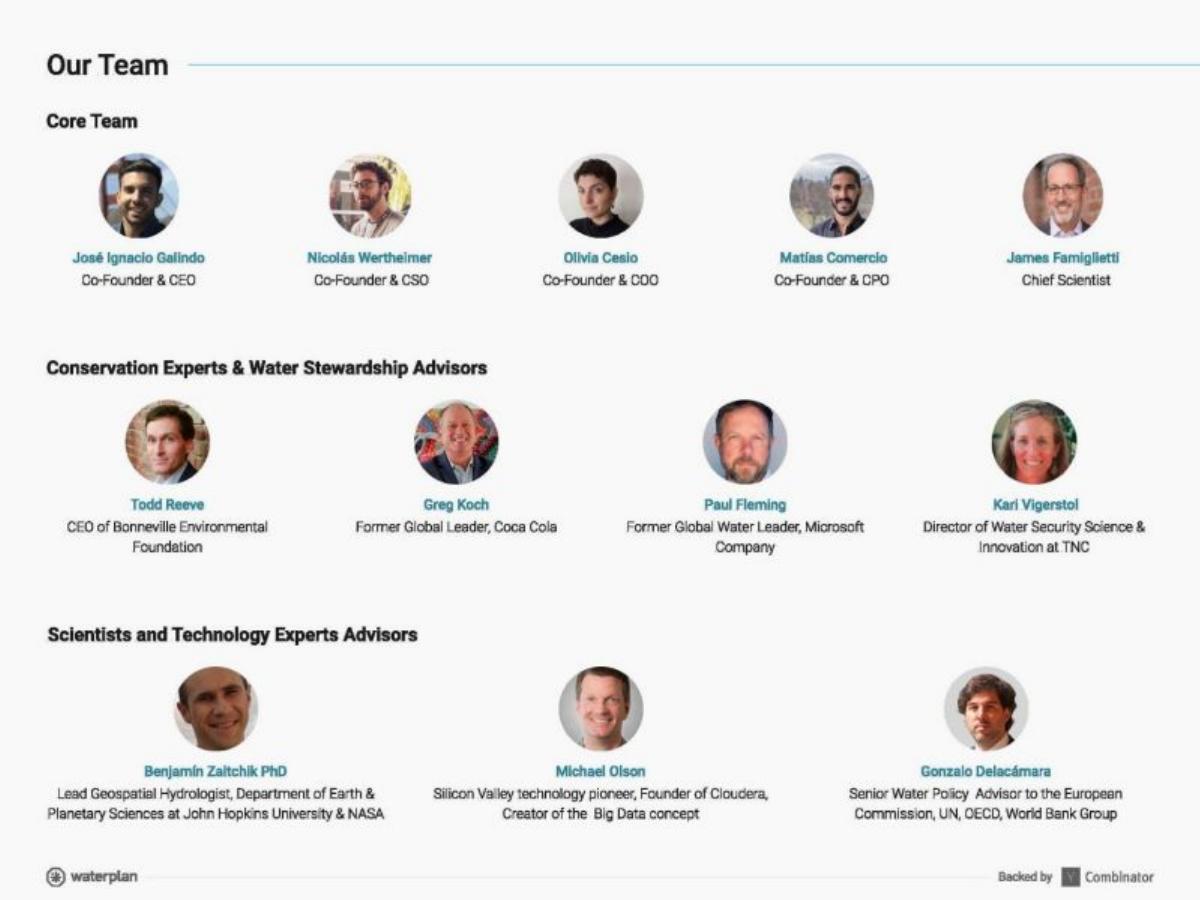
This is one of the most crowded team slides in recent memory, but for a science-heavy startup, the density works in their favor. It lists five core team members and seven advisors. The advisors are not just names; they are strategic anchors from organizations like Coca-Cola, Microsoft, The Nature Conservancy (TNC), and NASA . Including Michael Olson, the founder of Cloudera and "creator of the Big Data concept," provides the necessary software credibility to balance the environmental science.
Slide 4: Social Proof and Traction
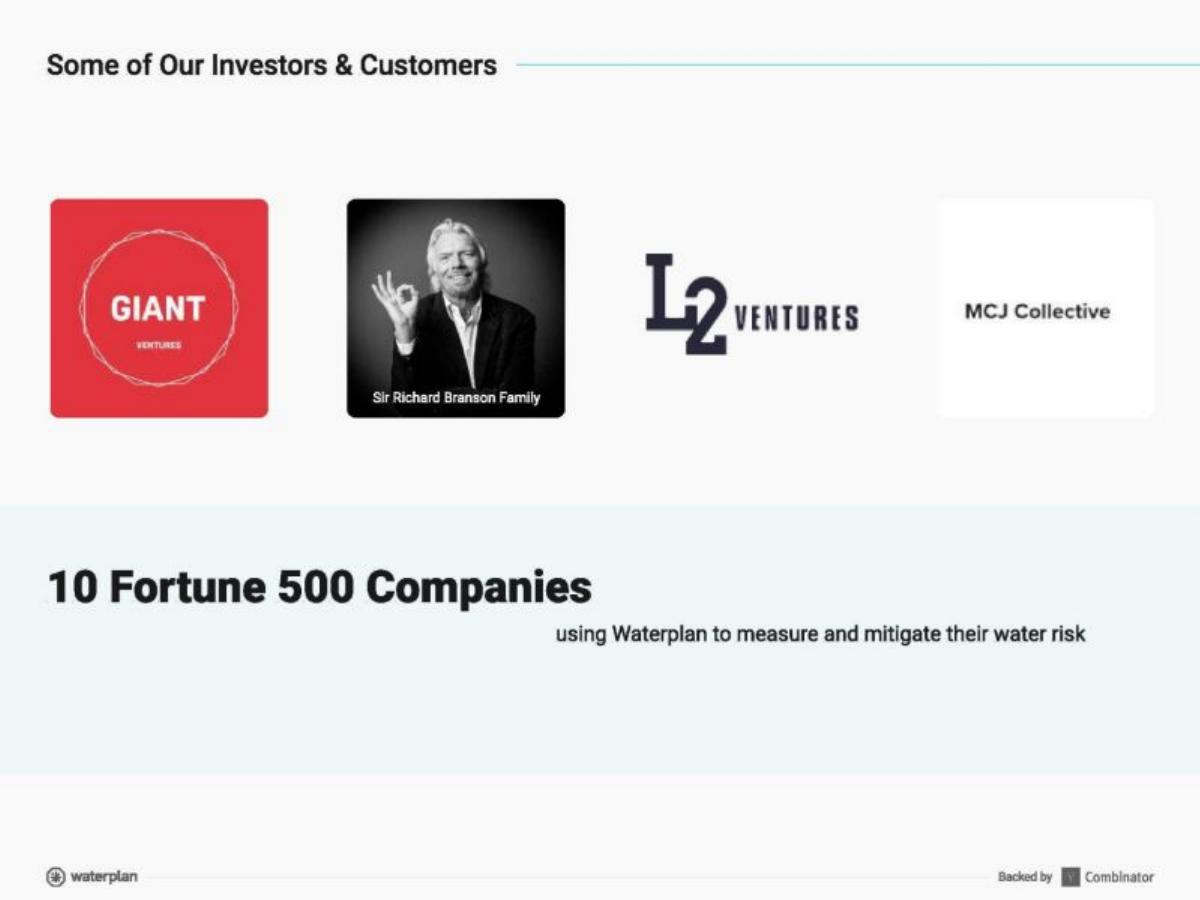
Slide 4 is a "trust" slide. It combines high-profile investors (Giant Ventures, Sir Richard Branson Family) with a significant traction metric: 10 Fortune 500 Companies are already using the platform. While the slide does not name the companies, the scale of the customers at such an early stage (Seed) suggests a strong product-market fit for the enterprise level.
Slide 5: Scientific Deep Dive
Waterplan doubles down on its technical moat here. They highlight James Famiglietti , their Chief Scientist, noting his 30-year career including roles at NASA’s Jet Propulsion Laboratory. The slide lists the specific models and data sources used, such as SWAT+ hydrological models and CHIRPS meteorological data . This slide is designed to preempt any technical due diligence questions regarding the accuracy of their risk assessments.
Slide 6: The Platform Overview
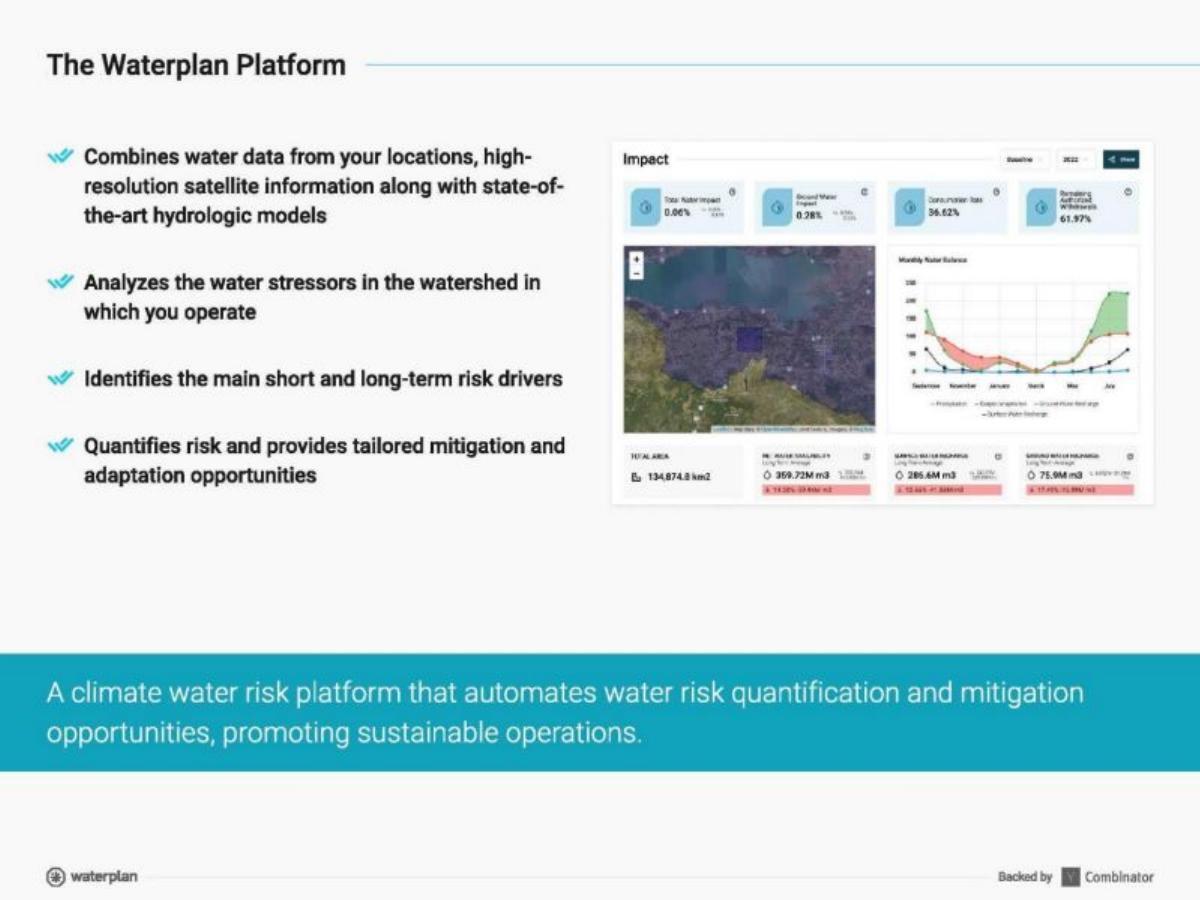
This slide introduces the first product screenshot. It describes the platform's ability to combine local data with satellite imagery and hydrologic models. The value proposition is summarized at the bottom: "A climate water risk platform that automates water risk quantification and mitigation opportunities." The UI shown is clean, data-rich, and looks like a modern enterprise dashboard.
Slide 7: Global Risk & Resiliency
Slide 7 focuses on the macro view. It shows a map-based interface that identifies risk at both operational and supplier sites. A key detail here is the mention of CDP reporting standards . By aligning their output with existing global reporting frameworks, Waterplan positions itself as a "must-have" for compliance rather than a "nice-to-have" for internal monitoring.
Slide 8: Water Resilience Planning
This slide moves from observation to action. It shows a risk matrix (Magnitude of Financial Impact vs. Likelihood) for specific locations, such as Santiago. The text highlights financial qualification algorithms , reinforcing the idea that this software translates environmental data into the language of the balance sheet.
Slide 9: The Waterplan Difference
This is a traditional "Why Us" slide. It lists four differentiators: constantly updated models, short & long-term projections, tailored mitigation, and automatic reporting . While it lacks a direct competitor comparison chart, the emphasis on "automatic reporting" suggests their main competitor is likely manual spreadsheets or expensive one-off consulting engagements.
Slide 10: Impact & Accounting
The deck returns to the product UI to show the "Impact" tab. This screen tracks KPIs like Consumption Rate, Ground Water Impact, and Remaining Authorized Withdrawals . This level of granularity is intended to show that the platform is not just a high-level modeling tool but a day-to-day operational utility for facility managers.
Slide 11: Scenario Modeling
Slide 11 showcases the "Opportunity Report." It includes an Estimated ROI of potential risk mitigation . Showing a screenshot with a specific "Estimated Cost of Response" ($50K) and an ROI calculation demonstrates that the software helps users build a business case for water-saving infrastructure projects.
Slide 12: Platform Overview Summary
This slide acts as a recap, categorizing the platform into three pillars: Stressors Sensing, Water Resilience Planning, and Reporting . It’s a clean summary that helps the investor internalize the three main ways the company generates value.
Slide 13: Conclusion
The final slide returns to the imagery of the first, with the mission statement: Accelerating the transition to a Water-Secure World. It is a standard "Thank You" slide that maintains the brand's visual consistency.
What Waterplan Does Well
Scientific Authority: The inclusion of a Chief Scientist with NASA credentials and a founder of Cloudera as an advisor creates an "unbeatable" team narrative for a data-driven climate startup.
Financial Framing: By consistently using terms like "Value at Risk," "ROI," and "Financial Impact," Waterplan avoids the trap of being seen as a non-profit or a low-priority ESG tool.
Enterprise Readiness: The product screenshots are sophisticated and clearly designed for large-scale corporate use. Mentioning 10 Fortune 500 customers at the Seed stage is an incredibly strong signal of sales execution.
What Is Missing from the Deck
Business Model: There is no mention of how Waterplan makes money. While we can infer it is a SaaS model from the catalogue facts, the deck doesn't disclose pricing structures, seat costs, or implementation fees.
The Ask: The deck does not state how much money is being raised or how the funds will be used. While this is common for "clean" versions of decks, it leaves the investor without a sense of the company's immediate capital needs or milestones.
Competition: There is no competitive landscape slide. Investors would want to know how Waterplan stacks up against established environmental consulting firms or other emerging climate-risk platforms like Jupiter Intelligence or Cervest.
What Other Founders Should Copy
The "Trust Bar": Placing the Y Combinator logo (or any top-tier accelerator/investor logo) on every slide is a subtle but effective way to maintain a baseline of credibility throughout the pitch.
Specific Data Sources: Don't just say you use "AI" or "Big Data." Waterplan lists specific models (SWAT+) and data sources (NASA, World Bank). This specificity prevents the technical slides from feeling like marketing fluff.
Outcome-Oriented Screenshots: Instead of just showing a login page or a settings menu, Waterplan shows the "Opportunity Report" and the "Financial Impact" matrix. They show the exact screen that provides the most value to the end-user.
Frequently asked questions
- How much did Waterplan raise with this deck?
- According to the catalogue facts, Waterplan raised $7 million in a Seed round in 2022. The deck itself does not state the amount being raised, which is common for decks shared publicly after a round closes.
- Who are Waterplan's key investors?
- Slide 4 lists Giant Ventures, L2 Ventures, MCJ Collective, and the Sir Richard Branson Family as investors. The deck also prominently displays the Y Combinator logo on every slide, indicating their participation in the accelerator.
- What is the core problem Waterplan solves?
- Slide 2 defines the problem as a 'Water Crisis' involving a 40% supply deficit by 2030. It frames this as a business problem where 'Inaction [is] 5X the Cost' of taking action, leading to losses in income and regulatory risks.
- What scientific data does the platform use?
- As detailed on slide 5, the platform integrates hydrological models (SWAT+), World Bank climate scenarios, and meteorological data validated by NASA experts, CHIRPS, and ERA5.
- Does the deck include a business model or pricing?
- No. The deck describes the product as a B2B Enterprise SaaS platform but does not provide specific pricing tiers, average contract values (ACV), or sales cycle lengths.