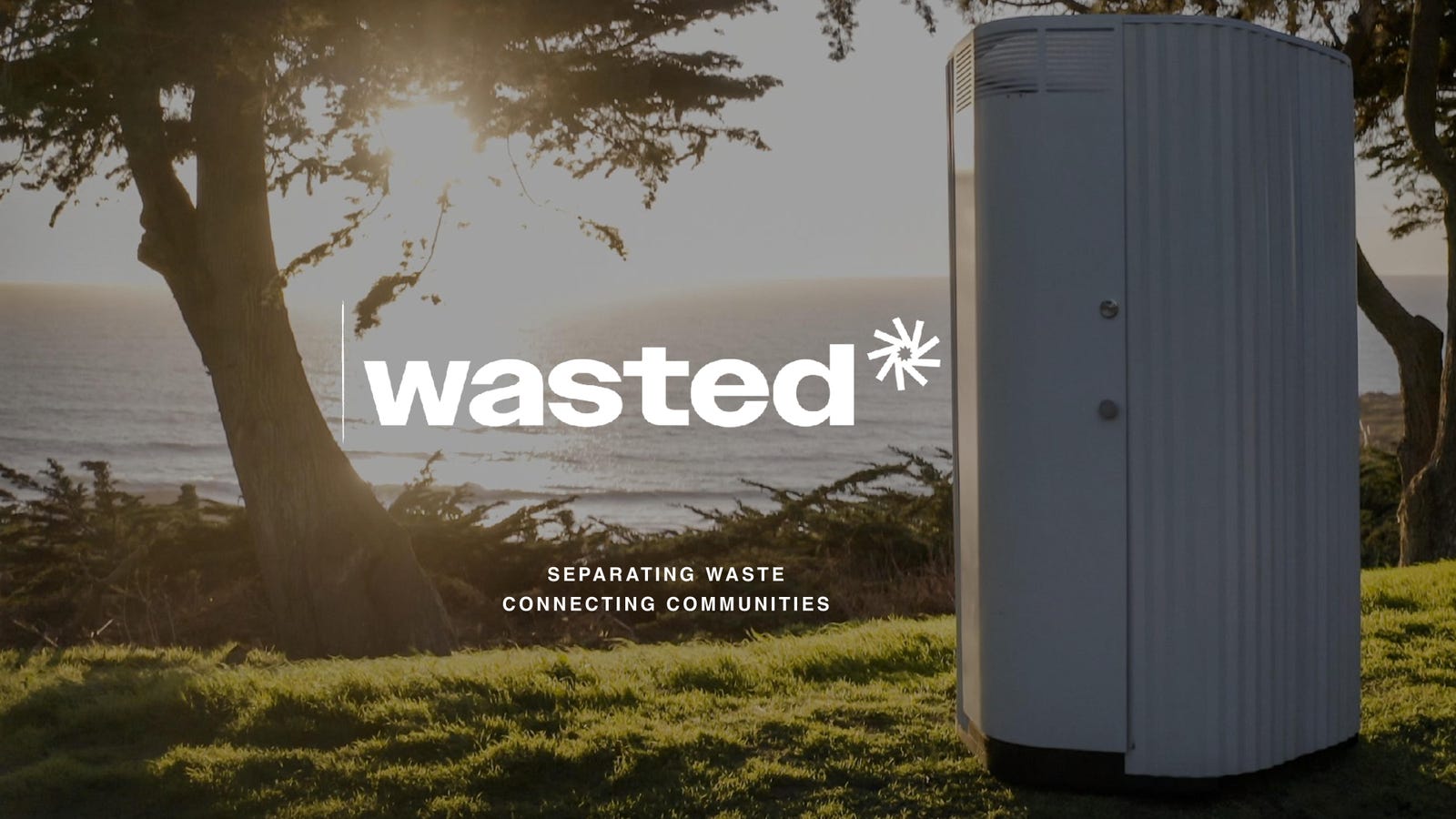
Wasted’s 17-slide deck is a masterclass in narrative-driven climate tech fundraising. By identifying a specific biological inefficiency—the mixing of liquid and solid human waste—the company positions itself as both a hardware innovator and a circular economy play. The deck successfully bridges the gap between a 'universally-hated' service (portable toilets) and a high-value commodity market (fertilizer). While the deck is light on specific unit economics and competitive landscape details, it leans heavily on the massive total addressable market across sanitation ($17B), fertilizer ($171B), a…
Key takeaways
- The core problem is defined as the intentional mixing of human pee and poo, which creates energy-intensive sludge (Slide 3).
- Wasted identifies a $13.6B annual value for nutrients currently trapped in urban wastewater streams (Slide 5).
- The beachhead market is portable sanitation, chosen because it is fragmented, antiquated, and disconnected from sewers (Slide 7).
- The 'wasted*hub' acts as a decentralized alternative to treatment plants, recovering 95% of water and producing NPK fertilizer (Slide 9).
- Construction is the primary anchor segment, representing 59% of the market (Slide 11).
- The deck targets three massive global markets: $17B in portable sanitation, $171B in fertilizer, and $280B in wastewater treatment (Slide 13).
- The team consists of five core members, including three co-founders and a CTO (Slide 15).
- The deck omits a specific financial 'Ask' slide and detailed unit economics for the processing hubs.
Introduction: The Circular Economy of Sanitation
Wasted entered the market with a bold proposition: human waste is not a liability to be disposed of, but a resource to be harvested. According to publisher reports from Business Insider, the company raised $7.5M in a Seed round in 2024. Based in North America and operating within the social impact and climate tech sectors, Wasted uses a 17-slide deck to explain how decentralized sanitation can solve massive inefficiencies in the global fertilizer and wastewater industries.
Slide 1-2: Branding and Visual Identity
The deck opens with a high-resolution, lifestyle-oriented image of their modular unit placed in a scenic, coastal environment. The tagline, "Separating Waste, Connecting Communities," immediately establishes the dual mission of the company: technical innovation (separation) and social impact (community). The branding is minimalist, using a clean sans-serif font and a sunburst-style logo that evokes a sense of circularity and energy.
Slide 3: A Bad Combination
Slide 3 defines the problem with a provocative hook: "Humans are the only mammals that intentionally mix their pee & poo." This slide identifies the core technical failure of modern sanitation. By mixing liquids and solids, we create a "sludge" that is described as "energy-intensive, expensive & unsustainable to process." This sets the stage for a solution based on source separation rather than downstream treatment.
Slide 4-5: Closing the Loop
Slide 5 introduces the economic opportunity of the circular economy. It notes that human waste is "packed with nitrogen, phosphorous, and potassium," the essential building blocks of fertilizer. The key metric on this slide is a boxed figure of "$13.6B," representing the "annual value of the nutrients in urban wastewater streams." This transition from a biological problem to a multi-billion dollar resource recovery opportunity is a classic venture capital narrative arc.
Slide 6-7: The Beachhead Market
Wasted identifies portable sanitation as their entry point. Slide 7 lists four reasons why this segment is "most ripe for transformation" : it is a "universally-hated product," utilizes "antiquated operations," is "fragmented and unconsolidated," and is "disconnected from sewers." By targeting portable toilets, Wasted avoids the massive capital expenditure required to retrofit existing municipal sewer infrastructure, allowing for faster iteration and deployment.
Slide 8-9: The Wasted Hub
Slide 9 explains the technical solution: the "wastedhub." This is described as a "sustainable & decentralized alternative to a wastewater treatment plant." The slide uses a simple flow diagram to show inputs and outputs. Inputs include separated pee and solids, agriculture and food waste, and renewable energy. Outputs include "NPK fertilizer," "Class-A biosolids," "95% recovered water," and the elimination of "nutrient pollution." This slide is crucial because it moves the company beyond being a 'toilet manufacturer' and into the realm of a 'decentralized utility.'
Slide 10-11: Anchor Customer Segment
Wasted focuses on the construction industry as its primary customer base. Slide 11 notes that construction is the "largest segment in the market (59%)" and offers a "dense concentration of customers in cities." The slide mentions "pilot projects with industry-leading construction companies," though it does not name specific partners. This focus on a high-volume, B2B segment suggests a clear path to scale and predictable revenue.
Slide 12-13: The Macro Market Opportunity
Slide 13 provides a comprehensive breakdown of the addressable markets. It splits the opportunity into three pillars:
Portable Sanitation: $17B global market, $2.1B US market. · Fertilizer Market: $171B global market, $83B US market, and $12B for organic fertilizer. · Wastewater Treatment: $280B global market, with $17.6B specifically for "global packaged, decentralized sanitation technology."
This slide effectively communicates that while the company starts with toilets, the ultimate goal is to capture value across the entire waste-to-commodity value chain.
Slide 14-15: The Wasted Team
The team slide (Slide 15) features five individuals. The co-founding trio consists of Thor Retzlaff (CMO) , Taylor Zehren (COO) , and Brophy Tyree (CEO) . They are supported by Abigail Cohen (CTO) and Bill Miles (Corporate Development) . The slide uses the header "Making Sanitation Sexy," which reflects the brand's attempt to bring modern design and marketing to a traditionally overlooked industry. However, the slide lacks professional bios or logos of previous companies/universities, which is a common omission in Seed-stage decks that rely more on vision than pedigree.
Slide 16-17: Conclusion
The deck concludes on Slide 17 with a quote from Julia Cavicchi: "Pee the change you wish to see in the world." This play on the famous Gandhi quote reinforces the company's mission-driven approach and maintains the lighthearted yet serious tone established throughout the presentation.
What Wasted Does Well
The Wasted deck excels at problem framing . By focusing on the biological inefficiency of mixing waste streams, they make the current multi-billion dollar sanitation industry look fundamentally broken. This creates an immediate "why now" and "why this" for investors. The visual design is also a significant asset; the photography of the units makes the product look like high-end consumer hardware rather than industrial equipment.
Furthermore, the market segmentation is logical. By identifying construction as 59% of the portable toilet market, they show they aren't just chasing small events or festivals, but are targeting the heavy-duty, high-utilization core of the industry. The inclusion of the $13.6B nutrient value figure (Slide 5) is a brilliant way to anchor the company's valuation in resource recovery rather than just service fees.
What is Missing from the Deck
Despite raising $7.5M, the deck has several notable omissions that would typically be expected in a Seed round. First, there is no explicit 'Ask' slide . While we know from publisher reports that they raised $7.5M, the deck itself does not state the amount sought or the intended use of funds. This suggests this version of the deck may have been used for initial interest or that the 'Ask' was handled in a separate document or conversation.
Second, there is a lack of unit economics . Investors in hardware-enabled service businesses usually want to see the cost to build a unit, the service revenue per month, and the margin on the fertilizer produced. Slide 9 mentions the outputs, but does not attach a dollar value to the hub's operational efficiency. Finally, there is no competitive landscape analysis. The deck mentions the industry is "fragmented," but it does not show how Wasted compares to incumbents like United Site Services or other circular sanitation startups.
Founder Takeaways: How to Copy Wasted's Success
Founders in 'unsexy' industries should take note of Wasted's branding strategy . They used high-quality imagery and a modern brand voice to make a sanitation company feel like a Silicon Valley tech firm. This is essential for attracting top-tier venture capital in sectors that are usually funded by private equity or traditional bank loans.
Another takeaway is the "Beachhead to Galaxy" strategy. Wasted doesn't try to replace the entire city sewer system on day one. They found a niche (portable toilets) where the problem is most acute and the barriers to entry are lowest, then mapped out how that leads to a $280B market. If you are building a complex infrastructure play, find the one segment where you can operate independently of the grid and prove your tech there first.
Frequently asked questions
- What is Wasted's primary product?
- Wasted develops modular, source-separating portable toilets and decentralized processing centers called 'wasted*hubs.' These hubs process human waste into NPK fertilizer, Class-A biosolids, and recovered water, creating a circular sanitation system that avoids traditional sewer infrastructure.
- How large is the market Wasted is targeting?
- The deck outlines three distinct market opportunities: a $17B global portable sanitation market, a $171B global fertilizer market, and a $280B global wastewater treatment market. They specifically highlight a $13.6B opportunity in recovering nutrients from urban waste.
- Why did Wasted choose the construction industry as its beachhead?
- According to slide 11, construction is the largest segment of the portable sanitation market at 59%. It offers a dense concentration of customers in urban environments and benefits from current sustainability and innovation tailwinds in the building sector.
- What are the specific outputs of the Wasted processing hub?
- As detailed on slide 9, the 'wasted*hub' produces four main outputs: NPK (Nitrogen, Phosphorus, Potassium) fertilizer, Class-A biosolids, 95% recovered water, and a reduction in nutrient pollution.
- Who are the key members of the Wasted leadership team?
- The team includes Co-Founders Thor Retzlaff (CMO), Taylor Zehren (COO), and Brophy Tyree (CEO), along with Abigail Cohen (CTO) and Bill Miles (Corporate Development), as shown on slide 15.