This 17-slide investor presentation from May 2018 outlines Walmart's strategic acquisition of a 77% stake in Flipkart Group for approximately $16 billion. The deck serves as a masterclass in justifying a high-premium acquisition by focusing on total addressable market (TAM) and long-term ecosystem value rather than immediate profitability. Walmart highlights India as a 'critical growth market' where e-commerce is projected to grow 4x faster than total retail. By showcasing Flipkart’s leading GMV share in fashion and electronics, alongside its logistics (Ekart) and payments (PhonePe) infrastru…
Key takeaways
- Walmart committed approximately $16 billion for an initial 77% ownership stake in Flipkart (Slide 16).
- The deal includes $2 billion of new equity funding specifically to accelerate Flipkart’s growth potential (Slide 16).
- India's e-commerce market is projected to grow at a 36% CAGR from 2018 to 2023, 4x faster than the 9% growth of total retail (Slide 8).
- Flipkart reported $7.5 billion in annual Gross Merchandise Value (GMV) with 54 million active customers at the time of the deal (Slide 10).
- The acquisition provides Walmart with an established ecosystem including Ekart (500k daily deliveries) and PhonePe for payments (Slide 9).
- Flipkart holds the #1 market position in Fashion, Mobile, and Large Appliances by GMV share (Slide 11).
- Walmart anticipated a negative EPS impact of $0.25 to $0.30 for FY19 following the transaction close (Slide 16).
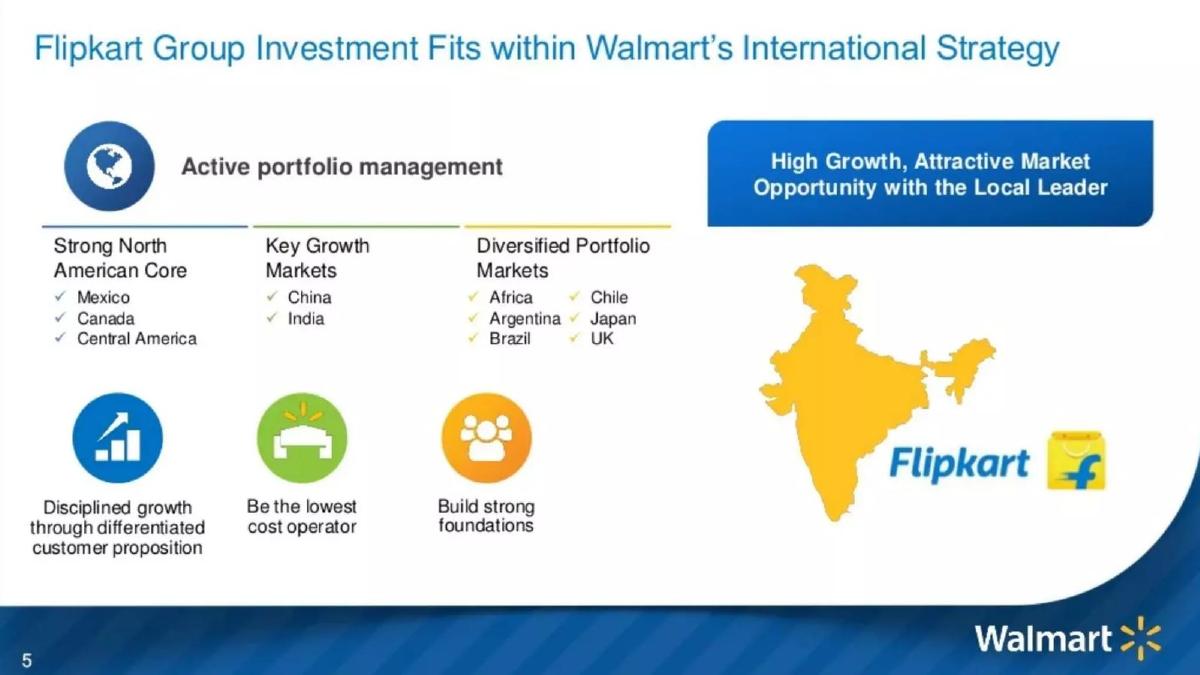
- The strategy involves active portfolio management, categorizing India and China as 'Key Growth Markets' (Slide 5).
The $16 Billion Bet: Walmart’s Strategic Pivot to India
The Walmart-Flipkart investor presentation from May 9, 2018, represents a watershed moment in global retail. This was not a standard startup pitch; it was a corporate justification for a massive capital outlay. The deck’s primary goal was to convince shareholders that a $16 billion investment—which would immediately dilute earnings per share—was the only way to secure a future in the world’s most promising retail theater: India.
Slides 1-4: Mission and Strategic Alignment
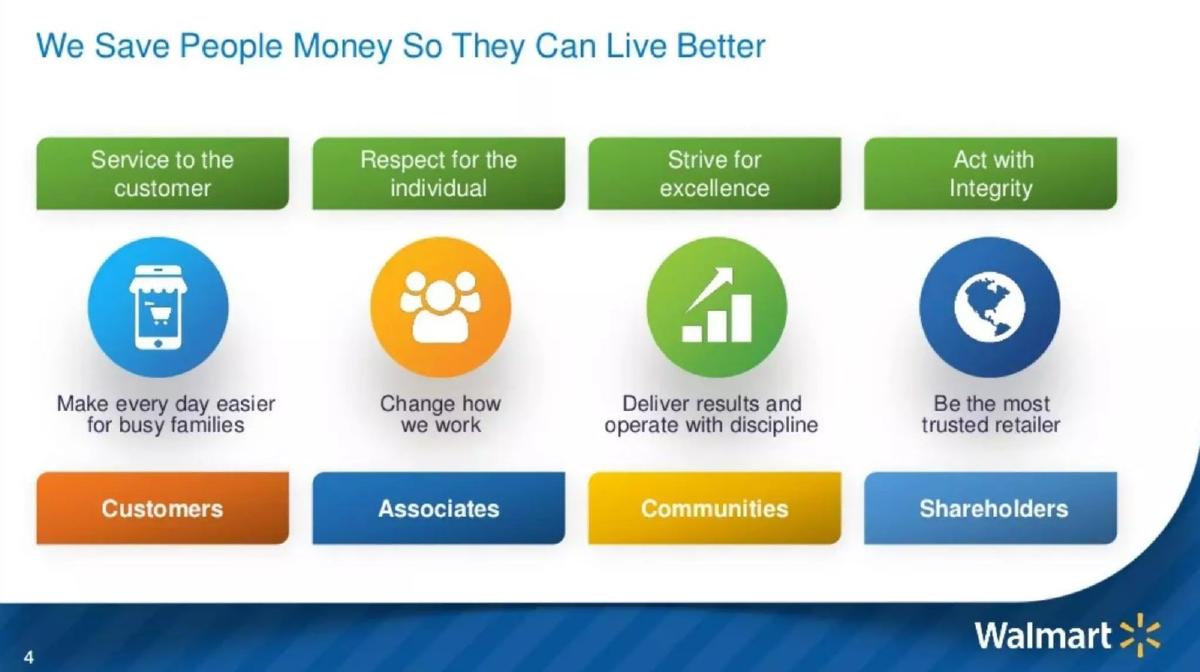
The deck opens with a clear title slide (Slide 1) dated May 9, 2018, featuring a consumer using a smartphone, immediately signaling the mobile-first nature of the deal. After a standard legal disclaimer (Slide 2), the deck moves into 'Strategy' (Slide 3). Slide 4 restates Walmart’s core mission: 'We Save People Money So They Can Live Better.' It breaks down value creation for four pillars: Customers, Associates, Communities, and Shareholders. This slide is crucial because it frames the Flipkart acquisition not as a departure from Walmart’s roots, but as a modern evolution of its 'Every Day Low Price' philosophy through digital means.
Slides 5-8: The Macro Opportunity in India
Slide 5 places Flipkart within the broader context of Walmart International’s strategy. It categorizes markets into three buckets: the 'Strong North American Core' (Mexico, Canada), 'Diversified Portfolio Markets' (UK, Japan, Brazil), and 'Key Growth Markets' (China, India). By placing India in the growth bucket, Walmart justifies the higher risk profile. Slide 6 summarizes the transformation, noting that e-commerce in India is growing 4x faster than the general retail industry.
Slide 7 provides the 'Why India' data: a 9.4% GDP CAGR over the last 10 years, 443 million Millennials and Gen Z (66% of the population), and a smartphone penetration rate expected to hit 58% by 2020. Slide 8 is the 'money slide' for market size, showing e-commerce penetration growing from a mere 2.1% in FY18 to a projected 6.2% by FY23. The visual of the 36% CAGR versus 9% for total retail makes the investment seem inevitable rather than optional.
Slides 9-11: Flipkart’s Market Dominance
Walmart shifts from the market to the specific asset in Slide 9. It defines Flipkart as an 'ecosystem,' highlighting the logistics arm (Ekart) with 500,000 daily deliveries and the payments app (PhonePe). This is a sophisticated way of saying they aren't just buying a store; they are buying the plumbing of Indian digital commerce. Slide 10 provides the hard metrics: $7.5 billion in annual GMV, 54 million active customers, and 261 million units sold in FY18. The bar charts show a ~12x growth in GMV and ~7x growth in active customers since FY14, demonstrating massive momentum. Slide 11 reinforces this by showing Flipkart holds the #1 spot in Fashion, Mobile, and Large Appliances, and #2 in Electronics.
Slides 12-14: Team, Partners, and Stakeholders
Slide 12 introduces the leadership team, emphasizing their pedigrees (IIT-Delhi, Wharton, McKinsey). For an acquisition of this size, Walmart needed to show that the 'local talent' had 'global expertise.' Slide 13 displays the logos of co-investors: Tencent, Tiger Global, and Microsoft. This serves as social proof; if the world’s leading tech and venture firms are in the cap table, the valuation is validated. Slide 14 returns to the 'Value for Everyone' theme, specifically mentioning job creation and support for farmers in India, which is vital for navigating the complex regulatory and political environment of Indian retail.
Slides 15-17: Transaction Mechanics and EPS Guidance
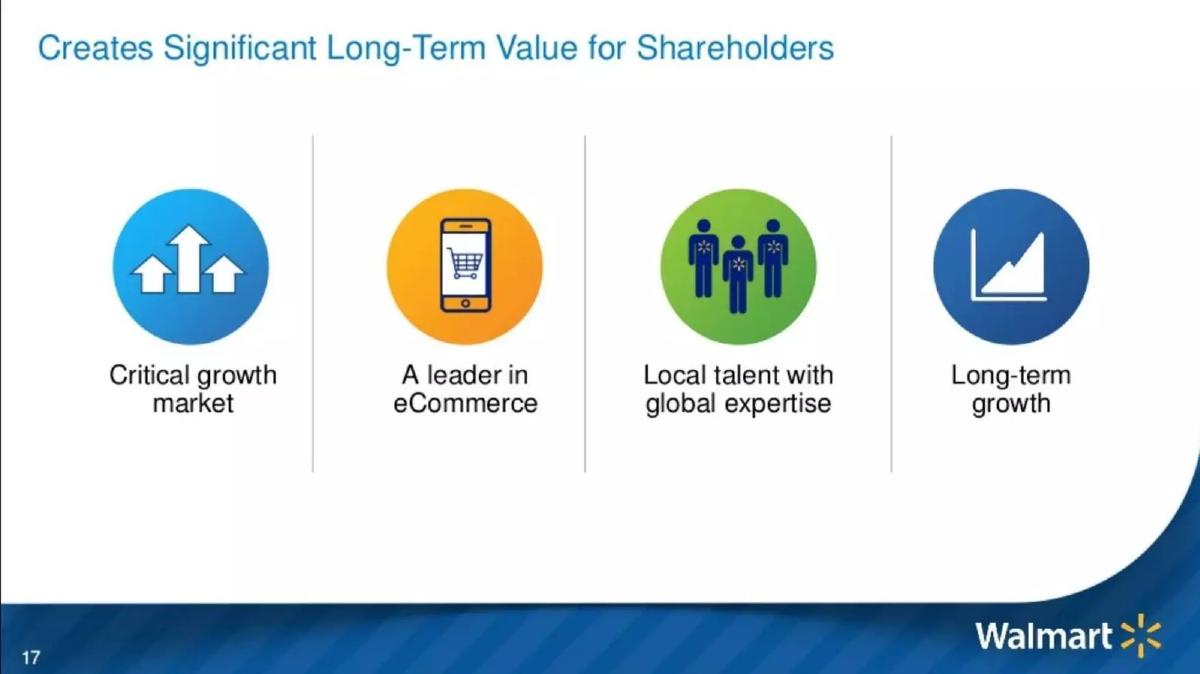
The final section (Slide 15) dives into the 'Transaction Details and Guidance.' Slide 16 is the most data-dense slide in the deck. It confirms the $16 billion price tag for a 77% stake and explicitly warns of a $0.60 EPS headwind in FY20. It breaks this down into $0.40-$0.45 in operating losses and $0.15 in interest expense. This level of transparency is designed to preemptively manage analyst expectations. The deck concludes on Slide 17 with a summary of long-term value: critical growth market, e-commerce leadership, and local talent.
What Works in This Deck
The '4x' Narrative: By repeatedly comparing e-commerce growth (36%) to total retail growth (9%), Walmart makes the case that staying out of India would be a greater risk than spending $16 billion to enter it. · Ecosystem Mapping: Slide 9 is excellent. It shows that Flipkart is more than a website; it’s a logistics and payments powerhouse. This justifies a premium valuation that a simple retail multiple wouldn't support. · Transparency on Dilution: Most decks try to hide the 'bad news.' Walmart puts the EPS headwind front and center on Slide 16. This builds trust with institutional investors who hate surprises. · Visual Consistency: The use of the Walmart 'Spark' logo and a consistent blue-and-orange color palette (representing Walmart and Flipkart) visually marries the two companies before the deal even closes.
What Is Missing
Path to Profitability: While the deck is honest about short-term losses, it lacks a specific year or milestone for when the Flipkart segment is expected to become break-even or profitable. It relies on the phrase 'mid to long term' (Slide 16). · Competitive Landscape: There is no mention of Amazon India. In 2018, the battle between Flipkart and Amazon was intense. The deck presents Flipkart's #1 positions (Slide 11) in a vacuum without acknowledging the aggressive capital spend of its primary competitor. · Regulatory Risk Detail: India is known for sudden changes in FDI (Foreign Direct Investment) rules for e-commerce. While mentioned in the disclaimer, the deck doesn't explain how the deal structure protects against local protectionist laws.
What a Founder Should Copy
The 'Market First' Approach: Before talking about their product, Walmart spends four slides (5-8) selling the size and velocity of the market. Founders should ensure their 'Why Now' and 'TAM' slides are this compelling. · Highlighting Infrastructure: If your startup has a 'moat' like a proprietary logistics network or a massive payments user base (like Ekart or PhonePe), give it its own slide. Don't bury it under 'Product.' · Social Proof via Cap Table: Slide 13 is a simple but powerful way to use your investors' brands to boost your own. If you have reputable angels or VCs, their logos are often more persuasive than your own metrics. · Clear Segmentation: Slide 11's use of simple icons and rankings (#1 in Fashion, #1 in Mobile) is a great way to communicate market dominance instantly without over-complicating the slide with spreadsheets.
Frequently asked questions
- How much did Walmart invest in Flipkart according to the deck?
- According to slide 16, Walmart’s investment was approximately $16 billion. This included $2 billion of new equity funding to help Flipkart achieve its growth potential. This gave Walmart an initial ownership stake of approximately 77%, with the remainder held by existing shareholders like Tencent, Tiger Global, and Microsoft.
- What was the primary strategic justification for the acquisition?
- The primary justification was market growth. Slide 8 shows that while total retail in India was growing at 9%, e-commerce was projected to grow at 36% CAGR. Walmart viewed India as one of the world's largest and fastest-growing markets, and Flipkart was the 'local leader' already possessing the necessary infrastructure (Slide 6).
- What specific business units within Flipkart were highlighted?
- Walmart highlighted a full ecosystem beyond just the main marketplace. Slide 9 identifies Myntra and Jabong as leading fashion destinations, Ekart as the logistics arm handling 500,000 deliveries a day, and PhonePe as the digital payments platform. This demonstrated that Walmart was buying an integrated digital economy, not just a website.
- What were the financial risks disclosed to investors?
- Walmart was transparent about the short-term negative impact on earnings. Slide 16 notes an expected negative impact to FY19 EPS of $0.25 to $0.30 and a further EPS headwind of approximately $0.60 in FY20. This was attributed to operating losses, interest expenses, and the amortization of intangible assets.
- Who were the key management figures mentioned?
- Slide 12 highlights the 'Experienced and Committed Management Team,' including Binny Bansal (CEO, Flipkart Group), Kalyan Krishnamurthy (CEO, Flipkart), Ananth Narayanan (CEO, Myntra and Jabong), and Sameer Nigam (CEO, PhonePe). Walmart used their backgrounds at McKinsey, Tiger Global, and eBay to build investor confidence.