The Stor.ai pitch deck is a concise 11-slide presentation focused on the digital transformation of the grocery sector. Raised in 2014, the deck highlights the 'fractured shopping experience' where 80% of shoppers are unsatisfied with fulfillment options (Slide 2). The company positions itself as an all-in-one platform covering engagement, merchandising, frictionless shopping, and fulfillment (Slide 4). A standout feature is the detailed case study of Yenot Bitan, Israel's second-largest grocer, which saw a 50% reduction in labor and 25,000 monthly online orders after implementing Stor.ai (Sli…
Key takeaways
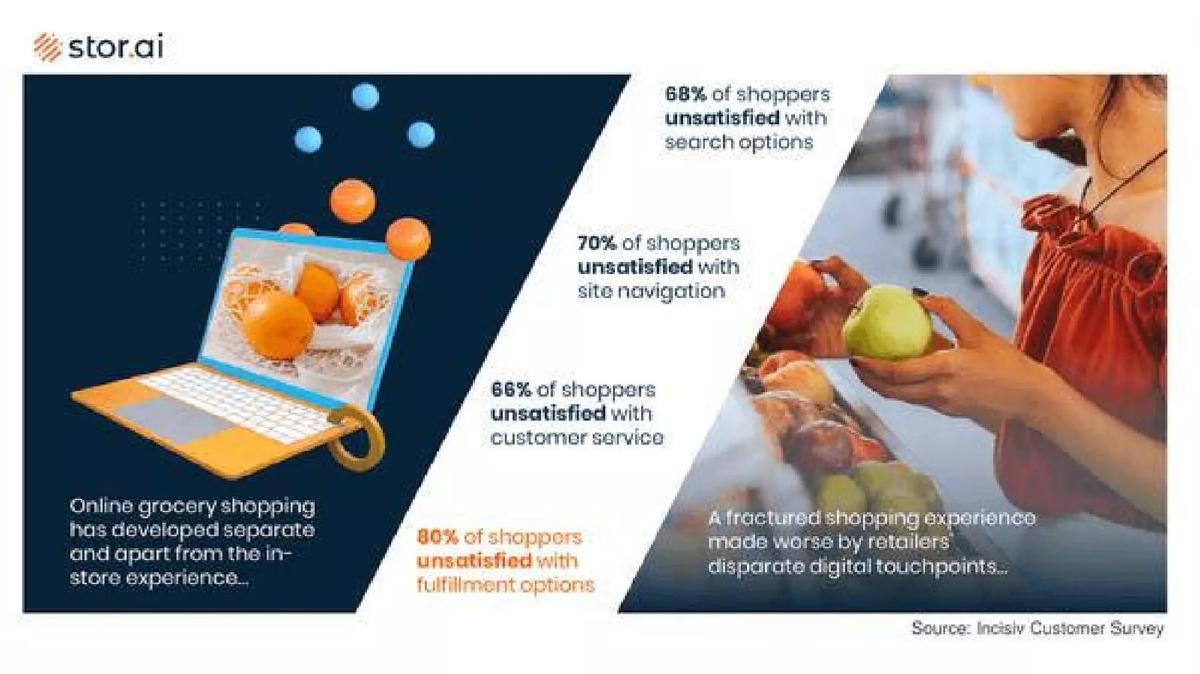
- The deck identifies a massive gap in grocery retail, citing that 80% of shoppers are unsatisfied with current fulfillment options (Slide 2).
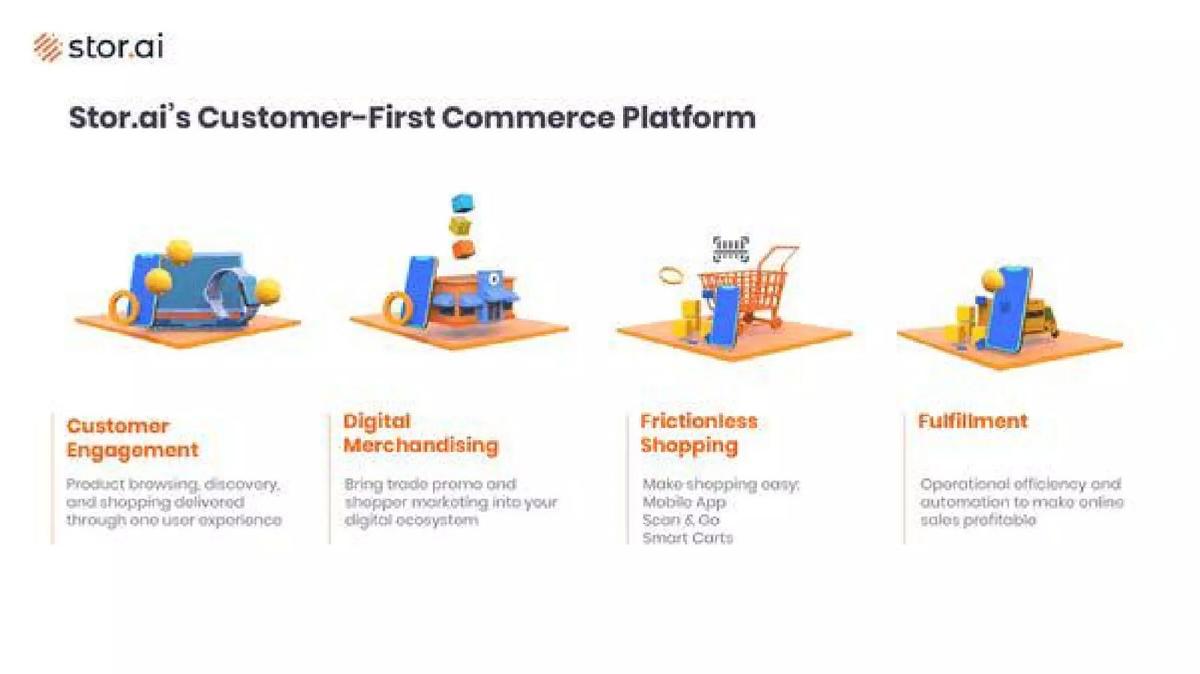
- Stor.ai defines its platform through four core pillars: Customer Engagement, Digital Merchandising, Frictionless Shopping, and Fulfillment (Slide 4).
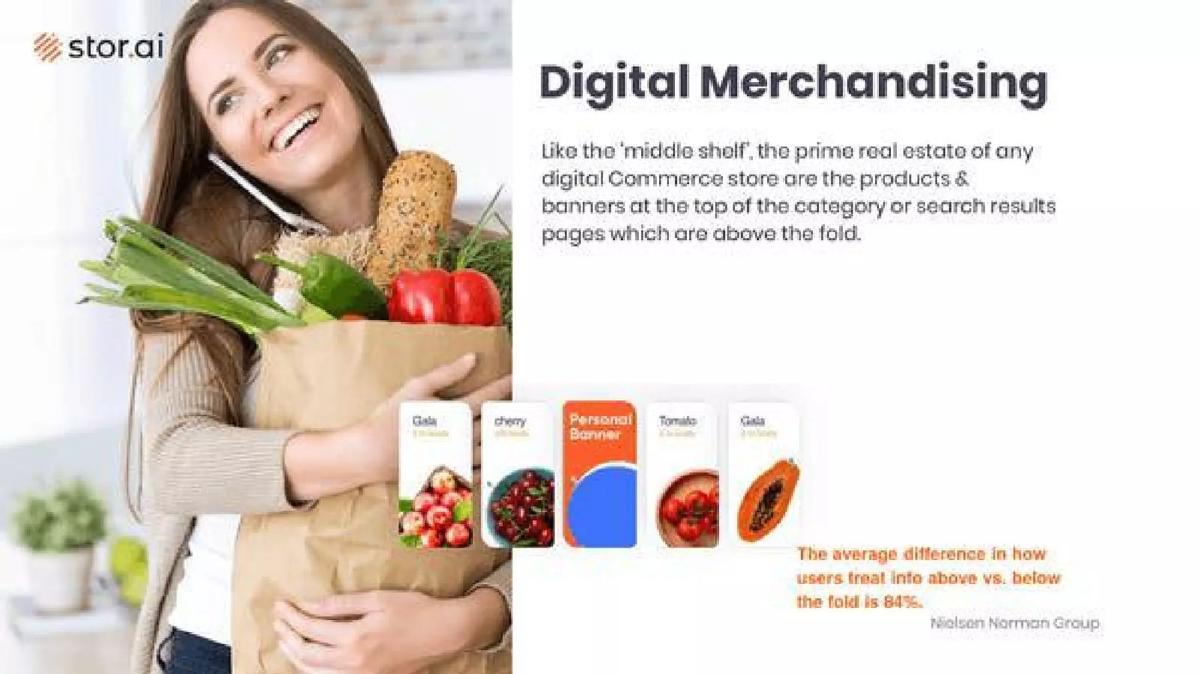
- The 'Digital Merchandising' slide uses a Nielsen Norman Group stat to show that users treat info above the fold 84% more than below it, justifying their UI focus (Slide 6).
- Fulfillment capabilities include three picking modes and integration with final-mile delivery and Micro-Fulfillment Center (MFC) partners (Slide 7).
- A single, deep-dive case study for Yenot Bitan demonstrates a $185 Average Order Value (AOV) and 85% Year-over-Year growth (Slide 8).
- The engagement model is based on a per-store license fee with no transaction fees, aiming for ROI in under 12 months (Slide 9).
- By the time of this deck, the company had already processed over 2 million orders annually across 300+ retailers (Slide 10).
- The leadership team features executives with backgrounds at Google, Toshiba, and major retailers like Shufersal (Slide 10).
Executive Summary: The Omnichannel Grocery Play
Stor.ai, formerly known as Self Point, entered the market at a time when traditional grocers were struggling to compete with digital-native delivery services. Their Series A deck, which facilitated a $28.5 million raise in 2014, focuses heavily on the operational complexities of grocery—specifically fulfillment and merchandising. The deck is brief at only 11 slides, but it manages to communicate a transition from a 'fractured' experience to a 'customer-first' commerce model. By emphasizing that retailers should own their own brand and data, Stor.ai positioned itself as the anti-Instacart for established grocery chains.
Slides 1-3: The Problem and The Vision
Slide 1: Title The deck opens with the tagline 'Customer-First Commerce.' The branding is clean, utilizing a professional color palette of blue and orange, featuring a consumer using a mobile device. It sets the stage for a mobile-centric solution.
Slide 2: The Fractured Experience This is the 'Problem' slide, and it is data-heavy. Citing an Incisiv Customer Survey, the slide lists four major pain points: 68% of shoppers are unsatisfied with search, 70% with navigation, 66% with customer service, and a staggering 80% with fulfillment options. The central thesis is that online grocery has developed 'separate and apart' from the in-store experience, creating a disjointed journey for the user.
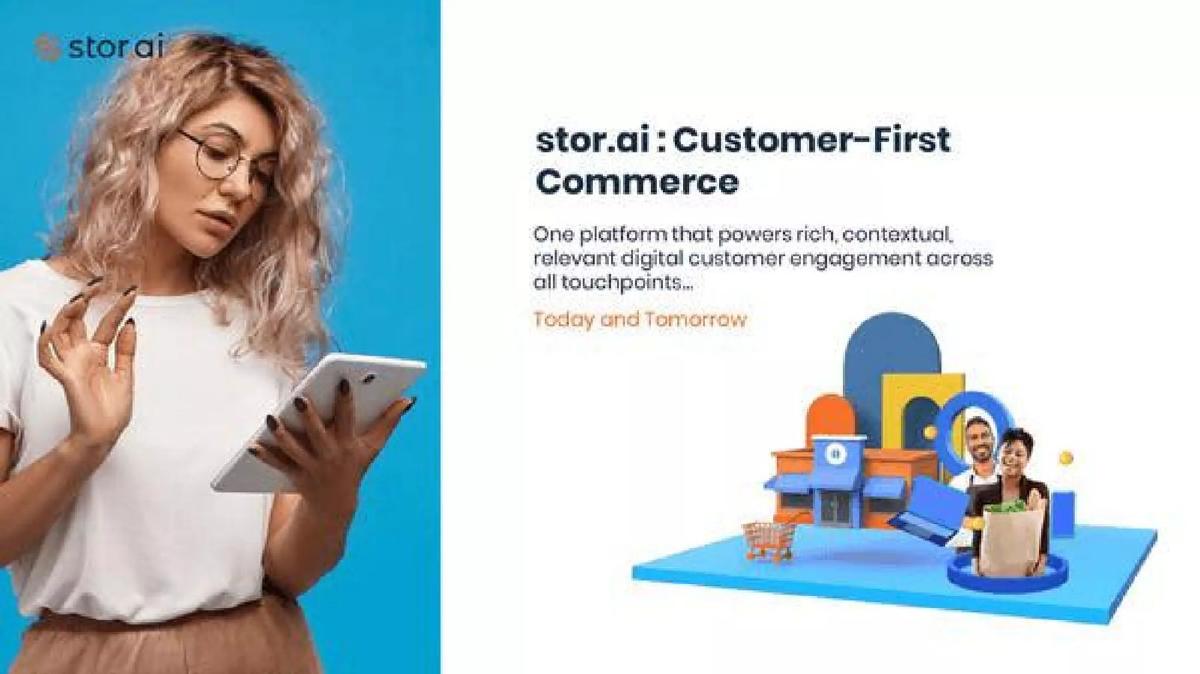
Slide 3: The Solution Stor.ai introduces itself as 'One platform that powers rich, contextual, relevant digital customer engagement across all touchpoints.' The slide is aspirational, using the phrase 'Today and Tomorrow' to suggest a long-term partnership with retailers rather than a quick software fix.
Slides 4-7: Product Deep Dive
Slide 4: The Four Pillars This slide breaks the platform into four distinct modules: Customer Engagement, Digital Merchandising, Frictionless Shopping, and Fulfillment. This is a crucial slide for a Series A deck as it defines the scope of the product. It shows that Stor.ai isn't just a website builder; it’s an end-to-end operational OS for grocers.
Slide 5: Immersive Digital Engagement This slide focuses on the 'front end' of the experience. It lists 'Browsing, Research, and Discovery' as the three core components. The visuals show a responsive web interface and a mobile app, emphasizing a 'consistent and seamless' experience across devices.
Slide 6: Digital Merchandising Stor.ai makes a specific argument here about the 'prime real estate' of digital stores. They compare the top of a search result to the 'middle shelf' in a physical store. Citing the Nielsen Norman Group, they note that the difference in how users treat info above vs. below the fold is 84%. This demonstrates that the company understands the psychology of e-commerce and how to drive high-margin sales for grocers.
Slide 7: Fulfillment For grocery, fulfillment is the hardest part of the equation. This slide lists six technical capabilities: three picking modes, POS integration, mobile apps for staff (Android/iOS), final-mile delivery integration, MFC (Micro-Fulfillment Center) deployment, and the ability to operate in 'dark stores.' The inclusion of a screenshot of the picking app shows the product is mature and ready for warehouse/back-of-store use.
Slides 8-9: Traction and Business Model
Slide 8: Customer Success Story Instead of a broad list of logos, Stor.ai chooses to go deep on one client: Yenot Bitan. As the 2nd largest grocer in Israel with ~200 stores and $1.5B in annual revenue, they are a significant validator. The slide shows a 'Before' and 'After' comparison. After implementing Stor.ai, the retailer saw labor reduced by 50%, 25,000 orders per month, an Average Order Value (AOV) of $185, and 85% YoY growth. These are the 'hard' numbers that investors look for in a Series A.
Slide 9: Engagement Model This slide outlines the commercial terms. The model is a 'Per store license fee' with 'No transaction fees.' This is a strategic choice; by not taking a cut of every order, Stor.ai aligns itself as a utility provider rather than a tax on the retailer's growth. They also promise a dedicated dev team and a Return on Investment (ROI) in under 12 months.
Slides 10-11: The Team and Closing
Slide 10: The Guide to Customer-First Commerce This serves as the 'Company' and 'Team' slide. It highlights that the company launched in 2014, has 300+ retailers in multiple regions, and processes over 2 million orders annually. The executive bios are strong, featuring Orlee Tal (CEO), Morris Azulay (CFO), and Irit Fridlis (VP Strategy). The slide also mentions GDPR and ISO27001 compliance, which is vital for enterprise-level retail contracts.
Slide 11: Contact A standard closing slide with contact information for Matt Walker. It lacks a specific 'Ask' (e.g., 'We are seeking $X million'), which suggests this version of the deck may have been used for general partnerships or that the specific terms were handled in a separate document.
What Works in This Deck
1. Specificity in the Problem: By breaking down dissatisfaction percentages (Slide 2), the founders show they have done their homework. They aren't just saying 'grocery is hard'; they are saying 'fulfillment is the specific area where 80% of people are unhappy.' 2. The 'Anti-Marketplace' Stance: The 'No transaction fees' mention on Slide 9 is a powerful differentiator. In a world where platforms like Instacart or DoorDash take significant margins from retailers, Stor.ai positions itself as a partner that helps retailers keep their profits. 3. The Deep-Dive Case Study: One high-quality case study (Slide 8) is often better than a 'wall of logos.' By showing the $185 AOV and 50% labor reduction, they provide a blueprint for what the software can do for other large chains.
What Is Missing
1. The Competitive Landscape: There is no slide addressing competitors. In 2014, the grocery tech space was becoming crowded. Investors would want to know how Stor.ai stacks up against legacy POS providers and new delivery startups. 2. The Financial Ask: The deck does not state how much money is being raised or how it will be spent. While the catalogue facts state $28.5M was raised, the deck itself is silent on the 'Ask.' 3. Unit Economics: While we see the retailer's ROI, we don't see the company's own unit economics. What is the Customer Acquisition Cost (CAC) for a 200-store chain? What is the Lifetime Value (LTV) of a license fee model? These are missing from the narrative.
What a Founder Should Copy
1. The 'Before and After' Format: Slide 8 is a masterclass in demonstrating value. If you have one big customer, don't just put their logo on a slide. Show the specific metrics that changed after they started using your product. 2. Pillar-Based Product Description: Slide 4 simplifies a complex enterprise platform into four easy-to-digest pillars. This helps investors categorize the product in their minds without getting lost in a feature list. 3. Pedigree Highlighting: Slide 10 does a great job of not just listing names, but listing 'why' those names matter (e.g., 'ex-Retalix,' 'funding guru,' '15+ years retail'). It builds immediate credibility for a Series A round.
Frequently asked questions
- What was the primary problem Stor.ai aimed to solve?
- Stor.ai addressed the 'fractured shopping experience' in the grocery industry. According to Slide 2, online grocery shopping had developed separately from the in-store experience, leading to high dissatisfaction rates: 70% for site navigation, 68% for search, and 80% for fulfillment. Their goal was to create a unified omnichannel experience where retailers own their data and customer relationships.
- How does Stor.ai generate revenue based on this deck?
- According to Slide 9, the 'Engagement Model' is built on a per-store license fee. Notably, they highlight a 'No transaction fees' policy, which differentiates them from many marketplace-style competitors. They also offer a dedicated development team to speed up implementation, claiming that most retailers see a Return on Investment (ROI) in less than 12 months.
- What specific metrics did the company use to prove traction?
- The company relied on two main data points: aggregate platform stats and a specific case study. Slide 10 notes they had over 300 retailers on the platform across the US, Canada, Europe, and Israel, processing over 2 million orders annually. Slide 8 highlights a specific customer, Yenot Bitan, achieving 25,000 orders per month and an 85% YoY growth rate.
- What are the core components of the Stor.ai platform?
- The platform is divided into four functional areas as shown on Slide 4: Customer Engagement (browsing and discovery), Digital Merchandising (trade promos and shopper marketing), Frictionless Shopping (mobile app, scan & go, smart carts), and Fulfillment (operational efficiency and automation for profitable online sales). This covers the entire journey from discovery to delivery.
- Who were the key people behind Stor.ai at the time of the raise?
- Slide 10 lists three key executives: Orlee Tal (CEO), an ex-Retalix and Google lecturer with 20+ years in retail; Morris Azulay (CFO), described as a 'funding guru' and M&A expert; and Irit Fridlis (VP Strategy), an ex-Shufersal executive with 15+ years in retail. The slide also displays logos for Toshiba, Unilever, Trax, Microsoft, and Salesforce, implying partnerships or integrations.