Strada’s 12-slide pre-seed deck, which secured $1.9M in 2024, is a masterclass in identifying industry-specific friction. Rather than focusing on a single AI tool, Strada positions itself as an 'AI-enabled marketplace' for the entire creative lifecycle. The deck moves from a high-level mission to drive professionals to the cloud (Slide 1) to a granular breakdown of the 11-step production process (Slide 3), highlighting inefficiencies in everything from 'shuttle disk backups' to 'conform color versions.' By framing the solution alongside giants like Airbnb and Spotify (Slide 4), the founders e…
Key takeaways
- The mission is explicitly stated as driving creative professionals to work 'exclusively in the cloud' (Slide 1).
- Strada identifies a massive gap between the perceived 3-step workflow (capture, edit, distribute) and the actual 11-step professional reality (Slides 2 and 3).
- The deck lists highly specific technical pain points including LTO backups, transcoding dailies, and assembling mix versions (Slide 3).
- Strada positions itself as a marketplace peer to Airbnb, Etsy, Spotify, and Grubhub, but specifically for 'creative workflows' (Slide 4).
- The market sizing uses a standard TAM/SAM/SOM model, identifying the 'Global Creator Economy' as the primary target (Slide 5).
- The 'Flywheel Effect' slide argues that marketplace modules will increase the number of creative professionals, leading to platform growth (Slide 6).
- The deck omits a traditional 'Ask' slide detailing the specific use of the $1.9M raised (as reported by Business Insider).
- There is no visible 'Team' slide in the provided sequence, which is unusual for a pre-seed round where pedigree is often the primary selling point.
The Narrative of Workflow Consolidation
Strada’s pitch deck is a focused argument for the centralization of creative work. In an era where AI tools are proliferating as individual features, Strada takes a platform-level view. The deck, used to raise $1.9M in 2024, focuses less on the 'how' of their AI and more on the 'where'—specifically, moving the entire production pipeline into a unified cloud environment.
Slide 1: The Mission Statement
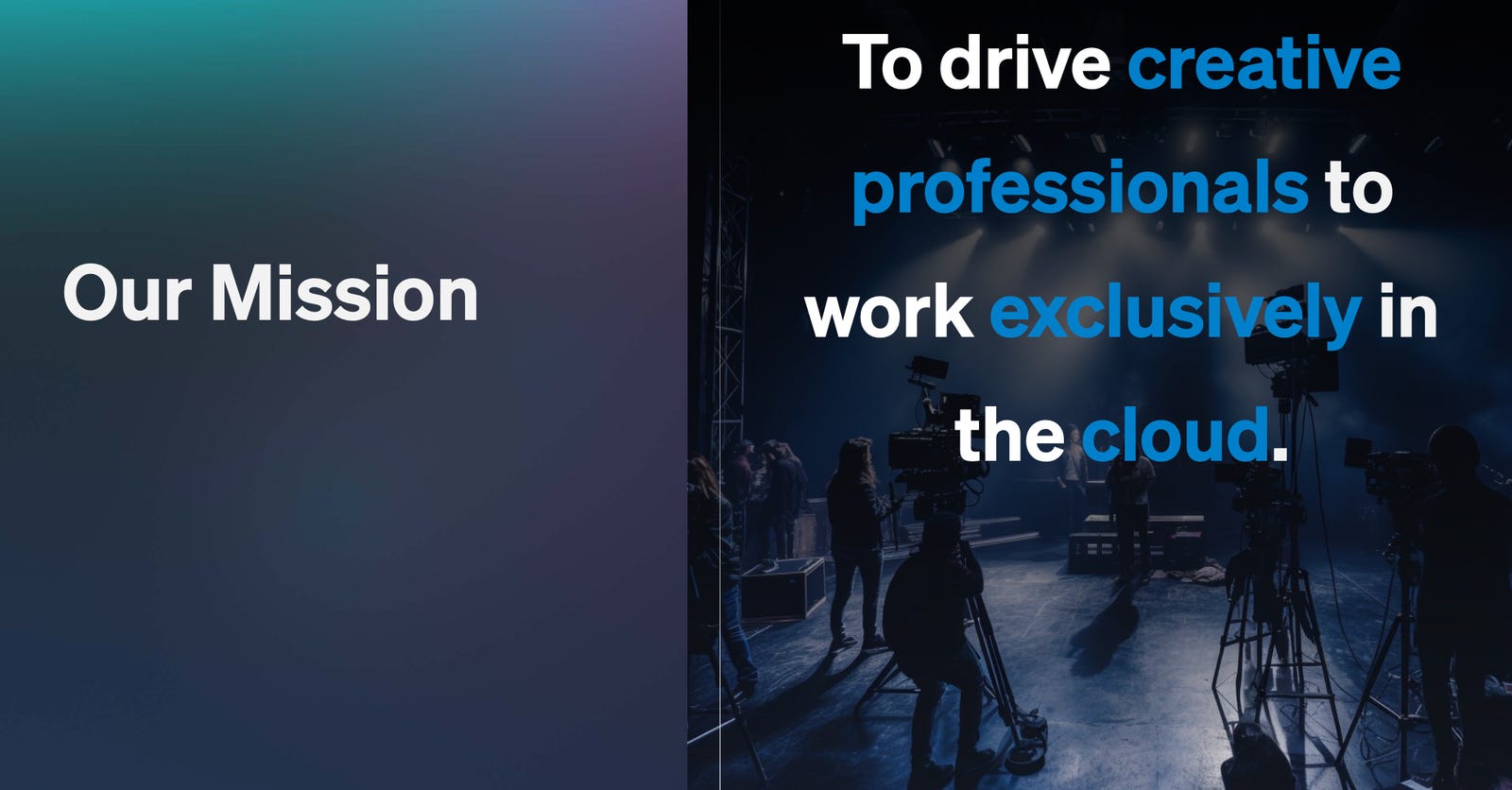
The deck opens with a bold, high-contrast slide. The mission is stated as: "To drive creative professionals to work exclusively in the cloud." This is a strategic choice. It doesn't mention AI immediately; instead, it focuses on a shift in infrastructure. For investors, 'cloud' implies recurring revenue, scalability, and data moat potential. The background image of a professional film set grounds the high-tech mission in a real-world, high-value industry.
Slide 2: The Simplified Workflow
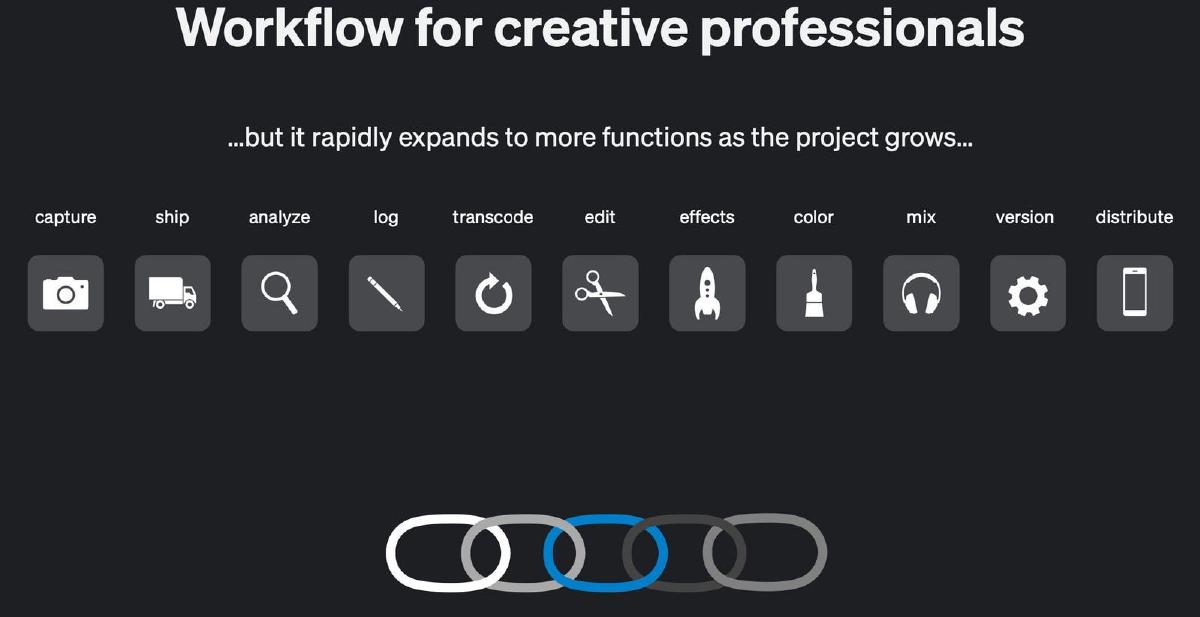
Slide 2 introduces the concept of 'Workflow for creative professionals.' It presents a simplified view of the industry: capture, edit, and distribute. This slide acts as a 'straw man' argument. It represents how the general public—and perhaps less-informed investors—view content creation. By starting here, the founders set themselves up to demonstrate their deep domain expertise in the following slide.
Slide 3: The Reality of Inefficiency
This is arguably the most important slide in the deck. It expands the 3-step workflow into an 11-step gauntlet: capture, ship, analyze, log, transcode, edit, effects, color, mix, version, and distribute. Under each icon, Strada lists specific, painful tasks like 'shuttle disk backup LTO,' 'logo detect,' 'dailies,' and 'conform color version.' This slide proves the founders understand the 'unsexy' parts of the business. It identifies exactly where time and money are wasted, making the case for an 'AI-enabled' solution that can automate or bridge these gaps.
Slide 4: The Solution as a Marketplace
On Slide 4, Strada defines itself: "Strada is the world’s first AI-enabled marketplace designed for creative professionals to save time, money and improve the quality of their content." The right side of the slide features the logos of Airbnb, Etsy, Spotify, and Grubhub. This is a classic 'X for Y' pitch strategy. By calling themselves a marketplace rather than just a tool, they are signaling a desire for platform effects. They aren't just selling a video editor; they are building the infrastructure where creative modules are bought, sold, and utilized.
Slide 5: Classifying the Market
The market slide (TAM/SAM/SOM) focuses on the Beachhead Market - Creator Economy.
TAM: Global Creator Economy · SAM: Professional members of Global Creator Economy · SOM: Strada revenue potential
While the slide is visually clean, it lacks the specific dollar amounts usually found in a pitch deck. However, in a pre-seed context, the goal is often to show the logic of the market approach rather than a definitive (and often fabricated) multi-billion dollar figure.
Slide 6: The Flywheel Effect
The final slide in the provided sequence illustrates the Strada Flywheel Effect. It connects four quadrants: Platform growth, Creative professionals, Marketplace modules, and Increase number of creative professionals. The loop suggests that as the marketplace grows, it changes 'creative professional behavior,' which leads to 'new content businesses.' This is a high-level strategic slide meant to show how the company becomes more defensible over time. The more modules (tools/AI models) in the marketplace, the more essential the platform becomes to the professional.
What Works in the Strada Deck
Specific Pain Point Identification: Slide 3 is a masterclass in establishing founder-market fit. By listing technical terms like 'LTO' and 'transcode,' the founders signal to investors that they aren't outsiders trying to disrupt a field they don't understand. They know the granular frustrations of a post-production supervisor.
Platform Positioning: By comparing themselves to Airbnb and Spotify, Strada avoids the 'feature trap.' If they were just an 'AI video editor,' they would be compared to dozens of other startups. As a 'marketplace for creative workflows,' they occupy a much larger, more defensible category in the investor's mind.
Visual Consistency: The deck uses a dark, professional aesthetic with consistent iconography. This mirrors the UI of professional creative tools (like Adobe Premiere or DaVinci Resolve), subconsciously suggesting that the product will fit seamlessly into a professional's existing toolkit.
What is Missing from the Strada Deck
The Team Slide: In a $1.9M pre-seed round, the team is usually the most important factor. The absence of a team slide in this sequence is a major omission. Investors need to know if these founders have previously worked at major studios, tech giants, or successful startups in the media space.
The 'Ask' and Use of Funds: There is no slide detailing how much is being raised or how it will be spent. While we know from external reports that they raised $1.9M, a pitch deck should ideally outline the roadmap—hiring, product development, or user acquisition—that this capital will enable.
Competitive Landscape: The deck identifies the problem well but doesn't mention existing incumbents (like Frame.io or Adobe Creative Cloud) or how Strada integrates with or replaces them. A 'competitor matrix' or 'landscape' slide would help clarify their unique value proposition.
Unit Economics and Revenue Model: While they call themselves a 'marketplace,' the deck doesn't explain the take rate, subscription fees, or how they actually make money from the 'Strada revenue potential' mentioned on Slide 5.
Lessons for Founders
1. Deconstruct the 'Simple' Workflow: If you are entering a complex industry, don't just show the high-level process. Show the messy, manual steps in between. That is where the real value (and the real investment opportunity) lies.
2. Use Analogies Wisely: The 'Airbnb for X' trope is tired, but Strada uses it effectively by grouping four different marketplace giants. This suggests they are adopting a business model (marketplace) rather than just copying a single company's features.
3. Focus on the Flywheel: Especially at the pre-seed stage, you need to show how your business gets stronger as it grows. A flywheel diagram is a simple way to communicate complex network effects and long-term defensibility to an investor who is looking 5-10 years into the future.
4. Bridge the Gap Between AI and Utility: Strada mentions 'AI-enabled' but focuses on 'workflow.' This is a key takeaway for 2024 and beyond: AI is the engine, but the workflow is the vehicle. Investors are increasingly wary of 'wrappers' and are looking for companies that use AI to solve structural industry problems.
Frequently asked questions
- What is the core problem Strada is solving?
- Strada addresses the fragmentation and inefficiency of professional video production. While many believe production is just 'capture, edit, and distribute,' Strada highlights an 11-step reality involving complex tasks like shuttle disk backups, transcoding, and multi-platform versioning that currently happen in silos.
- How does Strada define its market opportunity?
- Strada uses the Creator Economy as its beachhead. They categorize their TAM as the Global Creator Economy and their SAM as the professional members within that economy. Their SOM is defined as 'Strada revenue potential,' though specific dollar figures are not listed on the market slide.
- What is the 'Strada Flywheel Effect' mentioned in the deck?
- The flywheel suggests that by providing marketplace modules, Strada will attract more creative professionals. This influx changes professional behavior, leading to new content businesses and overall platform growth, which in turn attracts more modules to the marketplace.
- Why does the deck compare Strada to Airbnb and Spotify?
- This is a positioning tactic. By aligning with established marketplaces, Strada signals that it isn't just a software tool (SaaS), but a platform that facilitates transactions and workflows between different parties in the creative ecosystem.
- What key information is missing from this pitch deck?
- The provided slides lack a team slide, a competition slide, and a financial slide. Most importantly for a pre-seed deck, there is no 'Ask' slide detailing how the $1.9M will be spent or what milestones the company intends to hit with the capital.