Storyboard’s 2021 Seed deck is a masterclass in brevity and social proof. At only 8 slides, it omits standard sections like Team, Competition, and Financial Projections, choosing instead to lean heavily on its existing traction with 1,700+ organizations. The deck positions asynchronous audio as the 'next channel for enterprise,' moving beyond simple internal podcasts into 1:1 and 1:few messaging. By showcasing a steep growth curve in 'paid seats' and validating the market through third-party social media commentary, Storyboard successfully raised $4.5M. This teardown examines how the company…
Key takeaways
- The deck leads immediately with social proof, claiming over 1,700 organizations globally on Slide 1.
- High-profile enterprise logos including DHL, Delta, and Schneider Electric are featured on the title slide to establish instant credibility.
- The product is defined as a secure platform for audio messages, specifically targeting town halls and training (Slide 2).
- Storyboard differentiates between 'Internal Podcasts' (1:many) and 'Audio Messages' (1:1 and 1:few) to show product evolution (Slide 3).
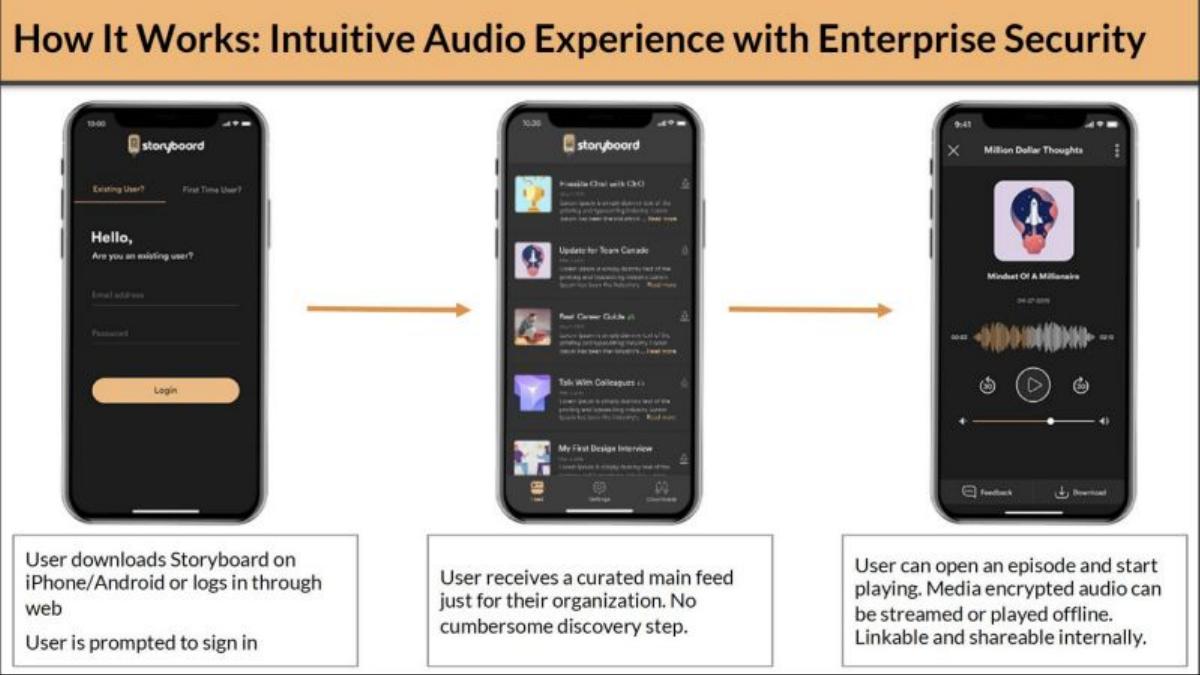
- The 'How It Works' slide emphasizes a 'no cumbersome discovery step' via a curated organizational feed (Slide 4).
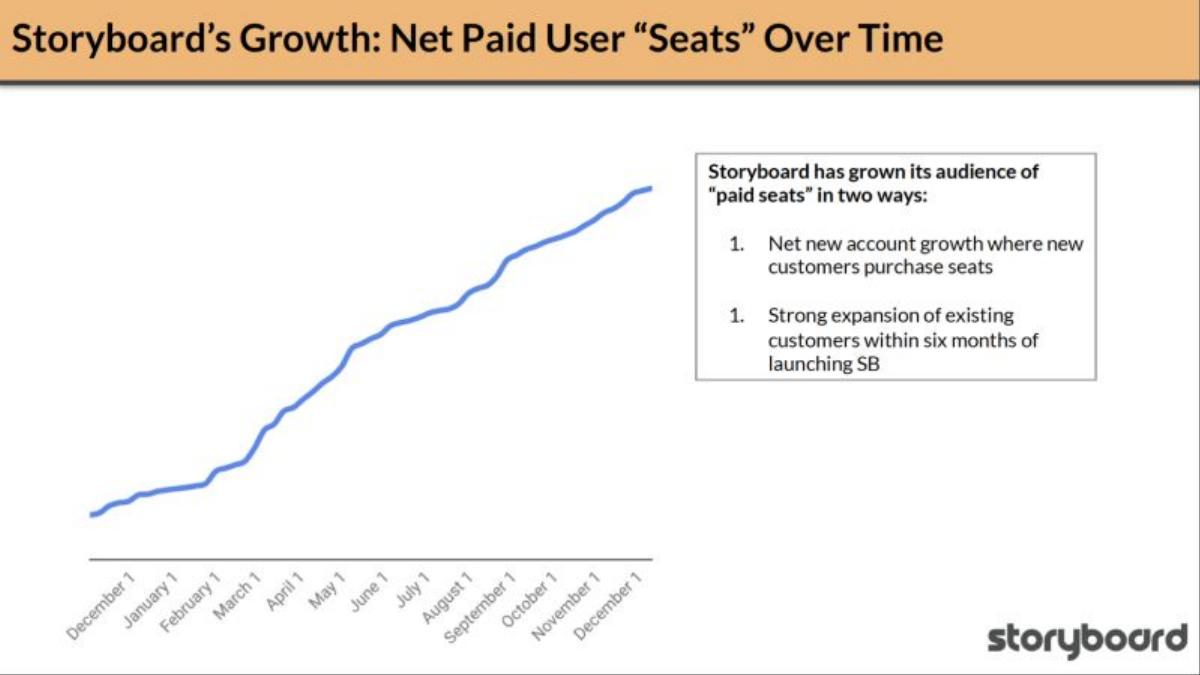
- Growth is visualized through a 'Net Paid User Seats' chart showing consistent upward momentum from December to December (Slide 5).
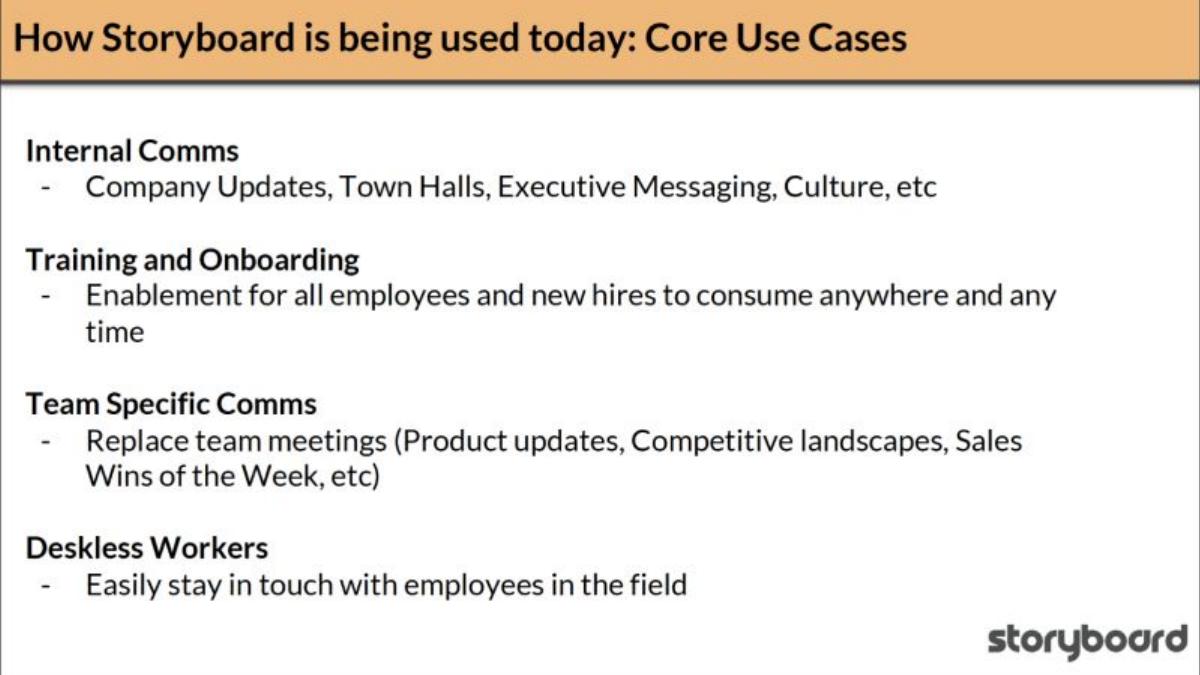
- The deck identifies 'Deskless Workers' as a core use case, highlighting a specific market segment often underserved by text-based tools (Slide 6).
- Market validation is provided through curated tweets from industry influencers rather than traditional market size data (Slide 7).
The Power of Brevity: Storyboard’s 8-Slide Seed Deck
Storyboard raised $4.5M in 2021 with a deck that defies many of the standard 'rules' of fundraising. There is no team slide, no financial model, and no competitive landscape. Instead, the deck is built entirely around two pillars: enterprise social proof and the evolution of audio as a core business utility. By focusing on how 1,700+ organizations are already using the tool, Storyboard shifts the conversation from 'will this work?' to 'how big can this get?'
Slide 1: The Title Slide and Instant Credibility
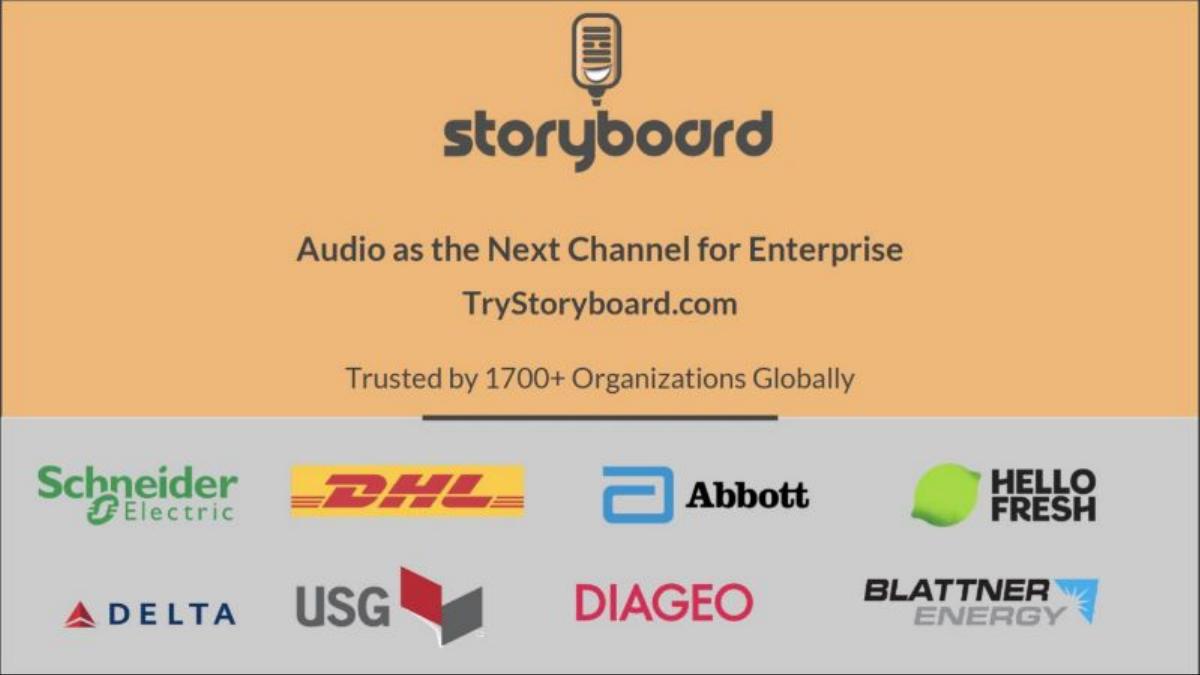
The title slide for Storyboard does more work than most entire decks. It establishes the vision— "Audio as the Next Channel for Enterprise" —and immediately backs it up with a claim of being "Trusted by 1700+ Organizations Globally." The bottom half of the slide is a logo wall featuring heavy hitters: Schneider Electric, DHL, Abbott, Hello Fresh, Delta, USG, Diageo, and Blattner Energy. Leading with these logos is a tactical choice to silence doubts about enterprise security and adoption hurdles before the pitch even begins.
Slide 2: Defining the Product
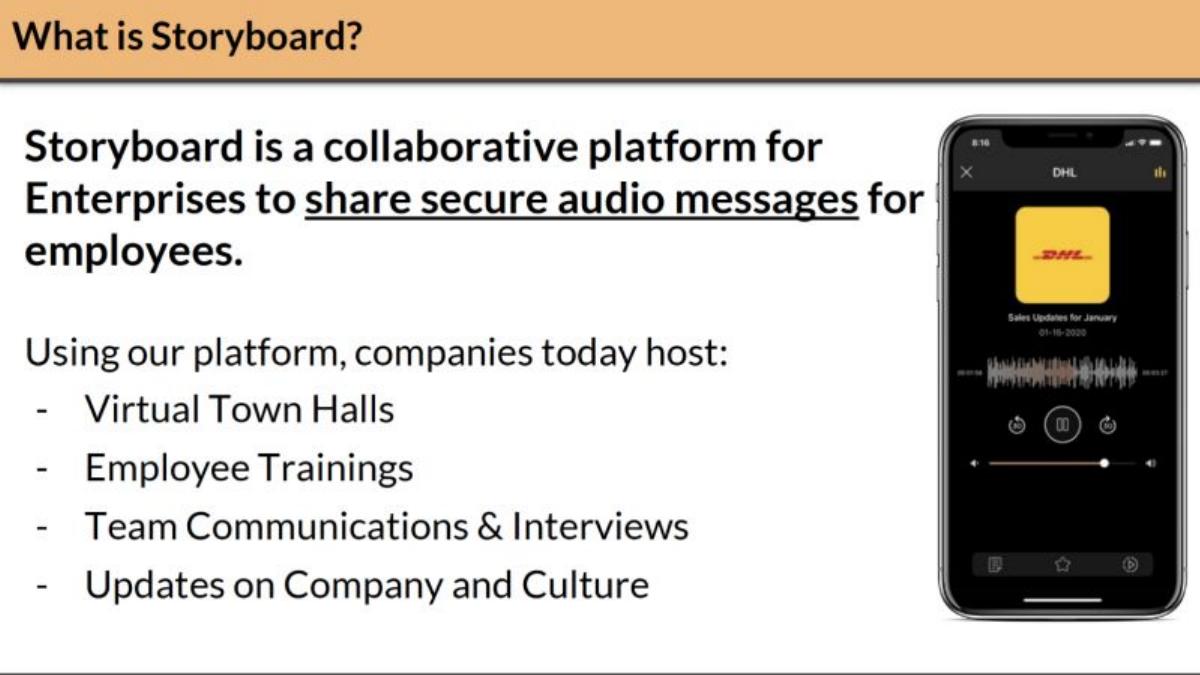
Slide 2 answers the fundamental question: "What is Storyboard?" It defines the platform as a collaborative tool for sharing "secure audio messages for employees." The slide lists four primary use cases: Virtual Town Halls, Employee Trainings, Team Communications & Interviews, and Updates on Company and Culture. A mobile mockup on the right shows a DHL-branded audio interface, reinforcing the enterprise-grade nature of the application.
Slide 3: Strategic Evolution and Frequency
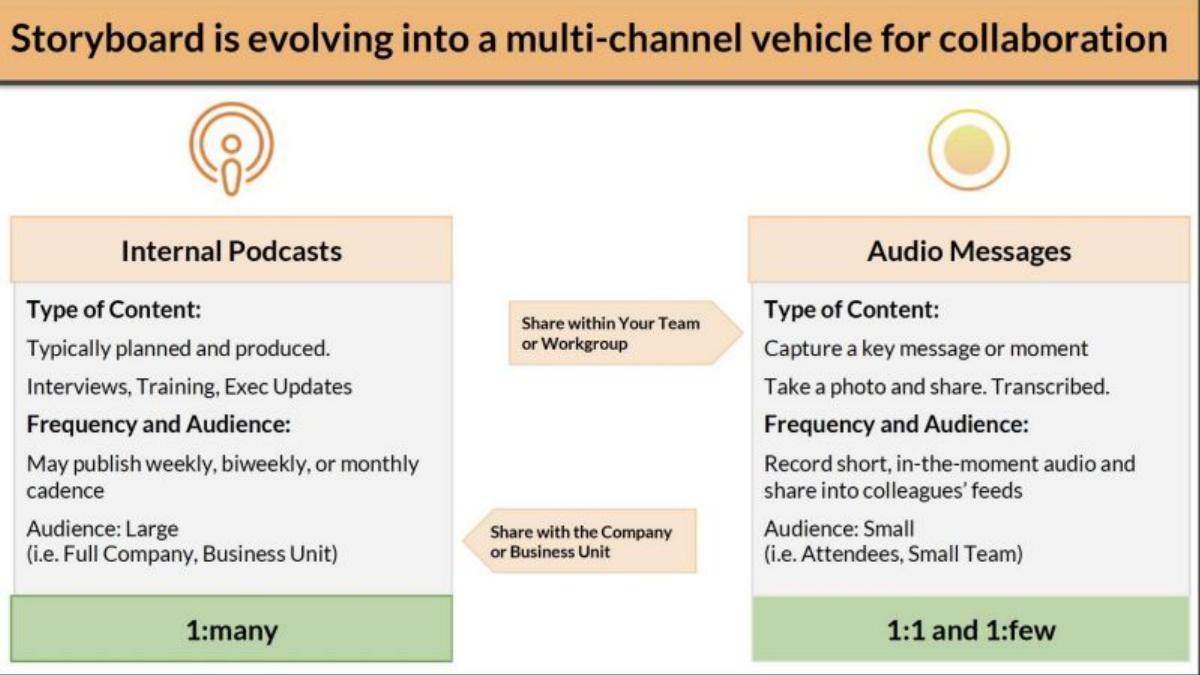
This slide is perhaps the most important for investors. It explains how Storyboard is "evolving into a multi-channel vehicle for collaboration." It contrasts "Internal Podcasts" (1:many, planned, produced, large audience) with "Audio Messages" (1:1 and 1:few, in-the-moment, transcribed, small audience). By moving into the 1:1 and 1:few space, Storyboard is positioning itself as a daily communication tool rather than a monthly broadcast tool. This shift is vital for justifying a high valuation based on daily active usage (DAU) rather than occasional engagement.
Slide 4: The User Experience
Slide 4, titled "How It Works: Intuitive Audio Experience with Enterprise Security," walks through a three-step user journey. 1) User downloads and signs in. 2) User receives a "curated main feed just for their organization" with "no cumbersome discovery step." 3) User plays encrypted audio, which can be streamed or played offline. The emphasis here is on removing friction—a common pain point in enterprise software.
Slide 5: The Growth Engine
The traction slide, "Storyboard’s Growth: Net Paid User 'Seats' Over Time," shows a line graph with a consistent, steep upward trajectory from December 1 to December 1. While the Y-axis lacks specific numbers, the visual trend is clear. The slide notes that growth comes from two sources: net new account growth and "strong expansion of existing customers within six months of launching SB." This 'land and expand' narrative is a favorite for SaaS investors as it proves the product's value to the end-user, not just the purchasing manager.
Slide 6: Core Use Cases and Market Segments
Slide 6 elaborates on how the tool is used today. It breaks down usage into Internal Comms, Training and Onboarding, and Team Specific Comms. Notably, it introduces a fourth category: "Deskless Workers." This is a massive market segment (drivers, warehouse workers, field technicians) that often cannot engage with text-heavy tools like Slack or email while working. Highlighting this segment suggests a unique competitive advantage in a specific, large-scale labor market.
Slide 7: External Validation
Instead of a traditional market size slide, Slide 7 uses social proof. Titled "The demand for internal audio channels is quickly taking shape," it features four tweets from tech and media influencers. Patrick McKenzie (@patio11) discusses the marginal value of internal podcasts, while Sonal Chokshi (@smc90) calls internal podcasts an "underrated and underdiscussed trend." This slide serves to prove that the 'zeitgeist' is moving toward audio, validating Storyboard’s timing.
Slide 8: The BestPitchDeck.com Placeholder
The final slide in this sequence is a promotional slide for the source library and does not contain company-specific information. The actual Storyboard deck concludes its narrative at Slide 7, leaving the 'Ask' and 'Team' to be handled in the live conversation or a follow-up data room.
What Storyboard Does Exceptionally Well
Logo Dominance: Very few Seed-stage companies can lead with a logo wall that includes DHL and Delta. Storyboard uses this to bypass the 'security' and 'enterprise readiness' questions that usually plague early-stage startups selling to the Fortune 500.
Clarity of Use Case: By explicitly listing town halls, training, and deskless workers, the deck makes the product's utility concrete. It isn't just 'audio for work'; it is a specific solution for specific corporate functions.
Focus on Expansion: Mentioning that customers expand within six months is a powerful signal of product-market fit. It tells investors that once the product gets inside a company, it spreads organically.
What Is Missing from the Storyboard Deck
The Team: There is no mention of the founders' backgrounds. While the traction is impressive, investors usually want to know why this specific team is best suited to build an enterprise audio giant.
The Financials and The Ask: The deck does not state how much they are raising (though we know from the catalogue it was $4.5M) or what the capital will be used for. There are no projections for future revenue or seat growth.
The Competition: The deck ignores the existence of Slack Huddles, Loom, or other asynchronous communication tools. While this keeps the focus on Storyboard, it leaves a gap in the narrative regarding how they will defend their position against established incumbents.
Founder's Guide: What to Copy
Use Social Proof Early: If you have big-name customers, do not bury them on Slide 12. Put them on the title slide. It changes the psychological posture of the investor from skeptical to curious. Show the Shift in Frequency: If your product is evolving from a 'low-frequency' tool to a 'high-frequency' tool, use a slide like Storyboard’s Slide 3 to visualize that transition. Higher frequency equals higher retention and higher valuation. Leverage Third-Party Validation: If industry experts are talking about your category on social media, use those screenshots. It is often more convincing than a self-generated bar chart showing a trillion-dollar TAM.
Frequently asked questions
- Why did Storyboard omit a Team slide in their $4.5M Seed deck?
- While unusual, Storyboard likely relied on the strength of their existing traction and the high-profile nature of their early customers to carry the pitch. In a Seed round, if the product is already 'trusted by 1,700+ organizations' as stated on Slide 1, the founders may feel the market validation speaks louder than their individual resumes. However, for most startups, omitting the team is a high-risk move that we generally advise against.
- How does Storyboard define its business model in this deck?
- The deck focuses on a 'paid seats' model. Slide 5 explicitly tracks 'Net Paid User Seats' over time, noting that growth comes from both net new account acquisition and the expansion of existing customers within six months of launch. This indicates a standard SaaS seat-based pricing structure common in enterprise communication tools like Slack or Zoom.
- What is the significance of the 'Internal Podcasts' vs. 'Audio Messages' distinction?
- Slide 3 shows a strategic shift from high-production, 1:many content (podcasts) to low-friction, 1:1 or 1:few communication (audio messages). This transition is crucial because it increases the frequency of use. While a town hall happens monthly, team-specific audio messages can happen daily, making the platform more 'sticky' and essential to the daily workflow.
- How does the deck handle market size and competition?
- Storyboard ignores traditional TAM/SAM/SOM slides and competitor grids. Instead, Slide 7 uses social media screenshots from figures like Patrick McKenzie and Sonal Chokshi to argue that 'demand for internal audio channels is quickly taking shape.' This 'social proof' approach to market validation suggests the market is being pulled by demand rather than pushed by the startup.
- Is an 8-slide deck enough to raise $4.5M?
- In this case, yes. Storyboard’s deck is highly focused on the 'What' and the 'Proof.' By showing a clear product interface (Slide 4) and a strong growth trajectory (Slide 5), they answered the most critical investor questions regarding product-market fit. The brevity suggests a high level of confidence in the metrics and the blue-chip customer list.