Stoke Talent's 2019 Seed deck is a masterclass in narrative-driven fundraising. Rather than leading with dense metrics or complex product screenshots, the deck focuses on a macro-economic shift toward on-demand, high-skilled labor. By framing the problem as an organizational evolution—moving from rigid structures to 'nimble' and 'distributed' teams—Stoke positions its software as the essential infrastructure for this new era. The deck successfully raised $4.5M by leaning heavily on the founders' deep enterprise backgrounds at companies like VMware and Microsoft, alongside a clear architectura…
Key takeaways
- The deck uses a 19-slide structure that spends the first 10 slides building a narrative case for the 'on-demand workforce' shift.
- Slide 7 identifies five key organizational changes: Result based, Agile, Nimble, Distributed, and On-Demand.
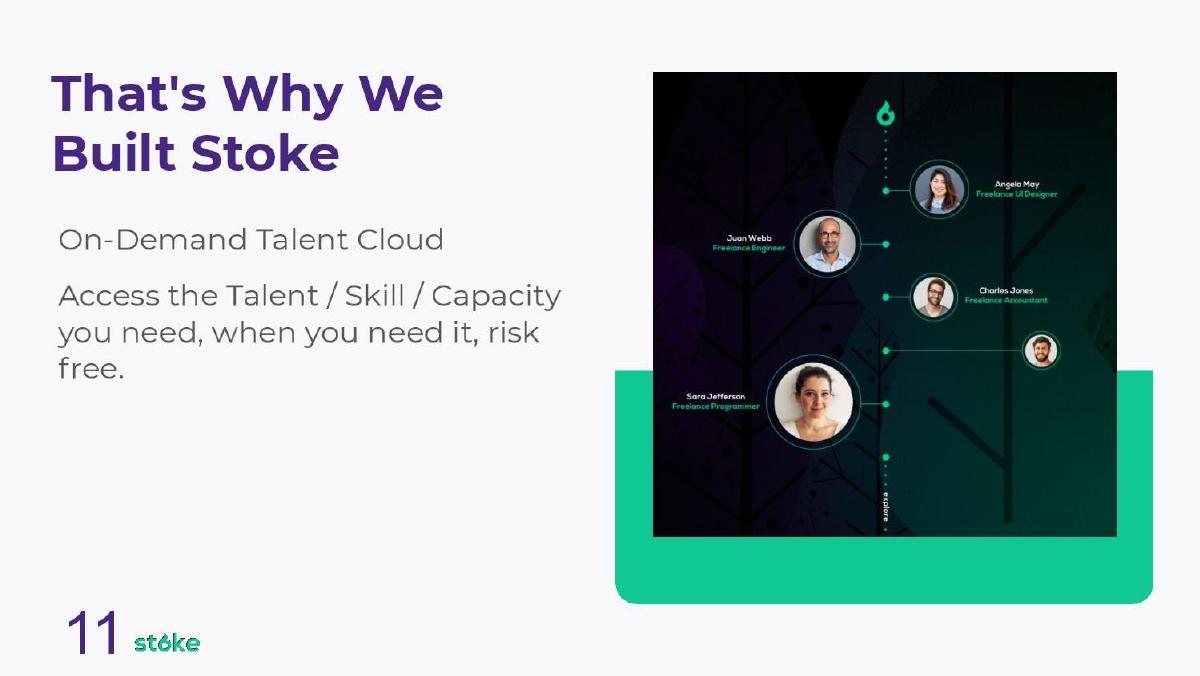
- The product is positioned as an 'On-Demand Talent Cloud' on Slide 11, focusing on risk-free access to skills and capacity.
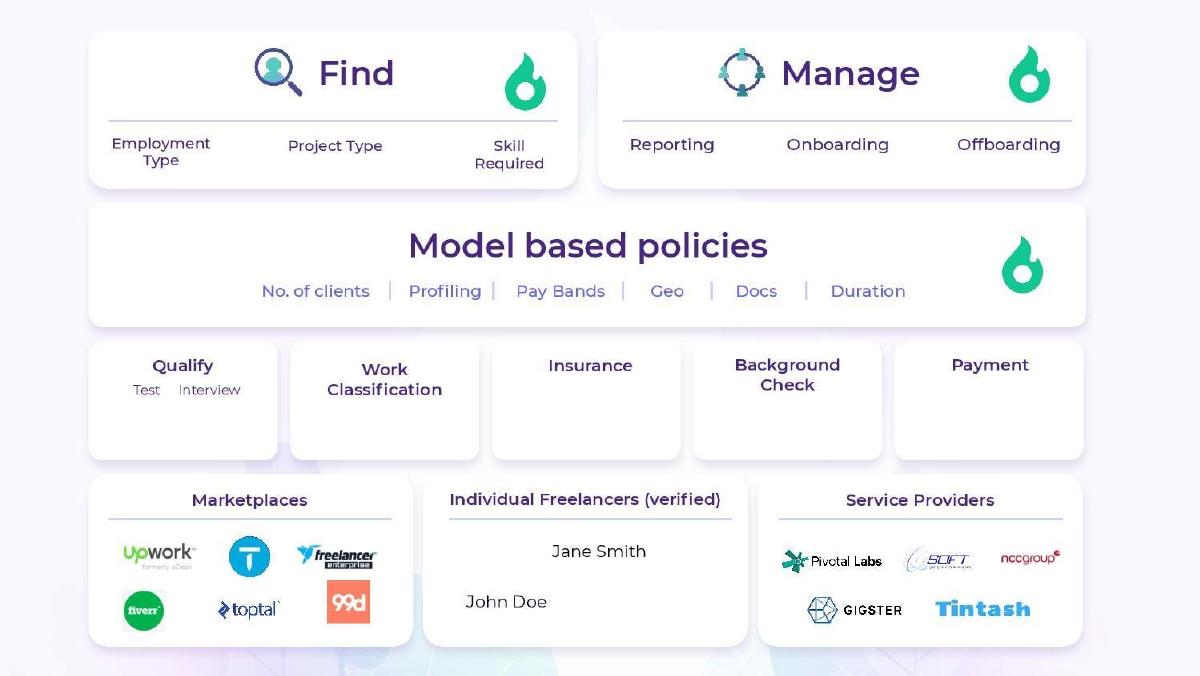
- Slide 15 provides a comprehensive ecosystem map, showing how Stoke integrates with marketplaces like Upwork, Fiverr, and Toptal.
- The platform features detailed on Slide 15 include work classification, insurance, background checks, and payment processing.
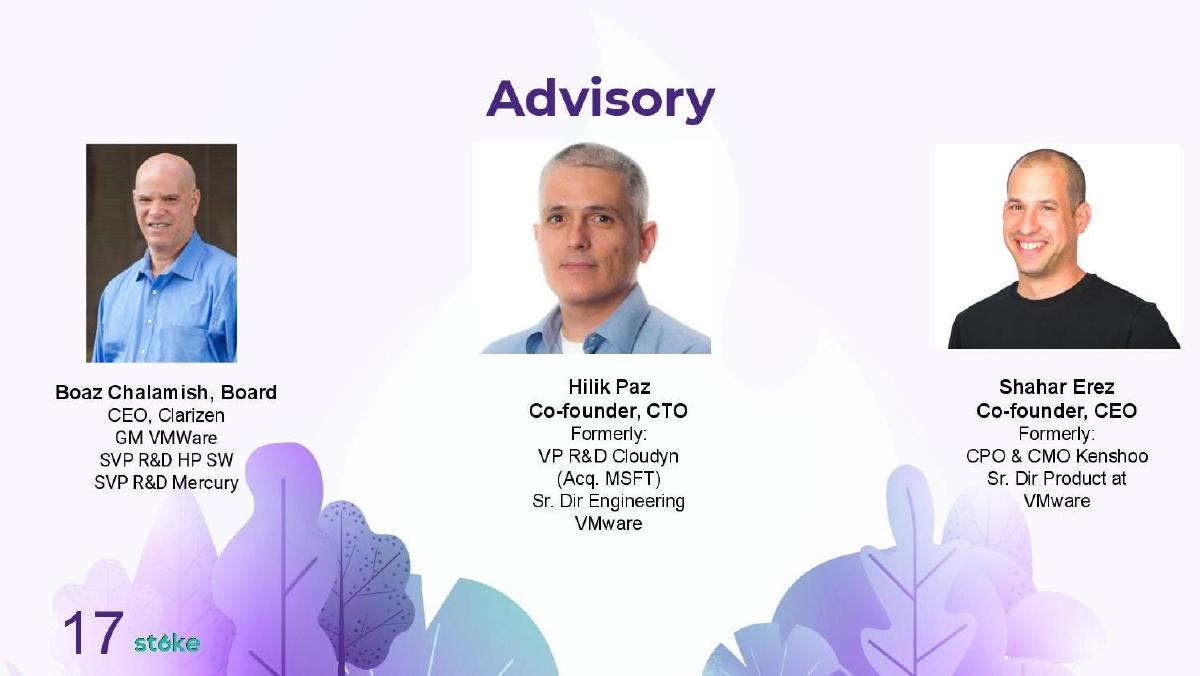
- The team slide (Slide 17) highlights significant enterprise experience at VMware, Microsoft, and Clarizen.
- There is no 'Ask' slide detailing the specific amount being raised or the intended use of funds within the 19 slides.
- The deck omits financial metrics, current revenue, and user growth data, relying instead on the market vision.
The Narrative Hook: Building the Case for Change
Stoke Talent’s pitch deck is an excellent example of a 'Vision' deck. In the early stages of a Seed round, especially in a crowded market like HR technology, founders often need to convince investors that a fundamental shift in the world is happening. Stoke does this by spending the first half of the deck not on their product, but on the macro-environment.
Slides 1-4: Setting the Stage
Slide 1 introduces the brand with the tagline 'Workforce at the pace of business.' The visual identity is consistent throughout—dark backgrounds with glowing, neon-accented illustrations. This creates a modern, 'tech-forward' feel that distinguishes it from legacy HR software. Slide 2 makes a bold claim: 'We are on the cusp of a significant shift when organizations will rely far more on an on-demand workforce.' This is the 'Why Now' of the deck.
Slides 5-8: Defining the New Worker
Slide 5 narrows the focus to 'high-skilled individuals.' This is a crucial distinction. Stoke isn't targeting the low-cost 'gig economy' of delivery drivers; they are targeting the professional freelance market. Slide 7 summarizes the organizational shift using five keywords: Result based, Agile, Nimble, Distributed, and On-Demand. By using the hashtag #shiftishappening, they attempt to create a sense of inevitability and urgency.
Slides 9-10: The 'But' and the Pivot
Slide 9 is a simple transition slide with the word 'But...' and an illustration of a rocket being lit. This is a classic storytelling technique used to introduce the conflict. The implication is that while the shift to on-demand talent is like a rocket, there is a missing piece to the puzzle that prevents it from taking off safely or efficiently.
The Solution: The On-Demand Talent Cloud
Slide 11: The Value Proposition
Slide 11 introduces the core product concept: the 'On-Demand Talent Cloud.' The slide lists three key benefits: Access to Talent, Skill, and Capacity. The most important phrase here is 'risk free.' For enterprise companies, hiring freelancers is often a compliance and legal nightmare. By promising a 'risk-free' experience, Stoke is speaking directly to the pain points of HR and Legal departments.
Slides 12-14: Democratizing the Workforce
Slide 13 uses the phrase 'Workforce Democratized.' This is a high-level vision statement that suggests Stoke is not just a tool, but a platform that levels the playing field for both companies and workers. The illustrations continue to emphasize a 'campfire' theme, suggesting community and warmth in a digital-first work environment.
Slide 15: The Functional Architecture
This is arguably the most important slide in the deck. It breaks down the platform into three horizontal layers: Find, Manage, and Model-based policies. Find covers employment types and skills. Manage covers reporting, onboarding, and offboarding. The middle layer, Model based policies , is where the 'magic' happens, including pay bands, geography, and duration. Below this, Stoke shows how they integrate with existing marketplaces like Upwork, Fiverr, Toptal, and 99designs. This positioning is brilliant because it tells investors: 'We are not competing with Upwork; we are the management layer that makes Upwork usable for big companies.'
The Team and the Exit
Slide 17: The Advisory and Leadership
For a $4.5M Seed round, the team is the primary asset. Slide 17 highlights the deep enterprise pedigree of the founders. Shahar Erez (CEO) was a Sr. Dir of Product at VMware and CPO/CMO at Kenshoo. Hilik Paz (CTO) was a Sr. Dir of Engineering at VMware and a VP of R&D at Cloudyn (which was acquired by Microsoft). Boaz Chalamish is listed as a Board member with CEO experience at Clarizen. This slide screams 'Enterprise Grade.' Investors are much more likely to fund a vision deck when the people behind it have already built and sold companies to the likes of Microsoft.
Slide 19: The Closing
The deck ends on Slide 19 with a simple 'Thank You' and contact information. Notably, there is no slide detailing the 'Ask' (how much money they want) or the 'Milestones' (what they will do with it). While these are often removed from public versions of decks, their absence in a pitch context would be a red flag. However, given the successful outcome, it is likely these were discussed in the verbal pitch or a supplemental data room.
What Works in the Stoke Talent Deck
Clear Positioning: By positioning themselves as a management layer (Slide 15) rather than a marketplace, they avoid the 'chicken and egg' problem of needing to attract both workers and employers simultaneously. · Strong Narrative: The deck follows a logical flow: The world is changing (Slides 2-7), there is a problem (Slide 9), we have the solution (Slide 11), and here is how it works (Slide 15). · Visual Consistency: The high-quality, custom illustrations give the company a premium feel, which is important when selling to enterprise HR departments. · Founder-Market Fit: The team slide (Slide 17) perfectly matches the product. If you are building enterprise software for managing talent, having 'Sr. Dir of Product at VMware' on your resume is a massive validator.
What is Missing from the Stoke Talent Deck
Financials and Traction: There is zero mention of revenue, number of customers, or growth metrics. Even at the Seed stage, showing some early pilot data or a pipeline of interested enterprises is usually expected. · The Ask: As mentioned, the deck does not state how much capital is being raised or how it will be allocated between engineering, sales, and marketing. · Competitive Landscape: While Slide 15 shows marketplaces, it doesn't show direct competitors in the 'Freelance Management Systems' (FMS) space, such as WorkLogix or Beeline. A slide showing why Stoke is better than existing enterprise VMS (Vendor Management Systems) would have been helpful. · Unit Economics: There is no mention of the business model. Does Stoke charge a SaaS fee per seat, or a percentage of the freelancer's pay? This is a critical question for any investor.
Lessons for Founders
Sell the Shift, Not Just the Tool: If you are in a new category, spend time explaining why the old way of doing things is dead. Stoke does this effectively by highlighting the move toward 'nimble' and 'distributed' teams. · Integrate, Don't Just Compete: If there are giants in your industry (like Upwork), show how you can add value to their ecosystem rather than trying to kill them. This makes your business model feel less risky. · Lead with Your Strengths: If you have a world-class team, make sure their logos (VMware, Microsoft) are prominent. In early-stage investing, the 'Who' is often more important than the 'What.' · Use a 'System' Slide: Slide 15 is a 'System' slide. It shows how all the pieces of the business fit together. Every deck should have one slide that acts as a map for the entire product offering.
Frequently asked questions
- How much did Stoke Talent raise with this deck?
- As reported by Business Insider, Stoke Talent raised $4.5M in a Seed round in 2019. The deck itself does not state the amount, which is common in decks shared publicly after the fact to protect sensitive deal terms.
- What is the primary problem Stoke Talent solves?
- Stoke Talent addresses the friction in managing high-skilled freelancers. Slide 15 shows that while marketplaces exist to find talent, companies struggle with the 'Manage' phase, including onboarding, offboarding, work classification, and insurance.
- Does the deck include a product demo or screenshots?
- No. The deck uses conceptual illustrations and architectural diagrams (Slide 11 and Slide 15) rather than actual software screenshots. This is typical for early Seed rounds where the vision and workflow are more important than the UI.
- Who are the founders of Stoke Talent?
- The deck identifies Hilik Paz (CTO) and Shahar Erez (CEO) on Slide 17. Both have significant backgrounds at VMware, with Paz also having experience at Microsoft and Erez at Kenshoo.
- What is missing from this pitch deck?
- The deck is missing several standard components: a specific financial 'Ask,' a slide on unit economics or revenue, a detailed competitor comparison table, and a roadmap of future features.