Momentum's 20-slide Seed deck is a masterclass in identifying a specific workflow friction point—the disconnect between sales conversations and CRM data—and positioning it as a massive market opportunity. By framing the solution as a 'no-code collaboration platform,' the founders successfully tapped into the broader trend of distributed work and the digitization of sales. The deck secured $5M from top-tier investors like Basis Set Ventures and South Park Commons. While it lacks detailed unit economics or a competitive matrix, it compensates with strong social proof, a clear product vision, an…
Key takeaways
- The problem is defined as the increasing complexity and 'messiness' of enterprise selling as deals scale (Slide 3).
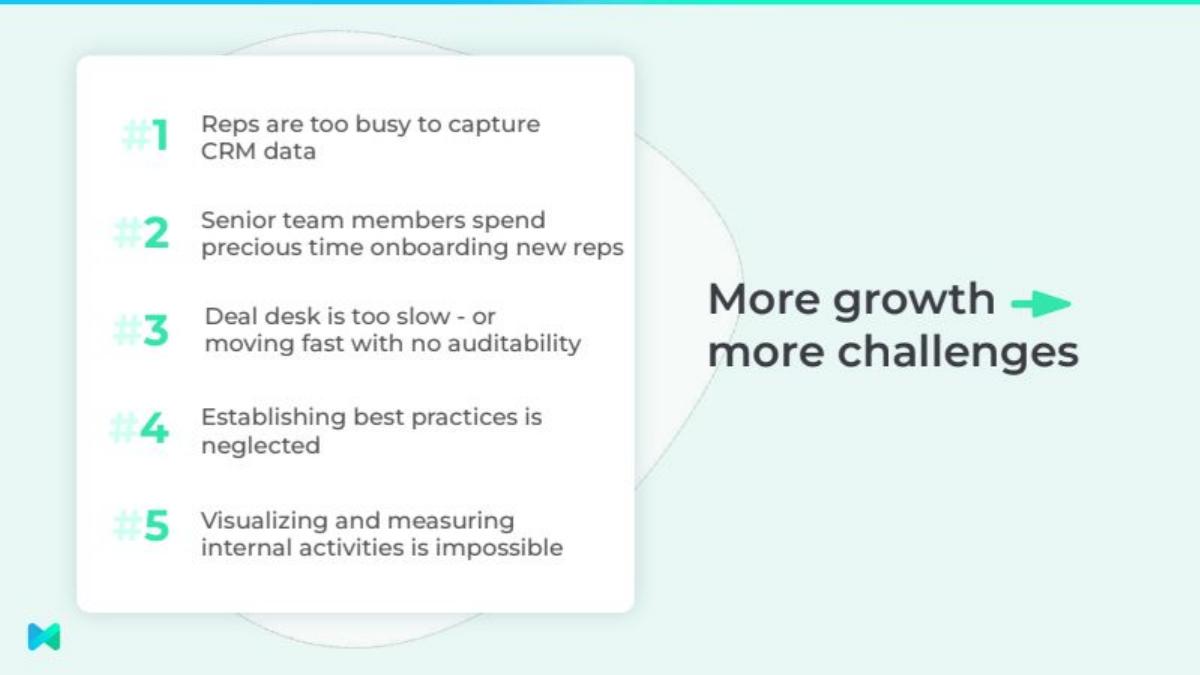
- Momentum identifies five specific pain points, including reps being too busy for CRM data entry and the difficulty of measuring internal activities (Slide 4).
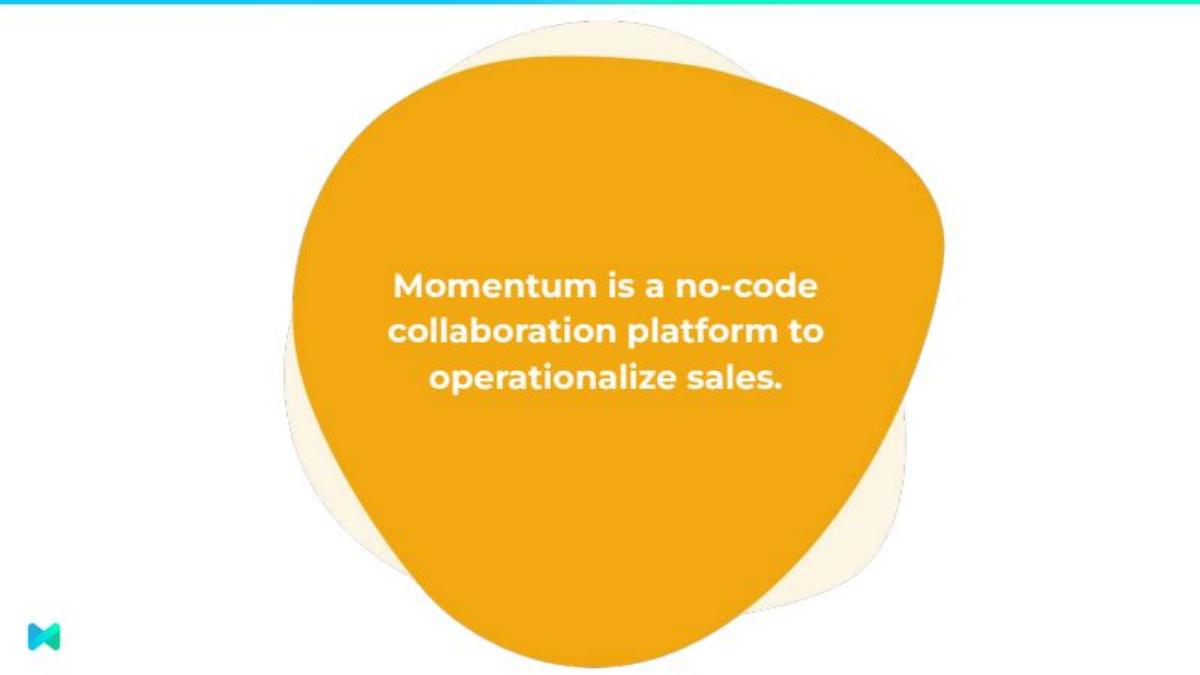
- The product is positioned as a 'no-code collaboration platform' to operationalize sales, rather than just a simple integration tool (Slide 6).
- The 'Why Now' slide anchors the solution in two macro trends: distributed work and the total digitization of SaaS sales (Slide 11).
- Traction is presented through redacted ARR figures and a list of logos, suggesting early market validation (Slide 12).
- The market opportunity is calculated by combining the $16B Salesforce Sales Cloud market with the $13.8B low-code platform market (Slide 14).
- The team slide highlights high-level advisors and executives from Miro and Asana to build credibility (Slide 15).
- The fundraise ask was $4M for 18 months of runway to reach $1M ARR, though the catalogue indicates they ultimately closed $5M (Slide 16).
The Narrative Arc: From Chaos to Automation
Momentum’s pitch deck is built on a classic problem-solution framework, but it elevates the narrative by focusing on 'Sales Operations' as a strategic lever rather than a back-office function. The deck uses a clean, minimalist aesthetic with high-contrast colors to guide the investor through the transition from the current 'messy' state of sales to a future of 'automated workflows.'
Slides 1-5: Defining the Enterprise Struggle
Slide 1 is a standard title slide featuring the Momentum logo and URL. It establishes a professional, tech-forward brand identity immediately.
Slide 2 and Slide 3 serve as the 'hook.' They argue that as deals get bigger, selling becomes more collaborative and complex. Slide 3 specifically uses the words 'chaotic and messy' to describe the deal cycle, a pain point that any enterprise sales leader or VC who has sat in a board meeting will recognize. This is a high-level emotional appeal to the difficulty of scaling a sales org.
Slide 4 gets granular. It lists five specific challenges: reps not capturing CRM data, senior members wasting time on onboarding, slow deal desks, neglected best practices, and the impossibility of measuring internal activities. This slide is crucial because it sets up the 'check-list' of features the product must eventually provide. If you agree these five things are problems, you are primed to accept Momentum’s solution.
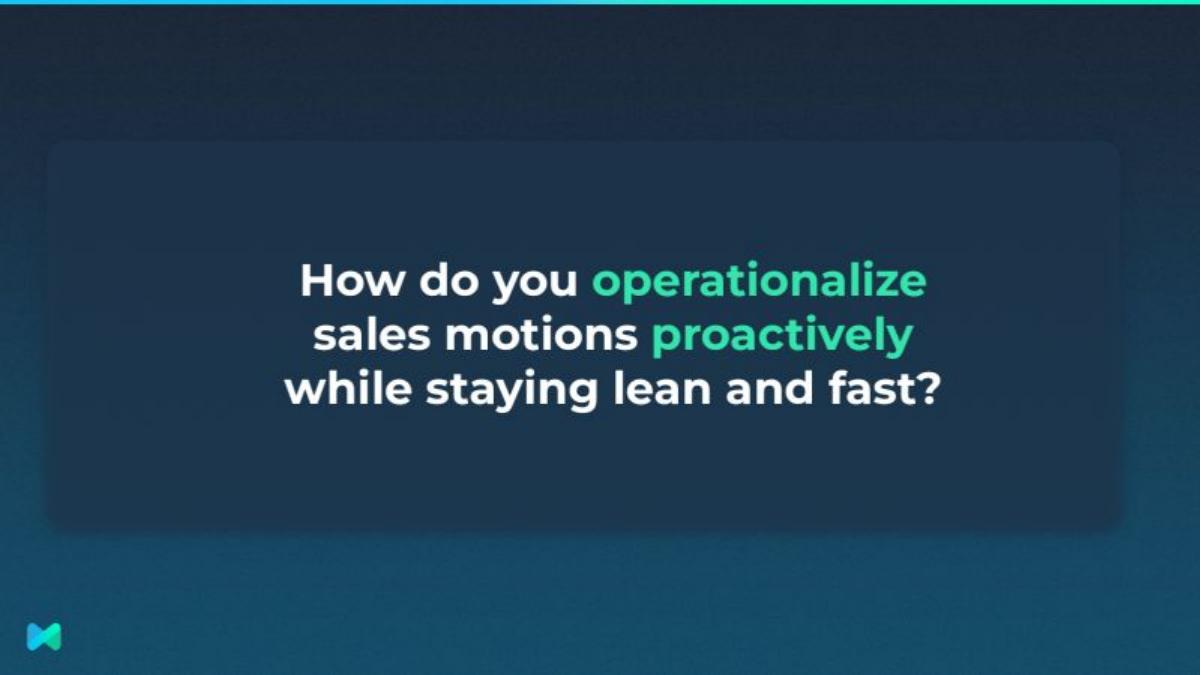
Slide 5 poses the central question: 'How do you operationalize sales motions proactively while staying lean and fast?' This transition slide bridges the gap between the 'what' (the problem) and the 'how' (the product).
Slides 6-10: The No-Code Solution
Slide 6 introduces Momentum as a 'no-code collaboration platform to operationalize sales.' By using the term 'no-code,' the founders are signaling that this isn't a heavy, months-long implementation. It’s a tool for the modern, agile RevOps team.
Slide 7 and Slide 8 elaborate on the 'building blocks' concept. Slide 8 highlights four value propositions: Real-time collaboration, Integrating key tools, Turn-key recipes, and High customizability. This suggests a platform that is both ready-to-use ('recipes') and flexible enough for unique enterprise needs.
Slide 9 provides the first glimpse of the product in action. It shows a Momentum notification regarding a 'Disney Opportunity' with attendees, LinkedIn links, and outstanding milestones. This visualizes the 'Smart Deal Room' concept, showing how CRM data is pulled into a collaborative environment.
Slide 10 summarizes the 'How It Works' through five pillars: Smart Deal Rooms, Meeting Game Plan, Deal Playbook, Deal Desk, and Deal Assist. A diagram shows Momentum sitting between the user and Salesforce, acting as the automation layer that ensures data flows back to the system of record without manual entry from the rep.
Slides 11-14: Market Validation and Opportunity
Slide 11 addresses the 'Why Now?' question. It cites the arrival of distributed work (making tools like Slack fundamental) and the digitization of sales (requiring cross-functional collaboration with marketing, legal, and finance). This frames Momentum not just as a 'nice-to-have' tool, but as a necessary infrastructure for the post-pandemic sales world.
Slide 12 covers traction. While the ARR figure is redacted in this version of the deck, the slide includes two columns of bullet points (likely customer names or growth metrics) and the header 'Early Traction is Promising.' This indicates that the product is already in market and generating revenue.
Slide 13 is a 'User Love' slide. It features testimonials from LinkedIn and Slack. One quote from Michael Wilde stands out: 'closed out that renewal... from Slack, in my truck... didn’t need even have to open the Salesforce app.' This is a powerful validation of the core value proposition—removing the friction of CRM usage.
Slide 14 defines the market. Momentum avoids the 'trillion-dollar market' trap and instead points to two tangible figures: the $16B Salesforce Sales Cloud market and the $13.8B low-code platform market. This suggests that Momentum is capturing a slice of the existing CRM budget while riding the wave of low-code adoption.
Slides 15-20: The Team and The Ask
Slide 15 introduces the team and investors. The founders (Santiago Suarez Ordonez, Moiz Virani, and Ashley Wilson) are shown alongside heavy-hitting advisors from Miro and Asana. This builds 'founder-market fit' by showing they have the backing of leaders from the most successful collaboration tools in the SaaS industry. Lead investors like Basis Set Ventures and South Park Commons are prominently displayed.
Slide 16 contains the 'Ask.' They were seeking $4M for 18 months of runway. The goal was clearly defined: 'continue building the product and track to $1M ARR.' This is a very standard and transparent Seed-stage ask, giving investors a clear milestone to hold the team accountable to.
Slide 17 is a simple 'DEMO' placeholder, likely where the founders would switch to a live product walkthrough during a pitch.
Slide 18 provides a final testimonial from Peter Ahn, VP of Sales at Twingate, who claims Momentum can mean the difference between 'closing a deal in two weeks versus two months.' This is a bold ROI claim to end the presentation on.
Slide 19 and Slide 20 are the 'Thank You' and closing slides, maintaining the brand consistency to the end.
What Momentum Does Well
The deck excels at problem identification . By breaking down the 'messiness' of sales into five distinct, relatable pain points on Slide 4, they make the solution feel inevitable. They also do a great job of positioning . They aren't just a 'Slack-to-Salesforce' bot; they are a 'no-code collaboration platform.' This allows them to command a higher valuation and point to a larger market (Slide 14).
The social proof is also exceptionally strong. Including a quote about closing a deal 'in a truck' (Slide 13) is a vivid, memorable detail that proves the product solves a real-world problem for busy sales reps. Finally, the team slide leverages the logos of Miro and Asana effectively, borrowing the 'cool factor' and operational credibility of those high-growth companies.
What Is Missing
The most notable omission is a Competitive Landscape slide. The sales automation and 'Slack-first' CRM space is crowded with players like Troops (acquired by Salesforce), Scratchpad, and Dooly. Momentum does not explain how it differs from these existing tools. Are they more 'no-code'? Is their 'Deal Room' functionality unique? The deck leaves these questions unanswered.
There is also a lack of Unit Economics or detailed sales efficiency metrics. While it is a Seed round, providing some data on customer acquisition cost (CAC) or the speed of implementation would have strengthened the 'Why Now' argument. Additionally, the deck does not detail the product roadmap beyond the $1M ARR milestone, leaving the long-term vision somewhat vague.
What Founders Should Copy
Founders should emulate Momentum’s 'Why Now' framing . Instead of just saying 'the market is big,' they tied their product to two undeniable shifts in the world: distributed work and the digitization of sales. This makes the product feel like a consequence of history rather than just a random idea.
The visual simplicity of the product slides (Slide 9 and 10) is also worth copying. They don't show every single button and menu; they show the outcome of the product (a milestone being updated, a team being notified). This keeps the focus on value rather than features. Lastly, the specific fundraise goal on Slide 16—linking the dollar amount to a specific time period (18 months) and a specific revenue milestone ($1M ARR)—is a best practice that every Seed deck should follow.
Frequently asked questions
- What specific problem does Momentum solve?
- Momentum addresses the 'chaotic and messy' nature of tracking deal cycles in enterprise sales. According to Slide 4, the primary issues are sales reps being too busy to capture CRM data, slow deal desks, and the inability to visualize internal activities. It aims to automate the 'building blocks' of sales workflows so teams can stay lean while scaling.
- How does Momentum define its market size?
- Instead of a traditional TAM/SAM/SOM bottom-up analysis, Momentum uses a proxy approach on Slide 14. They cite the $16B Salesforce Sales Cloud market and the $13.8B Gartner-sourced figure for low-code application development platforms. This positions them at the intersection of a massive existing CRM spend and a rapidly growing software category.
- What is the core functionality of the platform?
- The platform consists of five key features listed on Slide 10: Smart Deal Rooms, Meeting Game Plans, Deal Playbooks, Deal Desk, and Deal Assist. Visually, the deck shows these features acting as a bridge between communication tools (like Slack) and systems of record (like Salesforce), automating data updates and milestone tracking.
- Who are the key investors and team members?
- The team is led by CEO Santiago Suarez Ordonez, CTO Moiz Virani, and COO Ashley Wilson. Slide 15 also highlights Zhenya Loginov (Head of Revenue at Miro) and Oliver Jay (CRO at Asana) as key figures. The round was led by Basis Set Ventures (BSV), with participation from South Park Commons and others.
- What were the fundraising goals for this Seed round?
- On Slide 16, Momentum stated they were raising $4M to provide 18 months of runway. The primary objectives for this capital were to continue building the product and to track toward a milestone of $1M in Annual Recurring Revenue (ARR). The catalogue facts show they exceeded this goal, raising $5M.