MonkeyLearn’s 11-slide deck is a textbook example of how to pitch a complex technical product (Machine Learning as a Service) to a non-technical audience. The deck avoids the common pitfall of over-explaining the 'how' of AI, instead focusing on the 'what' through a three-slide visual sequence that demonstrates text analysis in real-time. With a clear value proposition—that building proprietary AI is expensive and slow—the deck pivots quickly to impressive early traction, showing $8,000 in MRR with 35% month-over-month growth. By anchoring the pitch in a $24 billion market and a team with a p…
Key takeaways
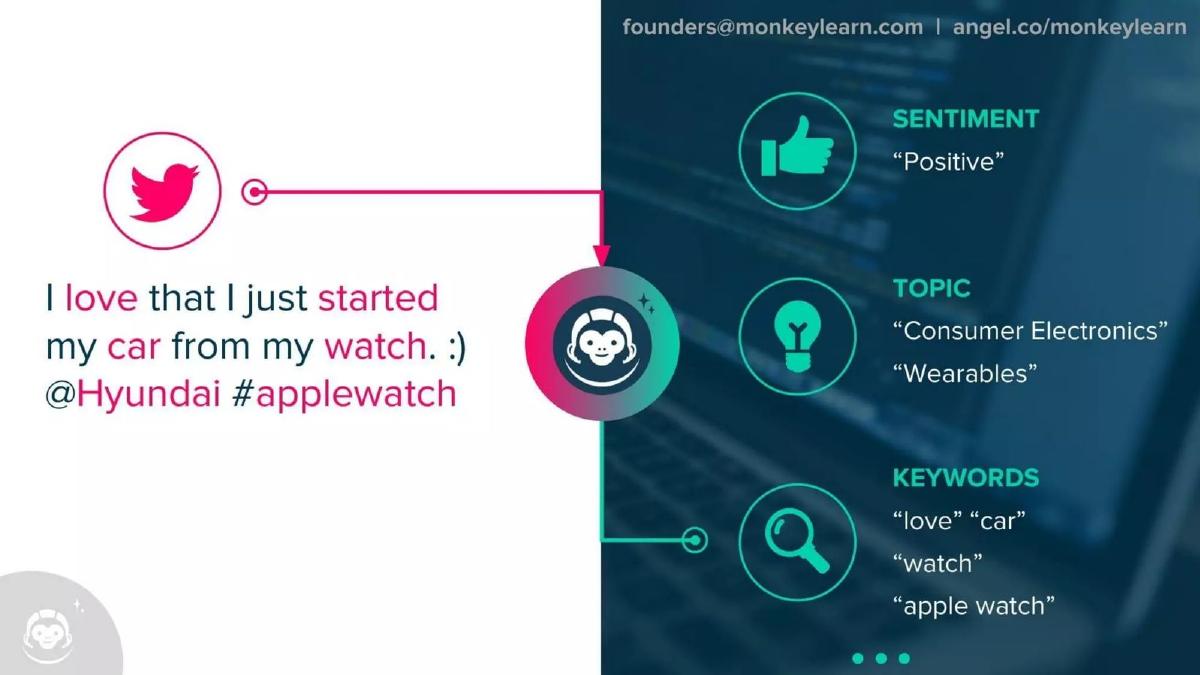
- The deck uses a progressive disclosure technique across slides 2, 3, and 4 to explain how the product extracts sentiment, topics, and keywords from a single tweet.
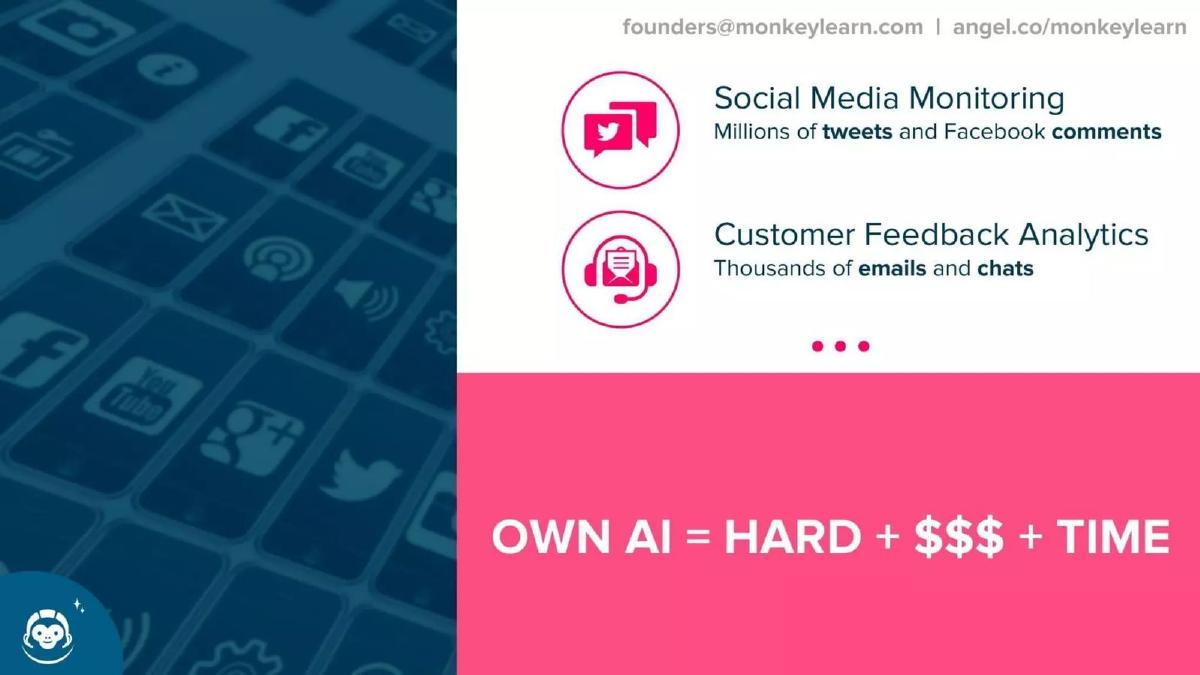
- Slide 5 explicitly identifies the pain point: 'OWN AI = HARD + $$$ + TIME', positioning the product as a cost-saving alternative.
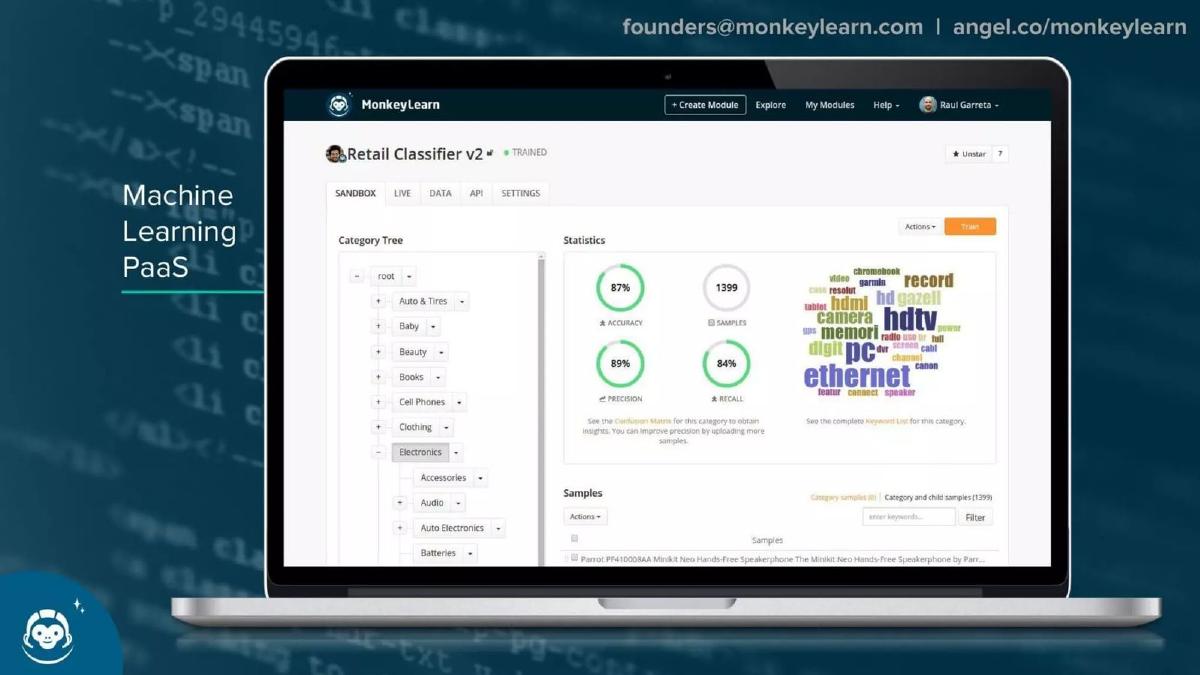
- The product is categorized as a 'Machine Learning PaaS' (Platform as a Service) on slide 6, showing a dashboard with 87% accuracy and 89% precision metrics.
- Traction is highlighted on slide 7 with over 7,000 users and a 10% month-over-month growth rate.
- Financial performance is transparently shared on slide 8, reporting $8,000 MRR and 35% MoM growth as of October.
- The market size is pegged at a $24 billion 'Big Data Market' growing at 32% annually on slide 9.
- The team slide (slide 10) leverages past success, noting the founders previously built Tryolabs to $4M+ in revenues.
- The deck completely omits a specific 'Ask' slide, failing to mention the $3.2 million target or the intended use of funds within the slides themselves.
The Power of Visual Logic in Technical Pitching
MonkeyLearn’s Seed deck is a masterclass in brevity. At only 11 slides, it manages to explain a complex Machine Learning (ML) product, prove market demand, and showcase significant revenue growth. In 2014, when this deck was used, Machine Learning was not yet the household term it is today. The founders faced the challenge of explaining Natural Language Processing (NLP) to investors who might not have been technical experts. They solved this by using a 'show, don't tell' approach that remains a gold standard for technical founders today.
Slides 1-4: The Visual Hook
Slide 1 is a standard title slide, establishing the brand and the tagline: "Machine Learning for Text Analysis." It sets the stage immediately—this is a B2B tool focused on data.
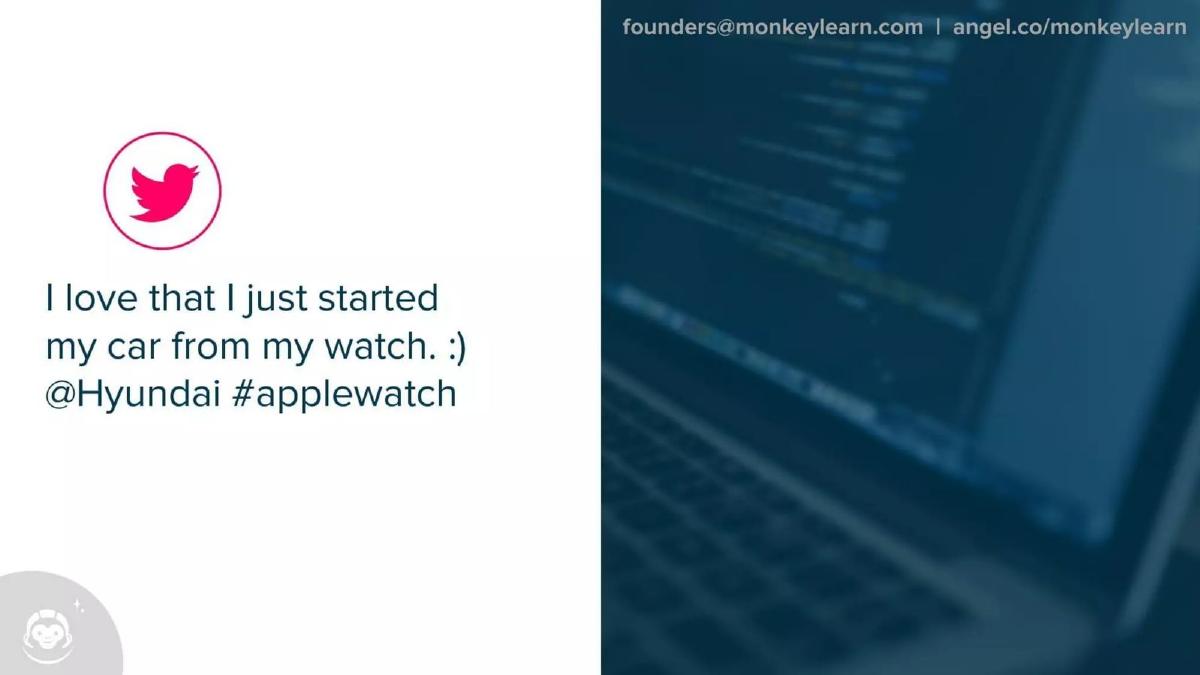
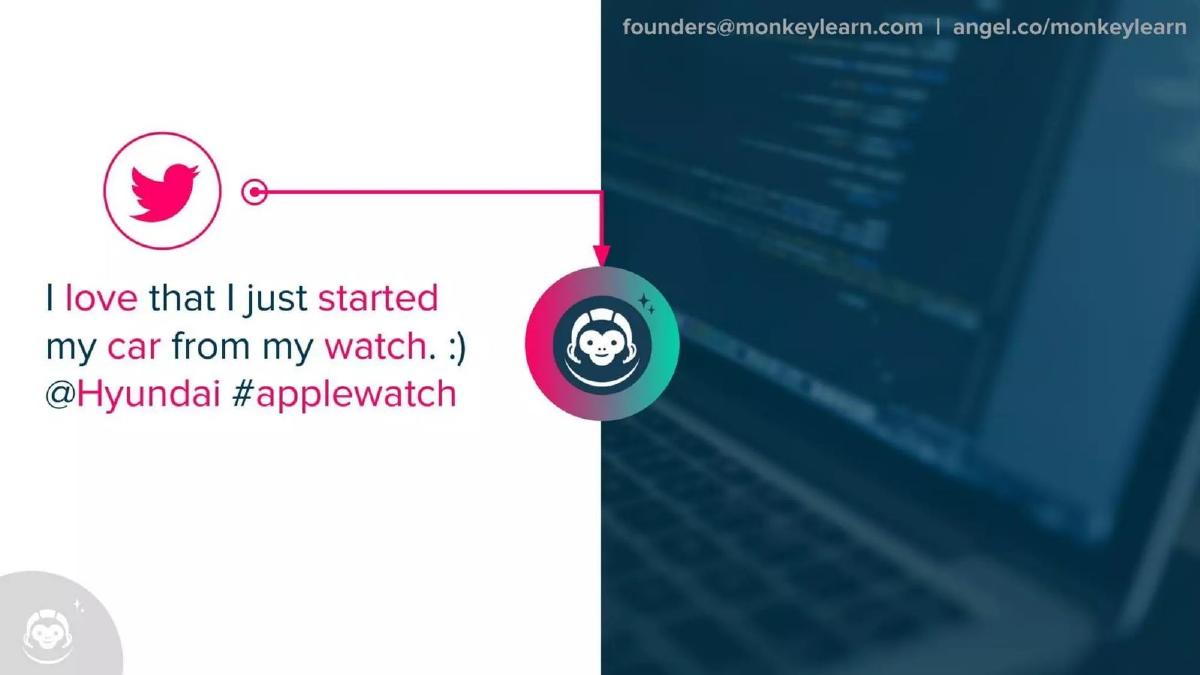
Slides 2, 3, and 4 function as a single animated sequence. Slide 2 shows a raw tweet: "I love that I just started my car from my watch. :) @Hyundai #applewatch." Slide 3 introduces the MonkeyLearn logo as a processing engine, drawing a physical line from the tweet into the 'brain' of the software. Slide 4 shows the output: Sentiment ("Positive"), Topic ("Consumer Electronics," "Wearables"), and Keywords ("love," "car," "watch," "apple watch"). This sequence is brilliant because it explains the product's entire functionality in under ten seconds of viewing time without a single bullet point of technical explanation.
Slide 5: The Economic Reality
Slide 5 shifts from 'what it is' to 'why it matters.' It identifies two primary use cases: Social Media Monitoring (millions of tweets) and Customer Feedback Analytics (thousands of emails and chats). The bottom half of the slide contains the core sales pitch to an investor: "OWN AI = HARD + $$$ + TIME." This acknowledges that while companies want these insights, the cost of hiring data scientists and building infrastructure is a major barrier. MonkeyLearn is positioned as the shortcut.
Slide 6: Product Interface and Credibility
Slide 6 provides a screenshot of the actual platform, labeled as a "Machine Learning PaaS." This is crucial for Seed stage decks because it proves the product isn't vaporware. The screenshot specifically highlights a "Retail Classifier v2" with impressive performance metrics: 87% Accuracy, 89% Precision, and 84% Recall based on 1,399 samples. By showing these specific data science metrics, the founders signal to technical due diligence teams that the engine is robust and functional.
Slides 7-8: The Traction Narrative
Slide 7 uses a photo of a crowded hackathon or office space, labeled "Actual Geek Situation," to humanize the user base. It claims >7,000 Users with +10% MoM growth. The arrow pointing to an "Ubergeek" who loves the product suggests strong developer adoption, which is the lifeblood of a PaaS company.
Slide 8 is the 'money slide.' It shows a clear bar chart of MRR (Monthly Recurring Revenue) from June to October. The revenue grows from approximately $2,000 to $8,000 MRR , representing a +35% MoM growth rate. For a Seed round, showing consistent, high-percentage monthly growth is often more important than the absolute dollar amount, as it suggests a repeatable sales process or product-market fit.
Slides 9-11: Market, Team, and Contact
Slide 9 attempts to quantify the opportunity. It features logos of high-profile users or customers like Adobe, Xerox, Meltwater, VoxPopMe, and PeopleMetrics. It also cites a $24B Big Data Market growing at 32%. While the market definition is broad, the presence of Fortune 500 logos provides the necessary social proof to mitigate the risk of the broad market claim.
Slide 10 introduces the "Kick-Ass Team." The most important detail here isn't the names, but the track record: "Previously founded Tryolabs (Machine Learning, $4M+ revenues)." This tells investors that the founders are not first-timers; they have already built a multi-million dollar business in the same technical domain. The slide also breaks down the team into functional groups: Machine Learning + Technology and Marketing + Sales + Growth, showing a balanced organization.
Slide 11 is a simple contact slide featuring the CEO, Raúl Garreta, and links to their AngelList profile.
What Works
Visual Product Demo: The three-slide sequence explaining NLP is the strongest part of the deck. It removes the 'black box' mystery of AI. · Traction Transparency: Sharing exact MRR and MoM growth percentages builds immediate trust with investors. · Founder-Market Fit: Highlighting the $4M revenue from their previous ML venture proves the team has the technical and commercial competence to execute. · Clear Categorization: Defining themselves as a "Machine Learning PaaS" helps investors bucket them into a specific valuation model (SaaS/PaaS).
What is Missing
The Ask: There is no slide stating how much money is being raised or what the valuation expectations are. · Use of Funds: The deck doesn't explain if the money will go toward engineering, sales, or international expansion. · Competition: There is no mention of other NLP APIs (like AlchemyAPI or Google Prediction API, which were active in 2014). A competitive matrix would have strengthened the 'why us' argument. · Unit Economics: While MRR is shown, there is no mention of Customer Acquisition Cost (CAC) or Lifetime Value (LTV), though these are often excused at the Seed stage.
What a Founder Should Copy
The 'Show, Don't Tell' Sequence: If your product is technical, use a 3-slide progression to show an input, the 'magic' happening, and the valuable output. · The Pain Equation: Use a simple formula like "Own [X] = Hard + Expensive + Slow" to anchor your value proposition in economic reality. · Logo Proof: Even if they are just pilot users or free tier users, showing recognizable enterprise logos (Adobe, Xerox) creates a 'halo effect' that makes the startup seem more established than its MRR might suggest. · Brevity: Keep the deck under 12 slides. If you can't prove your case in 10 minutes, more slides won't help.
Frequently asked questions
- What is the primary value proposition of MonkeyLearn according to the deck?
- The primary value proposition is reducing the barrier to entry for companies wanting to use artificial intelligence. Slide 5 explicitly states that building internal AI is difficult, expensive, and time-consuming. MonkeyLearn positions itself as a 'Machine Learning PaaS' that allows companies to monitor social media and analyze customer feedback without the overhead of building a custom tech stack from scratch.
- How does the deck handle the technical complexity of machine learning?
- It uses visual storytelling rather than technical jargon. Slides 2 through 4 take a single tweet and visually 'process' it through the MonkeyLearn logo to output sentiment, topics, and keywords. This makes the abstract concept of Natural Language Processing (NLP) immediately understandable to a generalist investor who might not understand the underlying algorithms.
- What specific traction metrics did MonkeyLearn share?
- MonkeyLearn shared three key traction layers: user growth, revenue growth, and logo proof. Slide 7 claims over 7,000 users with 10% MoM growth. Slide 8 shows a revenue bar chart peaking at $8,000 MRR with 35% MoM growth. Slide 9 lists enterprise logos including Adobe, Xerox, and Meltwater, proving the tool's utility for large-scale organizations.
- Is the market size slide effective in this deck?
- Slide 9 is somewhat broad, citing a $24 billion 'Big Data Market.' While this shows a large ceiling, it lacks a specific Bottom-Up analysis of the NLP or text analytics sub-sector. However, by showing a global map of user locations, they demonstrate that their market is geographically diverse and not limited to a single region.
- What is the most significant omission in the MonkeyLearn deck?
- The most significant omission is the 'Ask' and 'Use of Funds.' While the catalogue data confirms they raised $3.2 million, the slides themselves do not state how much they are looking for, what milestones they intend to hit with the capital, or what the specific roadmap looks like for the next 18-24 months.