Moonfare’s 12-slide presentation is less of a traditional startup pitch and more of a sophisticated investment thesis on the shifting landscape of global capital. By the time the company raised its $125M Series C in 2022, it had established itself as a bridge between high-net-worth individuals and top-tier private equity funds. The deck leans heavily on market education, dedicating nearly half of its slides to the outperformance of private markets versus public equities. While it lacks granular unit economics or a detailed team slide, it successfully positions Moonfare as the inevitable solut…
Key takeaways
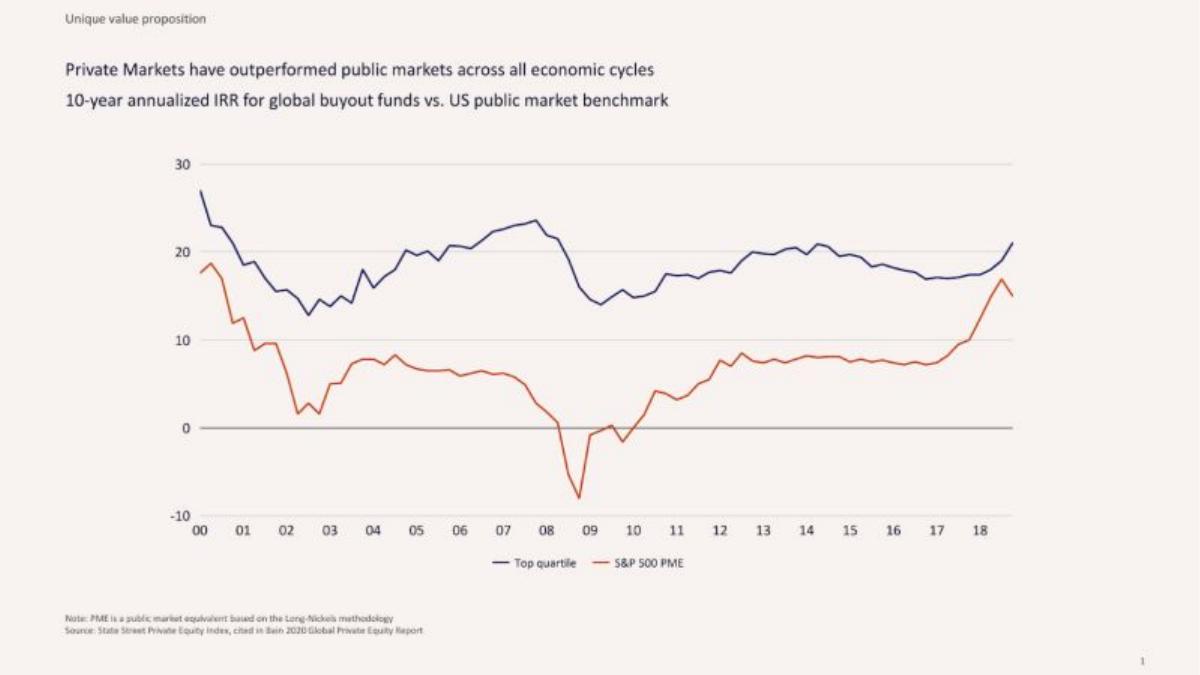
- The deck focuses on the 10-year annualized IRR for global buyout funds, which consistently outperformed the S&P 500 PME from 2000 to 2018 (Slide 1).
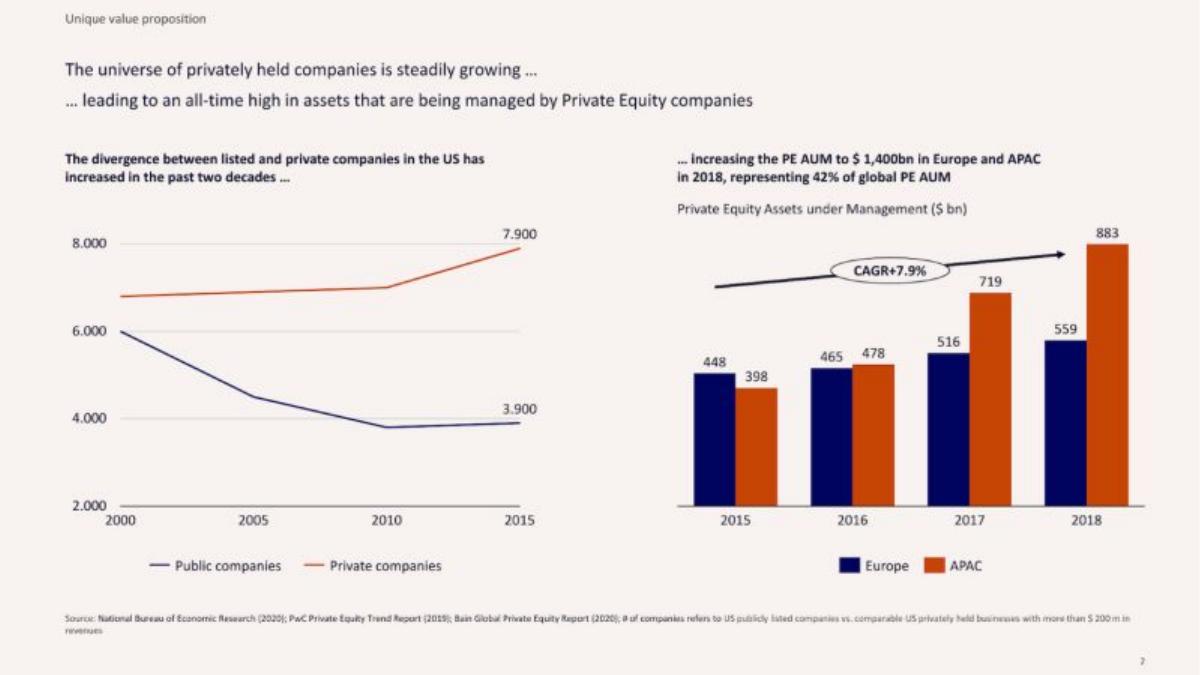
- Moonfare highlights a growing divergence in the US market, where the number of private companies rose to 7,900 while public companies fell to 3,900 by 2015 (Slide 2).
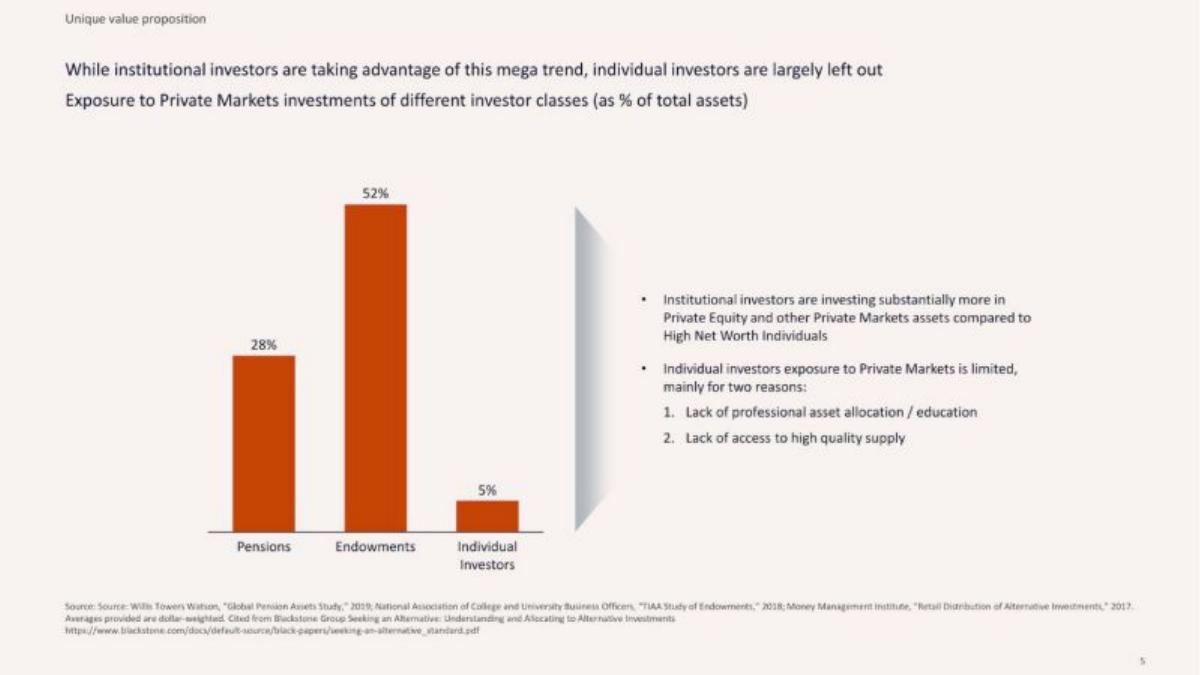
- The platform targets a massive 'access gap,' noting that individual investors hold only 5% of their assets in private markets compared to 52% for endowments (Slide 5).
- Moonfare lowers the barrier to entry for private equity investing to a minimum of €50k (Slide 7).
- The business operates through two distinct channels: Moonfare Direct (B2C) and Partnerships (B2B2C) for private wealth management institutions (Slide 8).
- A core value proposition is the creation of a digital secondary marketplace to provide liquidity in an otherwise 10-year lock-up asset class (Slide 9).
- The deck omits a dedicated team slide, financial projections, and a specific 'ask' or use of funds (Slides 1-12).
- The company cites a 7.9% CAGR in Private Equity Assets under Management in Europe and APAC between 2015 and 2018 (Slide 2).
The Macro Thesis of Private Equity Democratization
The Moonfare Series C deck is a masterclass in narrative-driven fundraising. Rather than leading with features or internal metrics, the company spends the first half of the presentation building an unassailable case for why private equity (PE) is the most attractive asset class of the 21st century. For a Series C round, where the business model is already proven, the goal is often to convince investors of the sheer scale of the opportunity. Moonfare does this by framing the 'retailization' of PE not just as a trend, but as a structural necessity for global investors.
Slides 1-2: The Performance and Growth Gap
Moonfare begins with a 'Unique Value Proposition' section that focuses entirely on market data. Slide 1 presents a 10-year annualized IRR comparison. The data shows that top-quartile global buyout funds have consistently outperformed the S&P 500 Public Market Equivalent (PME) from 2000 through 2018. By starting here, Moonfare establishes the 'Why': investors want in because the returns are superior.
Slide 2 shifts the focus to the shrinking public market. It notes a 'divergence between listed and private companies in the US,' where the number of public companies dropped from 6,000 in 2000 to 3,900 in 2015, while private companies grew to 7,900. This slide also introduces the geographic focus, showing a 7.9% CAGR in PE Assets Under Management (AUM) across Europe and APAC, reaching $1,400bn in 2018. This establishes the 'Where' and the 'How Much'—a massive, growing pool of capital that is increasingly moving away from public exchanges.
Slides 3-4: Value Capture and Asset Velocity
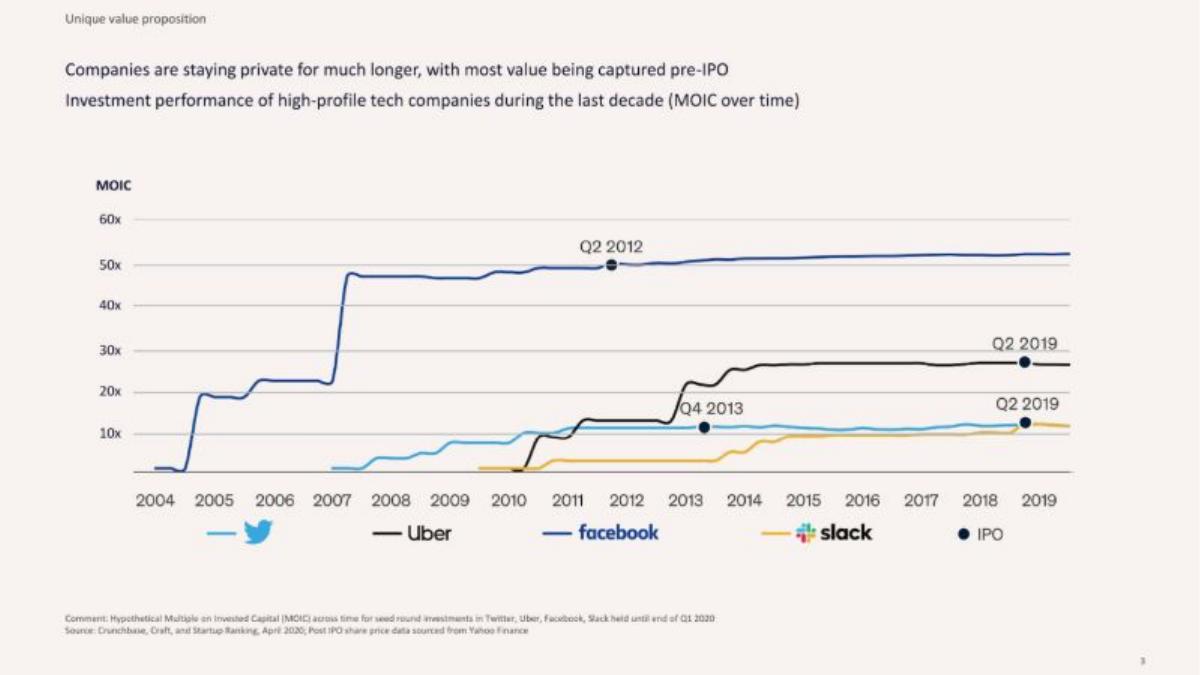
Slide 3 addresses the 'Pre-IPO' problem. Using high-profile tech companies like Twitter, Uber, Facebook, and Slack, Moonfare demonstrates that most value is now captured while companies are still private. The chart shows Multiple on Invested Capital (MOIC) over time, highlighting that by the time these companies hit their IPO (marked by black dots), the steepest part of the value creation curve has already passed. This is a powerful motivator for investors who feel they are 'too late' when buying stocks on the public market.
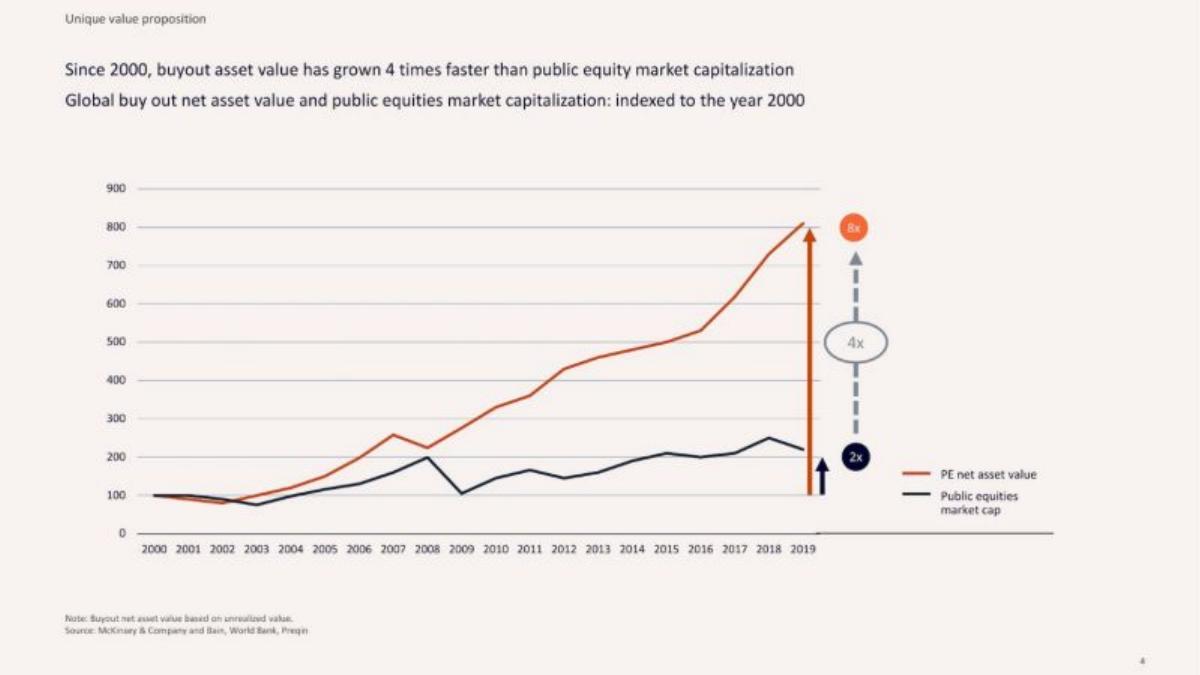
Slide 4 reinforces this by showing that since 2000, buyout asset value has grown 4 times faster than public equity market capitalization. The visual uses an indexed growth chart starting at 100 in the year 2000; by 2019, PE net asset value had reached an 8x multiple, while public equities only reached 2x. This 4x delta is the core of Moonfare’s 'mega trend' argument.
Slides 5-6: The Access Gap and the Blackstone Signal
Slide 5 identifies the specific problem Moonfare solves: the 'Access Gap.' It compares the exposure to private markets across different investor classes. Endowments lead with 52% exposure, and Pensions have 28%, but 'Individual Investors' sit at a mere 5%. Moonfare attributes this to a lack of professional asset allocation and, crucially, a 'lack of access to high quality supply.' This slide defines the target market—the underserved individual investor.
Slide 6 is a 'social proof' slide, but for an industry trend rather than the company itself. It features a quote from Bloomberg News (April 2019) stating: 'As early as 2023, 50% of Blackstone’s AUM are expected to come from retail.' By citing the world’s largest alternative asset manager, Moonfare validates its own existence. If Blackstone is pivoting to retail, the infrastructure to handle that retail influx (which Moonfare provides) becomes essential.
Slides 7-8: The Moonfare Solution and Distribution
Only on Slide 7 does the deck pivot to the product. It describes Moonfare as a 'digital platform for top-tier investment opportunities.' The slide lists four key pillars: sourcing and selection, building a community to lower minimums to €50k, a fully digital end-to-end process, and a digital secondary trading platform. This is the first time the €50k minimum is mentioned, which is a significant reduction from the millions typically required for direct PE investment.
Slide 8 explains the distribution strategy. The business is split into two channels: 1. B2C Business (Moonfare Direct) , which uses digital marketing and network effects to reach end-customers, and 2. B2B2C Business (Partnerships) , which provides custom solutions for private wealth management institutions. This dual-track approach suggests a diversified customer acquisition strategy that doesn't rely solely on expensive direct-to-consumer ad spend.
Slides 9-10: Solving for Liquidity and UX
Slide 9 tackles the 'elephant in the room' for private equity: illiquidity. The 'Traditional model' is described as having funds locked up for up to 10 years. 'Moonfare’s model' counters this with a 'digital secondary marketplace' that allows investors to buy and sell funds throughout the lifecycle. This is a critical piece of financial engineering that makes the asset class palatable for retail-adjacent investors.
Slide 10 emphasizes the 'Easy to access' nature of the platform. It shows the interface on a tablet and smartphone, highlighting a 'No barrier to entry' sign-up process (email, phone, password) that takes 'under a minute.' This 'Platform Agnostic' approach reinforces the 'FinTech' identity of the company, contrasting it with the paperwork-heavy, slow-moving world of traditional private banking.
What Moonfare Does Well
The deck is exceptionally strong at market education . For a Series C, investors are looking for a 'category king' in a massive market. By spending six slides on the macro-economic shift toward private markets, Moonfare makes its eventual success seem like a mathematical certainty of the financial markets. They don't just say they are a good company; they say they are the infrastructure for a global shift in capital.
The visual clarity of the charts is also high-tier. Using indexed growth (Slide 4) and clear bar comparisons (Slide 5) makes the 'Access Gap' easy to visualize. The branding is consistent, professional, and minimalist, which fits the 'Private Equity' aesthetic—conservative yet modern.
What is Missing from the Deck
Despite the successful $125M raise, the deck is missing several elements that would be mandatory for an earlier-stage startup:
Team Slide: There is no mention of the founders or the executive team. In a Series C, the 'who' is often as important as the 'what,' especially in a highly regulated space like FinTech. · Financials and Unit Economics: There are no slides showing revenue growth, Customer Acquisition Cost (CAC), Lifetime Value (LTV), or even current AUM. While these were likely in a separate data room, their absence from the main deck is notable. · The 'Ask': The deck does not state how much they are raising or what the funds will be used for (e.g., geographic expansion, product development). · Competitive Landscape: There is no mention of other platforms (like iCapital or Opto) that are also targeting the democratization of alternatives.
Founder Takeaways: Selling the Wave, Not the Surfboard
Founders should study this deck to understand how to sell a macro trend . If you are operating in a space where the market is shifting in your favor, you don't need to spend 20 slides on your features. You need to spend 10 slides proving that the world is moving in a direction that makes your company's existence inevitable.
Another takeaway is the use of institutional validation . Slide 6’s use of the Blackstone quote is a 'shortcut' to credibility. If the industry leader says retail is the future, and you are the platform for retail, you have successfully borrowed Blackstone’s authority to close your own round. Finally, the focus on solving a structural pain point (liquidity on Slide 9) is a lesson in product-market fit. Moonfare didn't just make PE easier to buy; they made it easier to sell, which is the real hurdle for non-institutional investors.
Frequently asked questions
- What is Moonfare's primary business model?
- Moonfare operates a digital platform that aggregates individual investors into feeder funds, allowing them to access top-tier private equity opportunities with minimums as low as €50,000. According to Slide 8, they utilize a dual-channel approach: a direct-to-consumer (B2C) model and a B2B2C partnership model where they provide custom solutions for private wealth management institutions.
- How does Moonfare address the issue of illiquidity in private equity?
- Private equity is traditionally an illiquid asset class with 10-year lock-up periods. Moonfare addresses this by offering a digital secondary marketplace. As stated on Slide 9, this marketplace allows investors to buy and sell fund interests throughout the fund's lifecycle, effectively making an illiquid asset class more liquid for their users.
- What market trends is Moonfare capitalizing on?
- The deck identifies three major trends: the outperformance of private markets over public ones (Slide 1), the fact that companies are staying private longer and capturing more value pre-IPO (Slide 3), and the 'retailization' of the asset class, evidenced by Blackstone's prediction that 50% of its AUM could come from retail by 2023 (Slide 6).
- Who are the target customers for Moonfare?
- Moonfare targets 'Individual investors and their advisors' (Slide 7). Specifically, they focus on high-net-worth individuals who currently have low exposure to private markets (5%) compared to institutional investors like pensions (28%) and endowments (52%), as shown on Slide 5.
- What is missing from the Moonfare Series C deck?
- The deck is notably missing several standard components: there is no team slide, no detailed financial performance or revenue metrics, no competitive landscape analysis, and no specific 'ask' regarding the $125M Series C round. It functions primarily as a high-level strategic overview rather than a granular operational report.