Morty’s 12-slide Series B deck focuses heavily on the efficiency of its marketplace model. Founded in 2016, the company used this presentation to highlight a massive 800% year-over-year growth in run rate while maintaining nearly flat expenses, a key indicator of software-driven scalability in a traditionally labor-intensive industry. The narrative centers on the 'autonomous mortgage,' detailing how their Leads API and automated underwriting engine displace the traditional loan officer. With 100% of customers acquired through B2B2C partnerships and a Net Promoter Score of 60—nearly quadruple…
Key takeaways
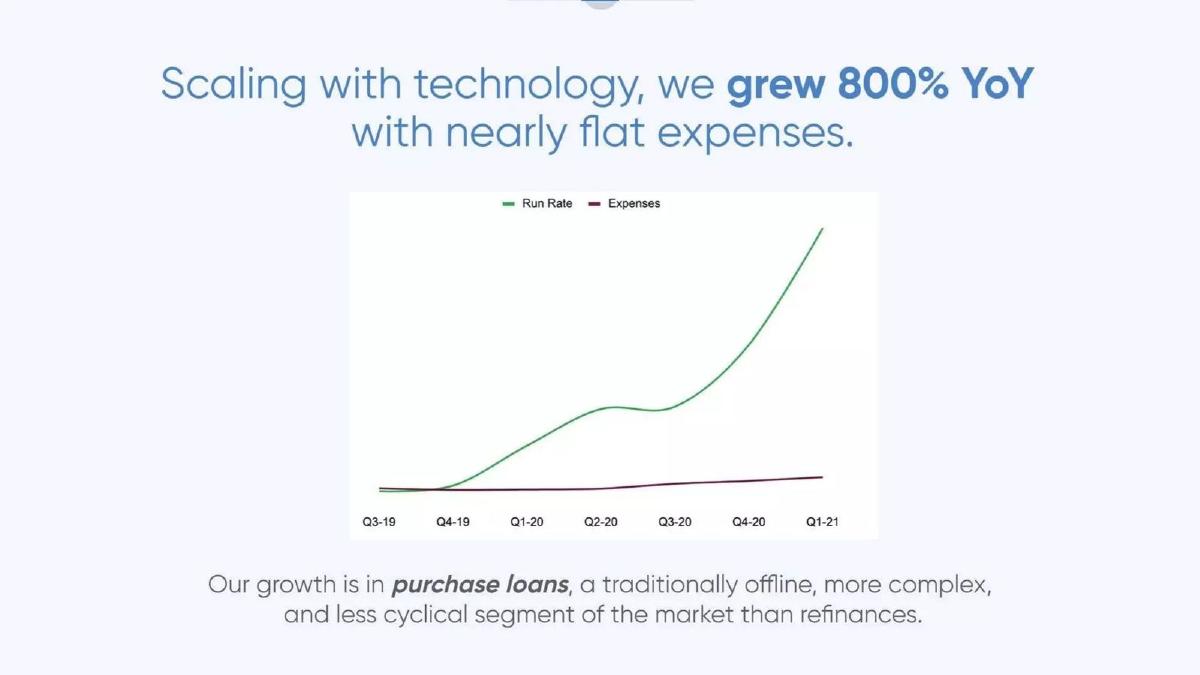
- Morty reported 800% YoY growth in run rate between Q3 2019 and Q1 2021, as shown on slide 3.
- The company maintains nearly flat expenses despite rapid revenue growth, demonstrating significant operational leverage (Slide 3).
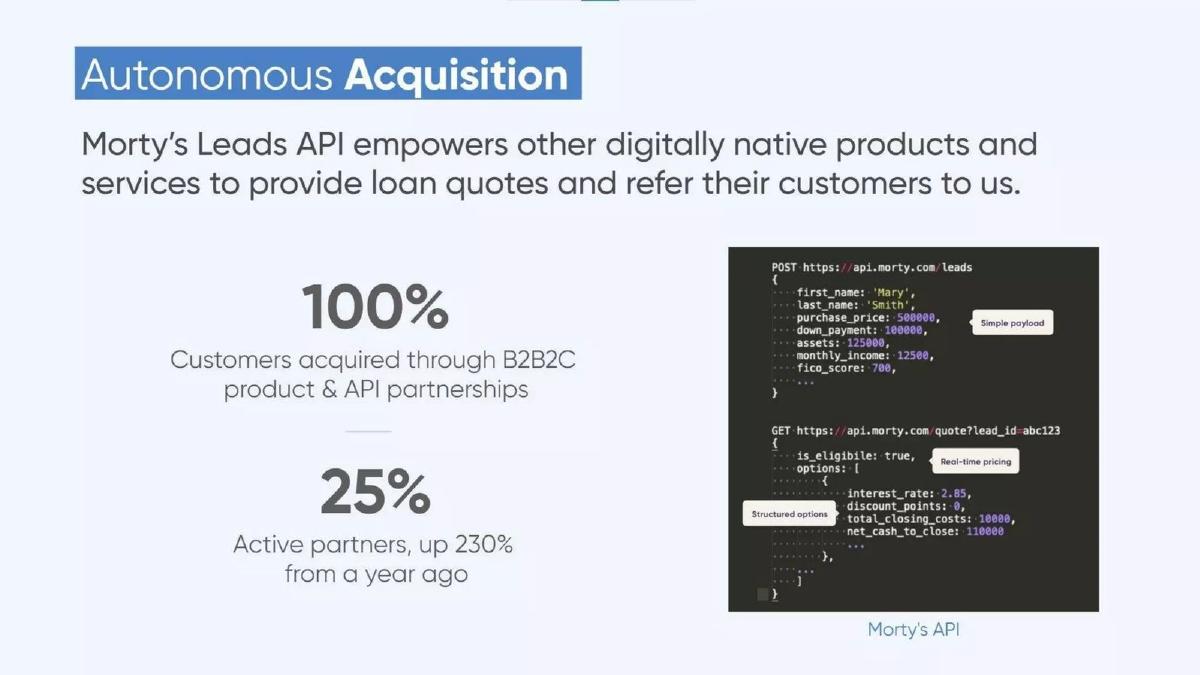
- Morty claims that 100% of its customers are acquired through B2B2C product and API partnerships (Slide 6).
- The platform achieves a Net Promoter Score (NPS) of 60, compared to a mortgage industry average of 16 (Slide 8).
- 90% of Morty's pre-approvals are self-driven by customers without requiring sales support (Slide 7).
- The deck highlights a 230% year-over-year increase in active partners using their Leads API (Slide 6).
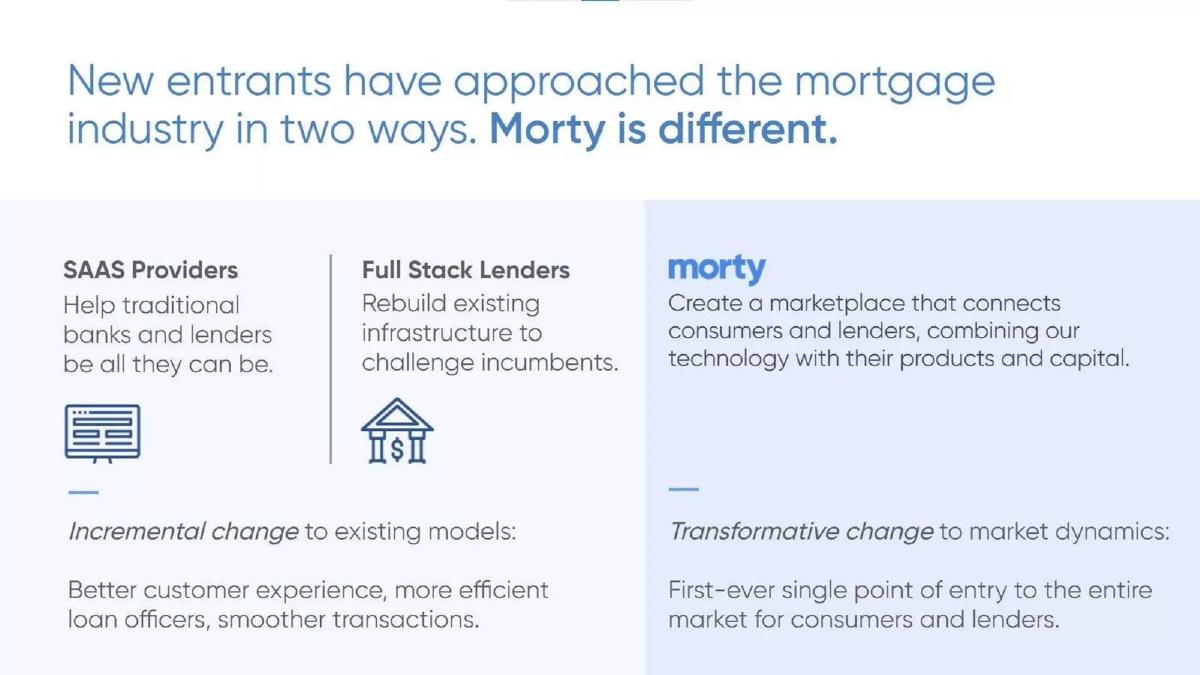
- Morty positions itself as a 'transformative' marketplace rather than an incremental SaaS provider or full-stack lender (Slide 4).
- The leadership team features backgrounds from Goldman Sachs, Morgan Stanley, and Techstars (Slide 12).
The Vision of the Autonomous Mortgage
Morty’s Series B pitch deck is a concise, 12-slide presentation that focuses on one core theme: efficiency through automation. In an industry notorious for paperwork and high-touch sales cycles, Morty argues that the future of mortgages is a self-service marketplace. The deck is structured to show that they have moved past the 'proof of concept' phase and are now in a period of hyper-growth characterized by extreme operational leverage.
Slides 1-2: The Marketplace Definition
The deck opens with a minimalist title slide (Slide 1) featuring only the brand name. Slide 2 immediately defines the business: "Morty is a mortgage marketplace." It clarifies that they provide mortgages through a "digitally native platform backed by the industry's largest lenders." This positioning is crucial; it tells investors that Morty isn't taking on the balance sheet risk of being a lender themselves, but rather acting as the sophisticated technology layer between the consumer and the capital.
Slide 3: The 'Holy Grail' Growth Chart
Slide 3 is arguably the most important slide in the deck. It displays a line graph showing "Run Rate" vs. "Expenses" from Q3 2019 to Q1 2021. While the run rate line curves sharply upward—representing 800% YoY growth—the expense line remains nearly flat. This visual proof of scalability is what Series B investors look for. The slide also notes that this growth is driven by "purchase loans," which are described as more complex and less cyclical than refinances, suggesting a more stable and defensible revenue stream.
Slide 4: Competitive Positioning
On Slide 4, Morty categorizes the competition into two buckets: SaaS Providers (incremental change) and Full Stack Lenders (rebuilding infrastructure). Morty positions itself as the third, superior option: a marketplace that creates "transformative change." By claiming to be the "first-ever single point of entry to the entire market," they argue that they aren't just improving the process, but changing the market dynamics entirely.
Slides 5-8: The Mechanics of Automation
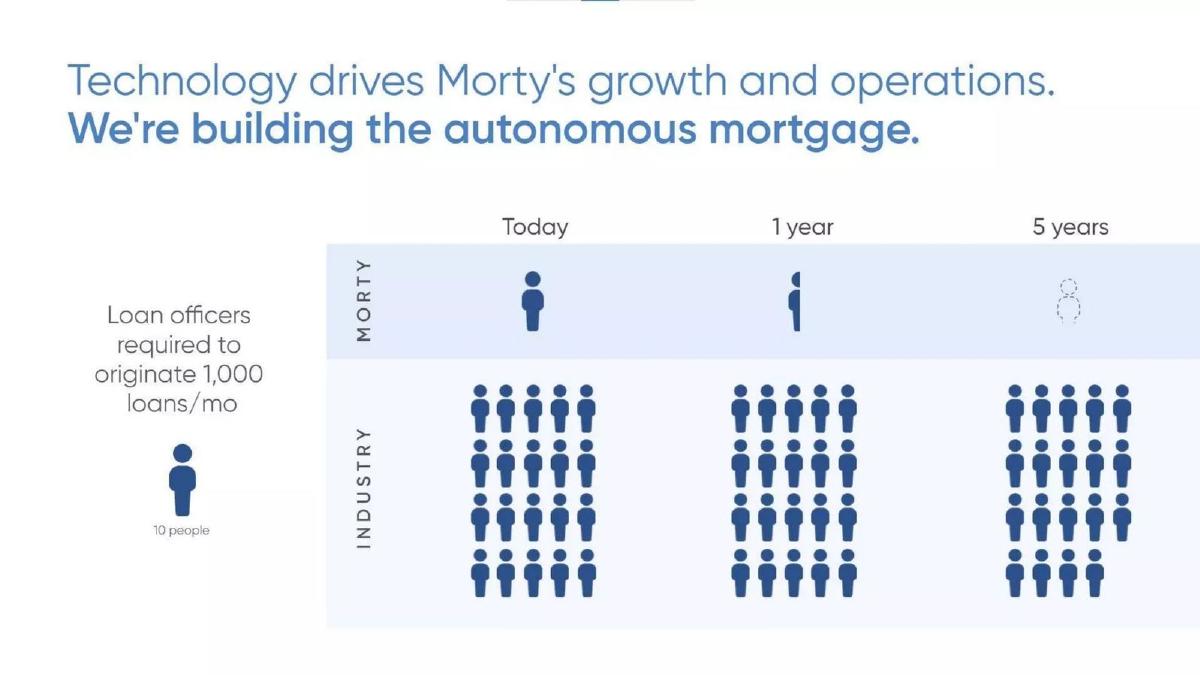
This section of the deck dives into how the 'autonomous mortgage' actually works. Slide 5 uses an icon-based chart to compare Morty’s staffing needs to the rest of the industry. It claims that while the industry needs 100 people to originate 1,000 loans per month, Morty currently needs significantly fewer and aims for near-total automation within five years.
Slide 6 introduces "Autonomous Acquisition." It reveals a staggering stat: 100% of customers are acquired through B2B2C partnerships. By providing a "Leads API" (illustrated with a code snippet), Morty embeds itself into other fintech products. This removes the need for a massive direct-to-consumer marketing budget. Slide 7 focuses on "Autonomous Sales," noting that 90% of pre-approvals are self-driven. Slide 8 completes the trifecta with "Autonomous Operations," highlighting an underwriting engine that handles back-office tasks. This slide also introduces their NPS of 60, contrasting it with the industry average of 16 to prove that automation doesn't come at the expense of customer satisfaction.
Slides 9-10: Marketplace Dynamics and Defensibility
Slide 9 breaks down the two sides of the marketplace. The demand side shows a bar chart of lead supply growing from "Today" to a projected "12 Months," while the supply side shows a pie chart of loan distribution across various lenders. This demonstrates that Morty is not overly dependent on any single lender, with the largest lender accounting for 34% and others distributed at 33%, 18%, 9%, and 5%.
Slide 10, titled "Winning the Market," outlines their competitive advantages (Price, Product Differentiation, Marketplace positioning) and their long-term moats (Cost Superiority, Network Effects, Integrated Partnerships, and Government/Regulatory barriers). This slide transitions the deck from 'what we have done' to 'why we will win long-term.'
Slides 11-12: The Future and The Team
Slide 11 looks toward "Morty’s next phase," which involves scaling volume and building a platform to be the "mortgage layer of the internet." Finally, Slide 12 introduces the leadership team and existing investors. The team is presented as "technical and quantitative," with backgrounds from Penn, Emory, and Berkeley, and professional stints at Goldman Sachs and Morgan Stanley. The investor list includes heavyweights like Thrive Capital and Lerer Hippeau, providing a final stamp of institutional credibility.
What Works in This Deck
The Efficiency Narrative: The contrast between 800% growth and flat expenses on Slide 3 is the ultimate proof of a successful tech-first business model. · B2B2C Focus: By showing that 100% of acquisition is through APIs and partnerships, Morty solves the 'customer acquisition cost' (CAC) problem that plagues many fintech startups. · Product-Led Proof: Including an actual API payload on Slide 6 and a screenshot of the Closing Tracker on Slide 8 makes the 'autonomous' claim feel tangible and real rather than theoretical. · Clear Differentiation: Slide 4 does an excellent job of explaining why Morty is different from other 'mortgage tech' companies without naming and shaming specific competitors.
What is Missing
The Financial Ask: The deck does not state how much money is being raised in this Series B round or how the funds will be specifically allocated. · Unit Economics: While the run rate vs. expense chart is great, the deck lacks a breakdown of contribution margin or specific CAC/LTV (Lifetime Value) ratios. · Detailed Roadmap: Slide 11 is very high-level. It mentions "scaling volume" and "building a platform" but lacks specific milestones or product features planned for the next 18-24 months. · Market Size (TAM): Surprisingly, for a Series B deck, there is no slide dedicated to the Total Addressable Market. It is assumed the investor knows the mortgage market is massive, but specific segments are not quantified.
What a Founder Should Copy
The 'Industry vs. Us' Comparison: Use simple iconography (like Slide 5) to show how your technology reduces the human headcount required to perform a standard industry task. · NPS Benchmarking: If your customer satisfaction is significantly higher than the industry average, put it on a slide (Slide 8). It is a powerful proxy for product-market fit. · Show the Tech: Don't just say you have an API; show a snippet of the code or the payload. It builds immediate credibility with technical investors. · Focus on Leverage: If you have achieved growth without a linear increase in headcount or expenses, make that the centerpiece of your deck.
Frequently asked questions
- What is Morty's primary value proposition?
- Morty positions itself as a mortgage marketplace that provides a single point of entry for both consumers and lenders. Unlike SaaS providers that help banks or full-stack lenders that rebuild infrastructure, Morty uses technology to connect consumers with products from the industry's largest lenders through a digitally native, autonomous platform.
- How does Morty acquire customers?
- According to slide 6, Morty relies entirely on a B2B2C model. They use a 'Leads API' that allows other digitally native products and services to embed mortgage quotes into their own platforms, referring customers to Morty. This strategy has led to a 230% increase in active partners year-over-year.
- What does Morty mean by 'Autonomous Mortgage'?
- The 'autonomous mortgage' refers to Morty's goal of using technology to replace the manual labor of loan officers. Slide 5 illustrates that while the industry requires roughly 100 people to originate 1,000 loans per month, Morty aims to reduce this to near-zero human intervention over a five-year horizon.
- Who are the key investors in Morty?
- The deck lists several top-tier venture capital firms on slide 12, including Thrive Capital, Lerer Hippeau, FJ Labs, Prudence Holdings, MetaProp, and Techstars. These investors backed the company's growth through its early stages and Series B.
- What metrics does Morty use to prove its success?
- Morty highlights three primary categories of metrics: growth (800% YoY run rate increase), efficiency (90% self-driven pre-approvals and flat expenses), and customer satisfaction (an NPS of 60, which is significantly higher than the industry average of 16).