Moteefe’s 12-slide deck from May 2020 is a data-driven presentation that prioritizes traction and infrastructure over narrative fluff. The company positions itself as a B2B2C powerhouse, solving the 'struggle to scale globally' for retailers of all sizes. With a heavy emphasis on their Global Printing Network (GPN) and triple-digit growth rates, the deck makes a compelling case for the efficiency of their print-on-demand model. While the version analyzed contains redacted financial figures (marked as '£x million'), the structural logic remains clear: prove the market size, demonstrate the ope…
Key takeaways
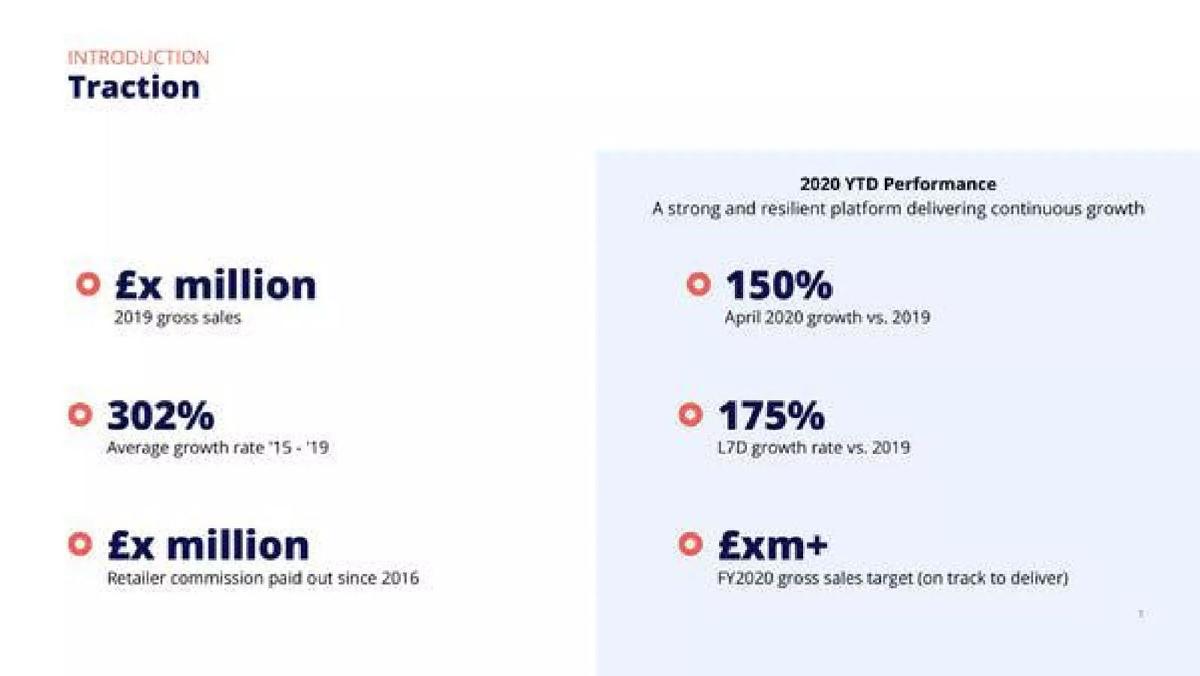
- Moteefe achieved a 302% average growth rate between 2015 and 2019, as stated on slide 1.
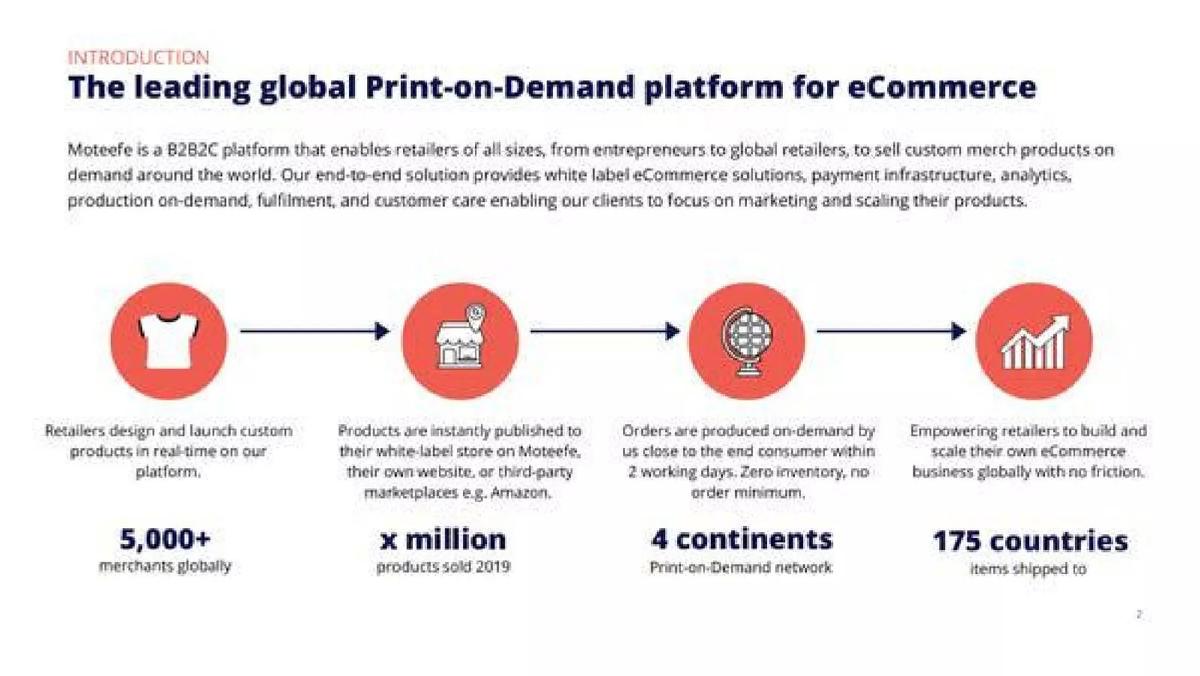
- The platform supports over 5,000 merchants globally and ships to 175 countries, according to slide 2.
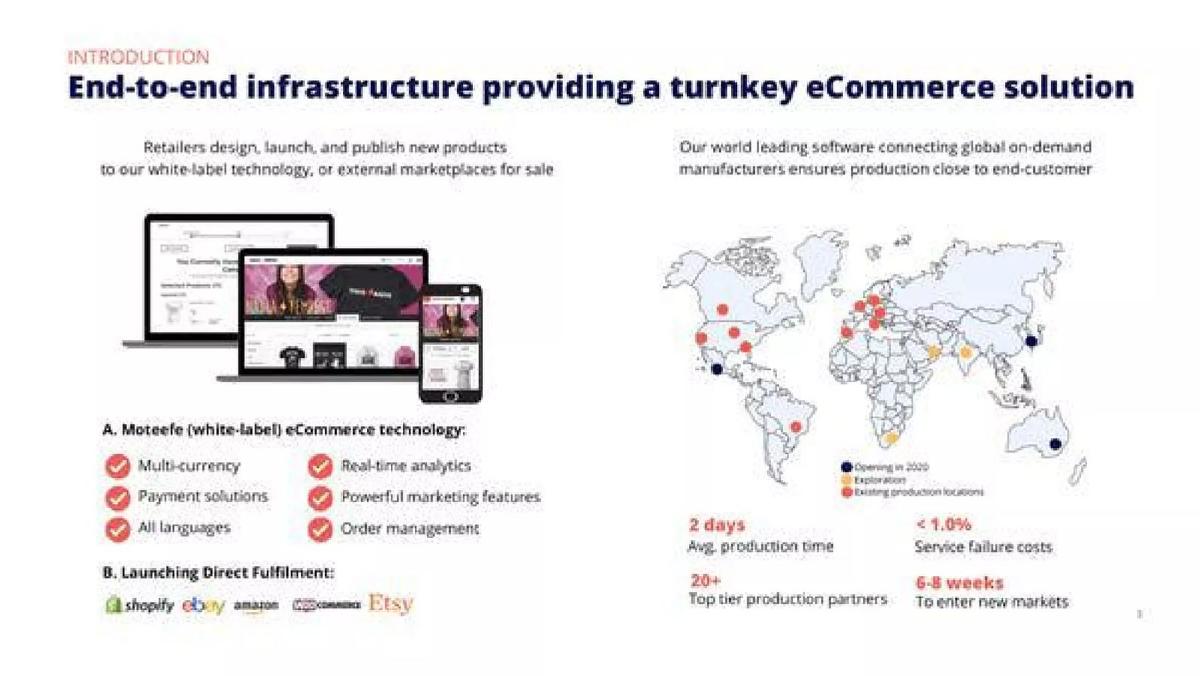
- Operational efficiency is highlighted by a 2-day average production time and service failure costs of less than 1.0% on slide 3.
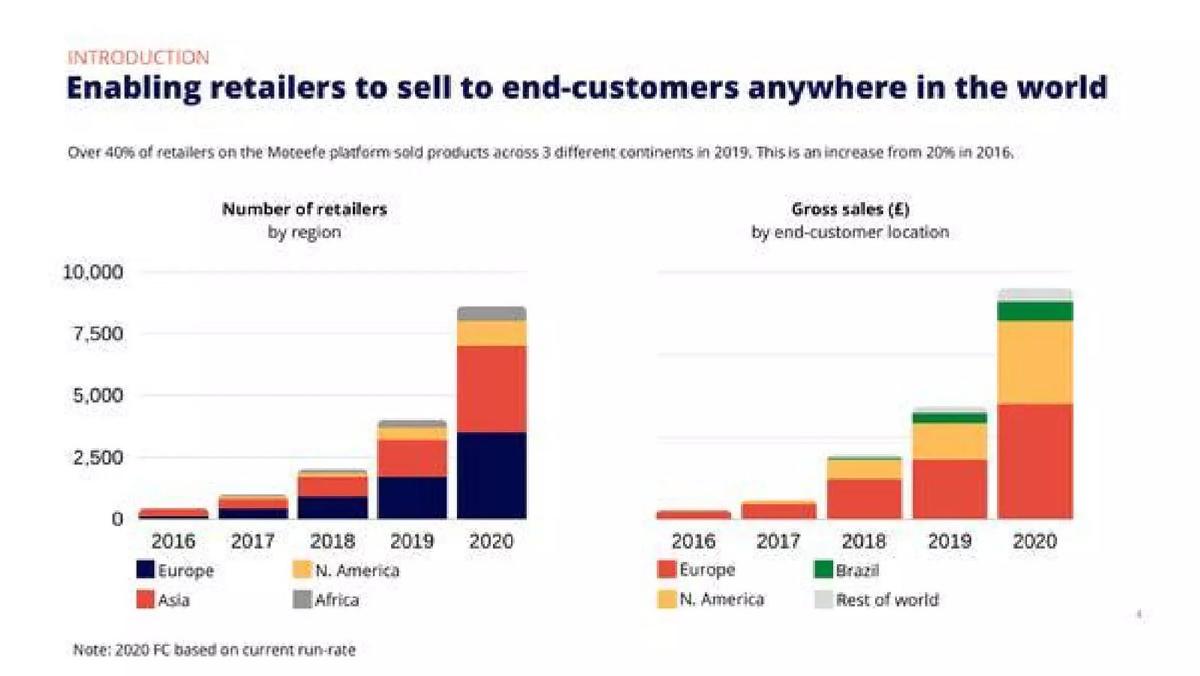
- The company demonstrated significant geographic expansion, with over 40% of retailers selling across 3 different continents in 2019 (slide 4).
- Moteefe identifies a Total Addressable Market (TAM) of £35bn by 2025 for apparel, accessories, and homewares on slide 7.
- The deck outlines a massive capacity scale-up plan, moving from a current 50,000 daily units to a long-term goal of 800,000 units (slide 9).
- Strategic growth levers include launching direct fulfillment integrations with Shopify, Amazon, eBay, and Etsy, as detailed on slide 10.
- The deck completely omits a team slide, which is unusual for a Series A presentation but common in redacted public versions.
Introduction and Immediate Traction
Slides 1-2: The Hook and the Value Proposition
Moteefe opens its May 2020 investment deck with a strong emphasis on Traction . Slide 1 sets the stage by showcasing a 302% average growth rate from 2015 to 2019. Even with redacted figures, the percentages tell a story of a company that benefited significantly from the e-commerce tailwinds of early 2020, citing a 150% growth in April 2020 compared to the previous year. This immediate disclosure of high-growth metrics is a classic Series A tactic designed to validate product-market fit before explaining the product itself.
Slide 2 defines the company as "The leading global Print-on-Demand platform for eCommerce." It introduces the B2B2C model , explaining that Moteefe provides the "white label eCommerce solutions, payment infrastructure, analytics, production on-demand, fulfilment, and customer care." By listing these components, they position themselves as a full-stack infrastructure provider rather than just a printing service. The slide also notes that they serve 5,000+ merchants and ship to 175 countries, establishing a massive global footprint early in the deck.
Infrastructure and Global Reach
Slides 3-4: Operational Moat and Geographic Expansion
On Slide 3, Moteefe dives into the "End-to-end infrastructure." This is where the company demonstrates its operational moat . They highlight a 2-day average production time and a service failure cost of less than 1.0%. For investors, these efficiency metrics are crucial in a low-margin business like printing. The slide also mentions 20+ top-tier production partners and the ability to enter new markets in just 6-8 weeks. This suggests a highly scalable, asset-light model where the company owns the software and the network but not necessarily the heavy machinery.
Slide 4 uses data visualization to show how Moteefe enables retailers to sell anywhere. A key stat here is that "Over 40% of retailers on the Moteefe platform sold products across 3 different continents in 2019," up from 20% in 2016. The bar charts for "Number of retailers by region" and "Gross sales by end-customer location" show a diversifying revenue base, with significant growth in Asia and North America alongside their European core. This diversification reduces geographic risk and proves the platform's universal appeal.
The Problem and the Market Opportunity
Slides 5-7: Identifying Pain Points and TAM
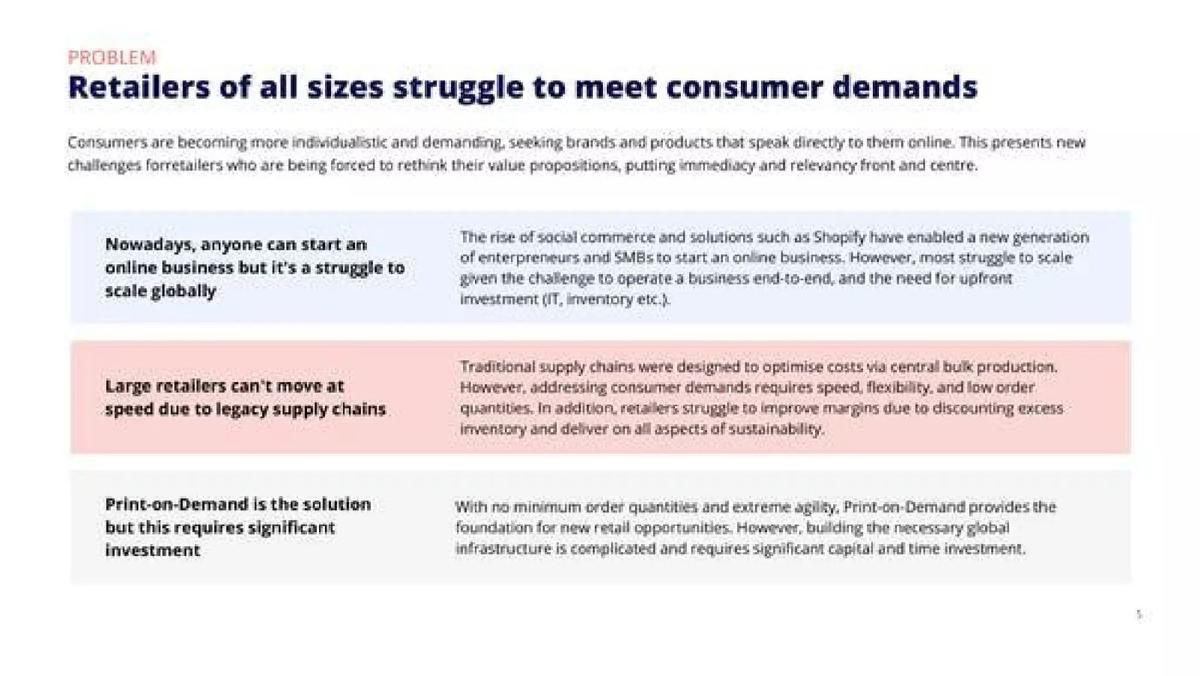
Slide 5 addresses the Problem . It segments the struggle into three areas: individual entrepreneurs who struggle to scale globally, large retailers hampered by legacy supply chains, and the high investment required for print-on-demand (PoD) infrastructure. By framing PoD as the solution that "requires significant investment," Moteefe justifies its own existence as the provider that has already made that investment so others don't have to.
Slide 6 outlines the "Strong benefits for retailers," including zero inventory, ROI certainty, and sustainability. The inclusion of sustainability as point number 5 is a nod to the growing ESG (Environmental, Social, and Governance) concerns in 2020, noting that local production reduces the carbon footprint.
Slide 7 quantifies the Total Addressable Market (TAM) . They project a £35bn market by 2025 for apparel, accessories, and homewares. The slide uses a pyramid to segment their users: 1,000,000+ Entrepreneurs, 100,000+ SMBs, and 1,000+ Enterprise clients. This tiered approach shows that while they started with small creators, the real growth (and the target for the Series A) is moving up-market into the Enterprise space.
Product Depth and Scalability
Slides 8-9: The Platform and Capacity
Slide 8 provides a technical overview of the "single platform to short-cut Print-on-Demand adoption." It visualizes the flow from the Merchant eCommerce portal to the Global Printing Network (GPN) . It explicitly mentions integrations with eBay and Shopify, showing that Moteefe isn't just a destination site but a backend engine that can power other storefronts. This "Direct fulfilment" strategy is a key growth lever.
Slide 9 focuses on Capacity . It presents a pyramid of "Units per day," starting with a current average sales volume of 5,000 units and scaling to a "Long-term capacity" of 800,000 units. This slide is vital for a Series A deck because it shows the physical limits of the business and the roadmap for expansion. It also lists their product categories, which include T-shirts, hoodies, drinkware, phone cases, and cushions, totaling ~60 harmonized items.
Future Outlook and Financial Forecast
Slide 10: Growth Levers and Investment Areas
The final content slide, Slide 10, presents the Forecast . It shows a revenue bar chart with aggressive growth projected through 2022. The "Growth levers" are clearly defined: growing active SMB retailers, launching direct fulfillment integrations (Shopify, AMZ, eBay, Etsy), and confirming the first partnership with a global retailer in the Enterprise segment. The "Key areas to invest" section mentions sales & marketing capabilities and platform performance, giving investors a high-level view of where the capital will be deployed.
Slides 11-12: Conclusion
The deck concludes with a simple branding slide (Slide 11) and a closing slide (Slide 12) featuring the tagline "Not the end. Just the beginning." This maintains the professional, minimalist aesthetic of the rest of the presentation.
What Works in This Deck
1. Data Density: Moteefe does not rely on vague promises. Every slide is packed with specific numbers, whether it is the 175 countries shipped to (Slide 2) or the 6-8 weeks to enter a new market (Slide 3). This builds immense credibility with institutional investors.
2. Clear Segmentation: By breaking down their target market into Entrepreneurs, SMBs, and Enterprise (Slide 7), they show a sophisticated understanding of their customer base and a clear strategy for moving up-market.
3. Operational Focus: Many e-commerce decks focus only on the front-end (the website). Moteefe spends significant time on the back-end (the Global Printing Network), which is where the real complexity and value of the business lie.
What Is Missing
1. Team Slide: In the version of the deck provided, there is no mention of the founders or the executive team. For a Series A, the pedigree of the team is usually a top-three factor for investors. The catalogue facts mention the founders met at INSEAD, which is a strong signal that should have been included.
2. Competitive Landscape: There is no direct comparison to competitors like Printful or Teespring. While Moteefe hints at their advantages, a dedicated slide showing their feature set versus incumbents would have strengthened the case for their "leading" status.
3. Unit Economics: While they show gross sales and revenue growth, the deck lacks a breakdown of Customer Acquisition Cost (CAC) and Lifetime Value (LTV). In a B2B2C model, understanding the cost to acquire a merchant versus the revenue generated from that merchant's customers is essential.
What a Founder Should Copy
1. The "Infrastructure First" Narrative: If you are building a platform, don't just sell the interface; sell the plumbing. Moteefe’s focus on their "Global Printing Network" makes them look like a logistics powerhouse rather than just another t-shirt website.
2. Visualizing Capacity: Slide 9 is a great example of how to show scalability. By plotting current volume against future capacity, you show investors that you have already built (or planned) the runway for the growth you are forecasting.
3. Geographic Proof Points: If your business is global, prove it with a map and specific stats about cross-border trade. Slide 4’s stat about 40% of retailers selling across 3 continents is a powerful way to prove that your product has international demand.
Frequently asked questions
- What is Moteefe's core business model?
- Moteefe operates a B2B2C print-on-demand platform. As described on slide 2, they provide white-label e-commerce solutions, payment infrastructure, and a global production-on-demand network. This allows retailers to design products that are only manufactured once a customer makes a purchase, eliminating inventory risk and upfront investment.
- How does Moteefe handle global logistics?
- The company utilizes a 'Global Printing Network' (GPN) that connects with 20+ top-tier production partners across 4 continents. Slide 3 and slide 8 explain that their software intelligently routes orders to the printing partner closest to the end consumer, which reduces shipping times to 2 working days and lowers the carbon footprint.
- What market segments does Moteefe target?
- According to slide 7, Moteefe targets three distinct tiers: Entrepreneurs (1,000,000+ potential users), SMBs (100,000+ potential users), and Enterprise retailers (1,000+ potential users). They position themselves as the only end-to-end solution capable of helping large retailers shortcut lengthy adoption processes for print-on-demand.
- What are the key financial metrics mentioned?
- While specific currency amounts are redacted in this version, slide 1 highlights a 150% growth in April 2020 vs. 2019 and a 175% growth rate in the last 7 days (L7D) vs. 2019. Slide 10 shows a revenue forecast with a steep upward trajectory through 2022, supported by 'triple-digit growth rates.'
- What is missing from the Moteefe pitch deck?
- The most notable omissions are a Team slide and a specific 'Ask' slide detailing how the $19M would be spent. Additionally, there is no explicit competitor analysis slide, though slide 5 hints at the limitations of traditional supply chains and basic social commerce tools like Shopify when used in isolation.