Much Better is a wellness brand positioning itself as a modern, accessible gateway to Traditional Chinese Medicine (TCM). The deck outlines a three-pronged strategy: educational content to build trust, an interactive quiz for personalization, and a subscription-based herbal supplement line priced at $40 per month. The company targets a massive market, citing that 41% of Americans already take herbal supplements. While the deck excels at identifying a cultural shift toward integrative medicine and hormonal health, it lacks critical operational data. There is no mention of current traction, spe…
Key takeaways
- The company identifies a 15% annual growth rate for herbal medications as a core market driver on slide 3.
- Much Better targets a global herbal industry projected to reach $86B by 2022, according to slide 5.
- The product offering is a subscription-based model for premium herbal blends in pill form, priced at $40 per month as shown on slide 7.
- The marketing strategy utilizes a 'WOM Incentive Program' involving testimonials, social sharing, and referrals to drive growth (slide 7).
- Personalization is a key differentiator, using an interactive quiz that asks questions like 'What color is your tongue?' to determine body type (slide 6).
- The brand explicitly positions itself against competitors like WTHN by emphasizing a creator-led, authentic Asian American perspective (slide 8).
- The deck lacks a formal 'Team' slide, 'Traction' metrics, or a specific 'Investment Ask' within the provided 9 slides.
- Revenue projections are based on a top-down calculation: 1% of 170M Americans equals $68M in estimated revenue (slide 7).
Slide-by-Slide Analysis
Slide 1: Title Slide
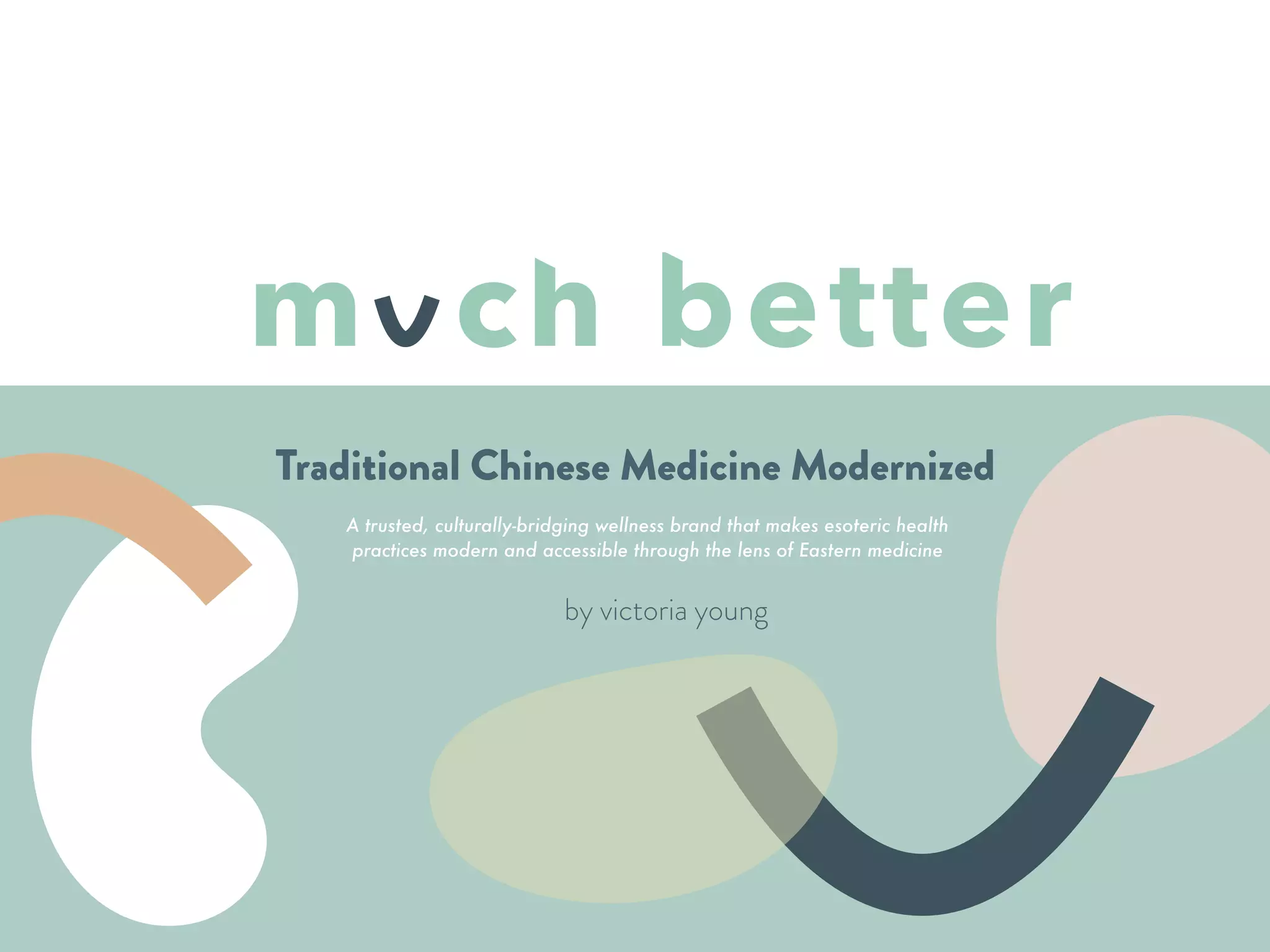
The title slide introduces the brand name, Much Better , with the tagline "Traditional Chinese Medicine Modernized." It describes the company as a "culturally-bridging wellness brand" that makes "esoteric health practices modern and accessible." The slide attributes the deck to Victoria Young . The visual style is minimalist with abstract shapes and a muted color palette, signaling a premium, modern wellness aesthetic.
Slide 2: The Vision
This slide sets the stage for the market shift. It states that alternative and holistic methods are no longer just accepted but "celebrated." It references the popularity of Ayurveda, turmeric, and acupuncture as precursors to the next wave: Eastern healing and herbal remedies. The core claim is that Much Better will be the "most accessible, modern, and authentic brand" at the forefront of this movement.
Slide 3: The Shift in Medicine
Slide 3 provides context on the evolution of the industry. It notes that the term "alternative medicine" is being replaced by "integrative medicine." A key data point is provided: herbal medications are growing at an annual rate of 15% per year. The slide emphasizes that conventional healthcare institutions in the U.S. are showing a new acceptance of these historically non-mainstream treatments.
Slide 4: Problems We Aim To Solve
People Are Sick And Stressed: Increased interest in natural supplements to moderate lifestyle-driven chronic diseases. · Experience of Benefits: A cultural shift toward plant-based remedies, noting that Americans spend well over $12B a year on natural supplements. · Demand for Personalization: Consumers want solutions tailored to their specific needs, similar to the trend in DNA testing (e.g., 23andme). · Hormonal Imbalances: A specific focus on women seeking natural ways to balance hormones as the root of health issues.
Slide 5: Market Size
This slide uses three data points to quantify the opportunity:
$86B: The projected size of the global herbal industry by 2022, growing at 10% annually. · 170M+: The number of Americans (41%) currently taking herbal supplements, a figure growing 13% Year-over-Year. · 80% / 93M: The number of Americans searching for health-related questions online.
Slide 6: What We Provide
Much Better defines its offering as a combination of Modern Content + Personalized Recommendations + Branded Products. The content helps users understand TCM solutions. The personalization is driven by an interactive quiz featuring questions like "What color is your tongue?" and "What time of night do you wake up?" The product itself is described as premium, custom-created herbal blends in pill form , delivered via subscription. A mockup of the packaging is shown, maintaining the minimalist brand identity.
Slide 7: Business Model
The business model slide illustrates a funnel. At the top, YouTube, blogs, and quizzes build awareness and trust. This leads to personalized recommendations and the sale of subscription solutions at $40 per month. The slide includes a "WOM Incentive Program" for referrals and social sharing. It concludes with a top-down revenue estimate: 1% of 170M Americans = $68M.
Slide 8: Competitive Advantages
Expert, Authentic Content: A creator-led model that differentiates from generic supplement brands. · Premium Product: Unique formulas tailored to body types and chronic diseases. · Data & Personalization: Using quiz feedback to inform strategy, specifically naming WTHN as a competitor. · Brand & Design: Focusing on a memorable user experience. · 1st To Market: Claiming to be the first modernized TCM brand created authentically by Asian Americans.
Slide 9: Demographic Data Appendix
The final slide provided is a technical table titled "Demographic and Health Characteristics of Adults With Multiple Chronic Conditions." It appears to be a reference from a 2015 Behavioral Risk Factor Surveillance System study. It breaks down chronic conditions by age, sex, race, education, and employment status, likely intended to support the target market assumptions made earlier in the deck.
What Much Better Does Well
Much Better excels at narrative positioning. The deck effectively captures the zeitgeist of the "modern wellness" movement, successfully rebranding Traditional Chinese Medicine from something perceived as "esoteric" or "alternative" into something "integrative" and "premium." The focus on a content-to-commerce funnel is a proven strategy in the D2C space, and the use of a quiz for personalization addresses a major consumer trend toward bespoke health solutions.
The visual identity of the deck is also a strength. It looks and feels like a modern consumer brand, which is essential for a company claiming that "Brand & Design" is a competitive advantage. By naming a specific competitor (WTHN) and identifying a unique angle (Asian American authenticity), the founders show they understand the competitive landscape and their specific niche within it.
What is Missing from the Much Better Deck
The most glaring omission in the provided slides is traction. There are no figures regarding current sales, number of active subscribers, website traffic, or quiz completion rates. Without these, the $68M revenue projection feels like a purely theoretical exercise. Investors typically want to see that the "content-to-commerce" engine has already been tested, even at a small scale.
Furthermore, the Team slide is missing. While Victoria Young is named on the title slide, there is no information about her background or the expertise of the rest of the team. In a space as regulated and sensitive as herbal medicine, having medical advisors or experts in TCM on the team is a critical requirement for credibility. Finally, the Ask is missing. A pitch deck should clearly state how much money is being raised and what specific milestones that capital will achieve.
Founder Takeaways: What to Copy
Use a Content-First Funnel: Founders in the health and wellness space should emulate Much Better's strategy of using education (YouTube, blogs) to build the trust necessary to sell a physical product. This is especially important for products that require a high degree of consumer education.
Quantify the 'Why Now': Slide 3 is a great example of explaining the market shift. By citing the change in terminology from "alternative" to "integrative" medicine and providing a growth rate (15%), the deck makes a compelling case for why this is the right time to enter the market.
Personalization as a Hook: The use of a quiz (Slide 6) is an excellent way to engage potential customers and collect first-party data. Founders should consider how they can use interactive elements to provide immediate value to the user while simultaneously qualifying them for a product purchase.
Frequently asked questions
- What is the core product of Much Better?
- Much Better offers premium, custom-created herbal blends in pill form. These are sold on a subscription basis for $40 per month. The product selection is guided by an interactive quiz that assesses the user's lifestyle, energy levels, and physical indicators like tongue color to provide personalized recommendations based on Traditional Chinese Medicine principles.
- How does Much Better plan to acquire customers?
- The company uses a content-first funnel. It aims to build awareness and trust through YouTube, blogs, and an interactive quiz. Once trust is established, it converts users to the subscription product. Growth is further fueled by a Word of Mouth (WOM) incentive program that encourages social sharing, referrals, and customer testimonials.
- What market opportunity does the deck highlight?
- The deck points to a $86B global herbal industry growing at 10% annually. It notes that 170M+ Americans (41% of the population) already take herbal supplements, and 93M Americans search for health-related questions online. Much Better specifically targets the shift from 'alternative medicine' to 'integrative medicine' and the rising demand for hormonal balance solutions.
- Who are the competitors and what is Much Better's advantage?
- The deck specifically names WTHN as a competitor. Much Better claims a competitive advantage through its 'creator/expert' model, emphasizing that it is the first modernized brand created authentically by Asian Americans. Other advantages cited include data-driven personalization from their quiz and a focus on 'delightful' brand design and user experience.
- What information is missing from this pitch deck?
- The provided slides are missing several standard venture components. There is no 'Traction' slide showing current sales or user growth. There is no 'Team' slide detailing the expertise of the founders or advisors. Finally, there is no 'Ask' slide indicating how much capital is being raised or how it will be deployed to reach specific milestones.