Muncher’s pitch deck outlines a specialized infrastructure play within the Latin American food-tech sector, moving away from traditional brick-and-mortar dark kitchens toward modular shipping container hubs. By targeting the high take rates of delivery platforms (20% to 40%) and the inefficiencies of peripheral kitchen locations, Muncher positions itself as a standardized, low-CAPEX alternative. The deck highlights strong unit economics, including a 10 to 15-month payback period and 15% to 20% EBITDA margins per kitchen. With a presence already established in Colombia, Mexico, and Peru, the c…
Key takeaways
- Muncher identifies delivery platform take rates of 20% to 40% as a primary pain point for restaurant profitability (Slide 2).
- The company projects the dark kitchen market in Latin America to grow from 500 units in 2019 to 275,000 units by 2024 (Slide 3).
- Muncher utilizes two standardized kitchen sizes: 20 ft (15 sq2) and 40 ft (30 sq2) based on shipping containers (Slide 5).
- Unit economics show an investment of USD $20K to $40K per kitchen with revenue potential up to USD $50K (Slide 7).
- The business model targets a 15% to 20% EBITDA margin with a payback period of 10 to 15 months (Slide 7).
- The competitive landscape positions Muncher against traditional dark kitchens like NanoKitchens and delivery platforms like Rappi and Uber Eats (Slide 8).
- The model claims a social impact of 5 direct employments per kitchen and 850 total indirect employments (Slide 9).
- Muncher has established operations and client bases across three countries: Colombia, Mexico, and Peru (Slide 6).
Muncher Pitch Deck Analysis: The Modular Future of Food Delivery
Muncher’s pitch deck for their Series A round focuses on solving the physical infrastructure gap in the Latin American food delivery market. By utilizing repurposed shipping containers, the company offers a standardized, scalable solution for restaurants looking to bypass the high costs of traditional real estate and the steep commissions of delivery aggregators. The deck is structured to highlight market growth, unit-level profitability, and regional traction.
Slide 1: Title and Vision
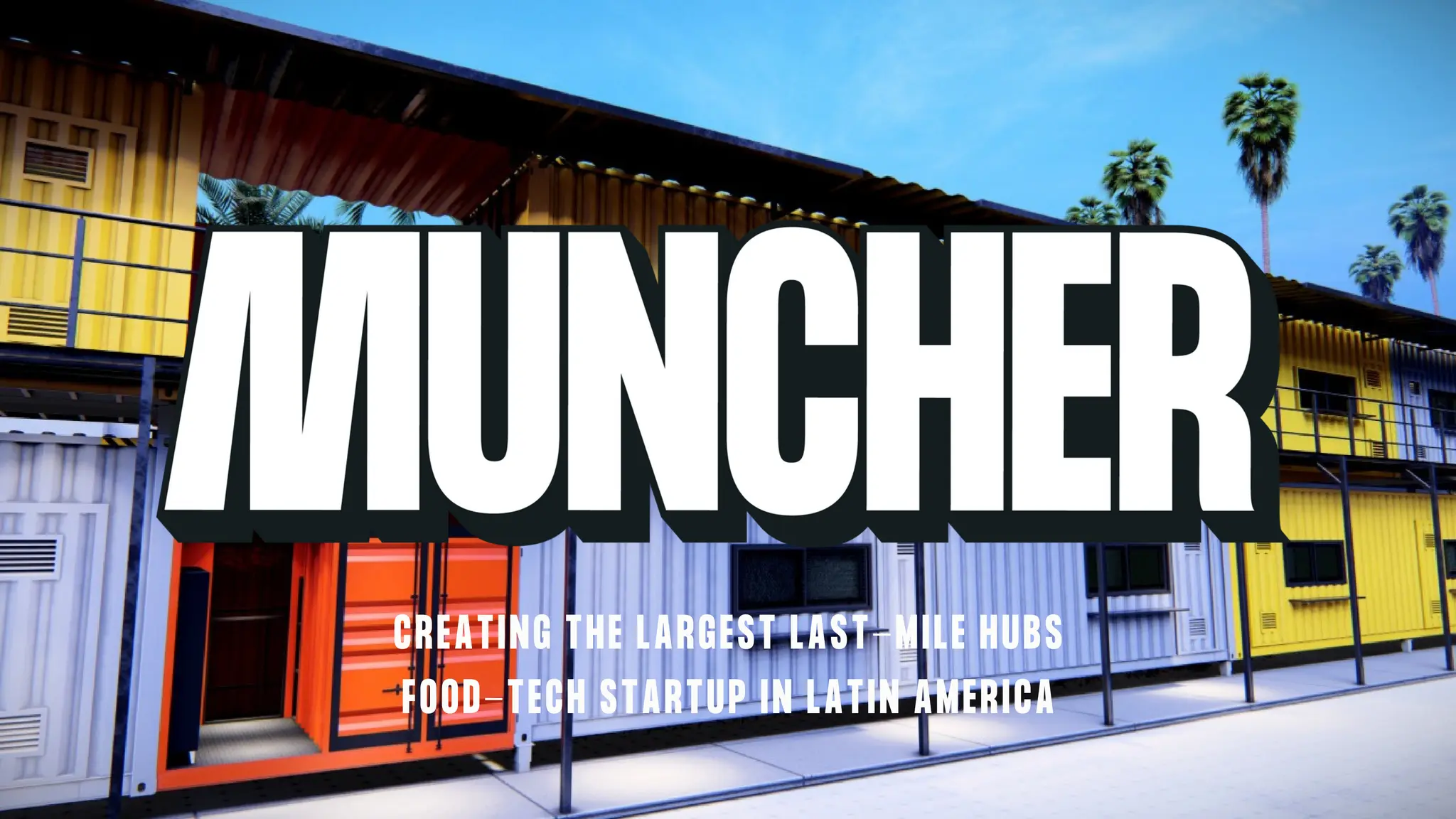
The cover slide establishes Muncher’s identity as a 'Food-Tech Startup in Latin America' focused on 'Creating the Largest Last-Mile Hubs.' The background image features a multi-story stack of brightly colored shipping containers, immediately signaling the company's modular infrastructure approach. The branding is bold and industrial, reflecting the physical nature of the business.
Slide 2: The Problems of Food Delivery
This slide identifies three core pain points. First, 'Delivery Platforms High Take Rates,' which they cite as being between 20% and 40%. Second, 'Inadequate Infrastructure,' noting that traditional kitchens suffer from high initial investments and inefficient lease costs. Third, the 'Lack of Proximity' of existing dark kitchens, which are often located in peripheral areas. This sets the stage for Muncher's solution as a more central, cost-effective alternative.
Slide 3: LATAM Food Service Market Opportunity
Muncher uses Euromonitor data from April 2020 to show a massive market shift. They project that restaurant units in Latin America will grow from 5 million in 2019 to 5.5 million by 2024. More importantly, they forecast dark kitchens growing from a negligible 0.01% (500 units) to 5% (275,000 units) of the market. The slide also breaks down delivery penetration by country: Colombia (10.3%), Brazil (4.6%), Mexico (2.7%), and Peru (2.0%).
Slide 4: Dark Kitchens Transition
This is a simple transition slide with the text 'DARK KITCHENS' in yellow on a black background. It serves as a visual break before diving into the specifics of their operational model.
Slide 5: Kitchen Reference Layout
This slide details the technical specifications of the product. Muncher offers two sizes: 20 ft (15 sq2) and 40 ft (30 sq2). A technical floor plan shows a highly optimized workflow, including dedicated zones for cleaning, 'Hot Area,' refrigeration, assembly, and delivery. The use of a computer station near the door suggests an integrated tech stack for order management.
Slide 6: Muncher’s Top Clients
Traction is demonstrated through a logo wall categorized by country. In Colombia, they list brands like Home Burgers and Foodology. In Mexico, clients include Vapiano and The Food Box. In Peru, they list Mad Burger and El Gringo. This slide validates that the model is not just a concept but is currently being utilized by established regional food brands.
Slide 7: Restaurants Business Model
This is the most critical slide for investors interested in unit economics. Muncher claims an investment of USD $20K to $40K per kitchen, generating up to USD $50K in revenue. The key metrics provided are a 15% to 20% EBITDA margin and a 10 to 15-month payback period. They also mention the ability to 'export' powerful brands to other countries, suggesting a cross-border growth strategy for their tenants.
Slide 8: Competitive Landscape
The competitive matrix places Muncher on an axis between 'Traditional Dark Kitchens' and 'Additional Business Capabilities' (like dark stores). They distinguish themselves from delivery platforms (Rappi, Uber Eats) and 'Kitchen as a Service' providers (Kitopi). Interestingly, they note CloudKitchens' acquisitions in the region, positioning themselves as a primary independent player in the LATAM market.
Slide 9: High Impact Startup
Muncher leans into ESG (Environmental, Social, and Governance) themes here. They highlight 'Social Impact' by stating each kitchen generates 5 direct jobs, totaling 850 indirect employments. Under 'Circular Economy,' they explain their process of overhauling disused containers to reduce carbon footprints and minimize the use of natural resources.
Slide 10: Contact Information
The final slide provides physical addresses for offices in Bogotá, Colombia, and Mexico City, Mexico. It includes phone numbers, an email address (soy@muncher.com.co), and a QR code for contact. This reinforces their dual-headquarters presence in the two largest Spanish-speaking markets in the region.
What Muncher Does Well
The deck excels at explaining a physical business model through clear, standardized metrics. By focusing on the 'container' as the unit of scale, they make the CAPEX and expansion strategy easy for an investor to visualize. The inclusion of a detailed floor plan (Slide 5) and specific unit economics (Slide 7) provides a level of transparency often missing in early-stage decks. Furthermore, the regional breakdown of clients (Slide 6) proves that the company has successfully navigated the regulatory and operational hurdles of three different countries, which is a significant 'moat' in the Latin American market.
What is Missing from the Muncher Deck
The most glaring omission in this 10-slide selection is a dedicated 'Team' slide. For a Series A round, investors need to see the founders' backgrounds and their ability to manage complex logistics and real estate. Additionally, there is no 'Ask' slide detailing how much capital is being raised or how it will be allocated (e.g., how many new hubs will be built). The deck also lacks a detailed technology slide; while they mention being a 'food-tech' startup, the focus is heavily on the physical containers rather than the software that manages the orders or optimizes the kitchen workflows.
Founder Takeaways: Copy the Unit Economics, Clarify the Tech
Founders building infrastructure-heavy startups should study Slide 7. It distills a complex business into six simple, high-impact numbers that every investor wants to see: space, investment, revenue, margin, payback, and scalability. However, founders should also ensure they balance the 'bricks and mortar' (or containers) with the 'bits.' If you call yourself a 'tech' company, you must show the proprietary software or data advantage that prevents you from being just a modular real estate developer. Muncher’s use of the 'Circular Economy' narrative is also a smart way to frame industrial operations as a modern, sustainable investment.
Frequently asked questions
- What is Muncher's core value proposition to restaurants?
- Muncher addresses the high costs and inefficiencies of traditional delivery models. According to Slide 2, they combat delivery platform take rates of 20-40% and the 'inadequate infrastructure' of traditional kitchens, which suffer from high initial investments and inefficient spaces. By providing standardized, modular kitchens in better locations, they aim to restore restaurant profitability.
- How does Muncher utilize shipping containers in its business model?
- Muncher uses a 'circular economy' approach by overhauling disused shipping containers to create kitchen hubs (Slide 9). These come in two standardized sizes: 15 square meters and 30 square meters (Slide 5). This modular design allows for rapid deployment and a 'unique and efficient' layout including dedicated areas for assembly, refrigeration, and delivery.
- What are the projected unit economics for a single Muncher kitchen?
- As stated on Slide 7, a single kitchen requires an equipment investment of $20,000 to $40,000 and can generate up to $50,000 in revenue. The company claims these units operate at a 15% to 20% EBITDA margin, allowing for a relatively fast capital payback period of 10 to 15 months.
- Who are Muncher's primary competitors in the Latin American market?
- Slide 8 provides a competitive matrix. Muncher competes with 'Traditional Dark Kitchens' (NanoKitchens, Cocinas Ocultas), 'Kitchen as a Service' providers (Kitopi, Mimic), 'Virtual Restaurants' (Foodology, RobinFood), and 'Delivery Platforms' (Rappi, iFood, Uber Eats). Muncher positions itself uniquely between traditional infrastructure and additional business capabilities.
- What is the scale of Muncher's current operations based on the deck?
- Slide 6 lists a significant roster of 'Top Clients' across three specific markets: Colombia, Mexico, and Peru. Notable brands include Vapiano, The Food Box, and Home Burgers. Slide 9 further mentions that the model has already generated 850 indirect employments, suggesting a substantial operational footprint at the time of the Series A pitch.