Muck Rack’s 9-slide Series A deck is notable for what it prioritizes: narrative and validation over raw financial data. Raising $180M in 2022, the company focused heavily on defining a new software category—Public Relations Management (PRM)—to distance itself from legacy incumbents. The deck excels at mapping specific industry pains, such as 'knowledge silos' and 'manual processes,' directly to automated solutions. While the deck lacks a traditional team slide, financial projections, or a specific 'ask' slide, it compensates with overwhelming social proof. By showcasing logos from Spotify, Pf…
Key takeaways
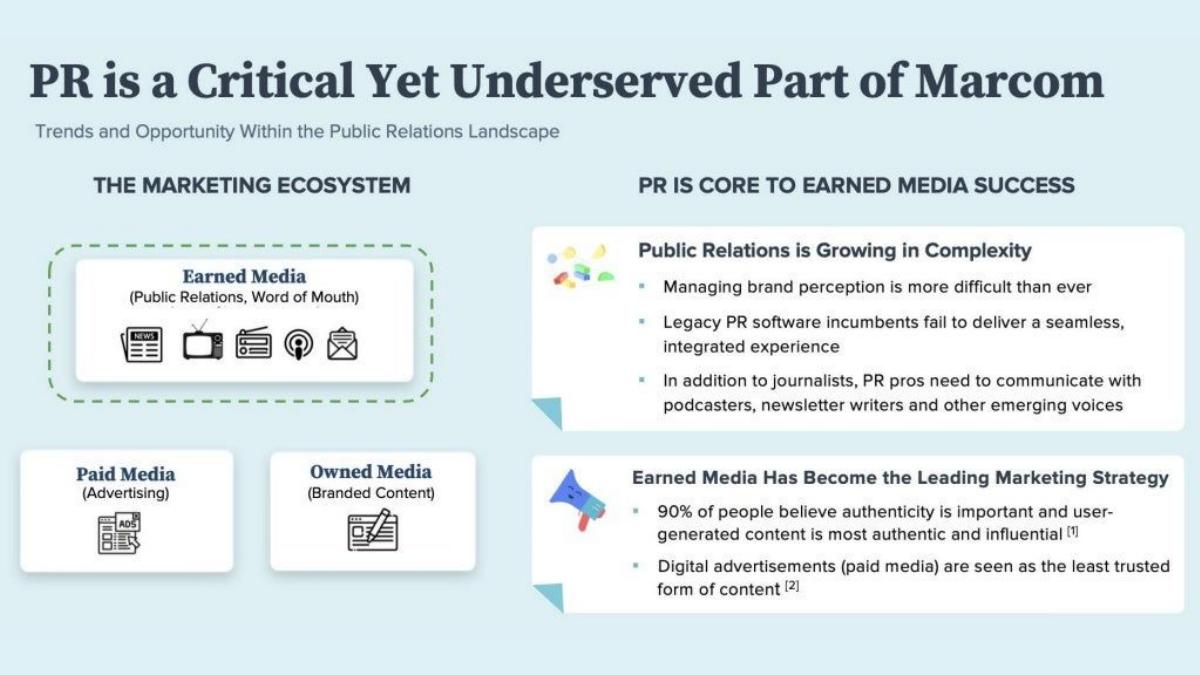
- The deck positions PR as a critical but underserved part of the marketing ecosystem on slide 2.
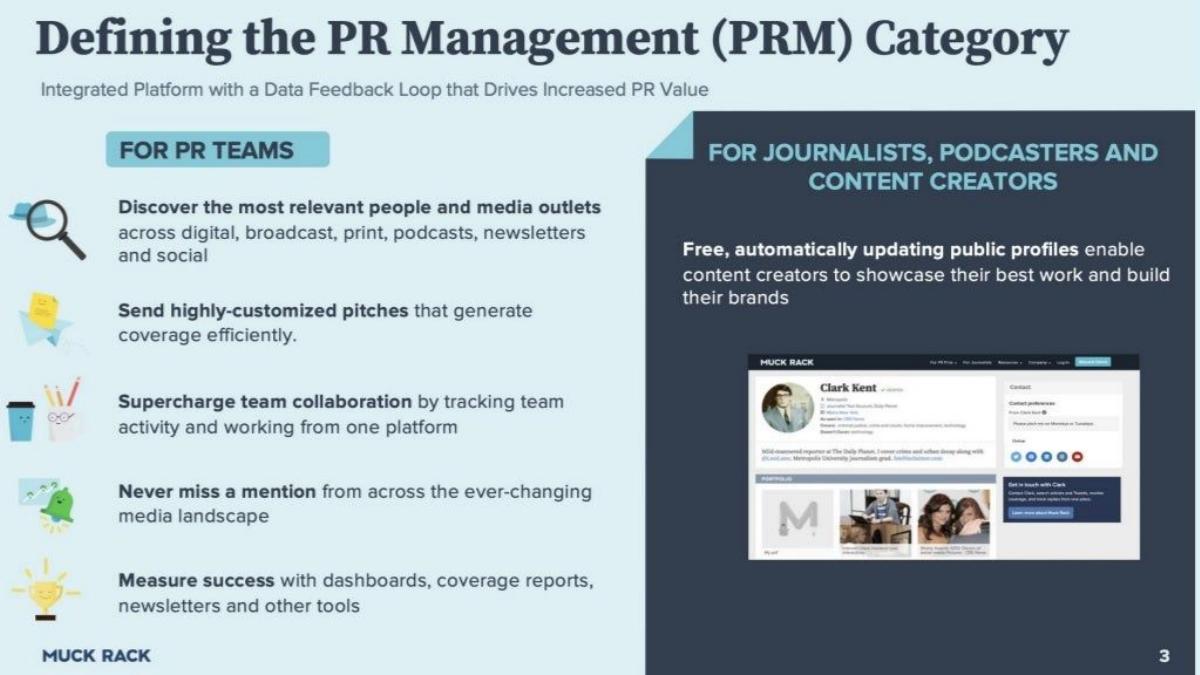
- Muck Rack explicitly defines a new category, PR Management (PRM), to differentiate from legacy tools on slide 3.
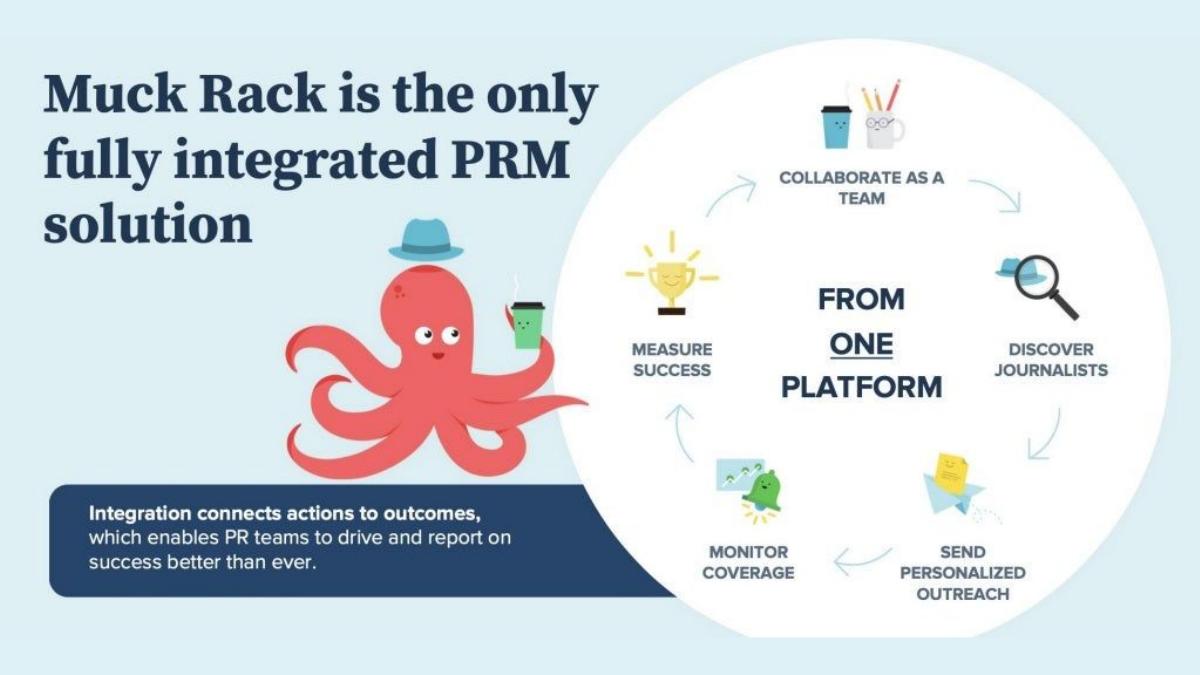
- The solution is presented as a circular workflow that connects actions to outcomes on slide 4.
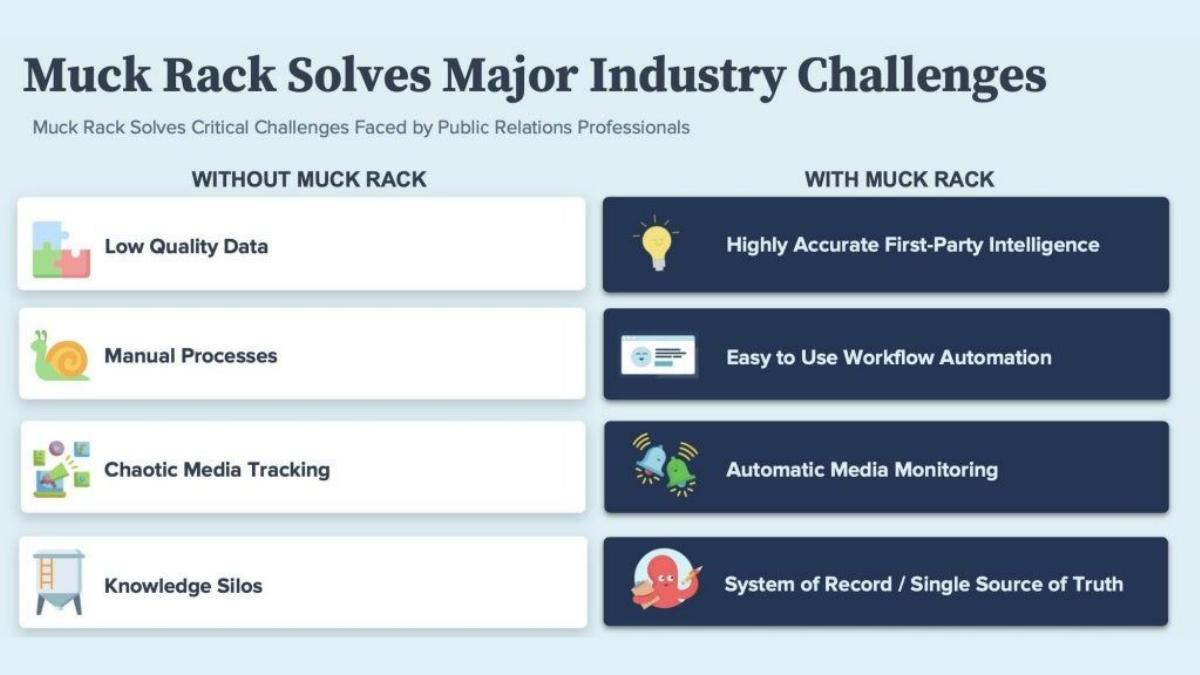
- A direct 'Before and After' comparison on slide 5 highlights the transition from 'Chaotic Media Tracking' to 'Automatic Media Monitoring.'
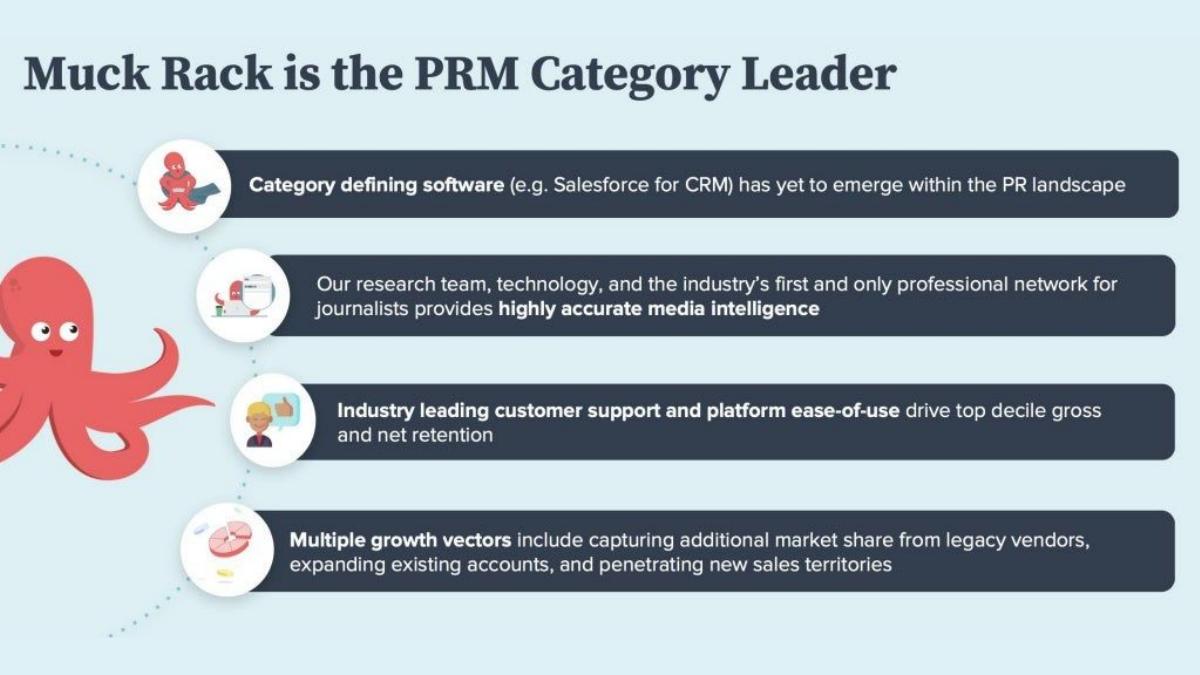
- The company claims 'top decile gross and net retention' on slide 6, though specific percentages are not disclosed.
- Social proof is a primary driver, with slide 7 featuring 18 high-profile logos including Samsung, PepsiCo, and Visa.
- Customer testimonials on slide 8 use aggressive metaphors, comparing Muck Rack to Netflix and Google.
- The deck omits a team slide, financial history, and a specific funding request entirely.
Introduction: The $180M Narrative
Muck Rack’s Series A deck is a concise 9-slide presentation that prioritizes category leadership and social proof over granular data. In 2022, the company secured $180M from VCs, a significant sum for a Series A, suggesting that the narrative of modernizing the 'Earned Media' space was highly effective. The deck focuses on the transition from legacy, siloed tools to a unified 'Public Relations Management' (PRM) platform.
Slide 1: Title and Branding
The deck opens with a clean, character-driven title slide. It features the company name, 'Muck Rack,' and the subtitle 'Public Relations Management.' The tagline, 'Smarter PR with powerful, easy-to-use software,' sets the tone for a user-experience-focused solution. The presence of the octopus mascot and whimsical illustrations of a typewriter and cactus suggests a modern, approachable brand identity, contrasting with the 'legacy' image they later project onto competitors.
Slide 2: The Market Opportunity
Slide 2, titled 'PR is a Critical Yet Underserved Part of Marcom,' establishes the macro environment. It divides the marketing ecosystem into Paid, Owned, and Earned media, highlighting Earned Media (PR) as the core focus. The slide cites two key statistics to build urgency: '90% of people believe authenticity is important' and that digital advertisements are 'the least trusted form of content.' This frames PR not just as a luxury, but as the most effective way to reach modern consumers who value authenticity. It also notes that PR is growing in complexity, requiring communication with podcasters and newsletter writers, not just traditional journalists.
Slide 3: Defining the PRM Category
This slide is the strategic heart of the deck. Muck Rack defines 'PR Management (PRM)' as an integrated platform with a data feedback loop. Crucially, it shows value for two distinct groups. For PR teams, it offers discovery, customized pitching, collaboration, and measurement. For journalists and creators, it offers 'Free, automatically updating public profiles.' By showing a screenshot of a profile for 'Clark Kent,' Muck Rack demonstrates that their data is self-correcting, which solves the 'low quality data' problem inherent in the industry.
Slide 4: The Integrated Workflow
Slide 4 reinforces the 'fully integrated' claim. It uses a circular graphic to show a continuous loop: Discover Journalists -> Send Personalized Outreach -> Monitor Coverage -> Measure Success -> Collaborate as a Team. The text emphasizes that this integration 'connects actions to outcomes,' a phrase designed to appeal to data-driven marketing executives who struggle to prove the ROI of their PR efforts.
Slide 5: The Before and After Comparison
Slide 5, 'Muck Rack Solves Major Industry Challenges,' uses a direct comparison table. It lists four specific pains 'Without Muck Rack': Low Quality Data, Manual Processes, Chaotic Media Tracking, and Knowledge Silos. It counters these with four specific solutions: 'Highly Accurate First-Party Intelligence,' 'Easy to Use Workflow Automation,' 'Automatic Media Monitoring,' and a 'System of Record / Single Source of Truth.' This slide is effective because it uses the customer's own language to describe the 'chaos' of the status quo.
Slide 6: Category Leadership and Retention
On slide 6, Muck Rack makes its boldest claim: 'Muck Rack is the PRM Category Leader.' It explicitly compares the need for PRM to the emergence of Salesforce for CRM. This is a classic venture capital framing technique—identifying a massive existing category (CRM) and claiming the equivalent spot in an adjacent industry. The slide also mentions 'top decile gross and net retention,' which, while lacking a specific number, signals to investors that the product is 'sticky' and that customers are not churning.
Slide 7: The 'Wall of Logos' Social Proof
Slide 7 is a dense grid of 18 high-profile customer logos. The list includes Spotify, Pfizer, Uber, Samsung, Yelp, NBC Universal, PepsiCo, Duolingo, Reddit, Etsy, FedEx, and Visa. By including brands from diverse sectors (tech, pharma, CPG, government/UNICEF), Muck Rack proves that their solution is horizontally applicable and already trusted by the world’s largest organizations. This slide serves as a proxy for revenue and market validation.
Slide 8: High-Impact Testimonials
The final content slide provides three testimonials. David Weissmann from Verizon compares Muck Rack to Google. Ellen Murphy from Syneos Health calls it the 'PR equivalent of Netflix to Blockbuster,' a powerful metaphor that implies legacy competitors are headed for extinction. Matt Prince from Taco Bell describes it as the 'map, compass and GPS' for the media landscape. These quotes are chosen to reinforce the idea that Muck Rack is an essential, modern utility.
Slide 9: External Resource Link
The final slide is a promotional page for 'bestpitchdeck.com,' which is not part of the Muck Rack business narrative but serves as a closing frame for the deck viewer. It does not contain any further information about Muck Rack's financials, team, or ask.
What Muck Rack Does Well
Muck Rack excels at category creation . By naming their space 'PRM' and comparing it to CRM, they move the conversation away from being a 'media database' (a commodity) to being an 'operating system' (a high-multiple SaaS business). The deck is also exceptionally strong on social proof . The combination of Fortune 500 logos and aggressive customer testimonials makes the investment seem 'de-risked.' Finally, the problem-solution mapping on slide 5 is clear and relatable, making it easy for a generalist investor to understand the daily friction of a PR professional.
What Is Missing from the Deck
The most glaring omission is a team slide . There is no mention of the founders, their backgrounds, or the size of the current staff. Additionally, there are no financial metrics . While they claim 'top decile retention,' they do not provide ARR (Annual Recurring Revenue), growth rates, or CAC/LTV ratios. There is also no 'Ask' slide ; the deck does not state how much they are raising or how they intend to use the capital. Finally, there is no competitive landscape beyond the vague mention of 'legacy vendors.' While this works for a narrative-driven pitch, most Series A decks would require these details for a full evaluation.
Founder's Takeaway: Copy the Narrative, Prepare the Data
Founders should emulate Muck Rack’s ability to frame their product as a 'System of Record.' Investors pay higher multiples for software that houses a company's primary data and workflows. The 'Before and After' slide (Slide 5) is a perfect template for any B2B SaaS founder to follow. However, unless you have the brand recognition of Muck Rack, you should not omit the team and financial slides. Use Muck Rack’s narrative structure to build excitement, but ensure your appendix or data room is ready to back up claims of 'top decile' performance with hard numbers.
Frequently asked questions
- Why does the deck omit a team slide?
- In a Series A round of this size ($180M), the founders are often already well-known to the investors, or the company has reached a level of scale where the brand's reputation supersedes individual bios. Muck Rack chose to use that space for customer validation and category definition instead, assuming the strength of the business spoke for the leadership.
- How does Muck Rack handle the competition in this deck?
- Rather than a standard 'X and Y axis' competitive matrix, Muck Rack uses slide 5 and 6 to frame the competition as 'legacy incumbents' and 'legacy vendors.' By positioning themselves as the only 'fully integrated PRM,' they attempt to make traditional competitors appear obsolete without naming them directly, focusing instead on the 'chaotic' workflows those tools represent.
- What is the significance of the 'PRM' category definition?
- Defining a new category (Public Relations Management) allows Muck Rack to set the rules of engagement. On slide 6, they compare themselves to 'Salesforce for CRM.' This tells investors that Muck Rack isn't just a database of journalists; it is the essential operating system for an entire department, justifying a much higher valuation and larger round.
- Is the lack of financial data a red flag?
- While unusual for a $180M round, this deck appears to be a high-level overview meant to establish the narrative. The 'top decile gross and net retention' claim on slide 6 serves as a proxy for financial health. Detailed unit economics and P&L statements were likely handled in a separate data room rather than the primary pitch presentation.
- What is the primary value proposition offered to journalists?
- Unique among PR tools, Muck Rack highlights a two-sided marketplace. Slide 3 shows that they offer free, automatically updating profiles for journalists and content creators. This ensures their data remains 'highly accurate' (slide 6) because the subjects of the data have an incentive to maintain their own profiles to 'showcase their best work.'