Firework’s Series B deck is a masterclass in narrative-driven fundraising for a growth-stage SaaS company. By leveraging the massive success of live commerce in China—projected at $470B+ in 2022 (Slide 3)—Firework positions itself as the infrastructure for the 'Open Web' to compete with social giants like TikTok and Instagram. The deck successfully argues that while 70% of short-form video happens in 'walled gardens', 97% of transactions still occur on the open web (Slide 4). With 84 billion seconds streamed in 2021 (Slide 8) and a team featuring former executives from Google, Walmart, and Di…
Key takeaways
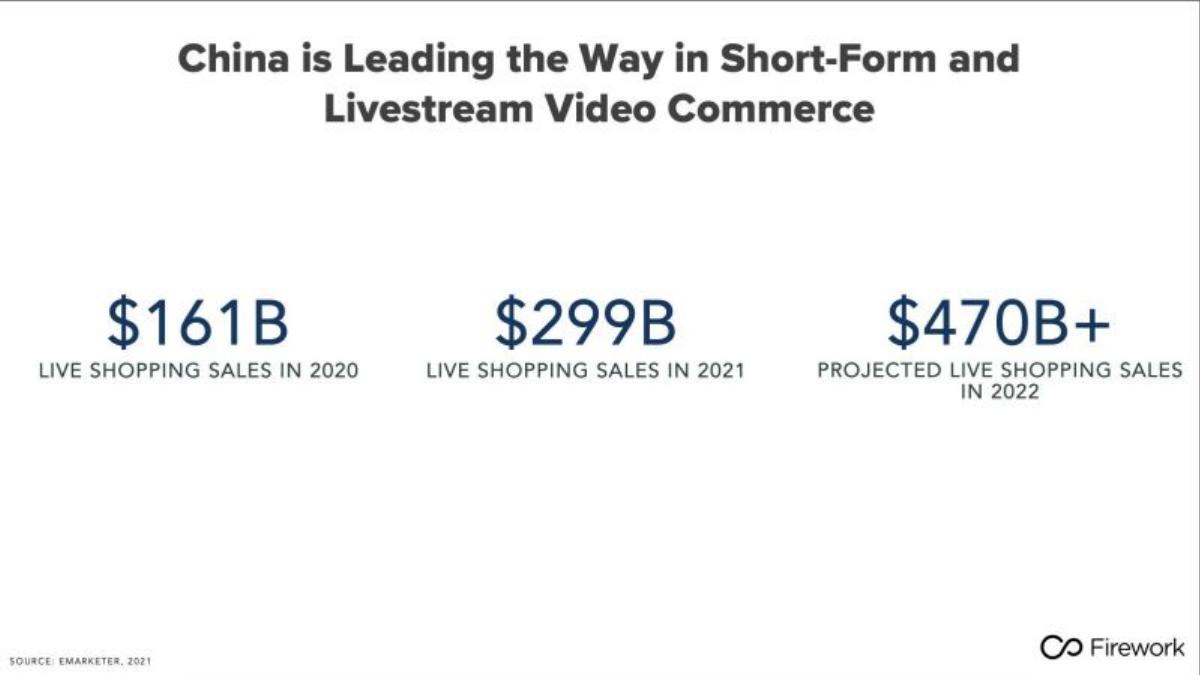
- The deck uses the 'China as a precursor' strategy, citing a jump from $161B to $470B+ in live shopping sales in just two years (Slide 3).
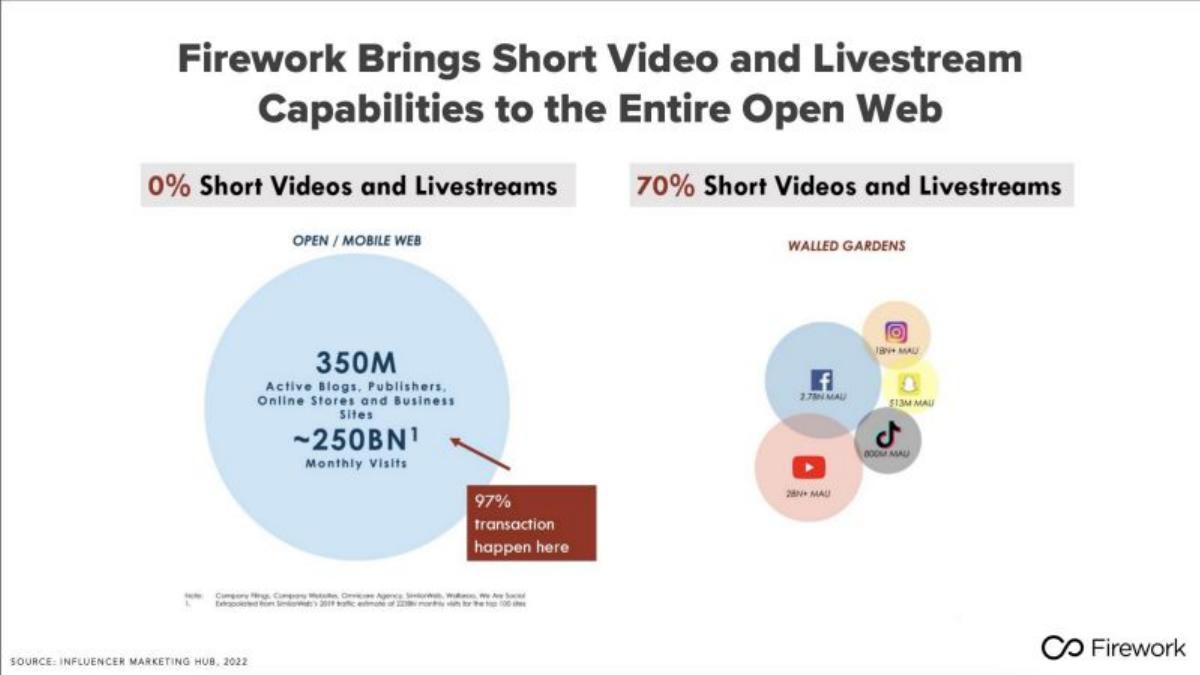
- Firework identifies a critical gap: 97% of transactions happen on the open web, yet that space has 0% short-form video penetration compared to 70% in social apps (Slide 4).
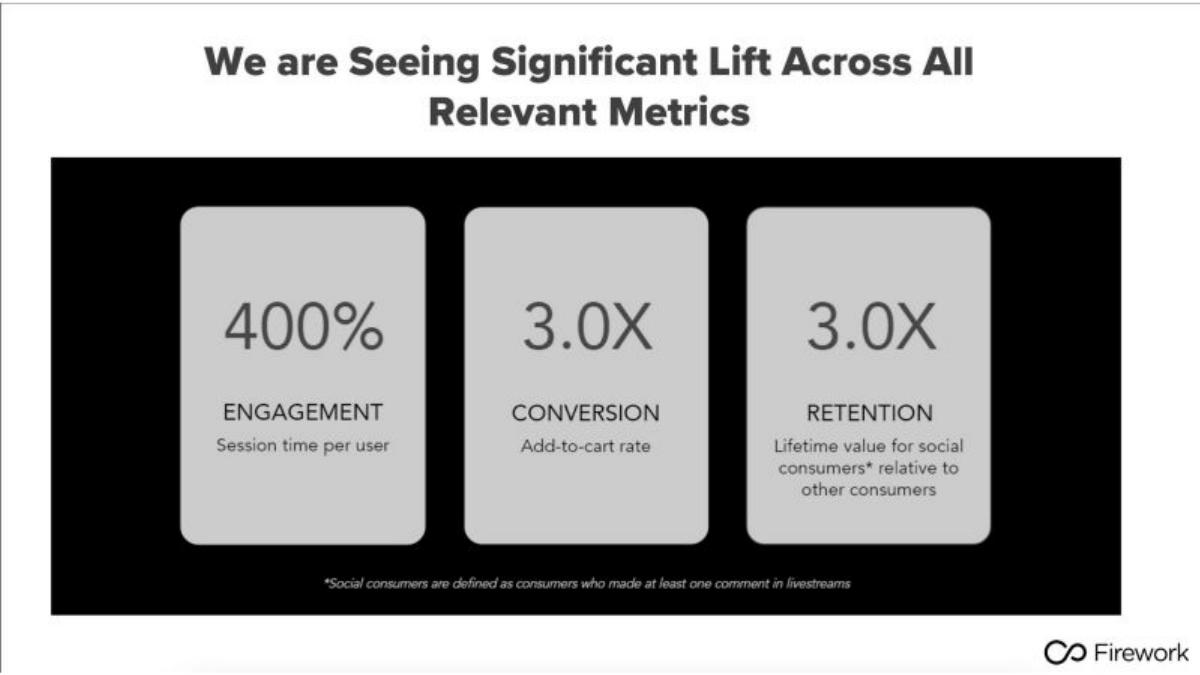
- The platform claims significant performance lifts for brands, including a 400% increase in session time and a 3.0x increase in add-to-cart rates (Slide 6).
- Firework positions itself as the 'Shopify' to TikTok's 'Amazon', emphasizing a decentralized B2B SaaS model over a centralized B2C ad model (Slide 7).
- Scale is demonstrated through global reach, with 84,000,000,000 seconds streamed across 36 countries in 2021 (Slide 8).
- Growth is visualized through a 15x increase in quarterly livestream minutes over an 18-month period ending in Q1 2022 (Slide 9).
- The team slide emphasizes 'Deep Expertise in the Retail Industry' with hires from Google, Walmart, Disney, and Albertsons (Slide 10).
- The deck omits traditional financial metrics like ARR, CAC, or LTV, focusing instead on engagement and volume-based 'North Star' metrics.
The Narrative of the Open Web
Firework’s Series B deck is a study in market-making. At this stage, a company isn't just selling a product; it is selling a future where they are the dominant infrastructure. The deck, which helped secure $150M from SoftBank Vision Fund in 2022, moves quickly from consumer behavior shifts to a massive market opportunity, and finally to their specific competitive advantage as a decentralized alternative to social media giants.
Slide 1: Title Slide
The deck opens with the tagline "Reimagining Commerce: the future of shopping is live." The imagery is modern and high-production, signaling a focus on high-quality video content. There is no mention of the specific round or the amount being raised on the cover.
Slide 2: The Paradigm Shift
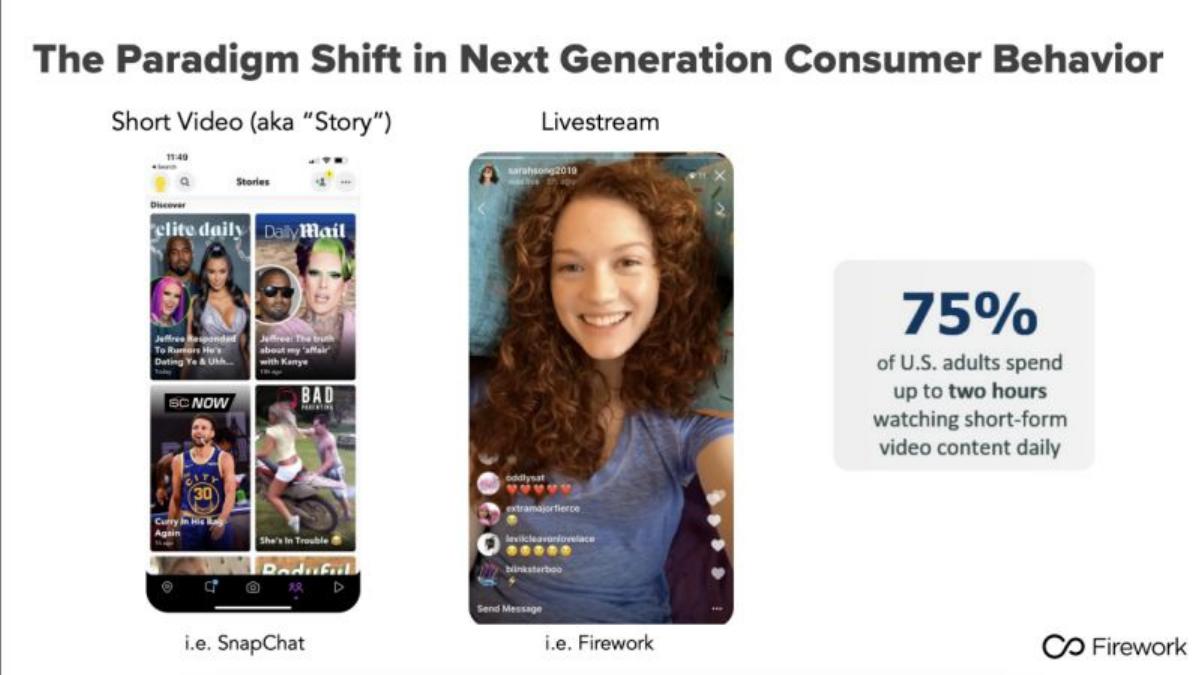
This slide establishes the "Why Now?" factor. It compares short video (Snapchat) with livestreaming (Firework). The core statistic provided is that 75% of U.S. adults spend up to two hours watching short-form video content daily. This frames the product not as a niche tool, but as a response to a fundamental shift in how humans consume information.
Slide 3: The China Precedent
To prove the potential scale, Firework looks to the East. The slide shows a staggering growth trajectory for live shopping sales in China: $161B in 2020, $299B in 2021, and a projected $470B+ in 2022. By citing eMarketer 2021 data, Firework is telling investors that the U.S. market is currently an untapped version of this proven Chinese phenomenon.
Slide 4: Open Web vs. Walled Gardens
This is the most critical strategic slide in the deck. It contrasts the "Open / Mobile Web" (350M active blogs/publishers and ~250BN monthly visits) with "Walled Gardens" (Facebook, Instagram, TikTok, etc.). The punchline is twofold: first, the open web has 0% short video penetration while walled gardens have 70%. Second, a red box highlights that "97% transaction happen here" (on the open web). Firework positions itself as the bridge that brings the high-engagement format of social media to the high-transaction environment of the open web.
Slide 5: Product Visualization
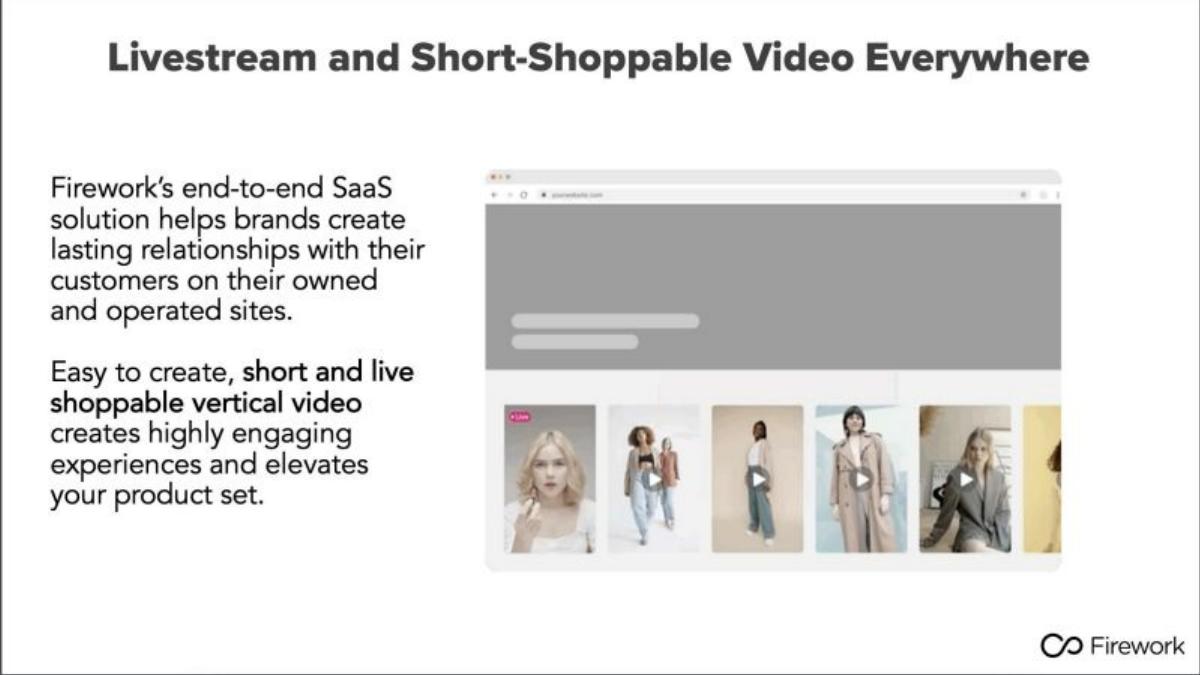
Slide 5 defines the solution as an "end-to-end SaaS solution" that helps brands create relationships on "owned and operated sites." The visual shows a clean web interface with a row of shoppable vertical videos at the bottom, demonstrating how the technology integrates seamlessly into a standard e-commerce site.
Slide 6: Impact Metrics
Firework claims "Significant Lift Across All Relevant Metrics." They list three specific figures: 400% Engagement (session time), 3.0x Conversion (add-to-cart rate), and 3.0x Retention (LTV for social consumers). A footnote defines social consumers as those who made at least one comment in a livestream. These are powerful 'proof of concept' numbers for a Series B investor.
Slide 7: Competitive Positioning
This slide uses a simple comparison to define Firework's identity. They compare TikTok (Centralized, B2C, Ads, Amazon-like) to Firework (De-centralized, B2B, SaaS, Shopify-like). By aligning themselves with the "Shopify" model, they tap into the investor sentiment that favors platforms enabling brand independence over those that control the audience.
Slide 8: Global Scale
To demonstrate they are already a global player, Slide 8 shows a world map with 15 office locations including San Mateo, New York, London, Tokyo, and Mumbai. The headline metric is "84,000,000,000 seconds streamed in 2021 across 36 countries." Using seconds instead of hours or minutes makes the number feel astronomically large.
Slide 9: Growth Momentum
The penultimate slide is a bar chart showing "15x Quarterly Growth in Livestream Minutes over the Previous 18 Months." The chart spans from 2020 Q1 to 2022 Q1. While the Y-axis lacks specific numbers, the trend line is a steep, consistent upward diagonal, which is exactly what a growth-stage investor wants to see.
Slide 10: The Team
The final slide, titled "Deep Expertise in the Retail Industry," features six executives. Notably, they don't lead with the founders, but with the "Heads of" various departments who came from massive incumbents: Google, American Express, Albertsons, Walmart, and Disney. This signals to investors that the company has the professional leadership required to handle a $100M+ injection of capital and navigate complex enterprise sales.
What Works in the Firework Deck
The 'Open Web' Argument: The deck identifies a massive structural inefficiency in the internet—that people watch video in one place (social) but buy things in another (websites). Firework presents itself as the obvious solution to this friction.
The Shopify Comparison: By explicitly using the Shopify logo and the word "De-centralized," Firework hit a major investment trend of the early 2020s. It frames the company as a champion for brands against the 'tax' of the walled gardens.
Massive Scale Metrics: Using "84 billion seconds" is a clever way to present data. It sounds more impressive than "23 million hours," even though they are the same. It emphasizes the sheer volume of data passing through their pipes.
What is Missing from the Firework Deck
Revenue and Unit Economics: For a Series B deck, the total absence of ARR (Annual Recurring Revenue), NRR (Net Revenue Retention), or even a general revenue range is unusual. The deck focuses entirely on engagement and volume metrics (minutes, seconds, sessions).
The Ask: There is no slide detailing how much they are raising or what the funds will be used for. While this is common in 'leaked' decks or those used for initial intros, a complete fundraising deck usually includes a roadmap for the capital.
Customer Logos: While they mention expertise from companies like Walmart and Albertsons via their team, the deck doesn't feature a 'wall of logos' showing which brands are currently paying for and using Firework. This is a missed opportunity to show market validation.
What Founders Should Copy
The 'China as a Crystal Ball' Slide: If you are building in a category that is more mature in another geography (like gaming in Korea or fintech in Brazil), use those market stats to prove the potential ceiling of your own market. It removes the 'market size' risk for investors.
The Comparison Table: Slide 7 is a perfect example of how to position against a giant. Don't say you are 'better' than TikTok; say you are the 'decentralized SaaS version' of TikTok. It makes your company feel like a partner to brands rather than a competitor to the incumbents.
Focus on 'Lift': Instead of just saying what your product does, show the 'lift' it provides (Slide 6). Investors care about the delta—how much better is the world after your software is installed? Firework’s 3.0x conversion lift is a much stronger selling point than a list of features.
Frequently asked questions
- What is Firework's core business model?
- According to the catalogue facts and Slide 7, Firework operates as a B2B SaaS company. Unlike social media platforms that rely on advertising revenue, Firework provides the technology infrastructure for brands and retailers to host shoppable, short-form, and live video directly on their own websites.
- How does Firework differentiate itself from TikTok or Instagram?
- Firework uses Slide 7 to draw a clear distinction: social platforms are 'Centralized' and 'B2C' (Walled Gardens), while Firework is 'De-centralized' and 'B2B'. They argue that while social apps are good for discovery, Firework allows brands to own the relationship and the data on their 'owned and operated' sites.
- What kind of growth did Firework show in this deck?
- The deck highlights massive volume growth rather than revenue. Slide 9 shows a 15x quarterly growth in livestream minutes over 18 months, and Slide 8 notes that the platform streamed 84 billion seconds of content in 2021 across 36 different countries.
- What metrics does Firework use to prove product-market fit?
- On Slide 6, the company presents three key 'lifts' seen by their clients: a 400% increase in engagement (session time), a 3.0x increase in conversion (add-to-cart rate), and a 3.0x increase in retention (lifetime value for 'social consumers').
- Who are the key people behind Firework?
- The team slide (Slide 10) focuses on retail and marketing heavyweights rather than just the founders. It lists Mark Wurtzel (ex-Google), Eva Wang (ex-Amex), Steve Stafford (ex-Albertsons), Drew Cashmore (ex-Walmart), Malli Coimbatore (ex-Disney), and Matt Lynch (ex-Albertsons).