Fintor’s 19-slide Seed deck focuses on the 'democratization' of real estate for Millennials and Gen Z, leveraging a fractional ownership model. The company positions itself as a solution to high entry costs and low liquidity in property investing. By charging a 3% annual fee per property, Fintor projects reaching $400M in revenue within five years, assuming a capture of 0.5% of the available market (47,000 properties). While the deck is visually clean and emphasizes regulatory tailwinds, it notably lacks detailed unit economics, a specific 'Ask' slide, and a competitive landscape analysis bey…
Key takeaways
- Fintor positions itself as 'The Stock Market for Real Estate' to simplify the value proposition for investors (Slide 1).
- The problem slide identifies a 50-day average closing time for traditional real estate as a primary pain point (Slide 3).
- The 'Why Now' slide attributes the opportunity to new regulations and digital transformation but lacks specific regulatory citations (Slide 7).
- Fintor's business model relies on a 3% annual fee per property managed on the platform (Slide 13).
- The company projects $400M in revenue over 5 years based on an average home price of $282,000 (Slide 13).
- The deck claims a total market share goal of 0.5% of the available market, equating to 47,000 properties (Slide 13).
- A comparison table claims Fintor offers 'Liquidity' and 'Low Volatility,' features traditionally at odds in real estate (Slide 11).
- The deck omits a formal 'Ask' slide, leaving the specific funding requirements and use of proceeds unstated (Slide 19).
The Vision: Real Estate as a Liquid Asset
Fintor’s pitch deck for their $6.2M Seed round is a study in minimalist design and bold market positioning. By framing the company as "The Stock Market for Real Estate," the founders immediately anchor the investor's mind to a high-volume, liquid, and scalable platform model rather than a traditional property management firm. As reported by Business Insider, the 2024 round was raised to further their mission of allowing users to invest as little as $5 into property shares.
Slide 1-2: Title and Visual Hook
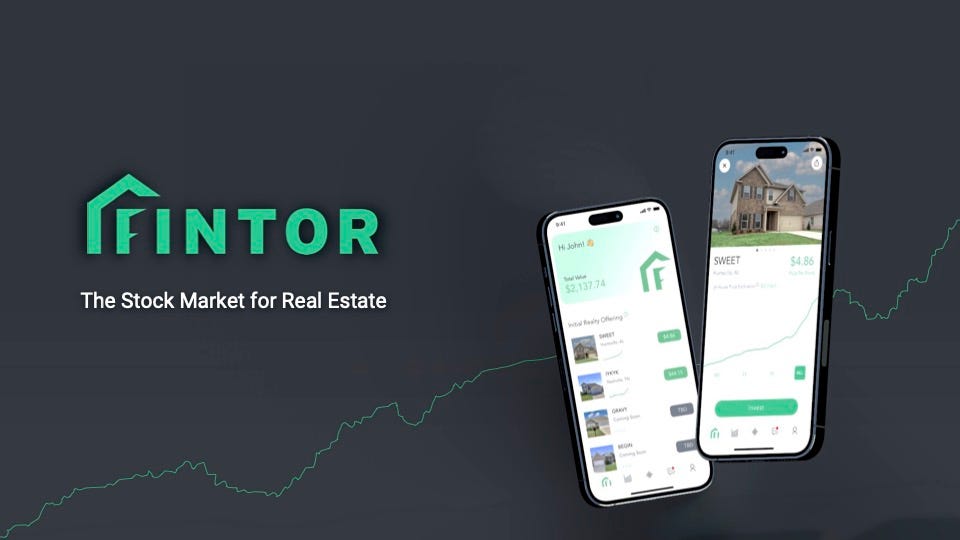
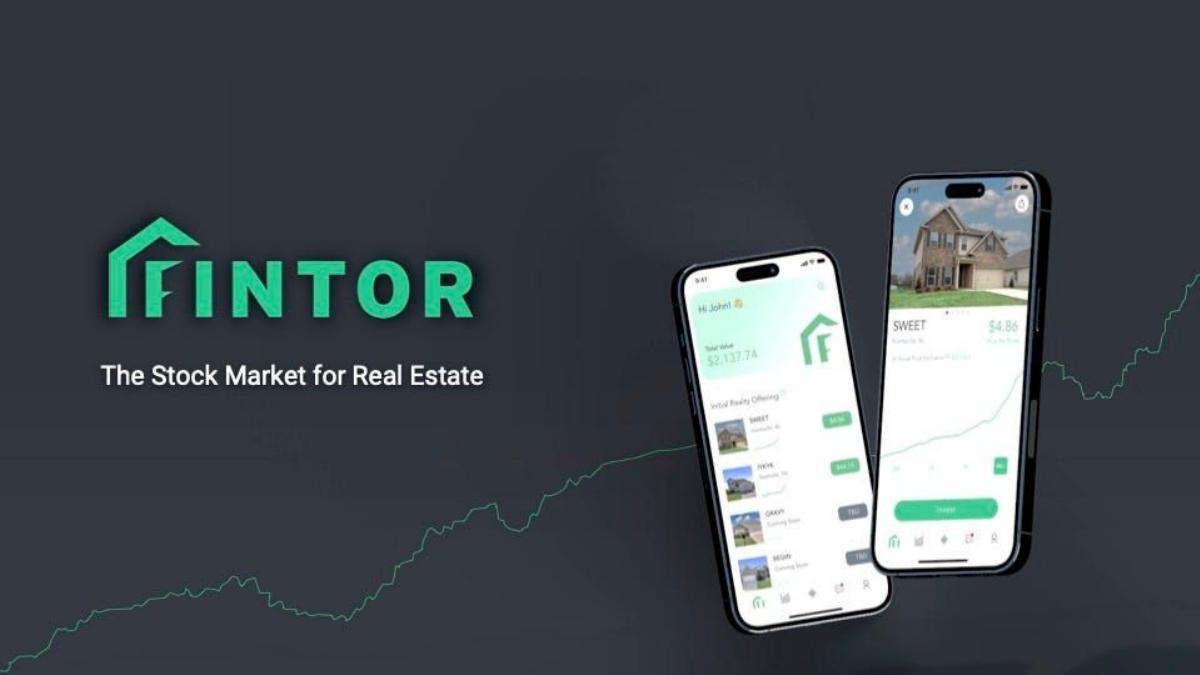
The deck opens with a clean, dark-themed title slide. The tagline "The Stock Market for Real Estate" is prominent. The visual includes two smartphone mockups showing a property named "SWEET" in Huntsville, AL, priced at $4.86 per share. This immediately demonstrates the product’s core functionality: fractional ownership. Slide 2 is a transition or spacer slide that maintains the visual identity.
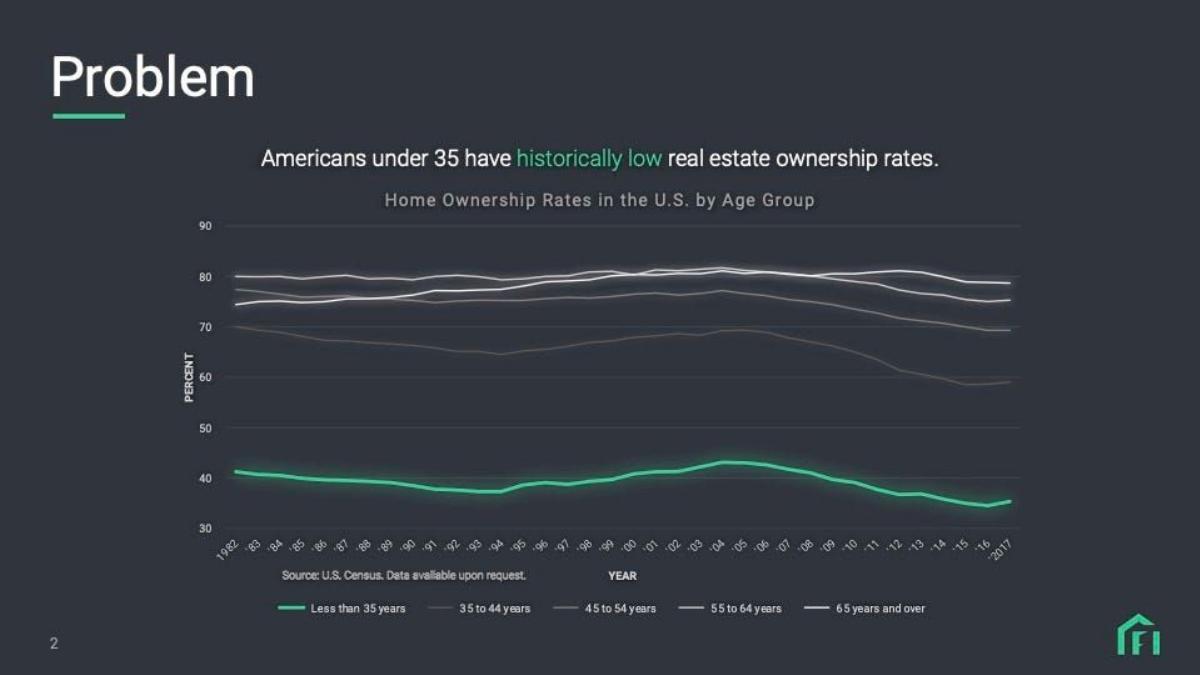
Slide 3-4: The Millennial Barrier
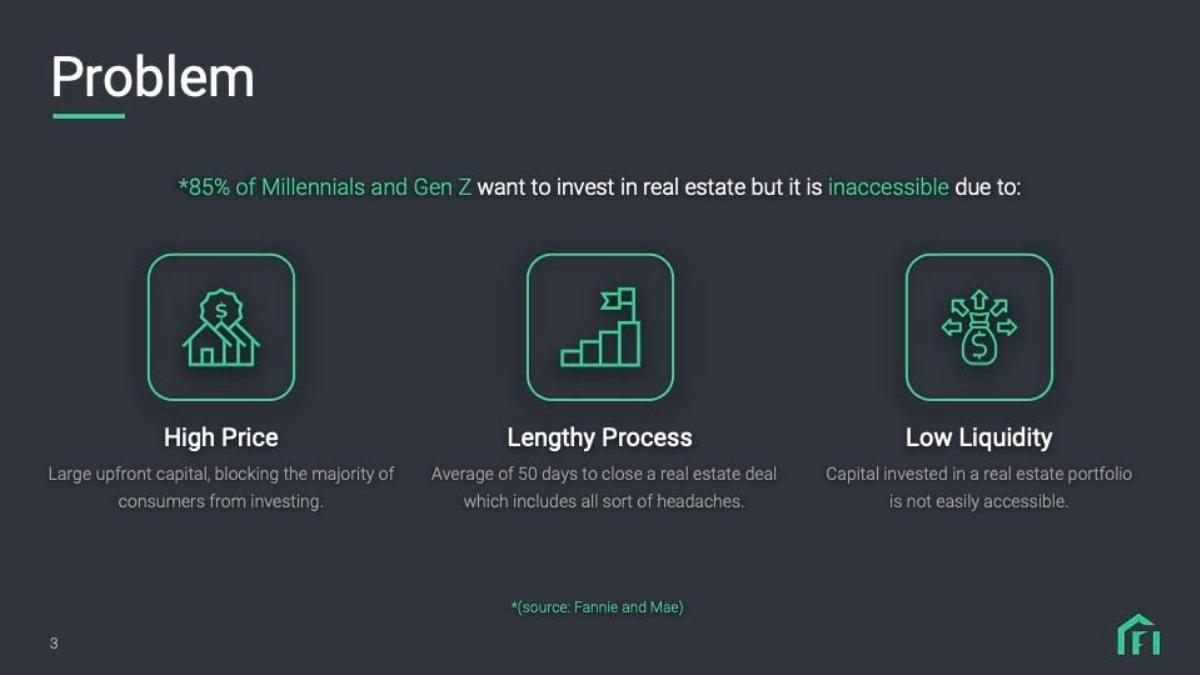
Slide 3 defines the problem space. It cites Fannie Mae, stating that 85% of Millennials and Gen Z want to invest in real estate but cannot. The deck identifies three specific hurdles: High Price (large upfront capital), Lengthy Process (average of 50 days to close), and Low Liquidity (capital is not easily accessible). By quantifying the closing time at 50 days, Fintor creates a specific metric they intend to disrupt. Slide 4 is another transition slide.
Slide 5-6: The Mission
Slide 5 states the mission: "To democratize real estate investing for all." While "democratize" is a common startup trope, it fits the fractional investment model. The simplicity of the slide suggests the founders want the mission to be the sole focus before diving into the mechanics.
Slide 7-8: Why Now?
Slide 7 addresses market timing. It points to three pillars: Digital Transformation, New Regulations, and Technological Infrastructure. While the slide is visually appealing, it is light on detail. It does not name the specific regulations (such as the JOBS Act or specific SEC Reg A+ / Reg D frameworks) that enable their business model. For a Seed round, investors usually look for more depth on the regulatory moat.
Slide 9-10: The Operational Loop
Slide 9 is the "How it Works" slide. It outlines a four-step cycle: 1. Secure the Asset, 2. Turn into Stock, 3. Sell the Shares, and 4. Manage the Asset. A critical footnote on this slide mentions that shares trade in an active marketplace maintained by a "partnered registered broker dealer." This is a vital piece of information for the business model, as it confirms Fintor is not acting as the broker-dealer itself but is leveraging a partnership to facilitate secondary trading.
Slide 11-12: The Asset Comparison
Slide 11 features a competitive matrix, but instead of comparing Fintor to other startups, it compares Fintor to other asset classes: Stocks, Bonds, Cash, and Gold. Fintor claims to check every box, including "Liquidity," "Low Volatility," and "Tax Advantages." This is a bold claim, as real estate is traditionally illiquid. The implication is that Fintor’s secondary marketplace (mentioned on Slide 9) is what provides this liquidity.
Slide 13-14: The $400M Revenue Projection
Slide 13 is the most data-dense slide in the deck. It breaks down the business model: Fintor earns a 3% annual fee per property. They use an average home price of $282,000 (based on targeted cities) to calculate a revenue of $8.5K per property. Their 5-year projection of $400M in revenue is based on capturing 0.5% of the available market, or 47,000 properties. This slide provides the "size of the prize" that justified the $6.2M Seed investment.
Slide 15-16: The Founders
Slide 15 introduces Farshad Yousefi (CEO) and Masoud Jalali, PhD (CTO). The slide is remarkably sparse. It includes photos and titles but omits any mention of previous companies, education (other than the PhD for Jalali), or relevant industry experience. In a Seed round, the "Team" slide is often the most important; Fintor relies here on the strength of the product and market vision rather than founder pedigree.
Slide 17-18: Impact and Vision
Slide 17 discusses "Impact," focusing on "Equality in Investing" and "Thriving of Market." It frames the company’s success as a social good by removing restrictions for all demographics. Slide 18 is a final visual of the app, showing a Dallas, TX property with a share price of $11.34 and a performance graph.
Slide 19: The Conclusion
The deck ends on a brand slide with the tagline "Investing in Real Estate for Everyone." Notably, there is no "Ask" slide in this version of the deck. There is no mention of the $6.2M target, the valuation, or how the funds will be allocated between engineering, marketing, and property acquisition.
What Fintor Does Well
The deck excels at clarity of value proposition . By the third slide, any investor understands exactly what Fintor does: they break houses into $5 shares. The use of a mobile-first UI throughout the deck reinforces the idea that this is a fintech product for a younger generation, not a stodgy real estate investment trust (REIT).
The business model slide (Slide 13) is also a highlight. It avoids complex jargon and focuses on a single, understandable lever: a 3% annual fee. By tying their revenue projections to a specific market share percentage (0.5%), they make a $400M revenue target feel grounded in a specific, albeit ambitious, reality.
What is Missing from the Fintor Deck
The most glaring omission is a competitive landscape analysis . Fintor is not the only player in fractional real estate; companies like Arrived, Fundrise, and Lofty operate in similar spaces. Investors would want to know how Fintor’s 3% fee or their secondary marketplace differs from these incumbents.
Furthermore, the Team slide (Slide 15) is insufficient for a multi-million dollar raise. While the founders clearly succeeded in raising the capital, a standard pitch deck should include the "Why Us"—specific professional achievements that prove the team can handle the regulatory and operational complexity of managing 47,000 properties.
Finally, the deck lacks Unit Economics . While we see the revenue per property, we do not see the cost to acquire a user (CAC) or the cost to source and onboard a property. In a low-margin fractional model, these numbers are the difference between a sustainable business and a cash-burning machine.
Founder's Guide: What to Copy
Founders should emulate Fintor's anchoring strategy . Calling yourself "The Stock Market for [Industry]" is a powerful way to bypass five minutes of explanation. If your product involves complex assets, find a familiar financial analogy that conveys liquidity and ease of use.
Additionally, the visual consistency of this deck is excellent. The dark mode aesthetic, consistent green accents, and high-quality app mockups create a sense of a finished, professional product. This is particularly important in fintech, where the "look and feel" of the UI is a proxy for the security and reliability of the platform.
Conclusion
Fintor’s deck is a vision-heavy Seed presentation that prioritizes market opportunity and product simplicity over operational detail. It successfully argues that real estate is a broken asset class for younger generations and offers a clear, fee-based path to significant revenue. While it leaves many questions unanswered regarding competition and execution, the $6.2M result proves that a compelling "Stock Market for X" narrative remains highly attractive to venture capital.
Frequently asked questions
- What is Fintor's primary revenue stream?
- According to Slide 13, Fintor earns a 3% annual fee for each property listed on its platform. Based on their targeted average home price of $282,000, they estimate this generates approximately $8,500 in revenue per property per year.
- Who is the target audience for Fintor?
- The deck specifically targets Millennials and Gen Z. Slide 3 notes that 85% of these demographics want to invest in real estate but are blocked by high prices and lengthy processes. The mobile-first UI shown on Slides 1 and 9 reinforces this focus.
- How does Fintor handle the actual trading of shares?
- Slide 9 explains that after an initial offering, shares trade in an active marketplace. Crucially, it notes that this marketplace is maintained by a 'partnered registered broker dealer,' highlighting the regulatory layer required for fractionalized securities.
- What are the biggest omissions in the Fintor deck?
- The deck lacks a competitive analysis of other fractional real estate platforms (like Arrived or Lofty). It also omits a 'Use of Funds' slide, a detailed roadmap, and specific unit economics regarding customer acquisition costs (CAC) versus lifetime value (LTV).
- What market share does Fintor need to hit its $400M revenue goal?
- Slide 13 indicates that Fintor aims to capture 0.5% of the available market. This represents 47,000 properties. Achieving this scale is the basis for their 5-year $400M revenue projection.