Finova Financial’s 2016/2017 deck is a study in using established traction to sell a speculative technological shift. The company successfully raised $155 million by first proving a high-yield lending model—the Car Equity Line of Credit (C-LOC)—and then layering on a vision for 'Jobs Crypto Offerings' (JCO). With $7.1 million already financed and a 122% yearly return on capital by slide 8, the deck establishes immense credibility before pivoting to blockchain concepts. However, the deck suffers from a jarring transition between a grounded fintech business and abstract crypto diagrams, leaving…
Key takeaways
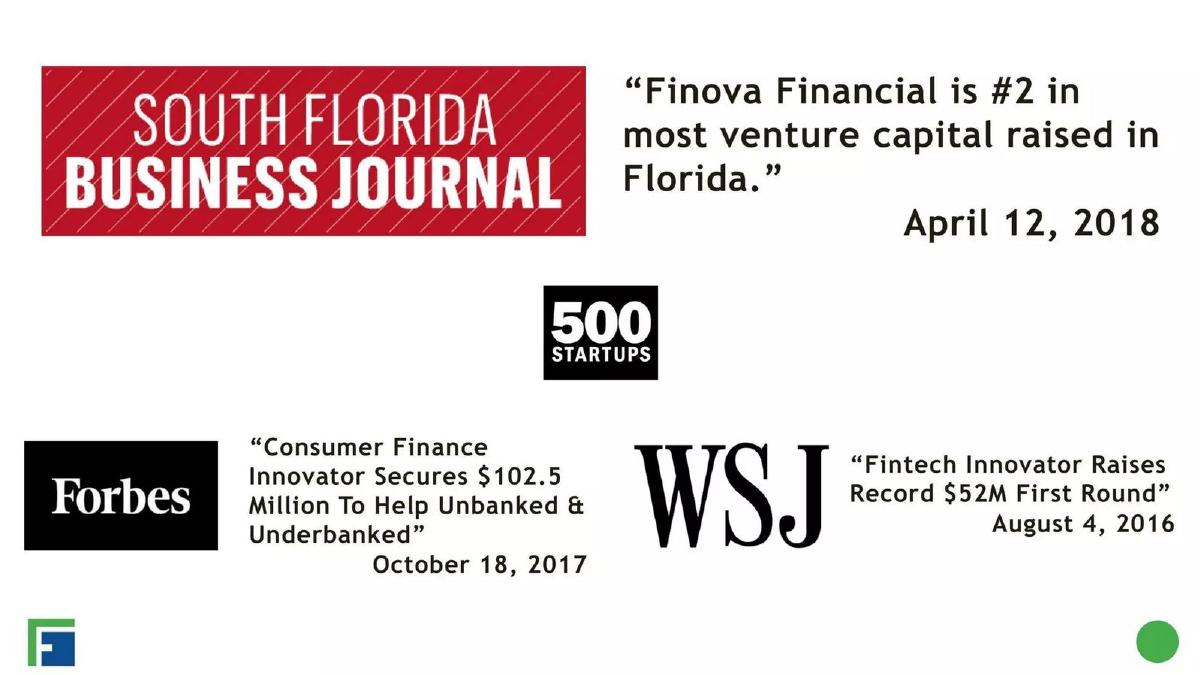
- The deck leads with heavy social proof, citing a $102.5 million raise in Forbes and a $52 million round in the WSJ (Slide 2).
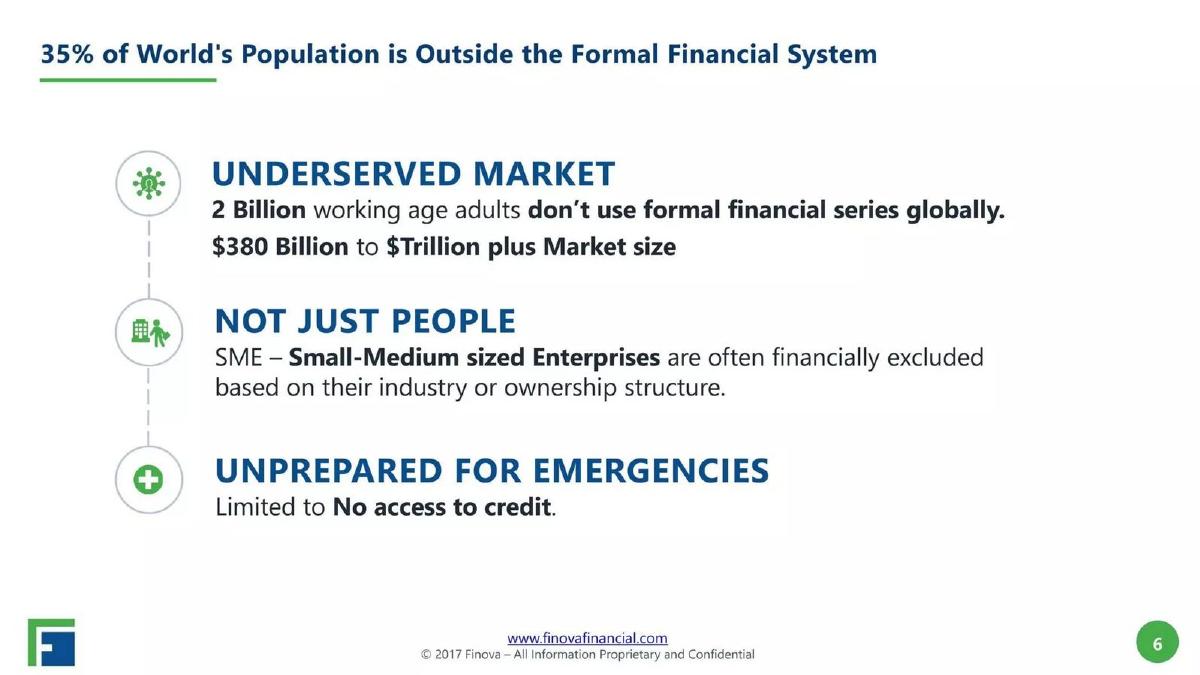
- Finova targets a massive underserved market of 2 billion adults globally who lack formal financial services (Slide 5).
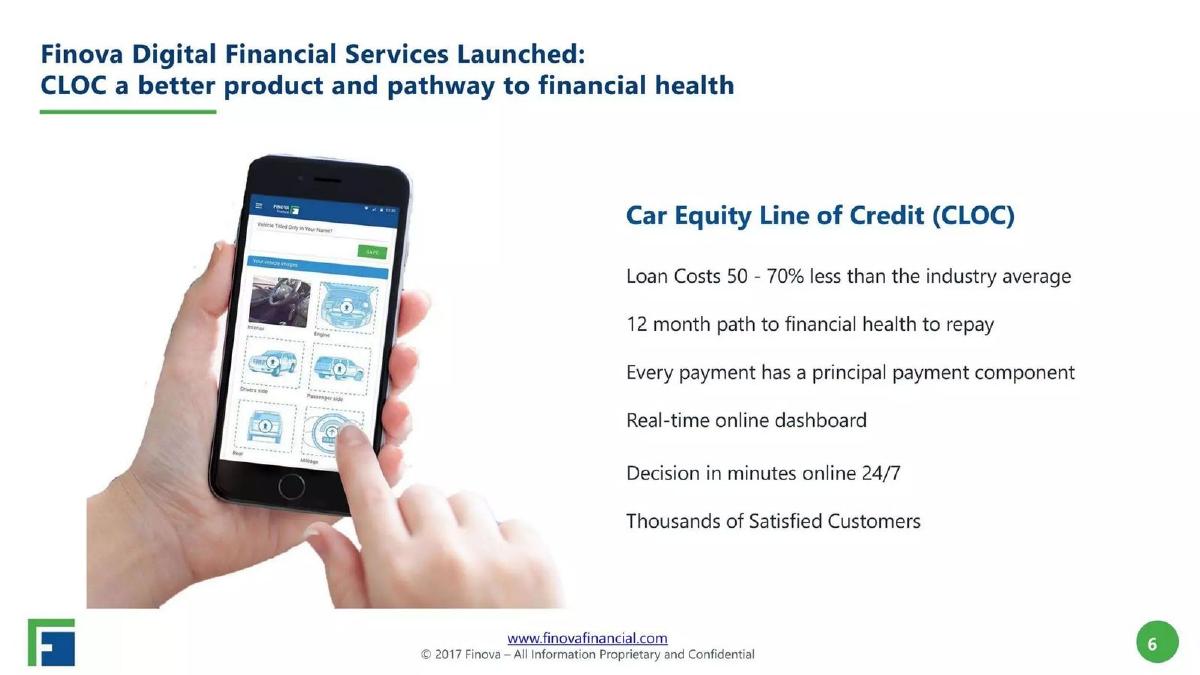
- The core product, C-LOC, claims to cost 50-70% less than the industry average for car equity loans (Slide 6).
- Traction is the deck's strongest point, reporting $2.4 million in 2017 revenue and a 122% yearly return on capital (Slide 8).
- The team boasts over 100 years of combined experience with logos from PwC, Morgan Stanley, and Mastercard (Slide 8).
- The deck introduces a 'Jobs Crypto Offering' (JCO) as a regulated pathway to IPO via Reg.D and Reg.A+ (Slide 10).
- There is a total absence of a specific 'Ask' slide detailing how the new funds will be allocated.
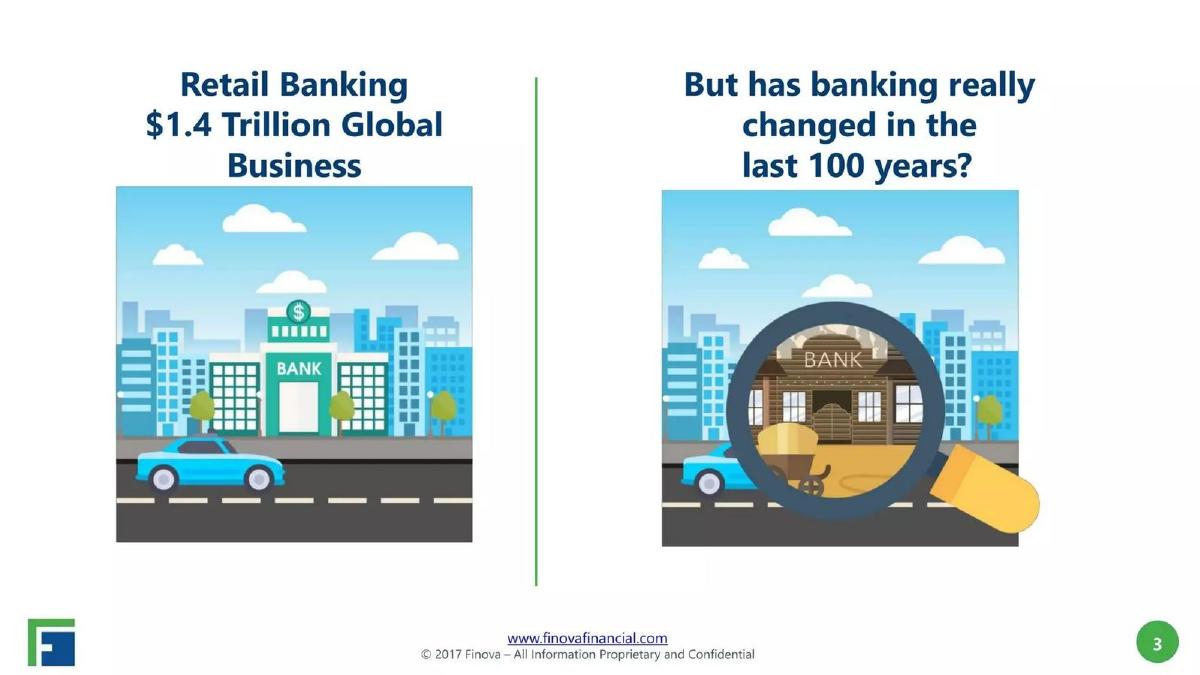
- The deck lacks a competitor matrix, relying instead on broad statements about banks not changing in 100 years (Slide 3).
Finova Financial: Bridging Subprime Lending and Blockchain
Finova Financial entered the market during a period of intense fintech experimentation. Their 14-slide deck represents a hybrid strategy: a high-interest, collateralized lending business (car titles) paired with a forward-looking crypto-equity fundraising model. With $155 million raised in total, the company clearly convinced investors that their 'socially responsible' approach to car equity could disrupt a predatory industry. This teardown examines how they balanced these two very different narratives.
The Hook and Social Proof (Slides 1-2)
Slide 1 introduces Gregory Keough as a 'Fintech Entrepreneur & Blockchain Innovator.' The subtitle immediately sets a dual agenda: affordable lending and blockchain-based investing. It is a bold opening that attempts to bridge the gap between the 'unbanked' consumer and the 'democratized' investor.
Slide 2 is a 'wall of fame' that most startups would envy. It features headlines from the South Florida Business Journal ('#2 in most venture capital raised in Florida'), Forbes ('Secures $102.5 Million'), and the WSJ ('Raises Record $52M First Round'). By placing these dates (2016, 2017, 2018) upfront, Finova establishes that they are not a pre-seed experiment but a heavily capitalized scale-up. This slide functions as a credibility shield for the more speculative blockchain slides that follow.
The Problem: Stagnant Banking (Slides 3-5)
Slide 3 uses a simple visual metaphor: a modern bank building versus a 100-year-old bank viewed through a magnifying glass. The text asks, 'But has banking really changed in the last 100 years?' while citing a $1.4 Trillion Global Business . This is a classic 'dinosaur' argument used to justify disruption.
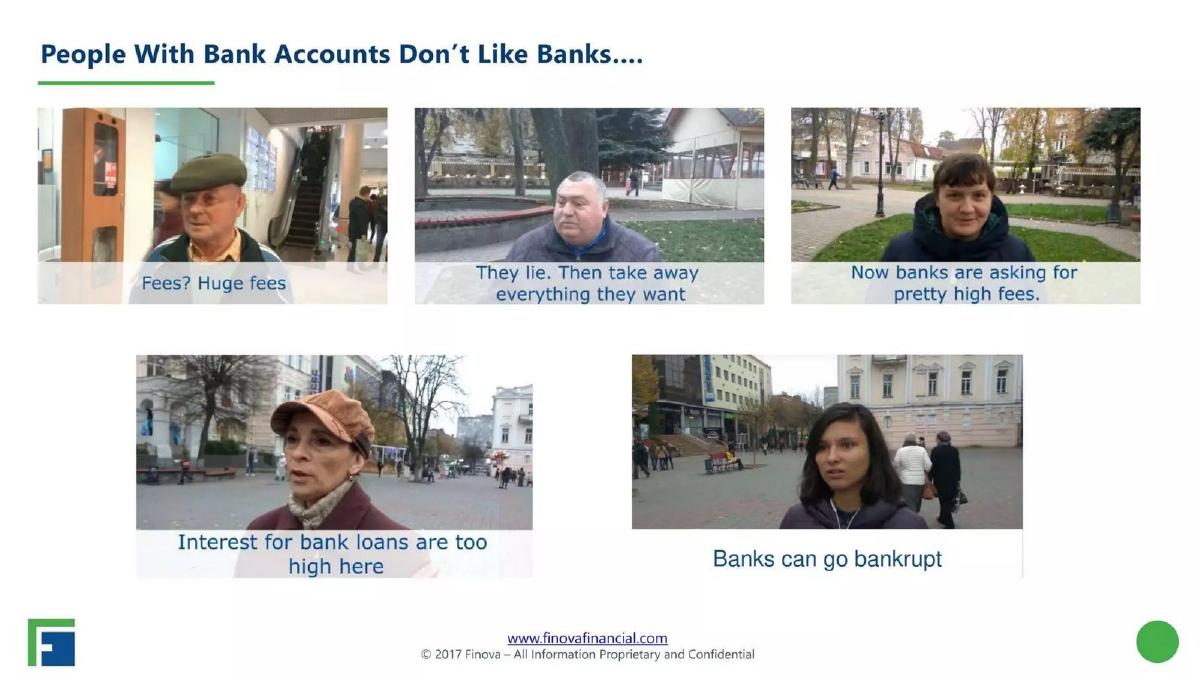
Slide 4 attempts to add a human element with 'Man on the Street' style photos and quotes like 'Fees? Huge fees' and 'Banks can go bankrupt.' While these quotes are generic, they serve to paint traditional banking as the antagonist. Slide 5 then quantifies the 'Underserved Market,' stating that 2 Billion working age adults do not use formal financial services, representing a $380 Billion to $Trillion plus market size. The slide also notes that SMEs are often excluded, broadening the scope of their potential impact.
The Solution: C-LOC and Prepaid Cards (Slides 6-7)
Slide 6 introduces the Car Equity Line of Credit (C-LOC) . This is the engine of the business. The slide lists several key value propositions: Loan Costs 50-70% less than the industry average , a 12-month path to repayment, and a real-time online dashboard. The visual shows a mobile app interface where users upload photos of their vehicle, emphasizing the 'digital-first' nature of the product. This is a critical distinction from traditional title loan offices.
Slide 7 expands the product suite to a Finova Secured Prepaid Card . The logic here is sound: 121 million consumers are in a 'cash economy' and pay high fees to check-cashing services. Finova uses the C-LOC to 'secure' the card, providing a low-cost loan payment and direct deposit mechanism. This creates a closed-loop ecosystem for the borrower, increasing stickiness and data collection for the lender.
Traction and Team (Slide 8)
Slide 8 is the most important slide in the deck for a serious investor. It combines the executive team with hard performance metrics. The company reports $7.1M Total Financed and $2.4M in 2017 Revenue . The standout figure is the 122% Yearly Return on Capital . For a debt-heavy business, this return is the primary signal of a working algorithm and efficient collections.
The team section highlights 100+ years of experience, with logos from Mastercard, Telefonica, Morgan Stanley, and PwC . The investor logos at the bottom— 500 Startups, MHS Capital, Compound, and Refactor Capital —confirm that the company has already passed the due diligence of top-tier firms. This slide effectively ends the 'Fintech' portion of the deck on a high note.
The Blockchain Pivot (Slides 9-12)
Starting at Slide 9, the deck shifts abruptly into 'Investing on the Blockchain.' The visuals become more abstract, using nodes and currency symbols (Bitcoin, Dollar, Euro, Pound). Slide 10 introduces the Jobs Crypto Offering (JCO) , which they describe as a 'Blockchain Pathway to IPO.' It outlines a regulatory flow: Reg.D (Block-SAFE) to Reg.A+ , leading to assets that 'Can be traded on SEC-licensed exchanges.'
Slides 11 and 12 are purely conceptual, showing interconnected networks to represent 'Decentralized and Democratized' capital raising. The text on Slide 12 is actually glitched or overlapping ('Decentralization' and 'Democratization' are printed on top of each other), which is a rare but notable production error in a deck of this caliber. These slides suggest that Finova wanted to use blockchain not just to lend money, but to change how they (and others) raise the capital used for lending.
Closing and Legal (Slides 13-14)
Slide 13 is a simple thank you with the 500 Startups logo and the CEO's email. Slide 14 is a dense legal disclaimer. The disclaimer is particularly important here because the deck discusses securities offerings (Reg.D, Reg.A+) and blockchain assets, which carry significant regulatory weight.
What Works in the Finova Deck
1. Massive Traction Evidence: The 122% return on capital and $7.1M financed (Slide 8) provides a 'proof of work' that few startups can match. It shows the core business model is not just theoretical; it is profitable and scaling.
2. Clear Product Differentiation: By explicitly stating that C-LOC is 50-70% cheaper than the industry average (Slide 6), Finova positions itself as a 'white hat' player in a 'black hat' industry (subprime title lending). This makes the company much more palatable to ESG-focused investors.
3. Regulatory Sophistication: Mentioning 7 state licenses (Slide 8) and specific SEC regulations like Reg.A+ (Slide 10) shows the team understands the legal moats required to succeed in fintech. They aren't just 'disrupting'; they are navigating.
What is Missing from the Finova Deck
1. The 'Ask': There is no slide stating how much money they are currently raising or what the valuation is. While this might be intentional for a deck used in various stages of a rolling close, it leaves the reader without a clear call to action.
2. Competitive Landscape: The deck attacks 'Banks' in general, but it doesn't mention other fintech title lenders or subprime credit card competitors. Investors need to know why Finova wins against other digital lenders, not just why they win against 100-year-old brick-and-mortar banks.
3. Unit Economics Detail: While the 122% return on capital is impressive, the deck lacks a breakdown of Customer Acquisition Cost (CAC) and Loan-to-Value (LTV). In subprime lending, the cost to acquire a borrower and the default rate are the two most critical variables; neither is detailed here.
What a Founder Should Copy
1. Use Social Proof Early: If you have press coverage from reputable sources like the WSJ or Forbes, put it on Slide 2. It sets a tone of 'this is a winning team' that carries through the rest of the presentation.
2. The 'Pathway' Visual: Slide 10’s chevron diagram for the JCO is an excellent way to explain a complex regulatory or technical process. It turns a confusing legal strategy into a simple step-by-step roadmap.
3. Highlighting Ecosystem Value: Slide 7 shows how one product (C-LOC) feeds into another (Prepaid Card). Founders should copy this method of showing how their products work together to increase customer lifetime value and reduce friction.
Conclusion: Finova Financial’s deck is a powerful example of how to use existing business success to 'permission' a pivot into new technology. By the time the investor reaches the abstract blockchain slides, they have already seen enough revenue and traction to take the founders seriously. However, the lack of a clear 'Ask' and the visual errors in the final slides suggest a deck that was perhaps rushed to capitalize on the 2017-2018 crypto boom.
Frequently asked questions
- What is the primary product Finova Financial offers?
- Finova’s flagship product is the Car Equity Line of Credit (C-LOC). According to slide 6, this digital financial service provides a 12-month pathway to financial health, with every payment including a principal component. The company claims the product costs 50-70% less than traditional car equity loan competitors, positioning it as a 'socially responsible' alternative in the subprime lending space.
- How does Finova use blockchain in its business model?
- Based on slides 9 through 12, Finova views blockchain primarily as a capital-raising and democratization tool rather than a core lending technology. They propose a 'Jobs Crypto Offering' (JCO) which uses a 'Block-SAFE' under Reg.D, eventually transitioning to a Reg.A+ filing. This allows the company to trade on SEC-licensed exchanges, effectively creating a decentralized pathway to an IPO.
- What metrics does the deck use to prove its success?
- Slide 8 provides the most dense concentration of data: $7.1 million total financed, $2.4 million in 2017 revenue, and $4.9 million in current contracted payments. Most notably, they claim a 122% yearly return on capital. They also highlight regulatory progress, noting that they have obtained 7 state licenses to operate their lending business.
- Who are the investors and leaders behind Finova?
- The executive team is led by CEO Gregory Keough and includes CLO Derek Acree and CFO Robert Conley. The company is backed by high-profile accelerators and VCs, including 500 Startups, MHS Capital, Compound, CoVenture, and Refactor Capital. The team slide (Slide 8) emphasizes their background with logos from major institutions like Morgan Stanley and Telefonica.
- What is missing from this pitch deck?
- The deck is notably missing a 'Use of Funds' or 'Ask' slide, which is standard for fundraising. It also lacks a detailed breakdown of unit economics (CAC vs. LTV) and a competitive landscape analysis. While it mentions the market is $380 billion to $1 trillion (Slide 5), it does not provide a clear roadmap for how it will scale from 7 states to global dominance.