The SupMed pitch deck is a technical, project-based presentation focused on climate adaptation for smallholder farmers in the Luxor Governorate of Southern Egypt. It identifies a target population of 2.5 million people, 52% of whom are rural, and focuses on two specific villages: Elzanaktaand and Elboghdat. The deck outlines a structured approach to agricultural intervention, citing sources from national agriculture institutes and local farmers. Key performance indicators (KPIs) include a target 20% increase in farm income and a 25% reduction in chemical fertilizers. While the deck provides g…
Key takeaways
- The project targets the Luxor Governorate, which covers a total area of 2.5K KM2 (Slide 5).
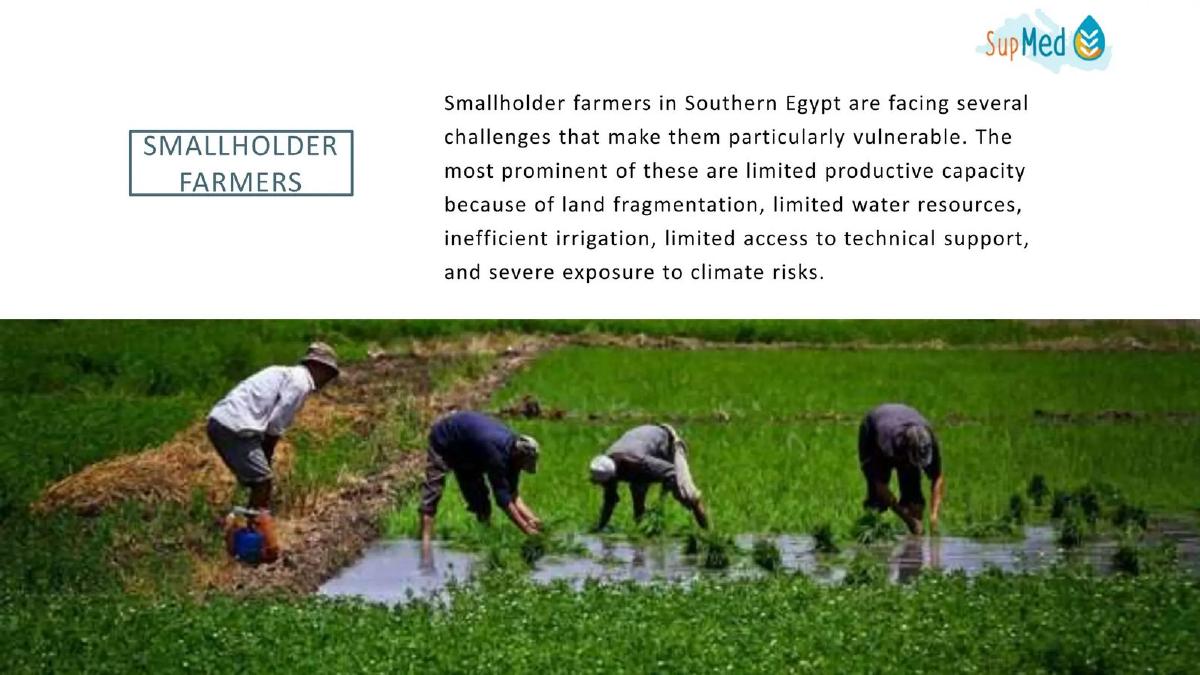
- Smallholder farmers in Southern Egypt are identified as vulnerable due to land fragmentation and limited water resources (Slide 2).
- Interventions are based on research approved by the MALR and local adaptation solutions from farmers (Slide 7).
- The baseline for the target cluster includes a family income 30% lower than the national average (Slide 11).
- Technical KPIs include a 30% decrease in nitrogen leaching and a 20% decrease in water balance per area (Slide 11).
- The project aims for a 20% increase in farm income by reducing inputs and maximizing outputs (Slide 13).
- A 70% target is set for building resilience through early warning solutions (Slide 13).
- The deck omits a team slide, business model, and a specific funding request.
Executive Summary: A Technical Approach to Climate Resilience
The presentation titled "Financial Viability of the Climate Adaptation Interventions" functions less as a traditional startup pitch and more as a technical project proposal. Focused on the SupMed initiative, the deck outlines a data-driven strategy to improve the livelihoods of smallholder farmers in Southern Egypt. By targeting specific villages in the Luxor Governorate, the project aims to mitigate climate risks through technical interventions such as heat-tolerant crop varieties and improved irrigation management. The deck is heavy on agricultural metrics but entirely silent on the corporate structure or financial requirements of the organization behind it.
Slide 1: Title Slide
The opening slide presents the title "FINANCIAL VIABILITY OF THE CLIMATE ADAPTATION INTERVENTIONS" in a simple, sans-serif font over a blurred green background of crops. The word "INTERVENTIONS" is framed by a white box. There is no company logo or date on this specific slide, though the "SupMed" logo appears on subsequent pages. The title sets a clinical, academic, or institutional tone for the rest of the presentation.
Slide 2: Smallholder Farmers and Vulnerability
Slide 2 introduces the target demographic: smallholder farmers in Southern Egypt. The text lists several challenges contributing to their vulnerability, including limited productive capacity due to land fragmentation, limited water resources, inefficient irrigation, and limited access to technical support. The slide features a photograph of four farmers working in a flooded field, providing visual context for the "inefficient irrigation" mentioned in the text. The SupMed logo is visible in the top right corner.
Slide 5: Luxor Governorate Geographic Focus
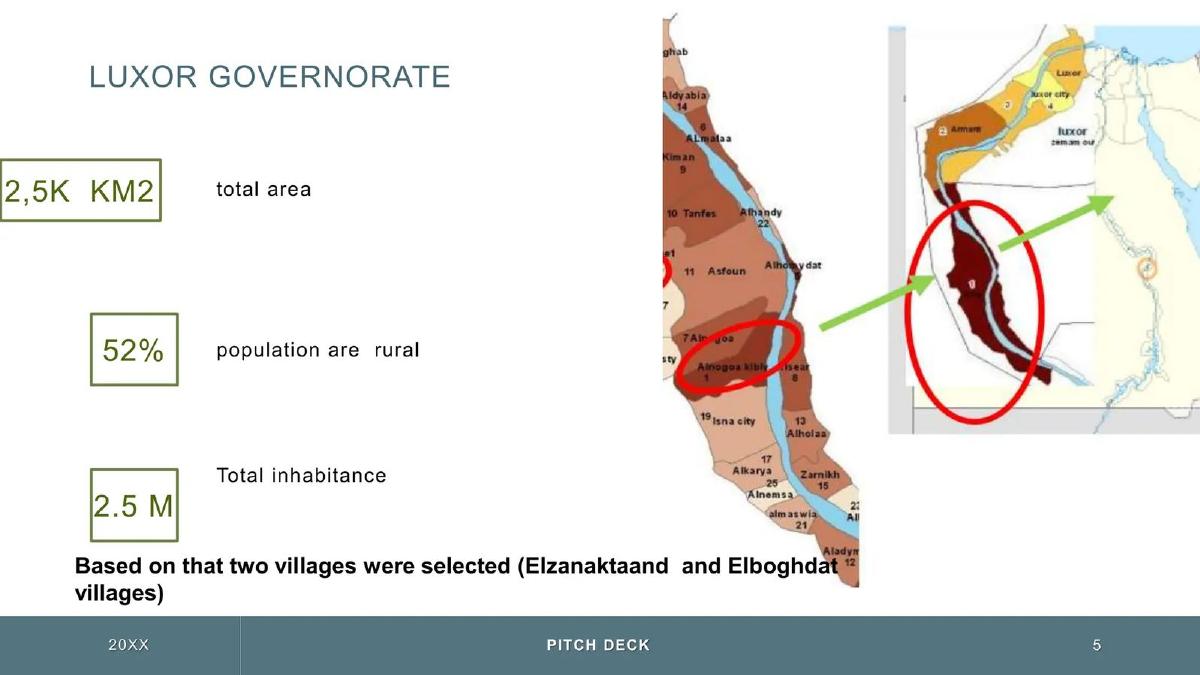
This slide provides the geographic and demographic scope of the project. It notes that the Luxor Governorate covers 2.5K KM2 and has 2.5 million inhabitants, 52% of whom are rural. A map of the region is included, with a red circle highlighting a specific area along the Nile. The slide explicitly states that two villages were selected for the project: Elzanaktaand and Elboghdat. This level of geographic specificity is typical of development projects rather than scalable software startups.
Slide 7: Adaptation Solutions Sources
Slide 7 explains where the project's interventions originate. It cites two sources: "APPROVED RESEARCH" from national agriculture institutes (approved by MALR, likely the Ministry of Agriculture and Land Reclamation) and "LOCAL ADAPTATION SOLUTIONS" from local farmers. The visual shows a farmer walking along a concrete irrigation channel, illustrating the practical application of these solutions. This slide establishes the credibility of the interventions by linking them to both official government bodies and grassroots experience.
Slide 9: Adaptation Solutions Overview
This is a transition slide with the text "ADAPTATION SOLUTIONS OVERVIEW" placed over a wide shot of a grain field. Like the title slide, it serves to segment the presentation but offers no new data. The use of high-quality agricultural photography maintains the thematic focus on rural development.
Slide 11: Detailed Intervention Matrix
Slide 11 is the most data-dense slide in the deck, presented as a table titled "ADAPTATION INTERVENTION FOR EACH FARMERS CLUSTER." It focuses on "Cluster 1: Salary-dependent males with a high level of education who work as subsistence farmers." The table breaks down the project into five columns:
Constraints (baseline): Lists 30% lower family income than the national average, 30% water user efficacy, and nitrate leaching at 30Kg/Acre. · Climate adaptation interventions: Includes heat-tolerant varieties, alternative livestock fodder, and using alternative water sources like agricultural drainage. · Activities: Mentions 10 demonstration fields, 4 workshops for water user associations, and 3 training sessions targeting rural women (GET Ahead program). · KPIs (Med term): Targets a 10% increase in family income, a 30% decrease in nitrogen leaching, and a 20% decrease in energy used.
The inclusion of specific baselines and targets suggests a rigorous monitoring and evaluation framework.
Slide 13: Expected Outcome
The final slide in the provided set summarizes the project's goals using four circular infographics. The targets are clearly defined: 25% Saving Water (via WUS-Soil Laser and shorter growth seasons), 25% Reducing Chemical Fertilizers (due to water saving), 70% Building Resilience (using early warning solutions), and 20% Increasing Farm Income (by reducing inputs and maximizing outputs). This slide serves as the "bottom line" for the proposed interventions.
What Works in This Deck
Granular Data: The deck excels at providing specific, measurable baselines. Stating that nitrate leaching is currently at 30Kg/Acre (Slide 11) gives the project a clear starting point against which success can be measured. This level of detail is often missing in broader climate-tech pitches.
Geographic Specificity: By naming the specific villages of Elzanaktaand and Elboghdat (Slide 5), the founders demonstrate a deep, localized understanding of the problem. This prevents the pitch from feeling like a generic, ungrounded proposal.
Source Credibility: Citing approval from national agriculture institutes and the MALR (Slide 7) provides a layer of institutional validation that is critical for projects operating in regulated sectors like agriculture and water management.
What is Missing from This Deck
The Team: There is no slide introducing the individuals or the organization behind SupMed. Investors or grant-makers need to know who is executing the project and what their qualifications are.
The Business Model: While the deck discusses the "financial viability" for the farmers, it does not explain how the SupMed entity itself survives. Is it a non-profit? Does it take a percentage of the increased farm income? Is it a consultancy? The economic engine of the company is absent.
The Ask: There is no slide detailing how much funding is required to achieve these outcomes. A pitch deck without a request for capital or resources is merely an information pamphlet.
Competitive Landscape: The deck does not address other organizations or government programs working in the same region. Understanding how SupMed fits into the existing ecosystem of Egyptian agricultural aid is a significant omission.
What a Founder Should Copy
KPI Visualization: The use of simple, clear circular infographics on Slide 13 to communicate complex outcomes is highly effective. It allows a viewer to grasp the project's impact in seconds.
Baseline vs. Target: The structure of Slide 11, which maps specific constraints to interventions and then to measurable KPIs, is a masterclass in logical project design. Founders should adopt this "Problem-Solution-Metric" alignment to show exactly how their product moves the needle.
Contextual Imagery: The photography used throughout the deck is relevant and high-quality. It grounds the technical data in the reality of the people the project aims to serve, which helps build an emotional connection with the audience without relying on hyperbole.
Frequently asked questions
- What is the primary geographic focus of this project?
- The project is specifically focused on the Luxor Governorate in Southern Egypt. Slide 5 identifies this region as having 2.5 million inhabitants, with 52% of the population living in rural areas. The interventions are further narrowed down to two specific villages: Elzanaktaand and Elboghdat.
- What are the specific environmental targets mentioned in the deck?
- The deck outlines several quantifiable environmental goals on Slide 13, including a 25% reduction in water usage and a 25% reduction in chemical fertilizers. Additionally, Slide 11 targets a 30% decrease in nitrogen leaching (from a baseline of 30Kg/Acre) and a 20% decrease in the quantity of energy used.
- How does the project plan to increase farmer income?
- According to Slide 13, the project expects a 20% increase in farm income. This is achieved by reducing agricultural inputs and maximizing outputs. Slide 11 further specifies that they aim for a 10-15% increase in agricultural income per household through the introduction of heat-tolerant varieties and improved agriculture techniques.
- What sources of information are used to develop the adaptation solutions?
- Slide 7 states that adaptation solutions are derived from two primary sources: approved research from national agriculture institutes (approved by the MALR) and local adaptation solutions sourced directly from local farmers. This suggests a blend of top-down scientific research and bottom-up traditional knowledge.
- Is this a standard startup pitch deck for venture capital?
- No. The deck lacks several critical components required for a VC pitch, including a management team slide, a clear business model for the entity itself, a competitive analysis, and a specific 'ask' or valuation. The structure and KPIs suggest it is a proposal for a development project, NGO initiative, or government-backed climate adaptation program.