Lirvana Labs secured a $5.3M Seed round in 2024 by positioning itself as a research-backed, AI-first education company. The deck, while visually simple, excels at establishing the 'founder-market fit' through a team with experience at Google, Amazon, and Osmo. It bypasses traditional market size slides in favor of deep-dive testimonials and social impact case studies, specifically highlighting a partnership with Jusoor to serve refugee children. By focusing on 'KASE' (Knowledge Acquisition and Steering Engine), the company frames its technology not just as an app, but as proprietary IP with s…
Key takeaways
- The 'Dream Team' slide emphasizes over 70 years of combined experience at major tech firms like Google, Amazon, and Salesforce (Slide 2).
- Early traction is demonstrated through 519k impressions and 15k downloads for the 'Yeti Confetti Kids' app while still in stealth (Slide 2).
- The company claims seven patentable IPs related to its 'KASE' Knowledge Acquisition and Steering Engine (Slide 2).
- Product architecture is defined by a 'Dynamically Changing Playlist' powered by LLMs to provide personalized tutoring (Slide 3).
- Social impact is a core pillar, evidenced by a partnership with Jusoor serving 14k+ refugee children (Slide 6).
- The deck utilizes long-form testimonials from high-profile advisors like Amy Chang (Disney/P&G Board Member) to build credibility (Slide 5).
- Lirvana Labs reports 8.4 million hits on YouTube within the first nine months of content release (Slide 2).
- The deck omits a traditional 'Ask' slide, financial projections, and a competitive landscape analysis.
The Pedigree-First Approach to Seed Fundraising
Lirvana Labs raised $5.3M in a 2024 Seed round, as reported by Business Insider. The deck they used is a departure from the standard Sequoia-style template. It doesn't start with a problem; it starts with a team and a mission. In an era where AI startups are ubiquitous, Lirvana Labs uses this deck to prove they aren't just another wrapper on an LLM, but a research-heavy organization with the technical chops to build something proprietary.
Slide 1: Title and Brand Identity
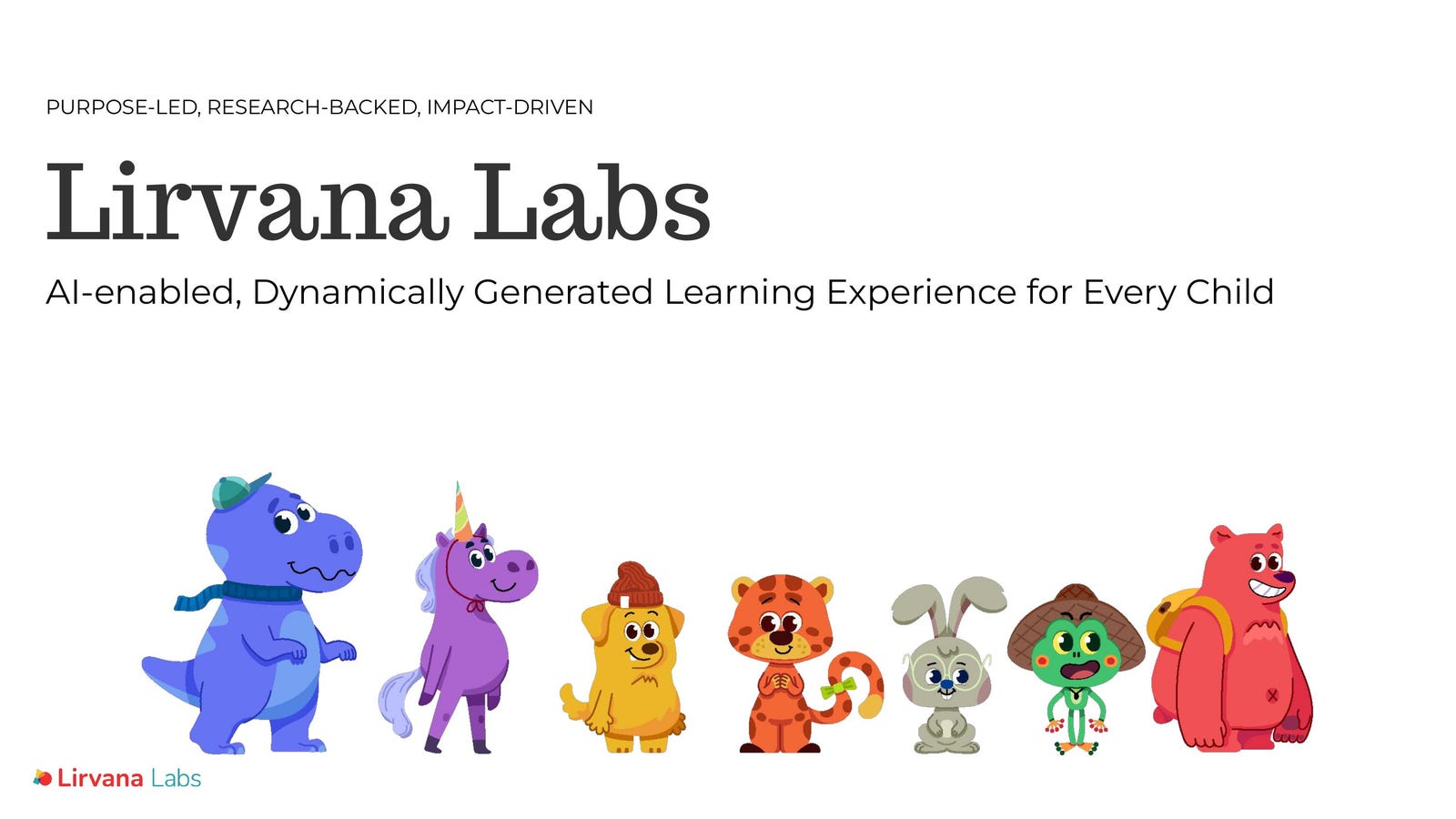
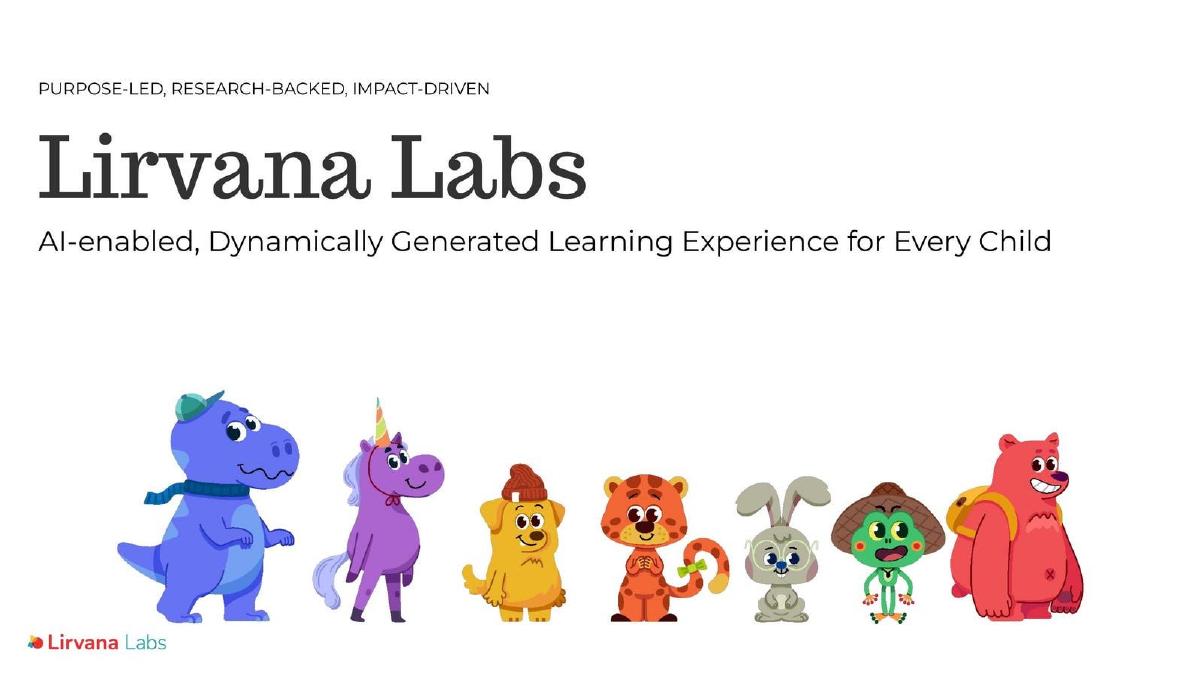
The cover slide is minimalist, featuring the company name and the tagline: "AI-enabled, Dynamically Generated Learning Experience for Every Child." The top of the slide includes the qualifiers "PURPOSE-LED, RESEARCH-BACKED, IMPACT-DRIVEN." Visually, the slide introduces the 'Yeti Confetti' characters—a line of seven diverse, colorful animal characters. This immediately signals that the product is child-facing and high-quality in terms of art direction, which is critical in the EdTech space.
Slide 2: The Dream Team and Stealth Traction
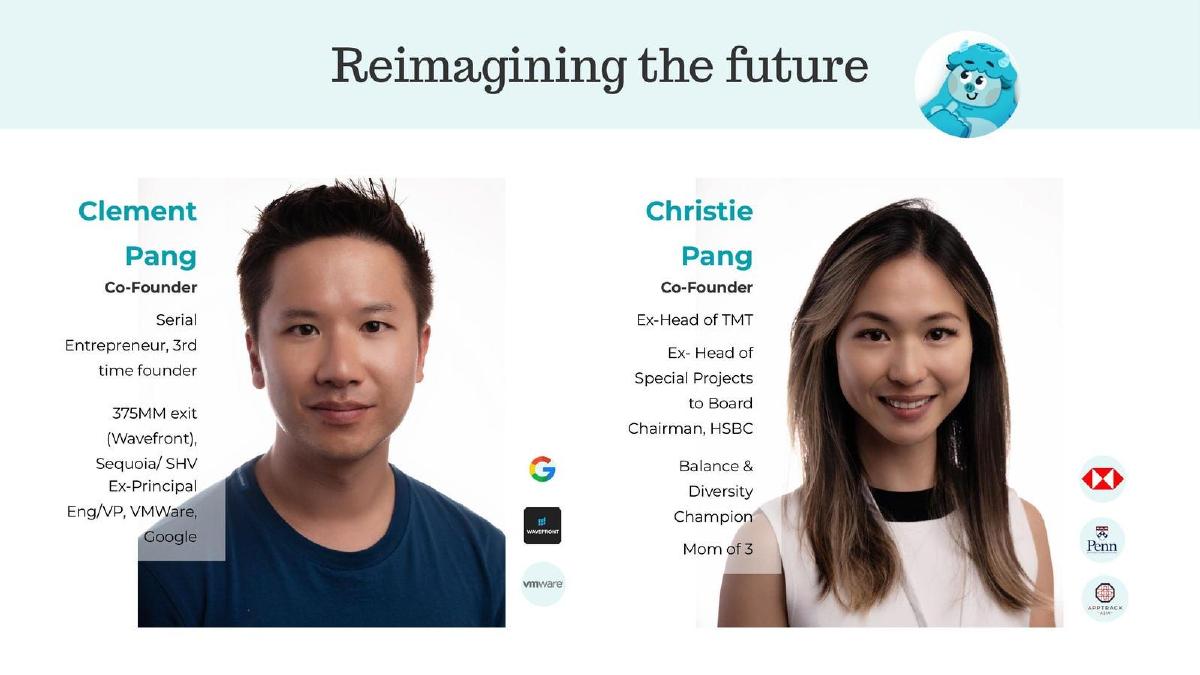
Slide 2 is the most information-dense slide in the deck. It serves two purposes: establishing founder-market fit and showing stealth traction. The 'Dream Team' section highlights engineers and designers with backgrounds at Google, Amazon, Salesforce, VMware, and Osmo. Specificity is key here; they mention a "13yr+ Designer Ex-Art Director for Amazon Glow" and an "8yr+ staff software engineer" from Osmo. This tells investors that the team has already built successful products in the kids' tech space.
The right side of the slide provides traction metrics that are impressive for a stealth company: 519k impressions, 15k downloads, and a 1-in-4 MAU (Monthly Active User) ratio. The mention of "7 Patentable IPs" under the LIRVANA.AI section is a defensive moat play, suggesting that their 'Knowledge Acquisition and Steering Engine' (KASE) is a unique technological asset rather than a generic implementation of third-party APIs.
Slide 3: Product Architecture (KASE)
This slide explains the 'how.' It breaks down the proprietary IP, KASE, into three functional roles: AI teacher, AI fun nanny, and AI doctor. The workflow is illustrated as a funnel: Multi-Modal Exposure and Participatory Assessment feed into a 'Dynamically Changing Playlist.' The bottom of the slide lists the pedagogical goals: Recall, Encourage, Steering, and Mastery. By using terms like "Multi-Modal" and "LLM," the deck aligns itself with current AI trends while grounding them in educational psychology.
Slide 4: B2B Partner Testimonial
Slide 4 features a long-form quote from Dr. Alexandra Chen, a UN and World Bank advisor. This is a strategic inclusion. Instead of just saying "we help refugees," they provide a detailed testimonial about how technology can be an "equalizer" in crisis contexts. The quote mentions a pilot with Jusoor and highlights a staggering statistic: 468 million children living in conflict zones. This frames Lirvana Labs not just as a consumer app, but as a tool for global educational resilience.
Slide 5: Expert Validation
Continuing the trend of social proof, Slide 5 features Amy Chang, a board member at Disney and P&G. Her testimonial focuses on the 'soul' of the company, specifically their recruitment of underrepresented youth as content creators. This slide addresses a common investor concern in AI: the 'black box' problem and the risk of biased or low-quality content. By highlighting their 'hiring with soul' and alignment with social-emotional learning standards, they mitigate these perceived risks.
Slide 6: Impact Case Study
Slide 6 provides a concrete timeline for their work with Jusoor. It tracks the partnership from "Understanding Needs" in November 2022 to "GO LIVE" in Fall 2023. The inclusion of a photo of a child in a classroom setting humanizes the data. This slide proves that the company can execute in difficult environments, which serves as a proxy for their ability to scale in more traditional markets.
Slide 7: The Investor and Partner Wall
The final slide (numbered 19 in the footer, suggesting this is a subset of a larger deck) displays the logos of their backers. Notable names include Kapor Capital, known for impact investing, and Chingona Ventures. The presence of the Stanford Deliberative Democracy Lab logo reinforces the "research-backed" claim from the cover slide. This is a standard but effective way to close a deck, showing that professional capital has already vetted the opportunity.
What Lirvana Labs Does Exceptionally Well
The primary strength of this deck is credibility through association . By the time an investor reaches the end of these seven slides, they have seen logos from Google, Amazon, Disney, the UN, and Stanford. For a Seed round, where there is often little revenue to analyze, this 'pedigree stack' is the most effective way to lower the perceived risk of the investment.
Furthermore, the deck handles the AI narrative correctly. Instead of focusing on the AI itself, it focuses on the application of AI (the KASE engine) and the output (personalized learning). They emphasize that the AI is "fine-tuned" and "expert," which suggests they are doing the hard work of training models on specific educational datasets rather than just using out-of-the-box solutions.
Critical Omissions and Weaknesses
While the deck is excellent at building a narrative, it is technically incomplete by traditional standards. The most glaring omission is the Problem Slide . The deck assumes the investor already agrees that early childhood education needs AI-driven personalization. While this might be true in the current market, failing to define the specific pain point (e.g., the teacher shortage, the 'COVID gap' in reading levels) is a missed opportunity to create urgency.
There is also no Market Size (TAM) slide. While the testimonial on Slide 4 mentions 468 million children in conflict zones, it doesn't translate this into a business opportunity. Investors need to know how Lirvana Labs intends to capture a multi-billion dollar market, not just how they will help a specific demographic. Finally, the lack of a Competitor Map is notable. The EdTech space is crowded with giants like Duolingo ABC, Khan Academy Kids, and Age of Learning (ABCmouse). Lirvana Labs does not explicitly state why their AI is better than the adaptive algorithms already used by these incumbents.
Lessons for Founders
Lead with your 'Unfair Advantage': If your team has 70+ years of experience at top-tier tech firms, that should be Slide 2, not Slide 10. Lirvana Labs knows their team is their strongest asset and puts them front and center. · Use 'Impact' as a Stress Test: By showing that their product works for refugee children in Lebanon, Lirvana Labs proves their tech is robust. Founders should look for 'extreme use cases' that validate their product's core value proposition. · Quantify Stealth Traction: Even if you haven't officially launched, you have data. Impressions, YouTube hits, and pilot participant numbers are all valid forms of traction that prove market interest. · Leverage High-Profile Advisors: A quote from a Disney board member is worth more than five slides of self-praise. If you have heavy hitters in your corner, give them their own slide. · Define Your 'Engine': Don't just say you use AI. Give your system a name (like KASE) and explain the logic flow. This makes your technology feel like a tangible asset that can be patented and defended.
Frequently asked questions
- What is the core technology behind Lirvana Labs?
- The core technology is called KASE, which stands for Knowledge Acquisition and Steering Engine. According to Slide 3, this proprietary IP acts as an 'AI teacher, AI fun nanny, and AI doctor.' It uses Large Language Models (LLMs) to create a dynamically changing learning playlist that adapts to a child's emotional needs, assessment performance, and past recall.
- How did Lirvana Labs demonstrate early traction?
- Despite being in stealth for 11 months, the company reported significant engagement metrics on Slide 2. This includes 519k impressions, 30k+ views, and 15k downloads for their iPad app. Additionally, their YouTube presence garnered 8.4 million hits and 230k+ views within the first nine months.
- Who are the key investors in Lirvana Labs?
- Slide 7 lists several prominent venture capital firms and partners, including Kapor Capital, Chingona Ventures, Transcend Capital Partners, SMASH, and College Track. The slide also mentions a partnership with the Stanford Deliberative Democracy Lab, further cementing their research-backed positioning.
- What is the company's approach to social impact?
- Lirvana Labs positions impact as a growth driver rather than a side project. Slide 6 details a specific timeline for a partnership with Jusoor, an NGO serving 14k+ refugee children. This pilot involved teacher training and an 'Arabic-English Duo' curriculum, proving the model's efficacy in high-stress, resource-strapped environments.
- What is missing from the Lirvana Labs pitch deck?
- The deck is notably missing several standard venture slides. There is no explicit 'Problem' slide defining a market gap, no 'Market Size' (TAM/SAM/SOM) analysis, no 'Competition' matrix, and no 'Financials' or 'Use of Funds' slide. It relies almost entirely on team pedigree and product-led impact.