Linkio's December 2019 pitch deck presents a mobile-first marketplace designed to connect consumers with service providers across virtually any category, from food delivery to home improvement. The core value proposition lies in a 'bidding war' mechanism intended to drive down consumer costs, contrasting with the fixed-price or hourly models of incumbents like TaskRabbit and Thumbtack. While the deck identifies a massive $15.5 trillion total addressable market and highlights a previous $500,000 raise, it lacks granular unit economics, specific user growth metrics, and a detailed breakdown of…
Key takeaways
- The company targets a total service industry revenue market of $15.5 trillion, citing U.S. Census data (Slide 3).
- Linkio employs a 'categofree' model, allowing users to post requests for any service without being restricted by predefined categories (Slide 5).
- The platform utilizes a bidding system where providers compete to offer the lowest cost to the consumer (Slide 11).
- Linkio is seeking $1.5 million in capital to expand into at least five different cities in 2020 (Slide 13).
- The startup previously raised $500,000 in May 2019 to prove its initial concept (Slide 13).
- The business model is strictly commission-based, though the specific percentage taken per transaction is not disclosed (Slide 9).
- The founding team includes CEO Landy Abreus, Nandy Abreus (Consumer Relations), and COO Manuel Villaverde (Slide 15).
- Competitors identified include Thumbtack, Takl, TaskRabbit, and Handy, with Linkio positioning itself as both more affordable and more convenient (Slide 11).
Linkio Pitch Deck Analysis
The Linkio pitch deck from December 2019 presents a vision for an all-encompassing service marketplace. The deck relies heavily on the concept of 'categofree' service acquisition, where the user's need dictates the transaction rather than a pre-set menu of options. While the visual presentation is clean and mobile-focused, the deck follows a traditional problem-solution-market format, though it omits several key data points required for late-seed or Series A due diligence.
Slide 1: Title Slide
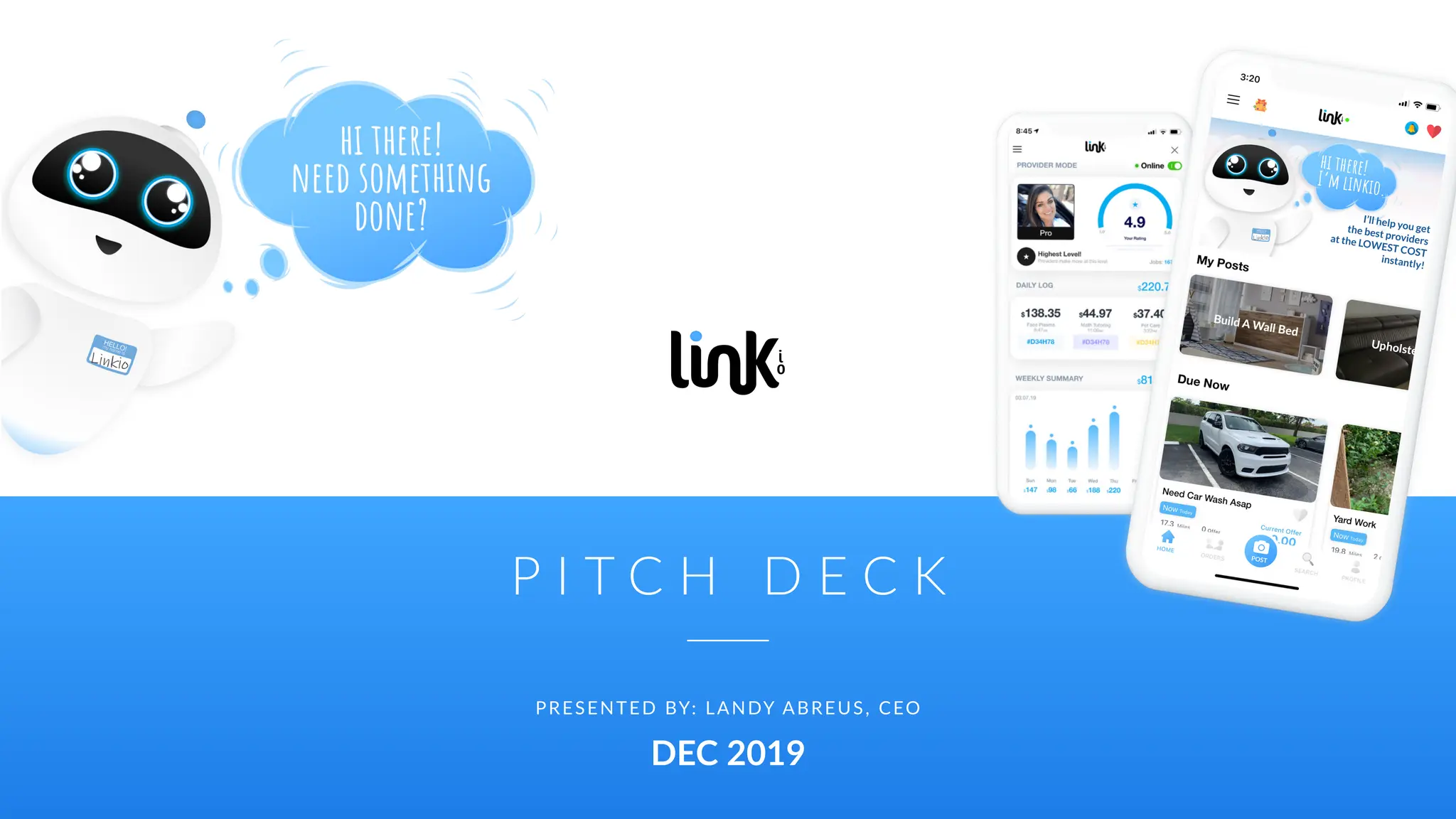
The cover slide introduces the brand identity, featuring a friendly robot mascot and a speech bubble asking, "Hi there! Need something done?" The slide clearly identifies Landy Abreus as the CEO and dates the presentation to December 2019. It also showcases two mobile mockups: a 'Provider Mode' dashboard showing a 4.9 rating and daily earnings of $220.70, and a consumer-facing feed with posts like 'Build a Wall Bed' and 'Need Car Wash Asap.' This immediately establishes the dual-sided nature of the app.
Slide 3: Market Size
Linkio targets the 'Service Industry Revenue,' which they value at $15.5 trillion. They cite a 2017 U.S. Census Bureau press release as the source for this figure. The text emphasizes that there are "virtually no limits" to the services requested, listing everything from tutoring to food delivery. While the $15.5T figure is an impressive headline, it represents the entire service sector, much of which (like healthcare or professional legal services) may not be suitable for a bidding-based mobile app. The deck does not provide a Serviceable Addressable Market (SAM) or Serviceable Obtainable Market (SOM).
Slide 5: The 'Categofree' Concept
This slide introduces the term "CATEGOFREE!" with the tagline "JUST SAY WHAT YOU NEED." It features the robot mascot relaxing in a beach chair, reinforcing the idea that the platform makes life easier for the consumer. This slide serves as a transition into the product's core functionality, suggesting that the removal of categories is a primary feature of the user experience.
Slide 7: Product Functionality
Titled "POST IT ON LINKIO," this slide walks through the user journey. The process is simplified into taking a picture, writing a title/description, and setting a location/time. A mockup shows a user requesting "TWO Lemons" to finish cooking a meal. The slide highlights that "IT'S FREE TO POST!" and promises offers from providers within minutes. This illustrates the platform's focus on micro-tasks and immediate fulfillment.
Slide 9: The Business Model
This is a high-level slide that simply states "THE BUSINESS MODEL" and "COMMISSION BASED." It lacks any specific numbers. In a professional fundraising environment, investors would expect to see the take rate (e.g., 10-20%), how payments are processed, and whether there are secondary revenue streams like featured listings or subscription tiers for providers. The omission of these details makes the business model appear conceptual rather than operational.
Slide 11: Competitive Landscape
Linkio uses a standard 2x2 matrix, plotting 'Affordable vs. Expensive' against 'Inconvenient vs. Convenient.' Linkio places itself in the top-right quadrant (Most Affordable and Most Convenient). The text identifies Thumbtack, Takl, TaskRabbit, and Handy as main competitors. The primary differentiator claimed is the "bidding war" mechanism. Linkio argues that because providers compete in real-time, costs drop faster than on platforms with set hourly rates or fixed prices. They also mention that the platform is a single app for both roles, whereas some competitors use separate applications.
Slide 13: Capital Raising
The 'Ask' slide is direct: Linkio is seeking $1.5 million. The slide reveals that the company previously raised $500,000 in May 2019. The stated purpose for the new funds is to improve the app and expand to at least five different cities in 2020. This indicates the company was in a post-seed/pre-Series A stage, looking to move from a single-market proof of concept to a multi-city operation.
Slide 15: The Founders
The team slide lists three individuals: Landy Abreus (CEO), Nandy Abreus (Consumer Relations), and Manuel Villaverde (COO). The biographies show a strong connection to the pharmacy industry, with both Landy and Manuel having graduated from pharmacy schools (LECOM and SUNY Buffalo, respectively). Landy is noted as having co-founded other startups in Miami, while Manuel brings ten years of experience from CVS Health. Nandy is credited with the original idea for the platform. While the team has operational experience, the deck does not highlight specific expertise in marketplace dynamics, logistics, or high-scale consumer tech engineering.
Slide 17: Contact Information
The final slide provides a phone number, a linkio.app email address, and social media handles (@LINKIOAPP). It maintains the blue and white color scheme used throughout the deck.
What Linkio Does Well
Clear Value Proposition: The deck successfully communicates its primary differentiator—the bidding system. By contrasting this directly with the 'expensive' and 'inconvenient' nature of fixed-price competitors, Linkio makes a clear case for why a new player is needed in the space.
Mobile-First Design: The use of high-quality mockups (Slides 1, 7, and 11) helps investors visualize the product. The 'Two Lemons' example on Slide 7 is a clever way to demonstrate that the app handles even the smallest, most immediate needs that larger platforms might ignore.
Market Breadth: The 'categofree' concept is an interesting take on the marketplace model. It suggests a horizontal expansion strategy that could theoretically capture more of a user's daily spend than a vertical-specific app (like a dedicated food delivery or home repair app).
What is Missing from the Deck
Traction Metrics: Despite having raised $500,000 previously and claiming to have "proven the concept" (Slide 13), the deck contains zero data on actual performance. There are no figures for Gross Merchandise Volume (GMV), number of active users, number of completed tasks, or month-over-month growth. This is a significant red flag for a $1.5M raise.
Unit Economics: There is no mention of Customer Acquisition Cost (CAC) or Lifetime Value (LTV). In a crowded marketplace sector, the cost of acquiring both sides of the market (providers and consumers) is usually the biggest hurdle to profitability.
Financial Projections: The deck outlines where the money will go (five cities), but not what that investment will yield in terms of revenue or market share by the end of 2020.
Technical Depth: The team bios are heavy on pharmacy and retail operations but light on software engineering. For a platform promising real-time bidding and a seamless dual-sided experience, the lack of a designated CTO or technical lead in the core management team is a notable omission.
What Other Founders Should Copy
The 2x2 Competitive Matrix: Linkio's Slide 11 is a good example of how to use a matrix effectively. Instead of just listing features, they use axes that matter to the end consumer (Affordability and Convenience) to show exactly where they fit in the ecosystem.
Simplified User Journey: Slide 7 does an excellent job of breaking down a potentially complex process into three simple steps. Founders should always aim to show that their product is easy to use, especially in the 'gig economy' space where friction leads to churn.
Specific Use Cases: Using a concrete example like "Need TWO Lemons" is much more memorable than saying "We facilitate small grocery deliveries." It grounds the technology in a real-world scenario that anyone can understand.
Final Thoughts
The Linkio deck is a strong 'vision' document but a weak 'investment' document. It identifies a massive opportunity and a clear product-market fit through its bidding mechanism, but it fails to provide the hard data necessary to back up its $1.5M ask. For a company that has already spent $500,000 in seed capital, the absence of traction data suggests either a very early-stage pivot or a lack of focus on the metrics that drive venture returns. Founders using this as a template should ensure they supplement the clean design and clear messaging with robust financial and growth data.
Frequently asked questions
- What is Linkio's primary competitive advantage according to the deck?
- Linkio differentiates itself through a bidding-based marketplace. Slide 11 explains that providers compete for business in a 'bidding war,' which the company claims brings costs down quickly. This is contrasted with competitors like TaskRabbit, which uses hourly rates, or Takl, which uses set prices. Linkio also emphasizes a 'dual-sided platform' that eliminates the need for separate apps for clients and providers.
- How does Linkio define its market size?
- On Slide 3, Linkio cites a total service industry revenue of $15.5 trillion. They position themselves as having 'virtually no limits' on the services offered, covering home improvement, auto services, pet care, tutoring, and food delivery. By using such a broad TAM, the company suggests that its 'categofree' approach allows it to capture value across the entire service economy.
- What are the specific funding requirements and goals?
- Slide 13 states that the company is raising $1.5 million. This follows a previous successful raise of $500,000 in May 2019. The primary stated goals for this new capital are to improve the mobile application and expand operations into at least five different cities during the 2020 calendar year.
- What is the background of the founding team?
- The team consists of three managers. CEO Landy Abreus has a background in pharmacy and computer network engineering, having co-founded other startups like 'We Take it Home, LLC.' Nandy Abreus handles consumer relations and originated the platform idea. COO Manuel Villaverde has over ten years of retail operations experience from CVS Health and also graduated from a school of pharmacy (Slide 15).
- What is missing from the business model slide?
- Slide 9 simply states 'Commission Based' in large text. It lacks critical financial details such as the specific commission percentage, average transaction value, projected margins, or any historical revenue data. For a deck seeking $1.5M, the absence of these figures represents a significant gap in the financial narrative.