LiquidStack’s 13-slide deck is a masterclass in market timing, positioning the company as the essential infrastructure provider for the Generative AI boom. By anchoring their value proposition to the specific power demands of NVIDIA’s Blackwell architecture, they transform a hardware pitch into a 'must-have' utility play. The deck excels at demonstrating technical maturity, featuring a new 20,500 square foot manufacturing facility and a leadership team with deep roots in Schneider Electric and Allied Control. While the deck is light on specific financial projections and customer logos, it use…
Key takeaways
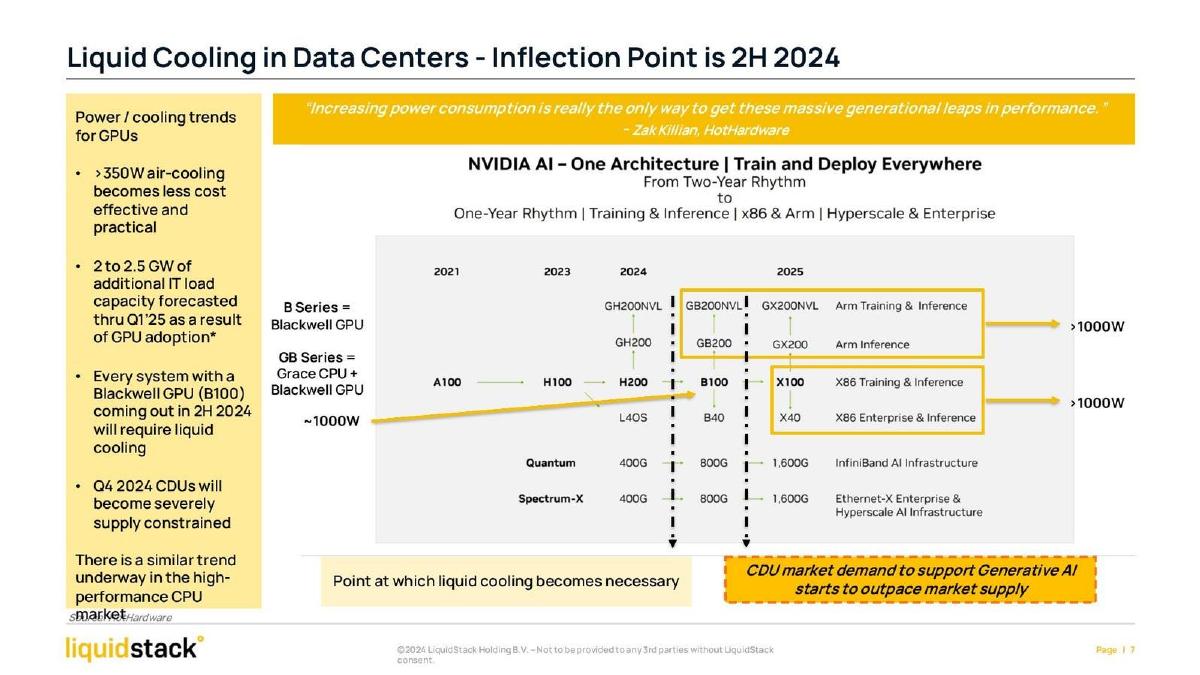
- The deck identifies a specific technical inflection point in 2H 2024 where air cooling becomes impractical for GPUs exceeding 350W (Slide 7).
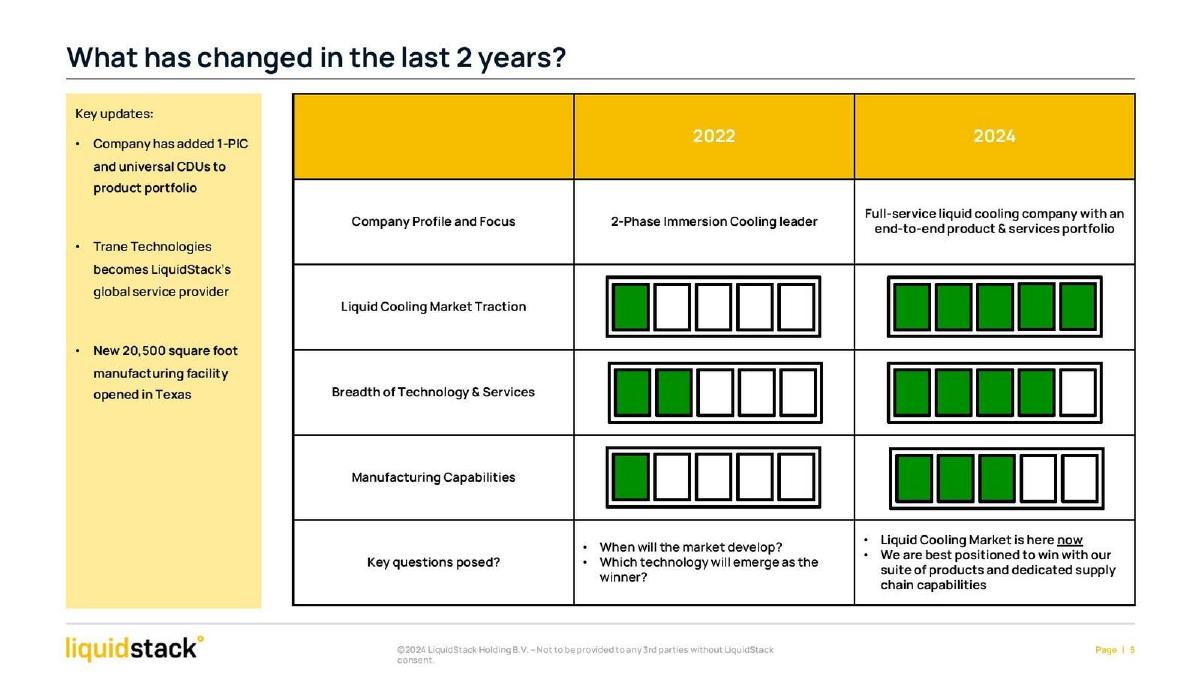
- LiquidStack positions itself as a 'Full-service liquid cooling company' rather than just a component manufacturer (Slide 5).
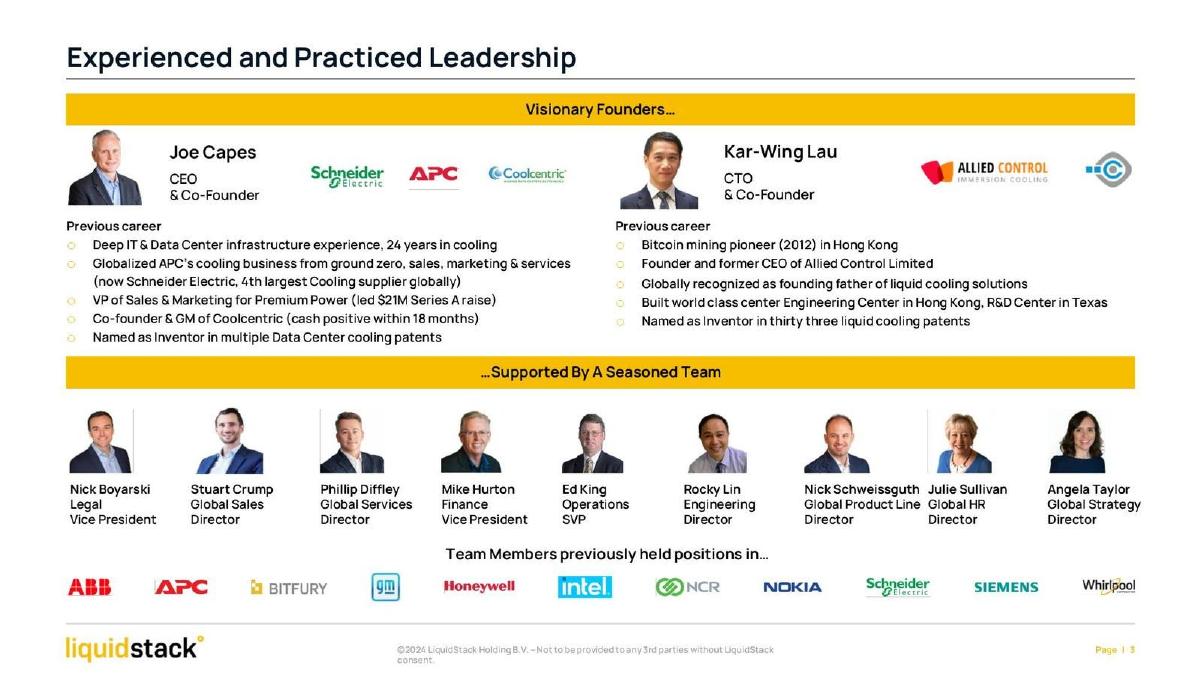
- The leadership team boasts significant industry pedigree, including 24 years of cooling experience from the CEO and 33 patents from the CTO (Slide 3).
- Operational scaling is evidenced by the opening of a new 20,500 square foot manufacturing facility in Texas (Slide 5).
- The product roadmap is tied directly to NVIDIA's release cycle, specifically the Blackwell (B100) GPU (Slide 7).
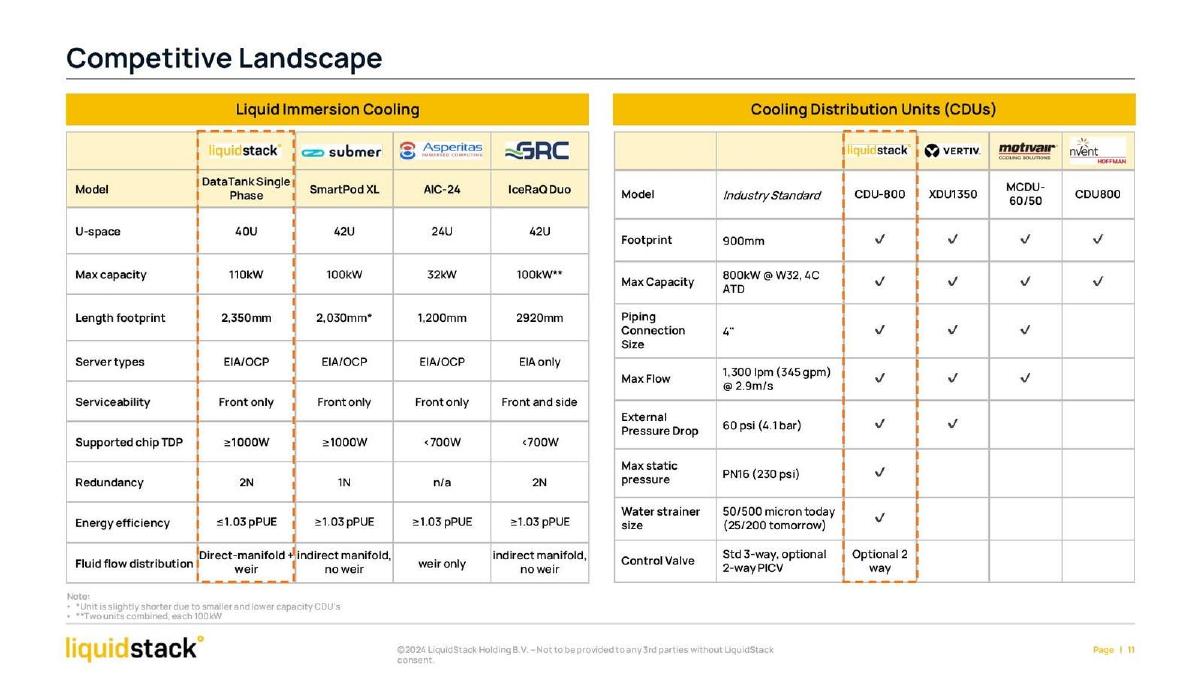
- Technical differentiation is highlighted through a 2N redundancy model and support for chip TDP ≥1000W (Slide 11).
- The company addresses supply chain concerns by predicting a severe constraint in CDU supply by Q4 2024 (Slide 7).
- LiquidStack uses a 'progress bar' visual to show their evolution from a niche immersion leader in 2022 to an end-to-end provider in 2024 (Slide 5).
LiquidStack: Cooling the AI Revolution
LiquidStack’s Series B deck is a targeted strike on the infrastructure bottlenecks of the generative AI era. As reported by Business Insider, the company raised $20M in 2024, a year characterized by the massive rollout of high-performance computing clusters. The deck is less about 'disruption' in the abstract sense and more about the physical reality of thermodynamics: chips are getting too hot for fans to handle.
Slide 1-2: Branding and Context
The opening slides establish the brand identity. Slide 1 features a high-tech data center aesthetic with a digital human silhouette, immediately signaling that this hardware is inextricably linked to the 'intelligence' of AI. The footer on these slides contains a standard confidentiality notice for LiquidStack Holding B.V., indicating the company's corporate structure.
Slide 3: The Pedigree of the Team
Slide 3, titled Experienced and Practiced Leadership , is one of the strongest slides in the deck. It splits the team into 'Visionary Founders' and a 'Seasoned Team.' Joe Capes (CEO) is credited with 24 years in cooling and globalizing APC’s cooling business (now Schneider Electric). Kar-Wing Lau (CTO) is framed as a 'Bitcoin mining pioneer' and the 'founding father of liquid cooling solutions' with 33 patents. The supporting team includes veterans from ABB, Intel, Nokia, and Siemens. This slide effectively de-risks the investment by showing the company is run by industry insiders, not hardware hobbyists.
Slide 5: The Two-Year Evolution
Slide 5 asks, What has changed in the last 2 years? This is a progress report that justifies a Series B valuation. The slide uses a 5-bar 'loading' graphic to show growth in market traction, technology breadth, and manufacturing. Key updates include the addition of 1-PIC and universal CDUs to the portfolio, a global service partnership with Trane Technologies, and the opening of a 20,500 square foot manufacturing facility in Texas. This slide tells investors that the 'heavy lifting' of setting up operations is already done.
Slide 7: The NVIDIA Inflection Point
This is the 'Why Now?' slide. Slide 7, Liquid Cooling in Data Centers - Inflection Point is 2H 2024 , creates a sense of extreme urgency. It quotes Zak Killian of HotHardware: 'Increasing power consumption is really the only way to get these massive generational leaps in performance.' The slide features a timeline of NVIDIA architectures (A100, H100, H200, B100). It explicitly states that air cooling becomes impractical above 350W, while the new Blackwell GPUs (B100) will require liquid cooling as they hit the ~1000W mark. By predicting that CDUs will become 'severely supply constrained' by Q4 2024, LiquidStack positions its hardware as a scarce and necessary commodity.
Slide 9: Product Maturity
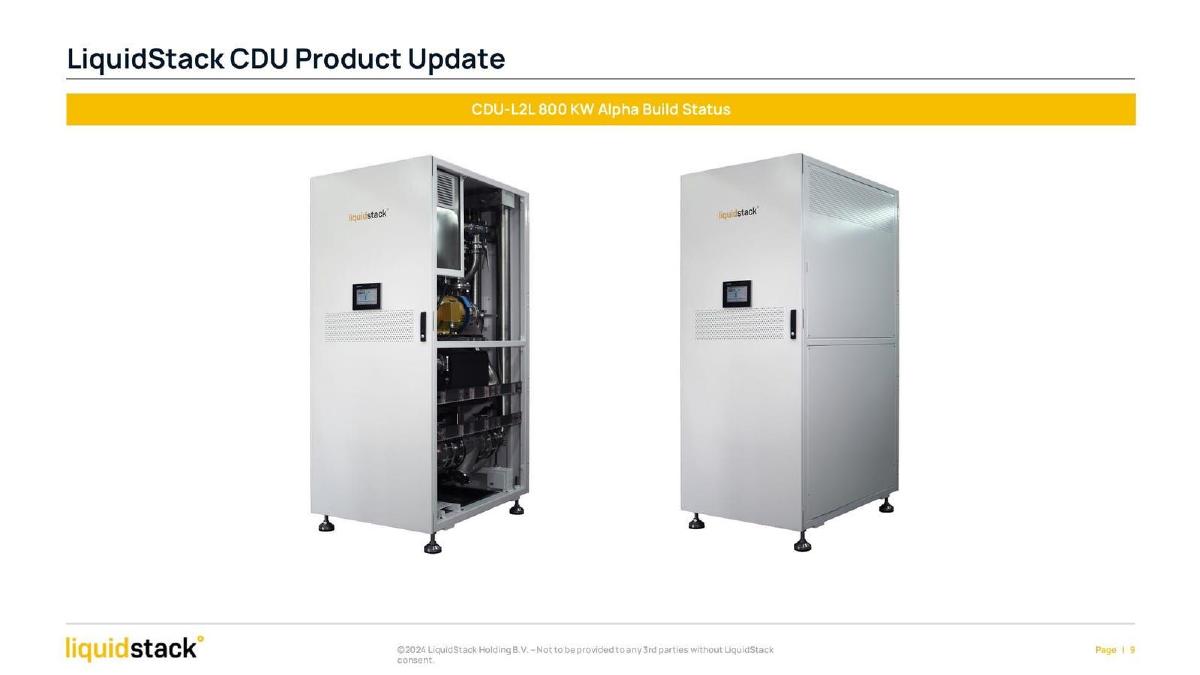
Slide 9 provides a LiquidStack CDU Product Update , showing the 'CDU-L2L 800 KW Alpha Build Status.' The slide features two high-resolution photos of the actual hardware—one with the panel off to show the internal plumbing and one with the panel on. For a hardware raise, seeing the physical product in a near-production state is vital. It proves the technology isn't just a CAD drawing.
Slide 11: The Competitive Matrix
Slide 11 is a dense, data-heavy comparison of the Competitive Landscape . It is split into two tables: Liquid Immersion Cooling and Cooling Distribution Units (CDUs). LiquidStack compares its 'DataTank Single Phase' against Submer, Asperitas, and GRC. It claims superiority in capacity (110kW), redundancy (2N), and supported chip TDP (≥1000W). In the CDU table, it compares its CDU-800 against Vertiv, Motivair, and nVent, highlighting its ability to handle higher static pressure and more precise control valves. This slide is designed for the technical due diligence phase, providing the specific metrics that data center operators care about.
Slide 13: The Conclusion
The deck ends on a simple 'Thank You' slide with the company logo. Notably, the provided slides do not include a specific 'Ask' slide detailing how the $20M will be spent, nor does it show a cap table or detailed financial projections. This suggests the deck was likely used as a high-level overview or that those sensitive slides were removed for the public version.
What LiquidStack Does Well
The deck is exceptionally good at Market Anchoring . By tying their success directly to the roadmap of NVIDIA, they ride the coattails of the most successful company of the decade. They don't have to prove there is a market for AI; they only have to prove that AI chips get hot. This is a much easier sell.
Furthermore, the Operational Proof is strong. Mentioning a specific square footage for a Texas factory and a partnership with a giant like Trane Technologies moves the company out of the 'startup' category and into the 'scale-up' category. The use of technical specifications (Slide 11) also shows they understand their buyer—data center engineers who care about 'lpm' (liters per minute) and 'psi' (pounds per square inch).
What is Missing from the Deck
The most glaring omission is Unit Economics and Financials . While we know from publisher reports that they raised $20M, the deck doesn't show revenue growth, margins on the hardware, or the cost of customer acquisition. In hardware, margins are everything, and investors usually want to see a path to software-like scalability or at least significant manufacturing efficiencies.
There is also a lack of Customer Case Studies . While they mention market traction, they don't name specific data centers or cloud providers currently using their tech. Seeing a 'Powered by LiquidStack' logo next to a major hyperscaler would have significantly bolstered the 'Market Traction' claims on Slide 5.
Lessons for Founders
Identify the 'Thermal Wall': If you are in hardware, find the specific technical limit of the status quo (like the 350W limit for air cooling on Slide 7) and center your pitch around the moment that limit is breached. · Use a Progress Bar: Slide 5’s use of a visual growth indicator is a great way to show momentum without revealing sensitive revenue numbers in an initial deck. · Pedigree Matters in Deep Tech: If your team has 33 patents and decades of experience at market leaders, lead with that. Deep tech investors are buying the team's ability to solve hard physical problems. · Map to the Ecosystem: Don't pitch in a vacuum. Show how your product fits into the release cycles of the industry giants (NVIDIA, Intel, AMD).
Frequently asked questions
- What is the core problem LiquidStack is solving?
- LiquidStack addresses the 'thermal wall' in data centers. As GPUs like NVIDIA’s Blackwell series exceed 1000W, traditional air cooling becomes cost-ineffective and physically impractical. LiquidStack provides liquid immersion cooling and Cooling Distribution Units (CDUs) that allow these high-density chips to operate efficiently without overheating or wasting excessive water and energy.
- How does LiquidStack differentiate itself from competitors like Submer or Vertiv?
- According to Slide 11, LiquidStack differentiates through higher capacity (110kW vs 32kW-100kW for others), 2N redundancy, and the ability to support chip Thermal Design Power (TDP) of 1000W or greater. They also highlight their 'front-only' serviceability and a wider range of CDU specifications compared to industry standards.
- What role does NVIDIA play in LiquidStack's pitch?
- NVIDIA is the primary market driver in this deck. Slide 7 maps out NVIDIA's transition from a two-year to a one-year architecture rhythm. LiquidStack argues that every system using a Blackwell GPU (launching 2H 2024) will require liquid cooling, creating a massive, non-optional market for their hardware.
- What is the significance of the Texas manufacturing facility mentioned?
- The 20,500 square foot facility in Texas (Slide 5) serves as proof of 'Manufacturing Capabilities.' For a hardware startup, showing that you have moved beyond R&D into industrial-scale production is critical for a Series B raise, as it mitigates the risk of being unable to fulfill large enterprise orders.
- Why is the timing of this deck (September 2024) important?
- The timing aligns with the predicted 'inflection point' where CDU market demand starts to outpace supply. By raising $20M in 2024, LiquidStack is positioning itself to capture the overflow of demand as data centers scramble to upgrade their infrastructure for the next generation of AI chips.