Eliyan’s 19-slide deck is a technical masterclass in identifying a specific, high-value bottleneck in the semiconductor industry: the limitations of current advanced packaging like CoWoS and EMIB. By focusing on their 'silicon-proven' Nulink D2D technology, the founders present a solution that offers 10x data rate per trace compared to conventional organic packages, effectively eliminating the need for expensive silicon interposers. The deck relies heavily on the pedigree of its founding team, including Ramin Farjadrad, who co-founded Aquantia. While the deck is light on traditional financial…
Key takeaways
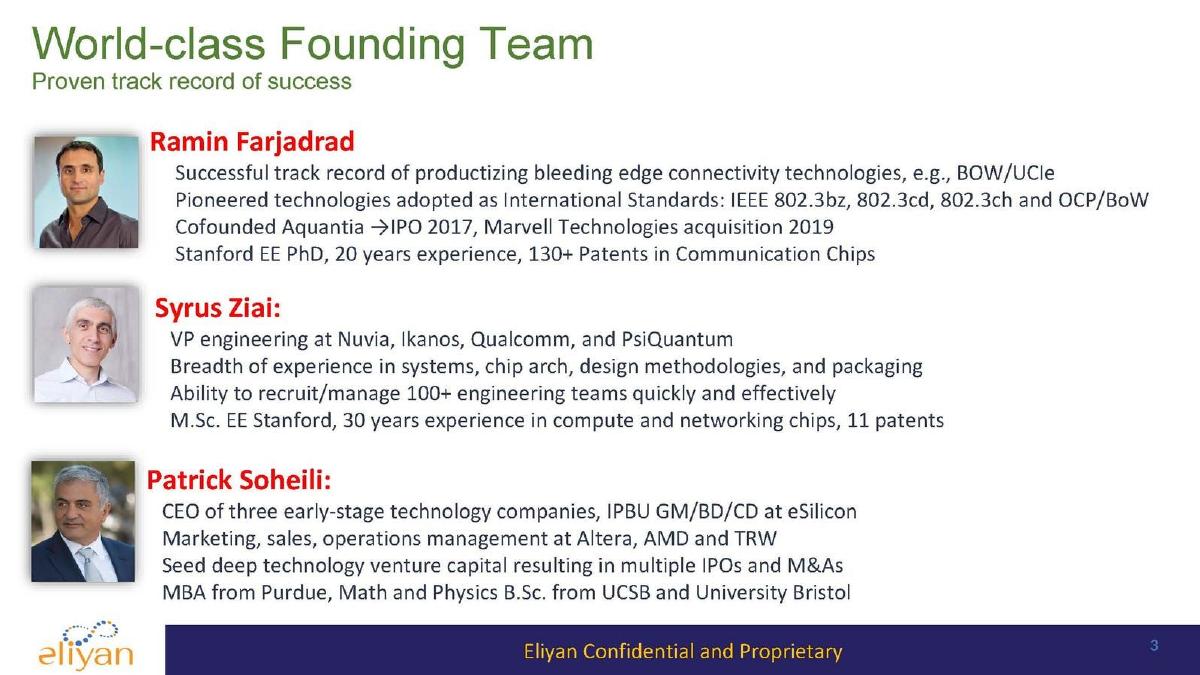
- The founding team features deep domain expertise, including a founder with 130+ patents and a successful IPO track record (Slide 3).
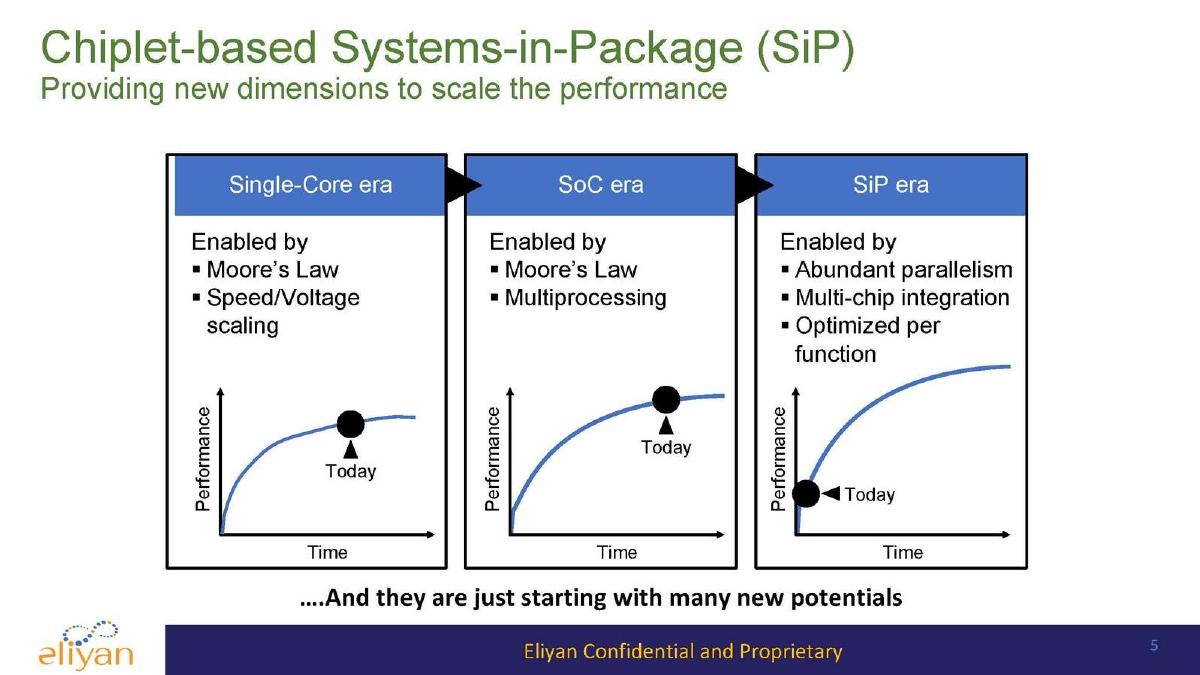
- Eliyan identifies the 'SiP era' as the current performance frontier, driven by multi-chip integration rather than just Moore's Law (Slide 5).
- The deck highlights the supply chain and cost limitations of existing 2.5D packaging solutions like CoWoS and EMIB (Slides 9, 11).
- Nulink technology claims to provide ~10x data rate per trace, allowing high performance on conventional organic packages (Slide 13).
- The technology enables the elimination of silicon interposers for ASIC-DRAM connectivity, reducing packaging complexity (Slide 15).
- Eliyan presents a significant yield advantage, projecting an 87% yield for a 12 HBM + 2 ASIC system compared to 50% for micro-bump solutions (Slide 17).
- The effective cost per system is shown to drop from ~$12K to ~$6.8K using Eliyan’s 130um bump technology (Slide 17).
- The deck emphasizes sustainability through the reduction of wasted materials and manufacturing lead times (Slide 17, 19).
Eliyan Pitch Deck Analysis
Eliyan is a hardware startup focused on the semiconductor industry, specifically addressing the 'interconnect bottleneck' that limits how chiplets communicate within a single package. As reported by Business Insider, the company raised a $40M Series A in 2024. Their deck is a highly technical document designed to convince sophisticated hardware investors that Eliyan has solved the primary cost and scaling issues currently facing AI and HPC chip manufacturing.
Slide 1-2: Title and Introduction
The deck opens with a minimalist title slide featuring the Eliyan logo and the tagline 'The Ultimate Chiplet System.' The branding is clean, using a deep blue and orange color palette. There is no fluff here; the focus is immediately on the company name and its core mission.
Slide 3: World-class Founding Team
Eliyan leads with its strongest asset: the team. In deep-tech hardware, the pedigree of the founders is often the primary signal for investors. Ramin Farjadrad is highlighted as a pioneer in connectivity technologies (BOW/UCIe) and a co-founder of Aquantia, which went public in 2017. With 130+ patents and a Stanford PhD, he represents the technical 'alpha.' Syrus Ziai adds engineering scale, having managed 100+ person teams at Qualcomm and Nuvia. Patrick Soheili rounds out the trio with business and operations experience from AMD and eSilicon. This slide establishes that the team has both the intellectual property (IP) creation capability and the operational experience to bring a complex chip to market.
Slide 5: The SiP Era
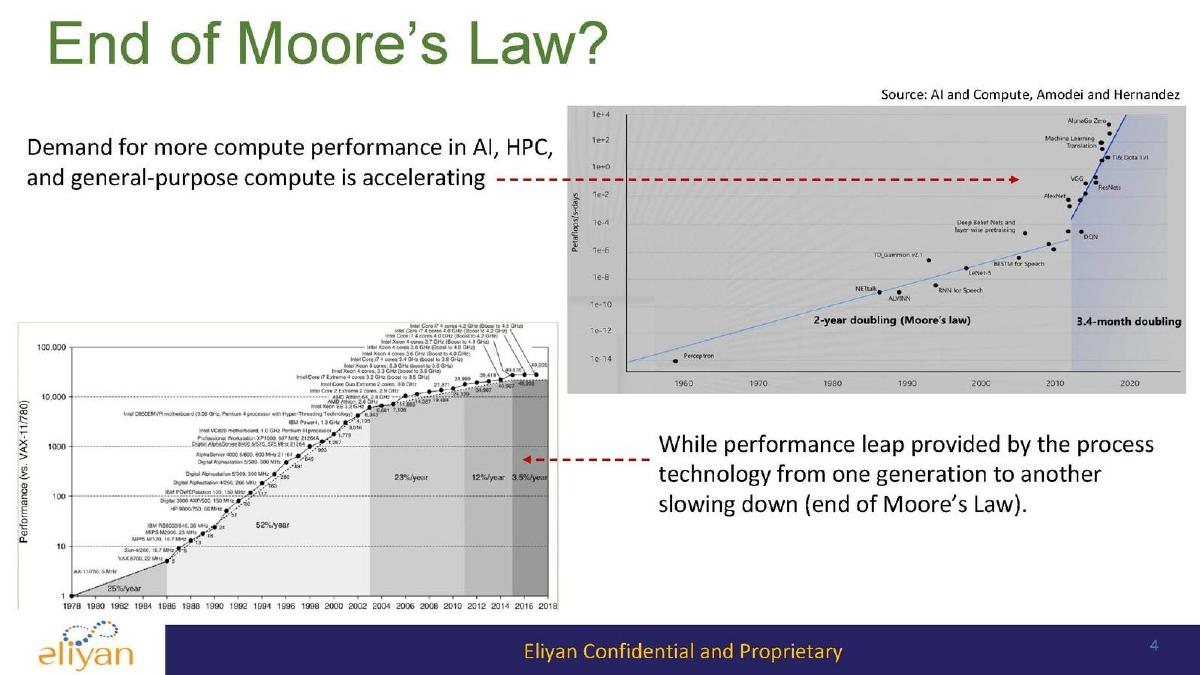
This slide sets the stage for the 'Why Now?' question. It illustrates the evolution of computing from the Single-Core era to the SoC (System on Chip) era, and finally to the current SiP (System-in-Package) era. The performance curves show that while Moore's Law is slowing down for single chips, performance is now being scaled through 'abundant parallelism' and 'multi-chip integration.' Eliyan positions itself at the very beginning of this new growth curve, suggesting a massive untapped potential for performance gains.
Slide 7: A Growing Movement
To validate the market demand, Slide 7 uses a 'social proof' collage of headlines from Forbes, Wired, The Wall Street Journal, and Protocol. The headlines focus on how chiplets are 'saving Moore's Law' and how industry giants like Intel and NVIDIA are pushing for standard chiplet interconnects (UCIe). This slide effectively argues that Eliyan isn't just building a niche product, but is part of a fundamental shift in how the world's most powerful computers are built.
Slide 9: 2.5D Packaging: Silicon Interposer (CoWoS)
Here, Eliyan begins the 'Problem' section by critiquing the current gold standard: TSMC's CoWoS (Chip on Wafer on Substrate). While acknowledging its high trace density, the slide lists six critical weaknesses: limited maximum system size, high cost, low yield, limited routability, long production cycles, and a limited supply chain. By calling out these specific pain points, Eliyan prepares the investor for a solution that addresses each one.
Slide 11: 2.5D Embedded Multi-Die Interconnect Bridge (EMIB)
Similar to Slide 9, this slide analyzes Intel's EMIB technology. It notes that while EMIB enables larger systems, it still suffers from high costs, low test coverage, and a limited supply chain. The inclusion of a physical photo of a chip package adds a layer of reality to the technical diagrams, reminding the investor that this is a tangible manufacturing problem.
Slide 13: Nulink: Eliyan’s Chiplet Connectivity Technology
This is the 'Solution' slide. Eliyan introduces Nulink , described as 'silicon-proven D2D technology.' The key metric here is '~10x data rate/trace,' which allows Eliyan to achieve advanced packaging performance using conventional organic packages. The diagram shows a 'Conventional MCM Package' evolving into a Nulink-enabled package, emphasizing that they can achieve high bandwidth without the exotic materials required by competitors.
Slide 15: Eliminating Silicon Interposers for ASIC-DRAM Connectivity
Slide 15 gets into the specific application of the technology. It shows how Nulink can connect HBM3 (High Bandwidth Memory) to an ASIC on a standard organic substrate. The slide lists benefits such as 'full wafer-level test coverage' and 'UCIe compatibility,' which makes adoption easier for customers already looking at industry standards. This slide is crucial because it demonstrates that Eliyan’s tech is a drop-in replacement that simplifies the supply chain by using standard partners like ASE and Amkor.
Slide 17: Major Cost & Yield Improvement
This is the 'Economic' slide and perhaps the most important for a Series A. Eliyan compares 'Chiplets with micro bumps' (the current standard) to 'Chiplets with standard bumps' (Eliyan’s approach). The data is stark: yield increases from ~50% to 87% for a complex system (12 HBM + 2 ASICs). Consequently, the effective cost drops from ~$12K to ~$6.8K . Furthermore, they claim to eliminate the 4-8 week lead time required for advanced packaging steps. This slide transforms a technical innovation into a clear business advantage: it’s faster, cheaper, and more reliable.
Slide 19: Providing a Paradigm Shift in HPC
The final slide summarizes the impact. Eliyan claims to 'democratize' chiplet implementation by making it accessible to more fabs and regions, rather than being locked into a few high-end providers. They also lean into the sustainability narrative, noting that higher yields mean less wasted material and lower power consumption. The slide ends on a high note, positioning Eliyan as the key to scaling AI and HPC for hyperscalers.
What Works in Eliyan's Deck
Founder Credibility: The team slide is exceptionally strong. In a field as specialized as semiconductor interconnects, having a founder who literally wrote the standards (UCIe/BOW) is a massive competitive moat. · Quantifiable Value: Slide 17 is the 'money slide.' It doesn't just say the tech is better; it provides a specific cost reduction (~$5.2K per system) and a specific yield improvement (37%). These are the metrics that drive enterprise adoption. · Clear Problem/Solution Fit: The deck does an excellent job of explaining why current solutions (CoWoS/EMIB) are failing to meet the needs of the AI era and how Eliyan specifically bridges that gap. · Visual Clarity: Despite the technical nature of the content, the diagrams are clear and consistently formatted, making it easier for a non-engineer investor to follow the logic of the 'interposer-less' architecture.
What Is Missing from Eliyan's Deck
The Ask: As presented, the deck does not include a slide detailing the funding amount requested or the specific milestones that the $40M Series A will fund. · Financial Projections: There are no revenue targets, pricing models, or market size (TAM/SAM/SOM) calculations. While the cost-per-unit savings are shown, the overall business scale is not. · Competitive Landscape: While they compare themselves to packaging technologies (CoWoS, EMIB), they do not mention other startups or competitors in the D2D (Die-to-Die) interconnect space, such as Alphawave or Rambus. · Customer Traction: The deck mentions the tech is 'silicon-proven,' but it does not name any partners, pilot programs, or early-access customers. In a Series A, investors typically look for some level of commercial validation.
Founder Takeaways
Lead with Pedigree: If your team has deep domain expertise or a history of successful exits in a technical field, put that slide first. It frames every subsequent technical claim as credible. · Focus on the Bottleneck: Eliyan doesn't try to solve all of semiconductor manufacturing. They focus exclusively on the interconnect. By narrowing the scope, they make the problem feel solvable and the solution feel essential. · Translate Tech to Dollars: The most effective slide in the deck is the one that translates 'bump pitch' into 'effective cost.' Founders should always aim to show how their technical innovation results in a better P&L for their customers. · Use Industry Standards as a Tailwind: By mentioning UCIe compatibility, Eliyan shows they are not building a proprietary island. They are building a better engine that fits into the industry's existing roadmap, which lowers the perceived risk for customers.
Frequently asked questions
- What is Eliyan's core value proposition?
- Eliyan's core value proposition is its Nulink D2D technology, which enables high-bandwidth chiplet connectivity on conventional organic packages. This eliminates the need for expensive and supply-constrained silicon interposers (like TSMC's CoWoS), significantly reducing manufacturing costs, increasing yields from 50% to 87% in complex systems, and shortening production cycles by 4 to 8 weeks.
- Who are the founders and why do they matter?
- The team is led by Ramin Farjadrad, Syrus Ziai, and Patrick Soheili. Farjadrad is a Stanford PhD with 130+ patents who co-founded Aquantia (IPO 2017). Ziai brings 30 years of experience from Qualcomm and Nuvia, while Soheili has a background in executive roles at eSilicon and AMD. Their collective experience in productizing connectivity standards and managing large engineering teams provides the technical credibility necessary for a hardware Series A.
- How does Eliyan compare to existing packaging technologies?
- Existing technologies like CoWoS and EMIB offer high density but suffer from limited system size, high costs, and long production cycles. Eliyan’s Nulink provides ~10x the data rate per trace of conventional methods, matching the performance of advanced packaging while using standard organic substrates. This allows for larger system sizes and a more flexible supply chain including partners like ASE and Amkor.
- What market is Eliyan targeting?
- Eliyan is primarily targeting the High-Performance Computing (HPC) and Artificial Intelligence (AI) sectors. These industries require massive ASIC-to-DRAM (HBM3) connectivity. By 'democratizing' chiplet implementation across a wider range of fabs and geographical regions, Eliyan aims to serve hyperscalers and chip designers who are currently bottlenecked by advanced packaging availability.
- What is missing from this pitch deck?
- The deck is highly technical and lacks several standard venture components. There is no explicit 'Ask' slide detailing how the $40M will be spent, no multi-year financial roadmap, and no detailed competitive landscape beyond general packaging categories. It also omits a specific go-to-market strategy or list of current pilot customers, though it mentions the technology is 'silicon-proven.'