Handly’s 10-slide pre-seed deck is a masterclass in identifying a specific, underserved niche within a massive global market. By focusing on craft service companies with 1-9 employees—a segment they claim represents 80% of the market—Handly positions itself as the bridge between pure B2B admin tools and B2C lead generation marketplaces. The deck successfully uses early traction data, showing a growth from 19 to 180 customers in four months, to validate their 'mobile-first' approach. While the deck lacks a formal 'Ask' slide and detailed financial projections, the strength of the team’s pedigr…
Key takeaways
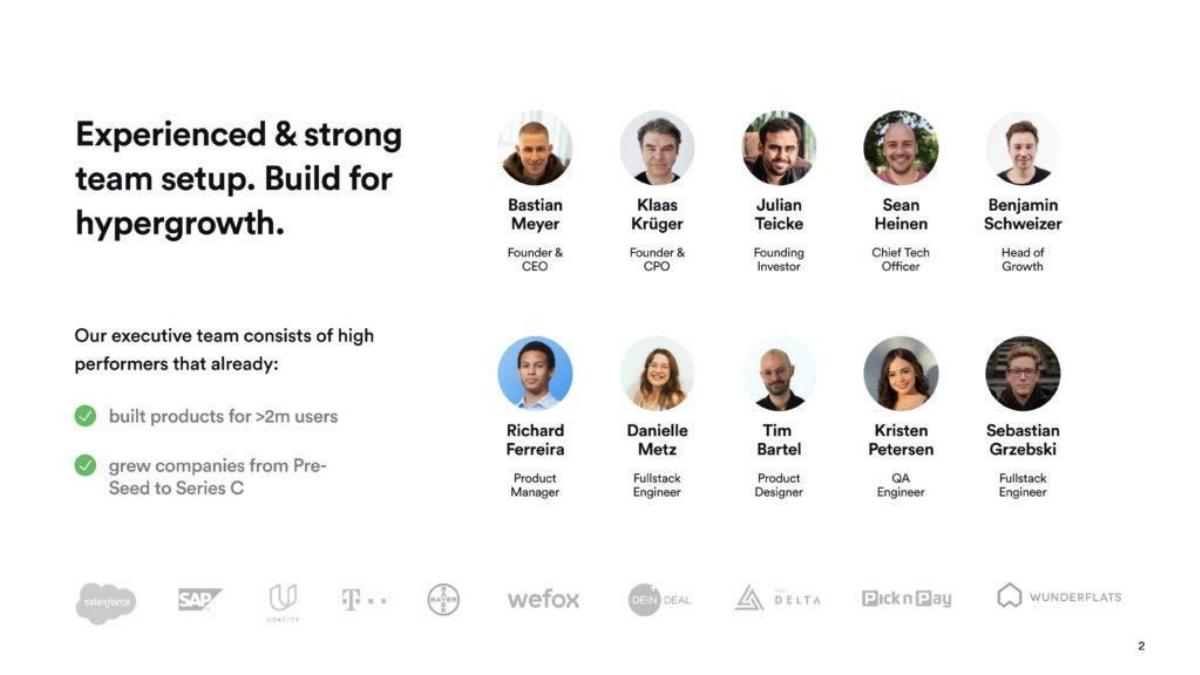
- The team slide (Slide 2) emphasizes 'hypergrowth' experience, noting products built for over 2 million users.
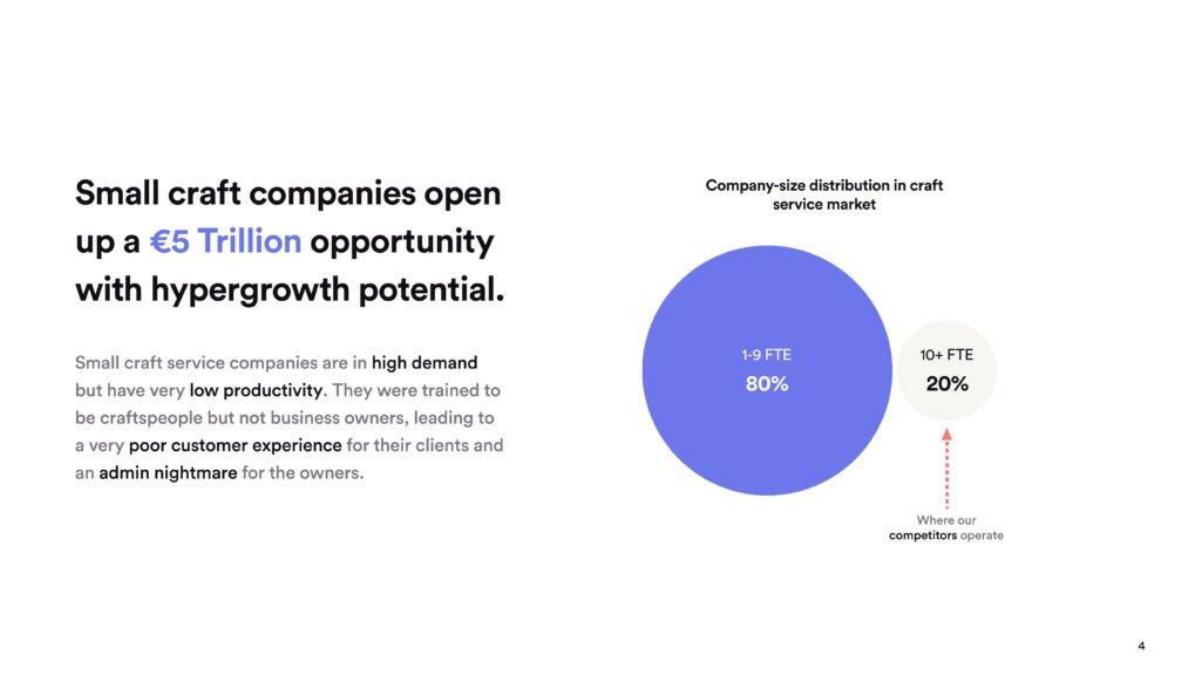
- Handly identifies a €5 trillion market opportunity specifically targeting the 80% of craft companies with 1-9 employees (Slide 4).
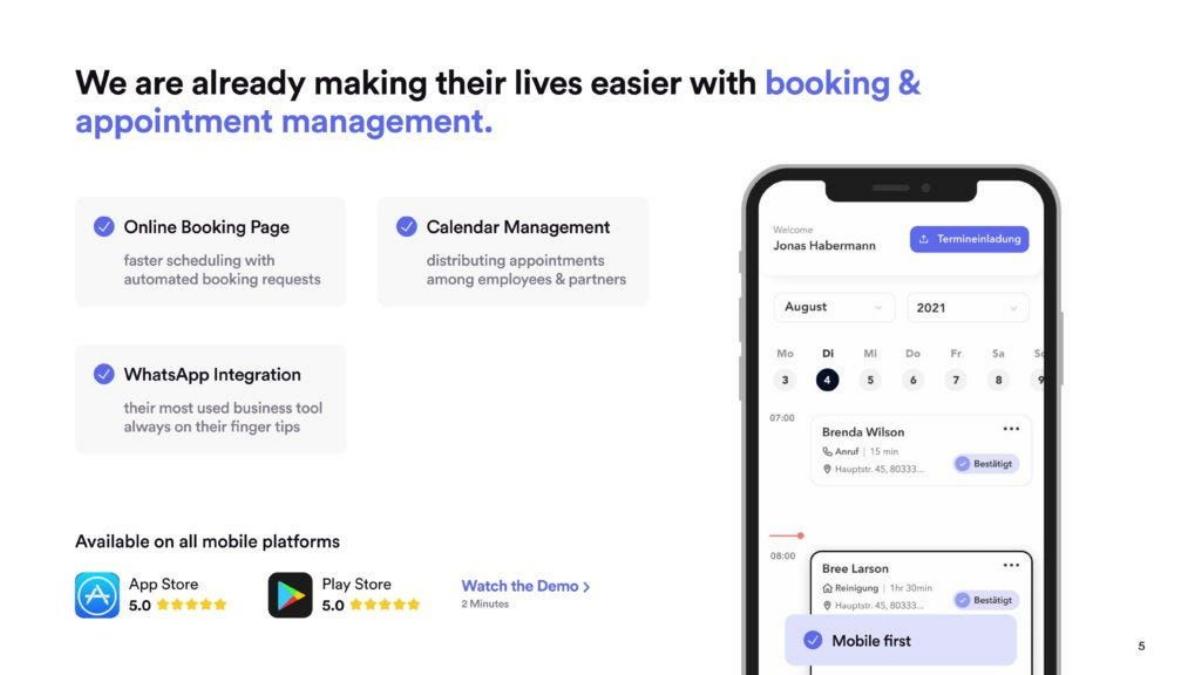
- The product is positioned as 'mobile first,' integrating with WhatsApp to meet craftspeople where they already work (Slide 5).
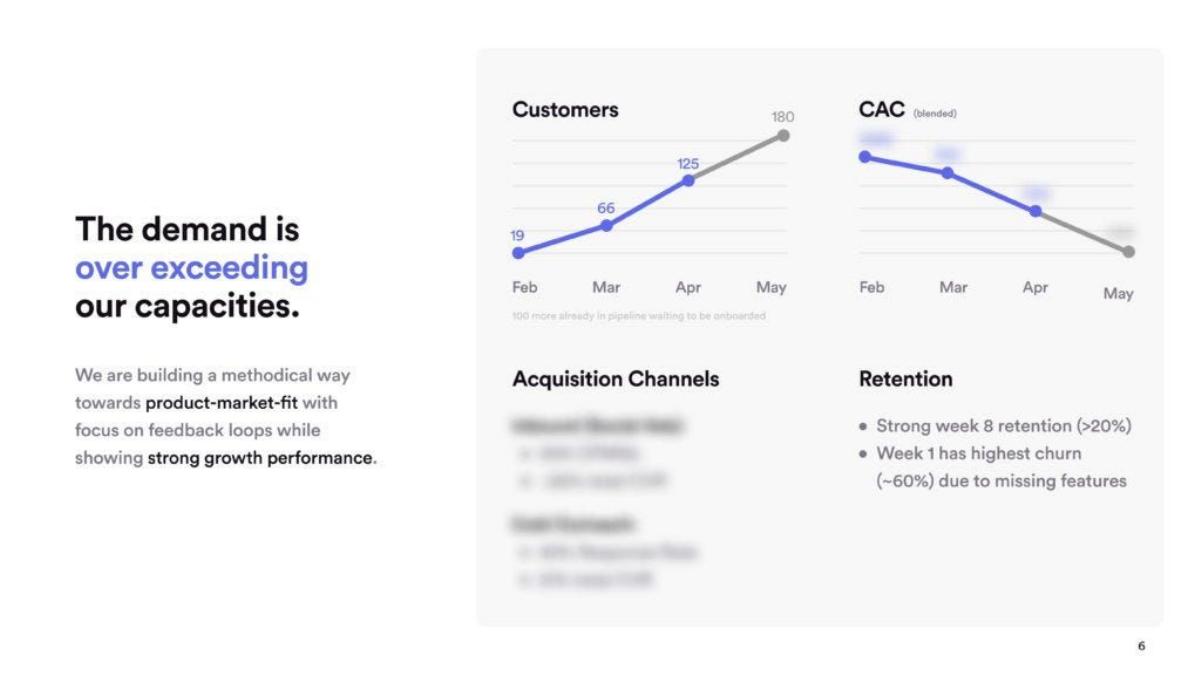
- Traction data shows customer growth from 19 in February to 180 in May, alongside a declining blended CAC (Slide 6).
- The startup admits to a ~60% Week 1 churn rate due to missing features, showing unusual transparency for a pitch deck (Slide 6).
- Handly claims their business model generates 3-4x more revenue than traditional B2B SaaS competitors by layering transaction fees (Slide 8).
- The competitive landscape (Slide 9) places Handly in a unique 'B2B2C' intersection, distinct from lead-gen sites like Angi or pure tools like Jobber.
- The deck completely omits a specific 'Ask' slide, failing to detail how much capital is being raised or the intended use of funds.
The Handly Pitch Deck: Targeting the Long Tail of Craft Services
Handly’s 2022 pitch deck is a concise, 10-slide narrative that focuses on the digitization of the 'craft services' industry—plumbers, electricians, and other home service providers. Based in Berlin, the company successfully raised $1.5 million in pre-seed funding by arguing that the vast majority of this €5 trillion market is underserved by existing enterprise software. The deck is notable for its clean design, aggressive market sizing, and a 'B2B2C' positioning that seeks to capture more value than a standard subscription model.
Slide 1: Title Slide
The deck opens with a minimalist title slide featuring the Handly logo and the tagline: "Reinventing craft services." Dated June 2022, it sets a professional tone without unnecessary clutter. The branding is soft and approachable, utilizing a blue and white color palette that suggests a consumer-friendly interface for a B2B product.
Slide 2: The Team
Handly leads with its team, a common strategy for pre-seed rounds where the business model is still being validated. The slide, titled "Experienced & strong team setup. Build for hypergrowth," lists ten individuals. Key figures include Bastian Meyer (Founder & CEO) and Klaas Krüger (Founder & CPO). The slide highlights that the executive team has "built products for >2m users" and "grew companies from Pre-Seed to Series C." Logos at the bottom include recognizable names like Salesforce, SAP, and Wefox, providing immediate social proof and suggesting the founders have the technical and operational pedigree to scale a platform.
Slide 3: The Problem
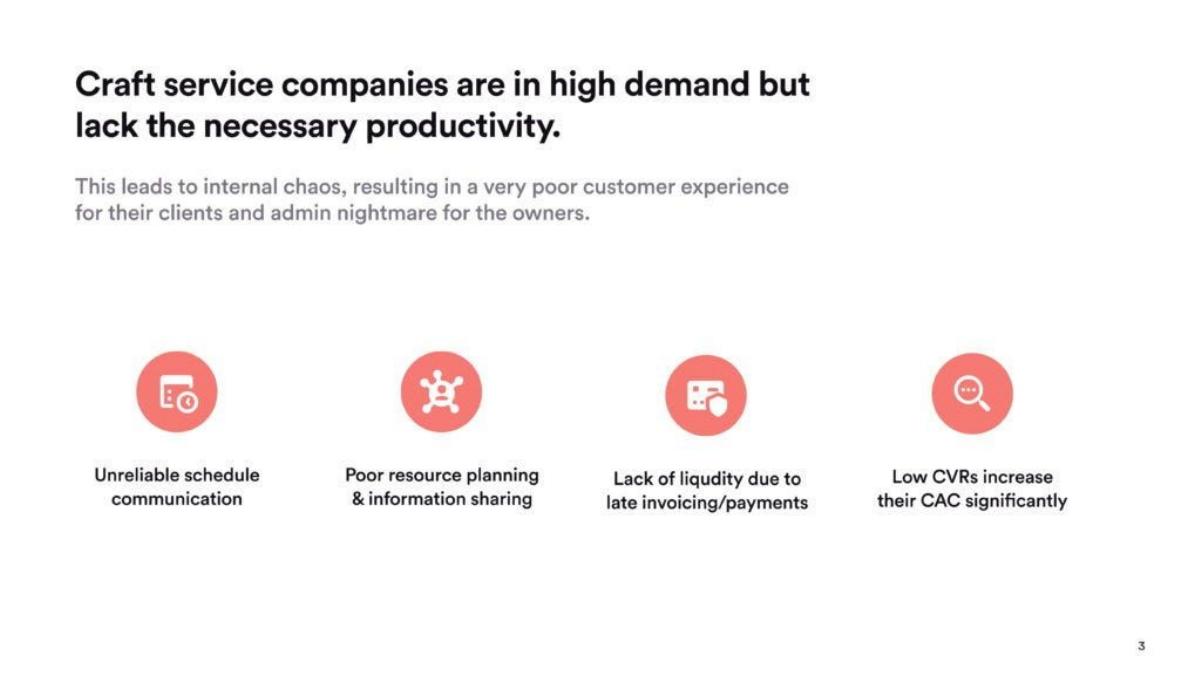
Slide 3 defines the pain points: "Craft service companies are in high demand but lack the necessary productivity." The deck identifies four specific symptoms of this problem: unreliable schedule communication, poor resource planning, lack of liquidity due to late invoicing, and low conversion rates (CVRs) which increase customer acquisition costs (CAC). By framing the problem as an "admin nightmare for the owners," Handly establishes a clear need for a centralized digital assistant.
Slide 4: Market Opportunity
This is the 'hook' slide. It claims small craft companies represent a "€5 Trillion opportunity." The most critical piece of data here is the "Company-size distribution in craft service market" chart. It asserts that 80% of the market consists of companies with 1-9 full-time employees (FTEs), while only 20% have 10+ FTEs. Handly explicitly points out that their competitors operate in the 10+ FTE segment, leaving the vast majority of the market—the 'long tail'—open for Handly to capture.
Slide 5: The Solution (Current Product)
Slide 5 introduces the product as a tool for "booking & appointment management." It lists three core features: an Online Booking Page, Calendar Management, and, most importantly, "WhatsApp Integration." The inclusion of WhatsApp is a strategic choice, acknowledging that for small craftspeople, their "most used business tool" is already on their phone. The slide also features a mobile app mockup and claims 5.0-star ratings on both the App Store and Play Store, though it does not specify the number of reviews.
Slide 6: Traction and Retention
Titled "The demand is over exceeding our capacities," Slide 6 provides hard data. A line chart shows customer growth from 19 in February to 180 in May. A second chart shows a declining blended CAC over the same period. The slide also includes a "Retention" section that is remarkably honest: it notes a "Strong week 8 retention (>20%)" but admits that "Week 1 has highest churn (~60%) due to missing features." This transparency likely built trust with investors, showing the founders are data-driven and aware of their product gaps.
Slide 7: Product Roadmap
Handly outlines its evolution from a booking tool to a "leading global craft service CRM." Future features include Job Management (a single source of truth), Video-Visitations (to reduce CAC by eliminating travel), and Mobile Payments (automating invoicing). The "Mobile first" badge is repeated here, reinforcing the idea that the software is designed for people who are constantly on the move, not sitting at a desk.
Slide 8: Business Model
Slide 8 explains how Handly intends to out-earn traditional SaaS companies. It compares a "B2B SaaS competitor" (100% software fee) to Handly’s multi-layered model. Handly’s revenue includes a Software Fee, an "Online Invoice Fee" (0.5% of transaction value), and a third blurred-out category likely related to lead generation or marketplace commissions. The headline claims this allows them to "make 3-4x more revenue per craft service company." This is a powerful argument for venture-scale returns in a traditionally low-ACV (Annual Contract Value) sector.
Slide 9: Competitive Landscape
The competitive analysis uses a Venn diagram to place Handly at the intersection of B2B (Software Tools like Jobber and ServiceTitan) and B2C (Lead Gen like Angi and Thumbtack). Handly labels this intersection "B2B2C - Software Enabled Marketplace." The slide argues that by automating the admin end-to-end, they can provide higher conversion rates for suppliers and more predictable, cheaper customer acquisition.
Slide 10: Closing
The deck ends with a call to action: "Lets define a €5T industry together." It includes the CEO’s contact information but, notably, does not include a slide detailing the specific investment ask, the valuation, or the use of proceeds. While these details are often removed from public versions of decks, their absence in a pitch context would be a significant omission.
What Handly Does Well
Niche Identification: By focusing on the 1-9 employee segment, Handly avoids a direct 'feature war' with established enterprise players like ServiceTitan. · Platform Familiarity: The emphasis on WhatsApp integration shows a deep understanding of the user's existing workflow. · Revenue Stacking: Moving beyond a simple subscription to include transaction fees is a smart way to monetize a high-volume, low-ticket user base. · Honesty: Admitting to high early churn due to missing features demonstrates a level of founder maturity that is rare in pre-seed decks.
What is Missing from the Deck
The Ask: There is no mention of how much money is being raised or what milestones that money will help the company reach. · Unit Economics: While CAC is shown to be decreasing, there is no data on Lifetime Value (LTV) or the payback period, which are critical for assessing the sustainability of the growth shown on Slide 6. · Geographic Strategy: As a Berlin-based company targeting a 'global' market, the deck doesn't explain the plan for international expansion or how they will handle local regulations and languages in the craft sector. · Financial Projections: There are no forward-looking revenue numbers, leaving investors to guess the actual scale of the business in 3-5 years.
Founder Takeaways
Use a 'Team First' approach if you have the pedigree: Handly’s Slide 2 is incredibly strong because it quantifies the team's past success (2m+ users). If your team has worked at 'unicorns' or major tech firms, lead with that. · Segment the market visually: Slide 4’s pie chart is a great way to show that while a market is 'crowded,' the specific segment you are targeting is actually wide open. · Show, don't just tell, your traction: The charts on Slide 6 are simple but effective. Showing a 10x growth in customers over four months is the best way to prove product-market fit is approaching. · Integrate with existing habits: If your target users already live in WhatsApp, Slack, or email, make that a core part of your value proposition rather than trying to force them into a new, standalone dashboard.
Frequently asked questions
- How much did Handly raise with this deck?
- According to publisher reports from Business Insider, Handly raised $1.5 million in a pre-seed round in 2022. The deck itself does not state the amount raised or the terms of the round, which is common for decks shared publicly after a close.
- What is Handly's core product?
- Handly is a digital assistant and CRM for craftspeople. Slide 5 and Slide 7 highlight features like online booking pages, WhatsApp integration, calendar management, job management, and mobile payments, all designed to reduce administrative 'chaos' for small business owners.
- Who is the target customer for Handly?
- Handly targets small craft service companies. Slide 4 specifies that 80% of the market consists of companies with 1-9 full-time employees (FTEs), a segment they claim is ignored by competitors who focus on larger enterprises (10+ FTEs).
- Why does Handly claim to have higher revenue potential than SaaS?
- Slide 8 illustrates that while competitors rely 100% on software fees, Handly adds an 'Online Invoice Fee' (0.5% of transaction value) and a commission for bringing in new jobs, resulting in a projected 3-4x increase in revenue per customer.
- What weakness does the deck acknowledge?
- Slide 6 contains a surprisingly honest retention metric, noting that Week 1 has the highest churn (~60%) due to missing features. However, they offset this by showing that demand is 'over exceeding' their capacity, with 100 more customers in the pipeline.