The hampr pitch deck is a masterclass in identifying a specific friction point—per-pound pricing—and solving it through a gig-economy framework. By positioning laundry as the next logical step in household outsourcing, alongside giants like Instacart and LawnStarter, hampr builds a compelling case for a 'washr' network. The deck relies heavily on impressive traction, citing 944% year-over-year revenue growth from 4Q20 to 4Q21. While the deck lacks a specific financial 'Ask' slide or detailed unit economics, it successfully argues for market readiness by highlighting a waitlist of thousands an…
Key takeaways
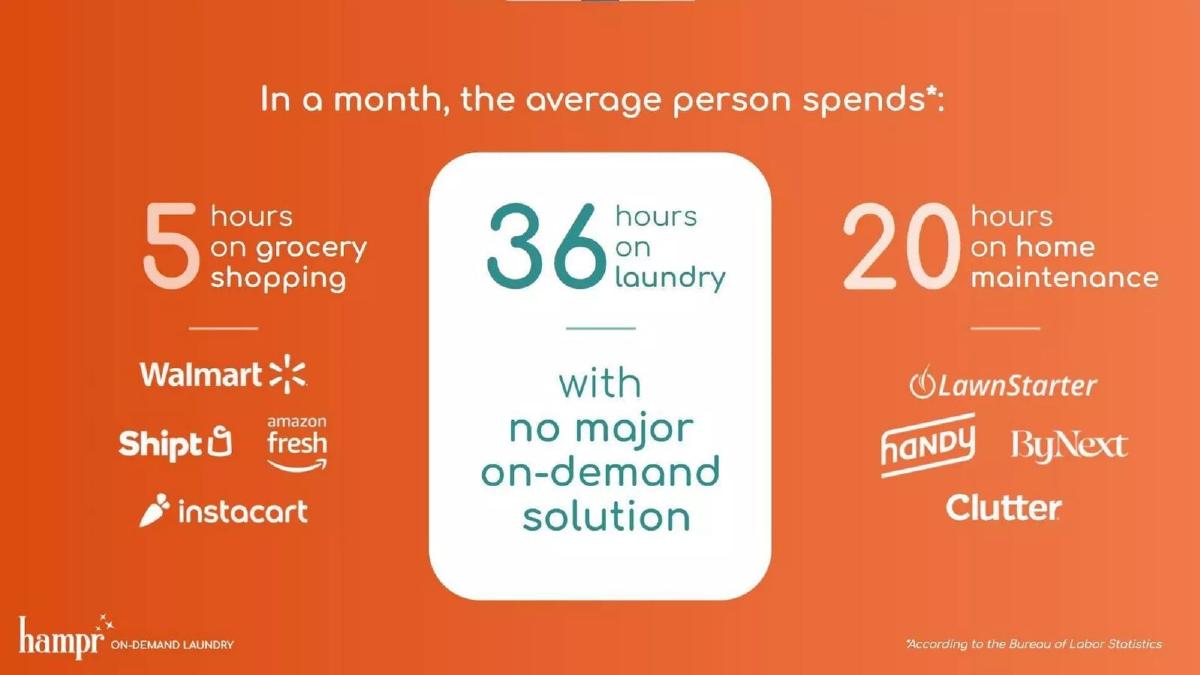
- The average person spends 36 hours a month on laundry, significantly more than grocery shopping or home maintenance, according to Slide 3.
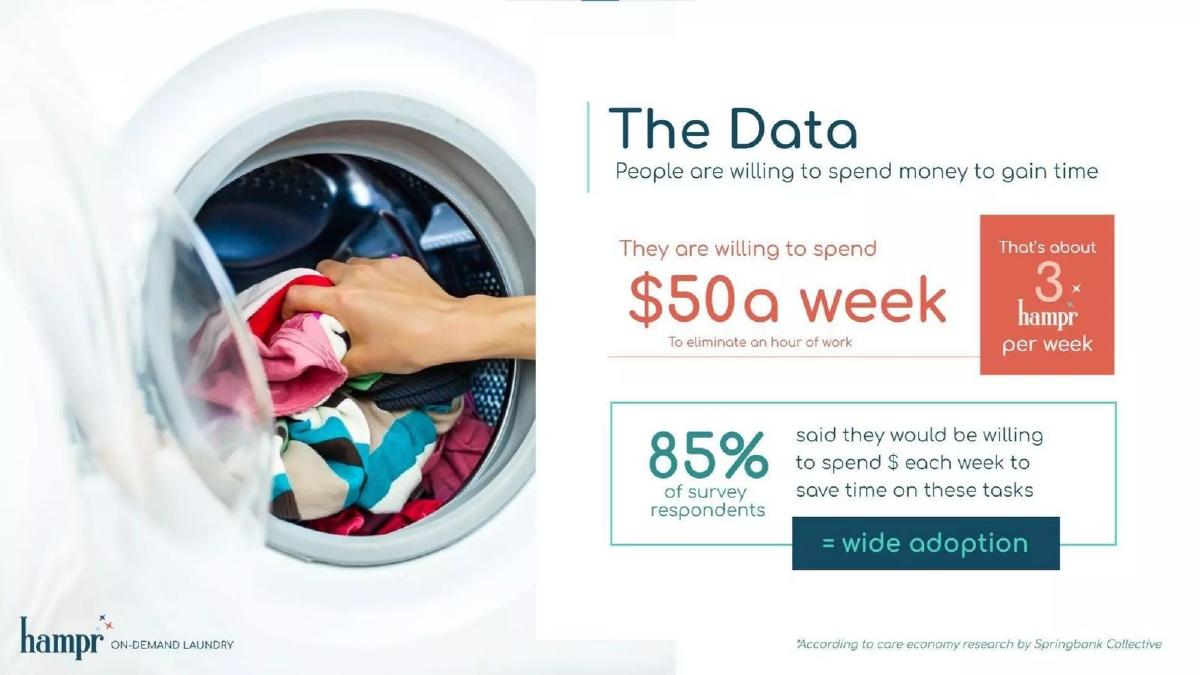
- Market research from Springbank Collective indicates 85% of survey respondents are willing to spend money to save time on household tasks, as shown on Slide 4.
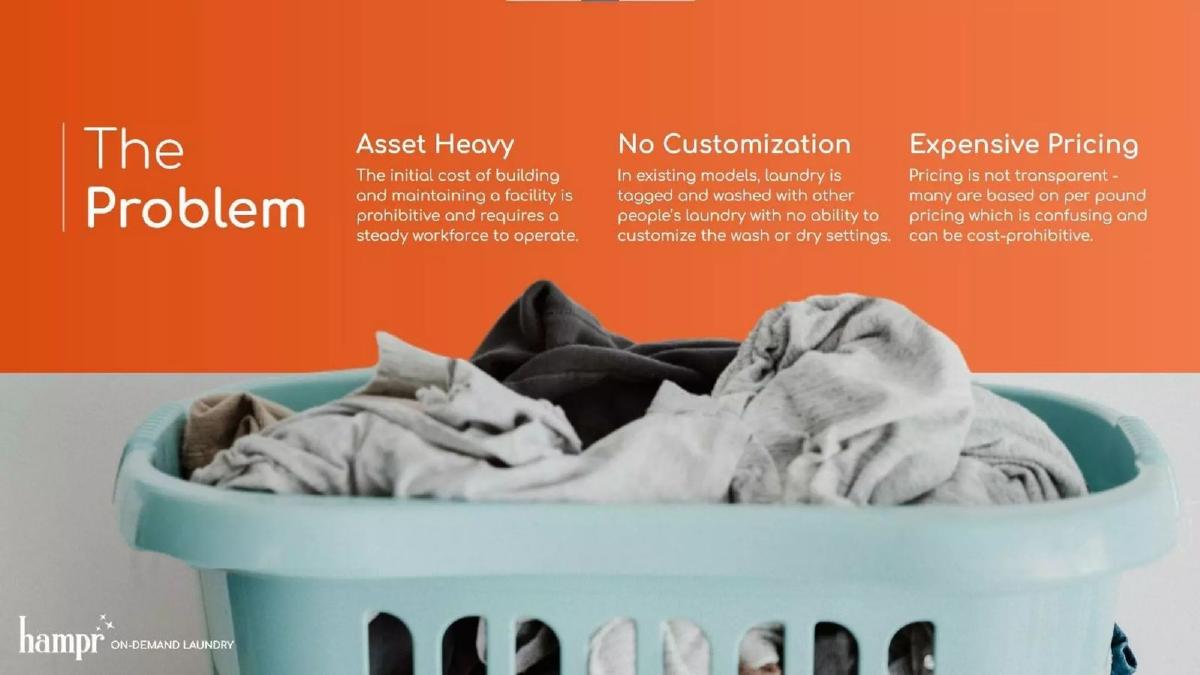
- hampr identifies three core failures of previous laundry startups: asset-heavy models, lack of customization, and non-transparent pricing (Slide 6).
- The company defines its Serviceable Obtainable Market (SOM) as $18B based on current member demographics at 40% penetration (Slide 8).
- Revenue and membership growth showed a 944% YoY increase from 4Q20 to 4Q21, as illustrated on the bar chart on Slide 14.
- The typical member is a dual-income family with 2+ kids in suburban neighborhoods, placing 'catch-up' orders every 13 days (Slide 13).
- The 'washr' workforce is composed of 1099 contractors, including stay-at-home parents and retirees, to minimize opportunity costs (Slide 13).
- The expansion roadmap for 2022-2023 targets 124 new markets, supported by a waitlist of thousands of people (Slide 16).
The Vision and Market Opportunity
The hampr deck opens by positioning time as a scarce commodity. Slide 2 sets the stage, claiming a rise in the outsourcing of household chores. This is immediately quantified on Slide 3, which compares laundry to other outsourced tasks. According to the Bureau of Labor Statistics, the average person spends 36 hours a month on laundry, which dwarfs the 5 hours spent on grocery shopping and 20 hours on home maintenance. By listing established players like Walmart, Instacart, and Handy, hampr suggests that laundry is the last great frontier of the gig economy that lacks a 'major on-demand solution.'
Data-Driven Validation
Slide 4 introduces care economy research from Springbank Collective to validate the business model. It states that 85% of survey respondents are willing to spend money to save time, with a specific willingness to pay $50 a week to eliminate an hour of work. hampr translates this into their own currency: 'about 3x hampr per week.' This slide is critical because it moves the conversation from 'is this a problem?' to 'is there a willingness to pay?'
Addressing Industry Failures
Why Previous Models Failed
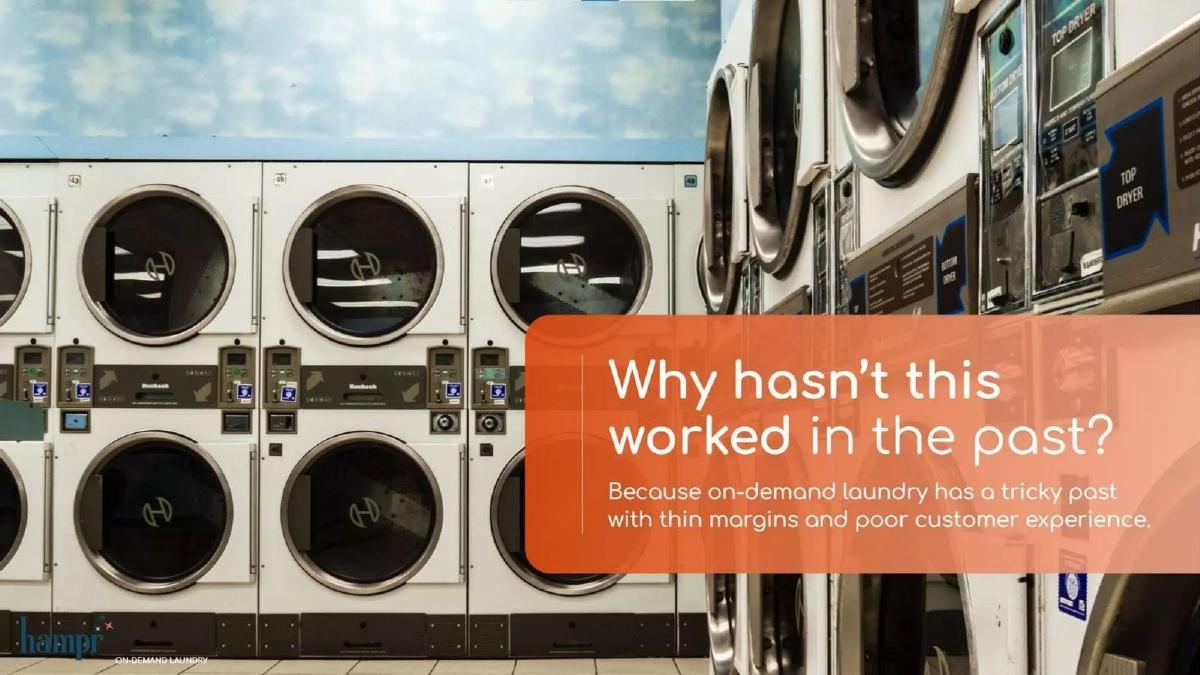
Slide 5 and Slide 6 tackle the 'elephant in the room': why hasn't on-demand laundry worked before? The deck identifies three structural flaws in previous attempts: they were asset-heavy (requiring expensive facilities), lacked customization (mixing laundry with other people's clothes), and utilized confusing per-pound pricing. By calling out these specific failures, hampr prepares the investor for their 'asset-light' solution.
The Peer-to-Peer Solution
Slide 7 introduces the hampr solution as a peer-to-peer model. It leans on the cultural shift toward the gig economy, noting that consumers are now comfortable with peers performing personal services. The key takeaway here is scalability; because they don't own the machines or the real estate, they claim they can 'scale literally anywhere that has demand.'
Market Size and Fragmentation
TAM, SAM, and SOM
Slide 8 provides a standard market sizing breakdown. They project the household management industry will grow from $122B to $339B by 2025. Within that, they identify a Total Addressable Market (TAM) of $56B, a Serviceable Addressable Market (SAM) of $45B, and a Serviceable Obtainable Market (SOM) of $18B. The SOM is specifically calculated based on current member demographics at a 40% penetration rate. Slide 9 reinforces the opportunity by stating the market is 'highly fragmented with no clear market leader... yet.'
Product and Operations
The User Experience
Slides 10, 11, and 12 walk through the 'How it Works' flow. The process is simplified into three steps: create a membership, schedule a pick-up (using a QR code on a branded hampr bag), and 'kick back & relax.' The use of lifestyle photography featuring a family at a dining table emphasizes the target demographic and the emotional benefit of the service.
The Two-Sided Marketplace
Slide 13 defines the two sides of the hampr marketplace. The 'Washrs' are 1099 contractors described as an 'untapped workforce' of stay-at-home parents and retirees. The 'Members' are dual-income suburban families who place orders every 13 days. This slide is vital for understanding the operational backbone of the company and how they maintain a low-cost supply chain.
Traction and Roadmap
Growth Metrics
Slide 14 is the 'money slide.' It shows a bar chart of revenue and membership growth over eight quarters (1Q20 to 4Q21). The headline figure is a 944% year-over-year growth in revenue from 4Q20 to 4Q21. The visual shows an accelerating curve, which is exactly what later-stage investors look for to justify a $7.5M round. Slide 15 supplements this quantitative data with qualitative social proof, citing a 9 out of 10 recommendation rating and various customer quotes.
Future Expansion
Slide 16 outlines the roadmap. It lists specific cities like Oklahoma City, Minneapolis, and Charlotte as immediate targets. More impressively, it claims a 'waitlist of thousands of people' and a goal of entering 124 new markets between 2022 and 2023. This suggests that the primary bottleneck for the company is capital for expansion, not customer demand.
Team and Appendix
The Executive Team
The deck concludes with an Appendix section. Slide 18 introduces the leadership team. Founder and CEO Laurel Hess is credited with 15+ years in marketing and PR, while Co-founder and CTO Ryan LeBlanc brings 15+ years of engineering experience and is a Marine Corps veteran. Spencer Hoyt (Co-founder) and Jennifer Raggio (VP Operations) round out the team with backgrounds in entrepreneurship and operations. The slide includes logos of former employers and affiliations like American Airlines, Verizon, and Comcast to build institutional credibility.
What Works in the hampr Pitch Deck
Clarity of the Pricing Pivot: One of the strongest elements of this deck is the explicit rejection of per-pound pricing. By identifying this as a major friction point in the 'Problem' slide and offering 'flat-rate, no-nonsense pricing' in the solution, hampr removes a significant barrier to entry for the average consumer.
Visualizing the Growth Curve: The traction slide (Slide 14) is exceptionally well-executed. It doesn't just show growth; it shows an inflection point. The jump from 4Q20 to 1Q21 and the subsequent scaling through 4Q21 provides a clear narrative of a business that has found its footing and is ready to pour fuel on the fire.
Demographic Specificity: Rather than saying 'everyone has laundry,' Slide 13 identifies a very specific persona: suburban dual-income families with 2+ kids. This specificity makes their marketing and expansion strategy feel much more grounded and achievable.
What Is Missing from the hampr Pitch Deck
The Financial Ask: The most glaring omission is a slide detailing the actual funding request. While catalogue facts state they raised $7.5M, the deck itself does not specify the amount sought, the valuation, or the intended use of funds (e.g., % to marketing, % to hiring, % to R&D).
Unit Economics: While the deck mentions revenue growth, it is silent on profitability and unit economics. Investors in the on-demand space are typically wary of 'growth at any cost' models. Providing data on the contribution margin per load or the average customer acquisition cost (CAC) would have strengthened the case for long-term sustainability.
Competitive Analysis: Slide 9 mentions the market is fragmented, but it doesn't name direct competitors or explain how hampr wins against local wash-and-fold services or other emerging tech competitors. A 'Petal' or 'Matrix' diagram comparing features would have been helpful.
What a Founder Should Copy
The 'Why Now' Slide: Slide 3 is a perfect example of how to frame a 'Why Now' argument. By showing that laundry takes up significantly more time than grocery shopping—a category already disrupted by multi-billion dollar companies—they make the opportunity feel inevitable rather than speculative.
Branded Assets in Product Shots: Throughout the 'How it Works' slides, the branded hampr bag is front and center. This isn't just for aesthetics; it demonstrates that the company has thought about the physical touchpoints of a digital service, which is crucial for building brand loyalty in a commoditized market.
Leveraging Waitlists for Roadmap Credibility: Instead of just listing cities they want to enter, Slide 16 mentions a 'waitlist of thousands.' This turns a roadmap from a 'wish list' into a 'to-do list,' signaling to investors that the demand is already captured and waiting for the capital to be serviced.
Frequently asked questions
- What is hampr's core business model?
- hampr operates a peer-to-peer on-demand laundry service. It utilizes a network of 1099 contractors, referred to as 'washrs,' who pick up, wash, fold, and return laundry within 24 hours. Unlike traditional services that charge by the pound, hampr uses a flat-rate, per-load pricing model to ensure transparency and ease of use for the customer.
- How does hampr differentiate itself from previous failed laundry startups?
- According to Slide 6, hampr avoids the 'asset-heavy' trap of building and maintaining its own facilities. By using a peer-to-peer model, they eliminate the prohibitive initial costs and steady workforce requirements of traditional laundromats. They also focus on customization and transparent pricing, which they claim were major pain points in previous industry attempts.
- What kind of growth has the company demonstrated?
- The deck highlights significant traction on Slide 14, reporting 944% year-over-year revenue growth between the fourth quarter of 2020 and the fourth quarter of 2021. This growth is mirrored by a steady increase in membership over the same eight-quarter period, suggesting strong product-market fit and scalability.
- Who is the target customer for hampr?
- Slide 13 identifies their primary members as dual-income, busy families with two or more children living in suburban neighborhoods. These are middle-class to mid-affluent users who utilize the service for 'catch-up' ordering roughly every 13 days to manage their household workload.
- What is missing from this pitch deck?
- The deck lacks a formal 'Ask' slide detailing how much capital is being raised and how it will be allocated. It also omits specific unit economics, such as Customer Acquisition Cost (CAC) or Lifetime Value (LTV), and does not provide a detailed competitive landscape beyond mentioning that the market is 'highly fragmented.'