TrueCare24’s 2015 seed deck is a masterclass in the 'Before vs. After' narrative. The company targets the home healthcare market, which it values at $110 billion with a 9% annual growth rate. The core of the pitch rests on a single friction point: the four weeks it currently takes for a social worker to manually coordinate care via phone and fax. TrueCare24 proposes an algorithmic alternative that reduces this process to hours. With a growing network of over 3,100 providers and an ARR of $348K at the time of the pitch, the deck successfully demonstrates both a massive market opportunity and e…
Key takeaways
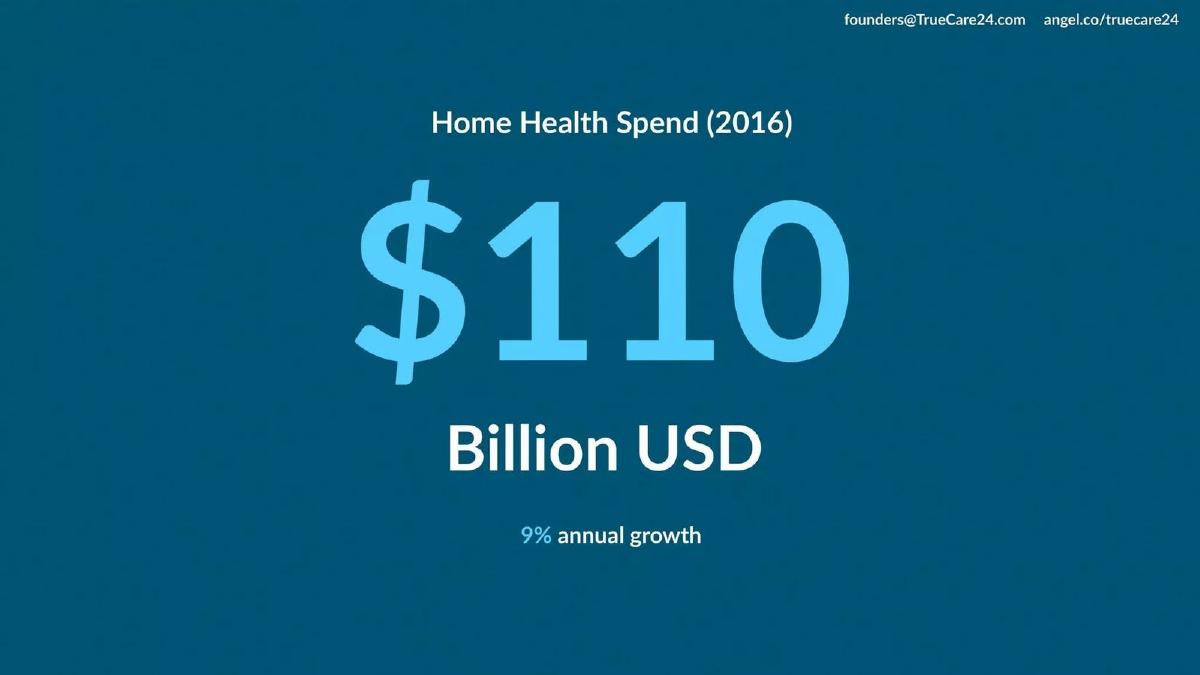
- The deck identifies a $110B market opportunity in home health spend as of 2016 (Slide 4).
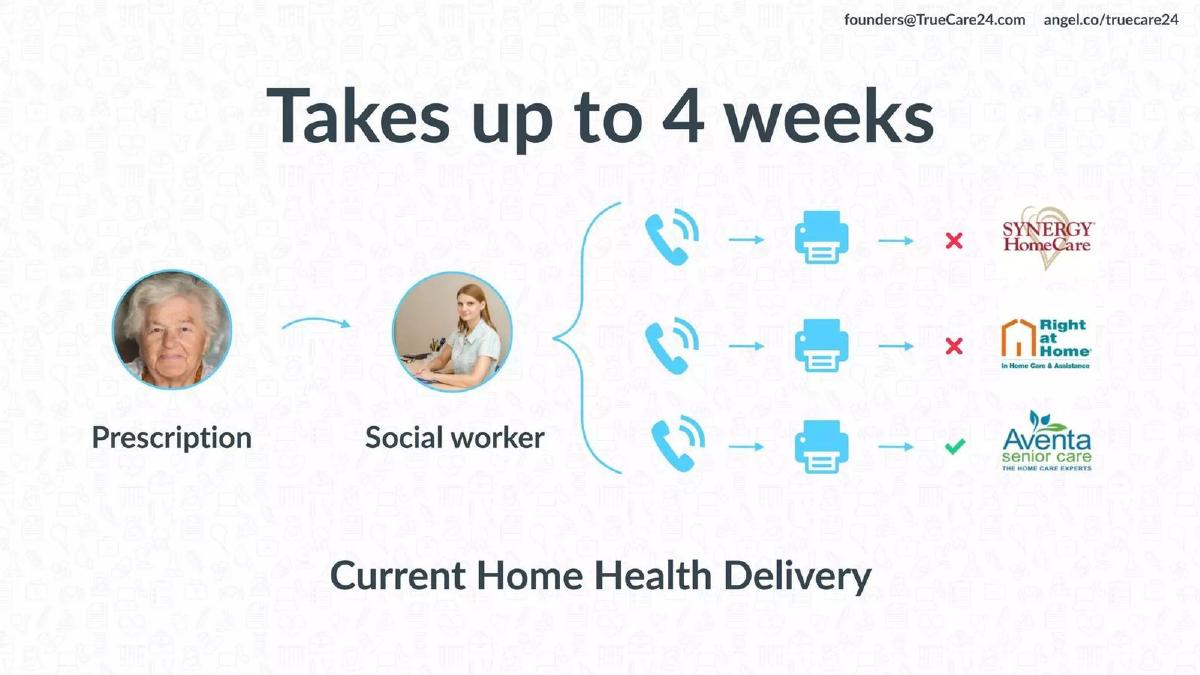
- It highlights a critical bottleneck where current home health delivery takes up to 4 weeks (Slide 5).
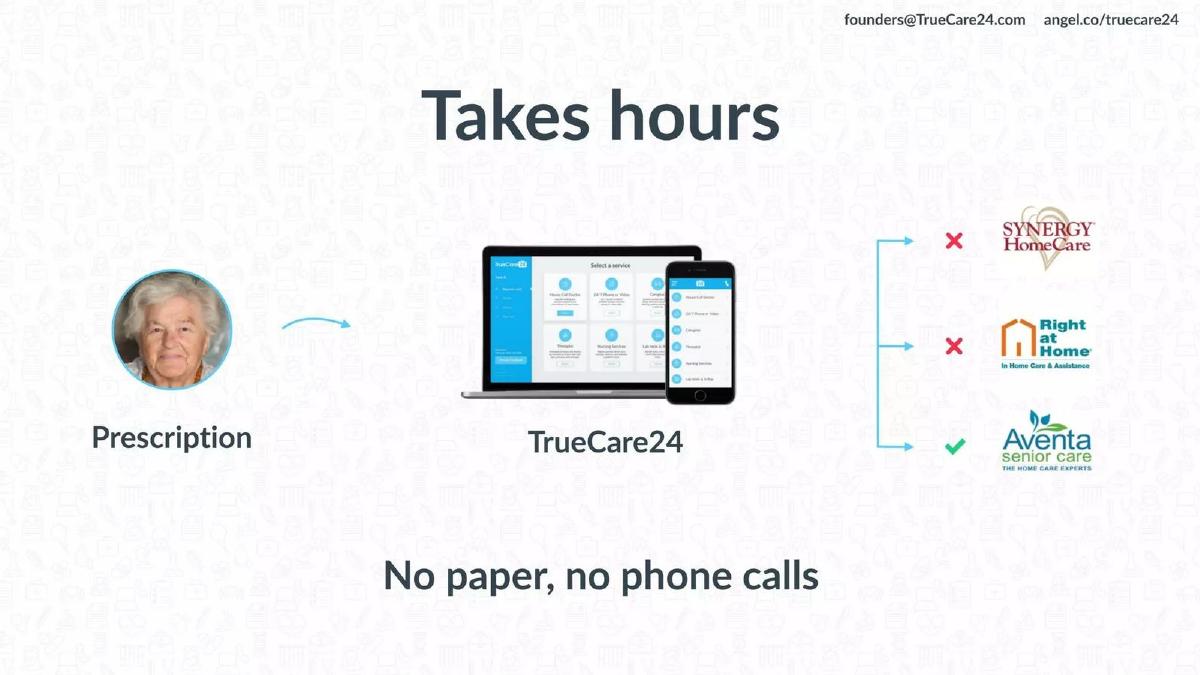
- The solution claims to reduce care coordination from weeks to hours using an automated platform (Slide 6).
- TrueCare24 reported a network of 3,100+ providers growing at 23% Month-over-Month (Slide 8).
- The company demonstrated financial traction with $348K in Annual Recurring Revenue (Slide 9).
- Revenue growth was stated at 27% Month-over-Month across a four-month period (Slide 9).
- The team slide emphasizes a mix of technology, growth, and clinical expertise with backgrounds from Wharton, Stanford, and Berkeley Haas (Slide 10).
- The deck omits a formal 'Ask' slide, failing to specify the amount being raised or the intended use of funds within the slides themselves.
Introduction: The Efficiency Play in Senior Care
TrueCare24 entered the market in 2015 with a clear mission: to modernize the fragmented and archaic world of home healthcare. At the time, the 'Uber for X' trend was in full swing, but TrueCare24 chose to focus on the 'unsexy' back-end coordination that plagues social workers and families. This 11-slide deck is a lean, metric-driven presentation that focuses on a single, massive pain point—the time it takes to get care into a home.
The Hook and the Market Opportunity (Slides 1-4)
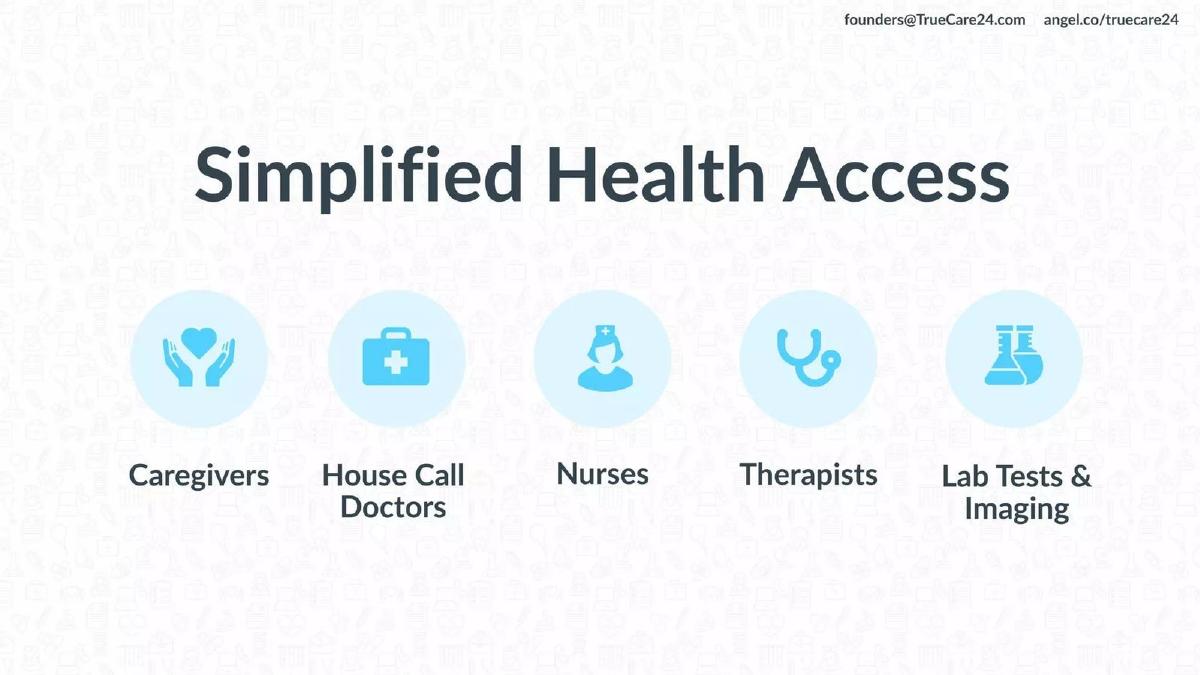
Slide 1 introduces the company as an 'In-Home Healthcare Access Network.' It is a straightforward title slide that establishes the brand identity immediately. Slide 2 , titled 'Simplified Health Access,' uses icons to show the breadth of the network: Caregivers, House Call Doctors, Nurses, Therapists, and Lab Tests & Imaging. This slide is crucial because it tells the investor that this isn't just a 'nanny' service; it is a comprehensive medical infrastructure play.
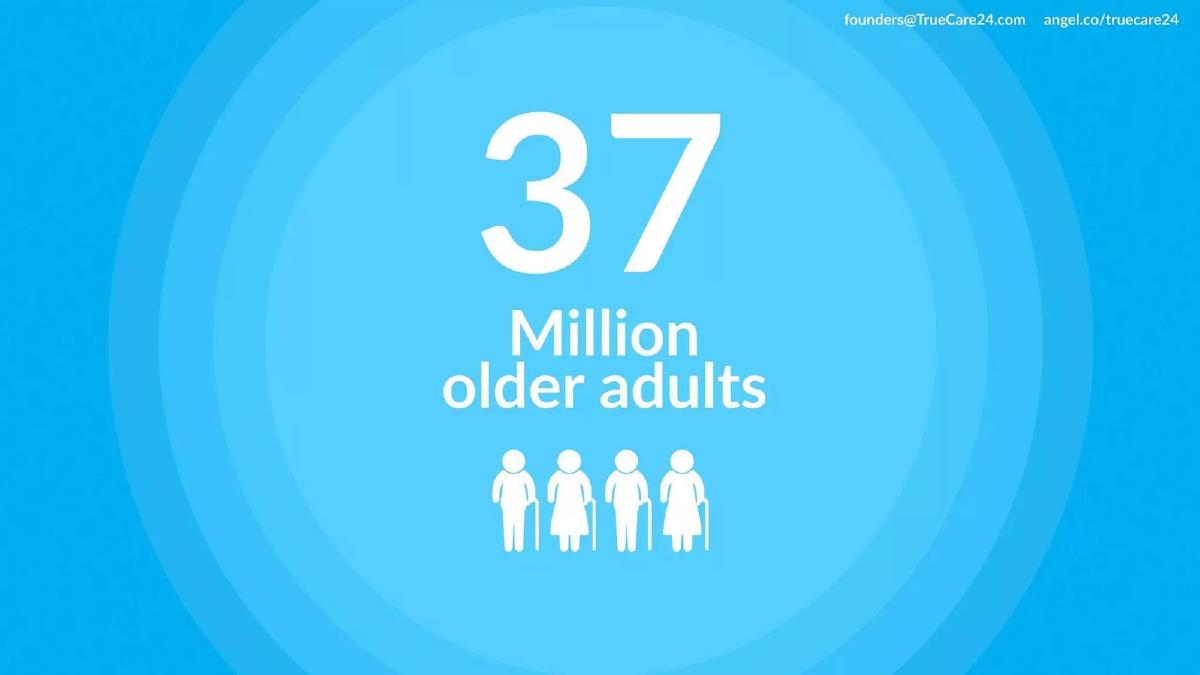
Slide 3 and Slide 4 establish the 'Why Now' and the 'How Big.' Slide 3 notes there are '37 Million older adults,' providing the demographic tailwind. Slide 4 provides the hard financial data: 'Home Health Spend (2016) $110 Billion USD' with a '9% annual growth.' By using a dark teal background and large, bold white text, the deck forces the investor to reckon with the scale of the market before seeing the product.
The Problem: The Four-Week Bottleneck (Slide 5)
Slide 5 is arguably the most important slide in the deck. It visualizes the 'Current Home Health Delivery' model. It shows a prescription leading to a social worker, who then has to make multiple phone calls and send faxes to various agencies like Synergy HomeCare and Right at Home. The headline is damning: 'Takes up to 4 weeks.' This slide identifies the 'villain' of the story—not the agencies themselves, but the manual, paper-based workflow that delays care for seniors.
The Solution: Algorithmic Fulfillment (Slides 6-7)
Slide 6 and Slide 7 present the 'After' scenario. Slide 6 shows the TrueCare24 interface on a laptop and smartphone, with the headline 'Takes hours' and the footer 'No paper, no phone calls.' Slide 7 goes deeper into the technology, highlighting a 'Provider matching algorithm' and '1-click fulfillment.' By mirroring the layout of the problem slide, the founders make the transition from the old way to the new way feel inevitable and obvious.
Traction and Scale (Slides 8-9)
Investors want to see that the 'matching algorithm' actually works in the real world. Slide 8 shows a 'Growing network' of '3,100+ providers' with a '23% MoM' growth rate. A map of the United States covered in TrueCare24 icons suggests that while they may be a seed-stage company, their reach is already national. This is a powerful way to signal that the model is scalable and not just a local pilot.
Slide 9 provides the financial proof. The headline 'Recurring revenue' is paired with a bar chart showing four months of growth (December to March) and a '27% Revenue growth MoM.' The key figure here is '$348K ARR.' For a 2015 seed round, having nearly $350k in annual recurring revenue while growing at nearly 30% monthly is a very strong position. The slide also lists '70+ Home Care partners,' showing that they are collaborating with the industry giants they mentioned in the problem slide, rather than trying to replace them entirely.
The Team and Summary (Slides 10-11)
Slide 10 presents the team. The deck highlights 'Technology + Growth + Clinical Expertise.' The pedigree is high-tier: CEO Bimohit Bawa (ServiceSource, Cisco, Berkeley Haas), CMO Leo Popov (Red Bull, Pepsi, Berkeley Haas), and VP of Operations Bianca Gonzalez (PhD, NP, MBA-c, Kaiser Permanente, Stanford Medicine, Wharton). This mix of 'Blue Chip' corporate experience and high-level clinical credentials (NP/PhD) is designed to de-risk the investment in a highly regulated space like healthcare.
Slide 11 is a summary slide that repeats the three biggest numbers: '$110B Market,' '3100+ Unique network,' and '27% MoM Revenue growth.' It ends with a contact email, providing a clean bookend to the presentation.
What Works in This Deck
The Contrast: The '4 weeks' vs. 'hours' comparison is a visceral way to explain the value proposition. It moves the conversation from 'features' to 'outcomes.' · The Traction: Showing 27% MoM revenue growth alongside 23% MoM network growth proves that both sides of the marketplace are scaling in tandem. · The Credibility: The team slide is excellent. It doesn't just list names; it categorizes them by the specific value they bring (Tech, Growth, Clinical), which addresses the three main pillars of a healthcare startup. · Simplicity: There is very little 'fluff.' Every slide has a single, clear message. The use of large fonts and high-contrast colors makes it readable in seconds.
What Is Missing
The Ask: The deck never specifies how much money they are raising, what the valuation is, or what the milestones are for the next 18 months. While this might be in a separate document, its absence here leaves the narrative unfinished. · Unit Economics: While we see ARR and growth, we don't see the Take Rate, Customer Acquisition Cost (CAC), or Lifetime Value (LTV). In a marketplace, these numbers are vital to prove that the growth is sustainable and profitable. · Regulatory/Compliance: Healthcare is a minefield of HIPAA and state-level regulations. The deck mentions 'Clinical Expertise' but doesn't explicitly state how they handle the legal complexities of home health coordination. · The 'How': The 'matching algorithm' is mentioned, but there is no detail on what data points it uses or why it is better than a human. Investors often want a 'peek under the hood' to ensure the 'algorithm' isn't just a manual spreadsheet behind the scenes.
What a Founder Should Copy
The Problem Visualization: If your startup solves an efficiency problem, copy Slide 5. Show the 'messy' current state with icons and a clear time-to-completion. It makes the solution feel like a relief. · The 'Power Three' Summary: Ending with your three most impressive metrics (Slide 11) ensures that those are the numbers that stick in the investor's mind after they close the deck. · Logo Association: TrueCare24 used the logos of established players (Slide 9) to build trust. If you have partners or customers with brand recognition, put their logos front and center. · Clean Design: This deck uses a consistent color palette and a very low word count per slide. It is designed to be spoken over, not read as a book.
Frequently asked questions
- How much did TrueCare24 raise with this deck?
- According to catalogue data from pitchdeckhunt.com, TrueCare24 raised $1,300,000 in a Seed round in 2015. The deck itself does not state the round size or terms, which is common in decks shared publicly after the fact.
- What is the primary value proposition of the platform?
- The primary value proposition is the 'automation' of home healthcare access. Slide 5 and Slide 7 contrast the manual, paper-heavy process of social workers making phone calls (taking 4 weeks) with TrueCare24’s provider matching algorithm and 1-click fulfillment (taking hours).
- What kind of traction did the company have at the time of the pitch?
- TrueCare24 showed significant early traction: $348K in ARR, 27% month-over-month revenue growth, and a network of over 3,100 providers. They also listed 70+ home care partners, including brands like Right at Home and Synergy HomeCare (Slide 9).
- Who are the founders and what is their background?
- The team includes Bimohit Bawa (CEO), Leo Popov (CMO), and Bianca Gonzalez (VP of Operations). Their collective experience spans companies like Cisco, Red Bull, and Pepsi, with academic credentials from Berkeley Haas, Wharton, and Stanford Medicine (Slide 10).
- Is there a competitor analysis in the deck?
- There is no dedicated competitor slide. However, Slide 5 and Slide 6 use the logos of established home care agencies like Synergy HomeCare and Right at Home to illustrate the 'Current' slow delivery model versus the TrueCare24 model, effectively positioning incumbents as part of the problem rather than direct tech competitors.