The 2007 AppNexus seed deck is a masterclass in leveraging founder credibility to sell a grand, capital-intensive vision. By framing the problem through their specific 'war stories' at Right Media, the founders established unique authority to build a high-performance cloud infrastructure. While the deck lacked technical depth and financials, its strategic 'Nexus' vision and phased roadmap successfully secured backing from top-tier investors like Marc Andreessen. The company eventually pivoted from a general-purpose AWS competitor to a dominant vertical ad-tech exchange, leading to a $1.6 bill…
Key takeaways
- Anchor your problem in a personal story to demonstrate visceral, lived experience rather than theoretical market needs.
- Sell a strategic vision like a high-margin marketplace or 'Nexus' rather than just a low-margin utility product.
- Create a phased, fundable roadmap that breaks massive ambitions into milestone-driven chunks for investors.
- Acknowledge your biggest competitors head-on to build credibility and frame your differentiation strategy on your own terms.
- Leverage founder-market fit as the centerpiece; unparalleled experience can compensate for missing technical or financial data.
The Moment in Time: 2007, The Dawn of Cloud
To understand the AppNexus deck, you have to rewind to 2007. The iPhone had just launched. Facebook was still mostly for college students. And 'the cloud' was a nascent, almost mystical concept. Amazon Web Services had launched EC2 just a year prior in 2006, and it was seen by many as a tool for startups and side projects, not serious, high-performance applications. Most large internet companies—like Right Media, where the AppNexus founders made their name—still managed their own physical infrastructure. Racking servers, managing data centers, and forecasting capacity was a core, painful competency.
This was the world into which Brian O'Kelley and Michiel Nolet pitched their vision. They weren't just proposing a company; they were proposing a new way to build internet-scale applications. The timing was impeccable. Programmatic advertising was exploding in complexity and volume, creating immense computational demand. Simultaneously, the success of Right Media, which had been acquired by Yahoo for a reported $850 million, had minted its executives as industry luminaries. Brian O'Kelley, as the former CTO and inventor of the Right Media Exchange, wasn't just another founder with an idea. He was the person who had personally felt the problem at a scale few others on the planet could comprehend.
It was in this context that AppNexus raised a $3.1 million seed round co-led by First Round Capital and legendary investor Marc Andreessen, with participation from Ron Conway. They were betting on a world-class team with unique founder-market fit, tackling a massive, emerging market with a vision that went far beyond just renting servers.
Slide-by-Slide Analysis
The AppNexus seed deck is a masterclass in leveraging founder credibility to sell a grand, capital-intensive vision. It's sparse, conceptual, and almost entirely devoid of the metrics-heavy slides common today. It focuses on the 'Why' and 'Who', trusting that investors would believe in their ability to figure out the 'How'.
Founders: Unbeatable Founder-Market Fit
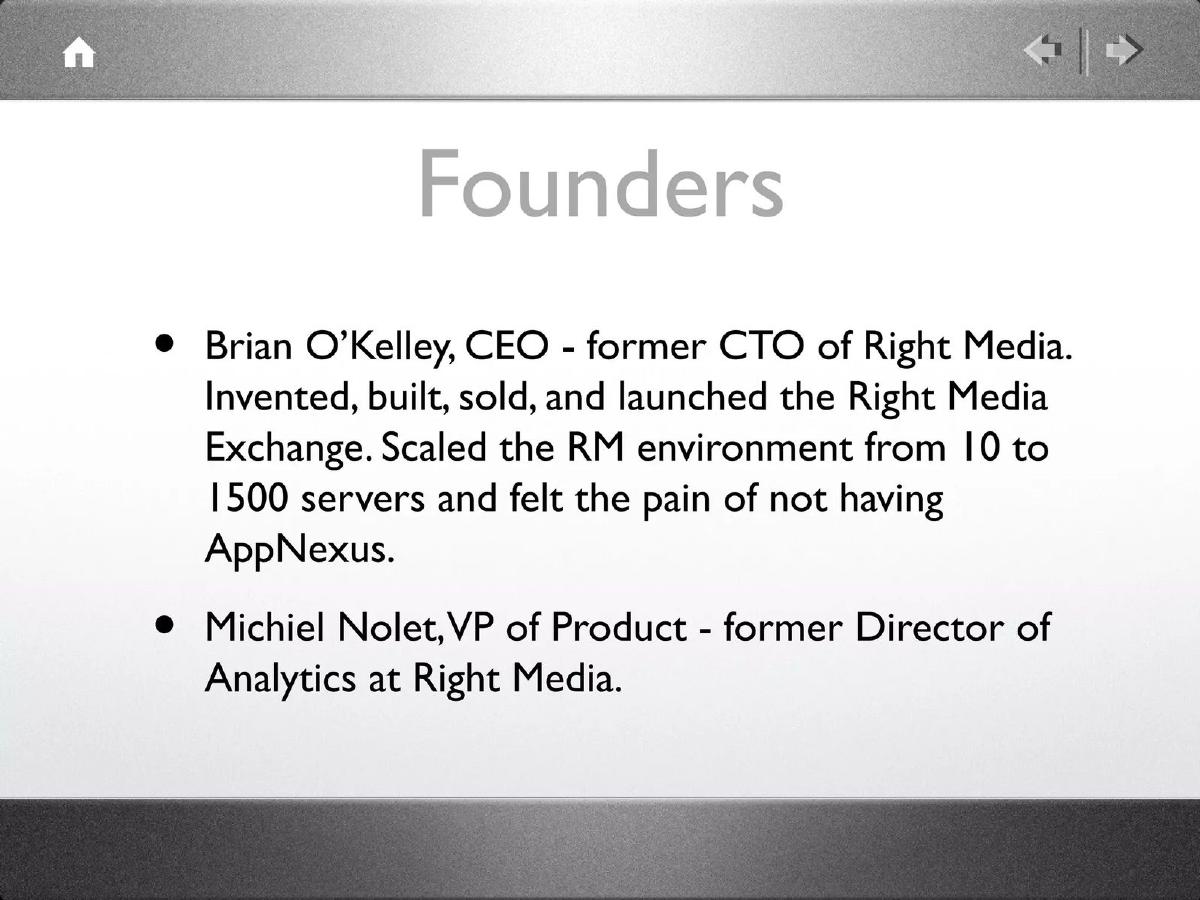
The deck wisely opens with the founders. This isn't just a formality; it's the entire foundation of the pitch. The key phrase is on Brian O'Kelley's bio: "Scaled the RM environment from 10 to 1500 servers and felt the pain of not having AppNexus." This one sentence is worth more than a hundred slides of market analysis. It establishes three critical points:
Experience: He has built and operated a system at massive scale. · Pain: The problem he is solving is not theoretical; it's a visceral pain point he lived daily. · Solution: The new company, AppNexus, is the explicit solution to that deeply understood pain.
Michiel Nolet's background as Director of Analytics at Right Media reinforces this. The team represents both the infrastructure and the data/product side of the exact problem they are tackling. For a 2007 seed-stage investor, it’s hard to imagine a more perfect founding team for this specific idea. They aren't just qualified; they are arguably the only team qualified to build this.
The Problem: 'Right Media Challenges'
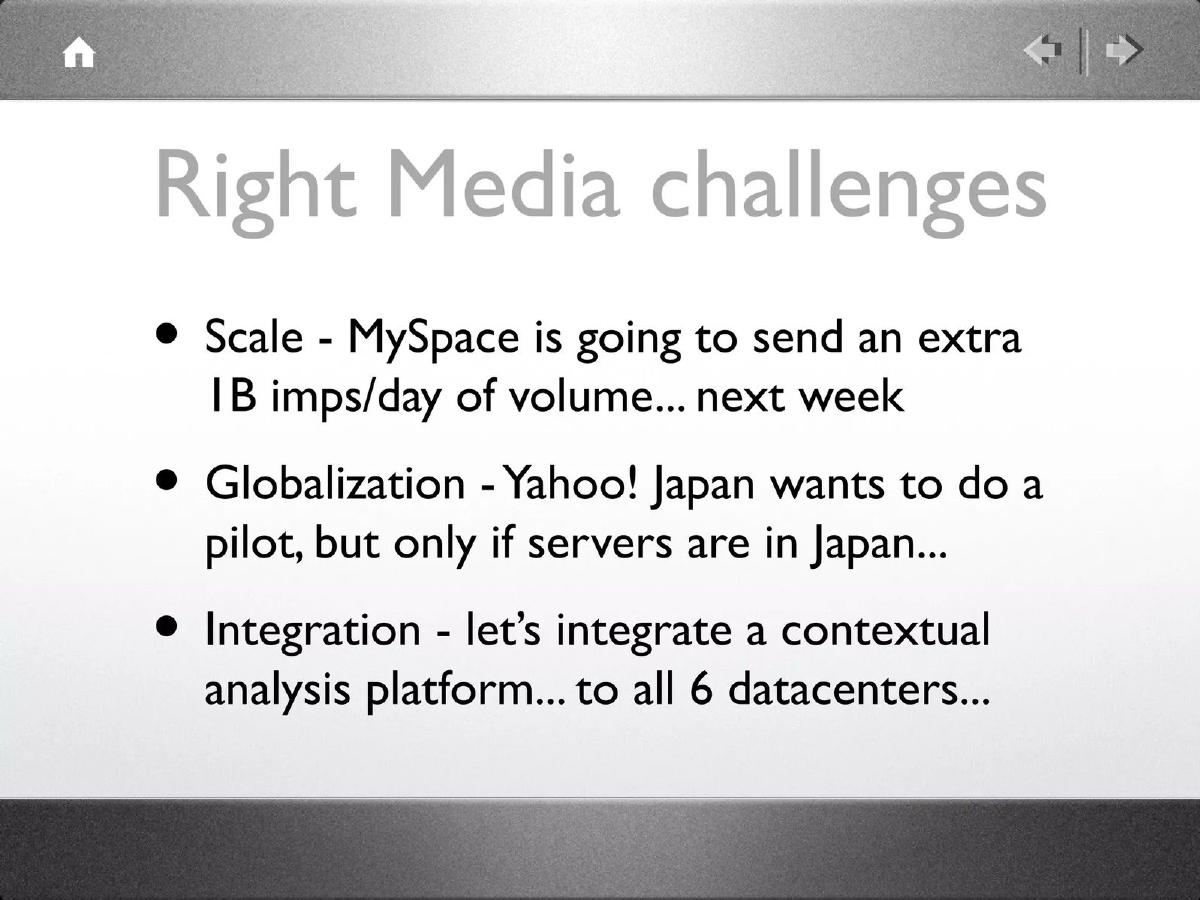
AppNexus brilliantly frames the problem through the lens of their own story. Instead of generic statements about market needs, they list the concrete challenges they faced at Right Media. This makes the problem tangible and validated.
Scale: "MySpace is going to send an extra 1B imps/day of volume... next week." This isn't a forecast; it's a war story. It communicates the sheer volatility and magnitude of the demand they dealt with, for which traditional infrastructure was ill-suited. · Globalization: "Yahoo! Japan wants to do a pilot, but only if servers are in Japan..." This highlights the friction and high cost of global expansion in the pre-cloud era, a key pain point for any growing internet business. · Integration: "let’s integrate a contextual analysis platform... to all 6 datacenters..." This speaks to the operational nightmare of adding new features or third-party services across a distributed, bare-metal environment.
By personalizing the problem, they make it incredibly compelling and simultaneously reinforce their unique expertise. They are showing, not just telling, the market need.
The Solution: From Cloud to 'Nexus'
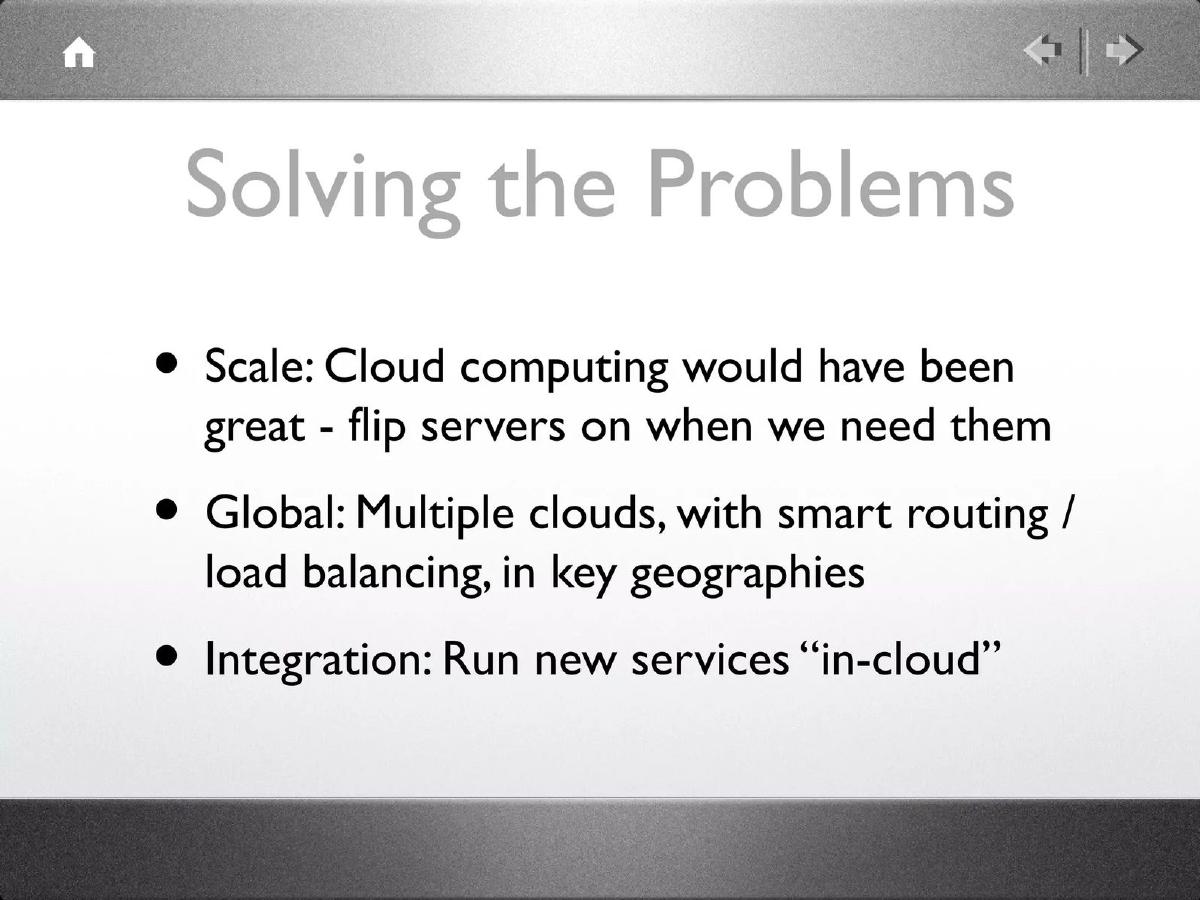
The solution is presented as a direct answer to the problems. Scale is solved by cloud computing's elasticity. Globalization is solved by having multiple cloud locations with smart routing. Integration is solved by running new services 'in-cloud'. This is clear and logical. But the deck doesn't stop there. The truly visionary slide is 'Cloud → Nexus.'
This is where AppNexus elevates itself from a potential AWS competitor to something much more strategic. The 'Nexus' is the platform layer, a marketplace built on top of the infrastructure. It's a place where applications can consume services from third-party providers, with AppNexus providing the connective tissue: a centralized directory, documentation, community, and billing. This is the promise of a network effect. It's a PaaS (Platform as a Service) vision on top of an IaaS (Infrastructure as a Service) foundation.
The cloud becomes a “nexus” where applications can consume services. This single idea transforms the business from a low-margin utility into a high-margin, defensible platform. It's the key reason investors got excited. They weren't just funding servers; they were funding the creation of an ecosystem.
Business Model: A Multi-Layered Approach
The revenue slide is straightforward and ambitious. It outlines multiple income streams, showing they've thought through monetization at different layers of the stack.
IaaS Revenue: "Rent high-end 4-core boxes for around $10/core/day (virtualized, of course)." This is their direct competitor to EC2, but the 'high-end' positioning is important. They are not competing on price but on performance. Giving a specific price point makes the model concrete. · Add-on Services: Renting database boxes, storage, bandwidth, and backup shows they intend to capture more of the customer's infrastructure wallet. · PaaS/Marketplace Revenue: "Profit-sharing with service providers." This is the monetization of the 'Nexus' vision. By taking a cut of transactions between applications and service providers on their platform, they align their success with the success of the ecosystem. This is a classic, high-margin software revenue model.
This multi-pronged approach de-risks the business model. Even if the 'Nexus' marketplace takes time to develop, they can build a profitable business just by providing high-performance cloud infrastructure.
Competition & Differentiation: Facing the Amazon Juggernaut
Many founders shy away from naming their biggest competitors. AppNexus runs straight at the problem. They explicitly list Amazon/EC2 as the 'biggest risk,' followed by hosting companies like Rackspace and latent giants like Google and Microsoft. This honesty builds enormous credibility.
Near Term: They plan to win on being Global from the start, providing superior Ops tools (leveraging their painful experience), and being obsessively customer-centric. This is a classic 'do the unscalable things' strategy to win early customers from a large, less-focused incumbent. · Long Term: The real moat is the network effect. "With network effect (lots of services & lots of applications) will be difficult for a new cloud player to compete." They correctly identify that once they build a vibrant two-sided market, the platform will become sticky and very hard to displace. They even mention getting applications "locked in" to the AppNexus way. This is the language VCs love to hear.
Go-to-Market: The 'Ping Pong' Growth Strategy
This is arguably the strongest section of the deck. AppNexus lays out a clear, believable, three-phase plan to get from a seed-stage idea to a market-dominating 'Nexus'.
The 'Ping pong' growth slide elegantly describes their marketplace flywheel: Use early applications to recruit service providers, then use those services to attract more applications, and so on. It's a simple, powerful visualization of their network effect strategy.
Phase 1: The Cloud. The goal is to build the core IaaS product and land the first 20 clients. This is what the $2-3M seed round (plus debt for servers) will fund. The timeline is specific: Beta in Jan 2008. · Phase 2: Credibility. 'Go elephant hunting' for major anchor clients. This phase is about proving the platform can handle serious workloads and building brand prestige. This will be funded by a larger $10-15M Series A to buy over 2,000 servers. · Phase 3: Nexus. With critical mass achieved, the network effect kicks in, and the focus shifts to marketing and evangelism to accelerate the flywheel. This requires a growth round of $25-50M to go global and compete at scale.
This staged approach is brilliant. It takes a massive, terrifyingly ambitious goal and breaks it into fundable, milestone-driven chunks. An investor writing a $3M check knows exactly what it's meant to achieve: a functional IaaS product with 20 initial customers, setting the stage for a Series A.
Traction: The Early Pipeline
For a pre-product company, traction is about demonstrating market pull. AppNexus does this by listing a pipeline of potential customers. The names are significant: Exelate, Blue Kai, and Media Six Degrees are all ad-tech companies, showing they are leveraging their home-turf advantage. Wide Orbit (SaaS), Garage Games (Gaming), and Digital Fountain (Video CDN) show the broader applicability of the vision. This slide proves that the founders have already been talking to the market and that their value proposition is resonating with real, sophisticated buyers.
What Was Weak or Missing
Despite its strengths, the deck is a product of its time and has notable gaps by today's standards.
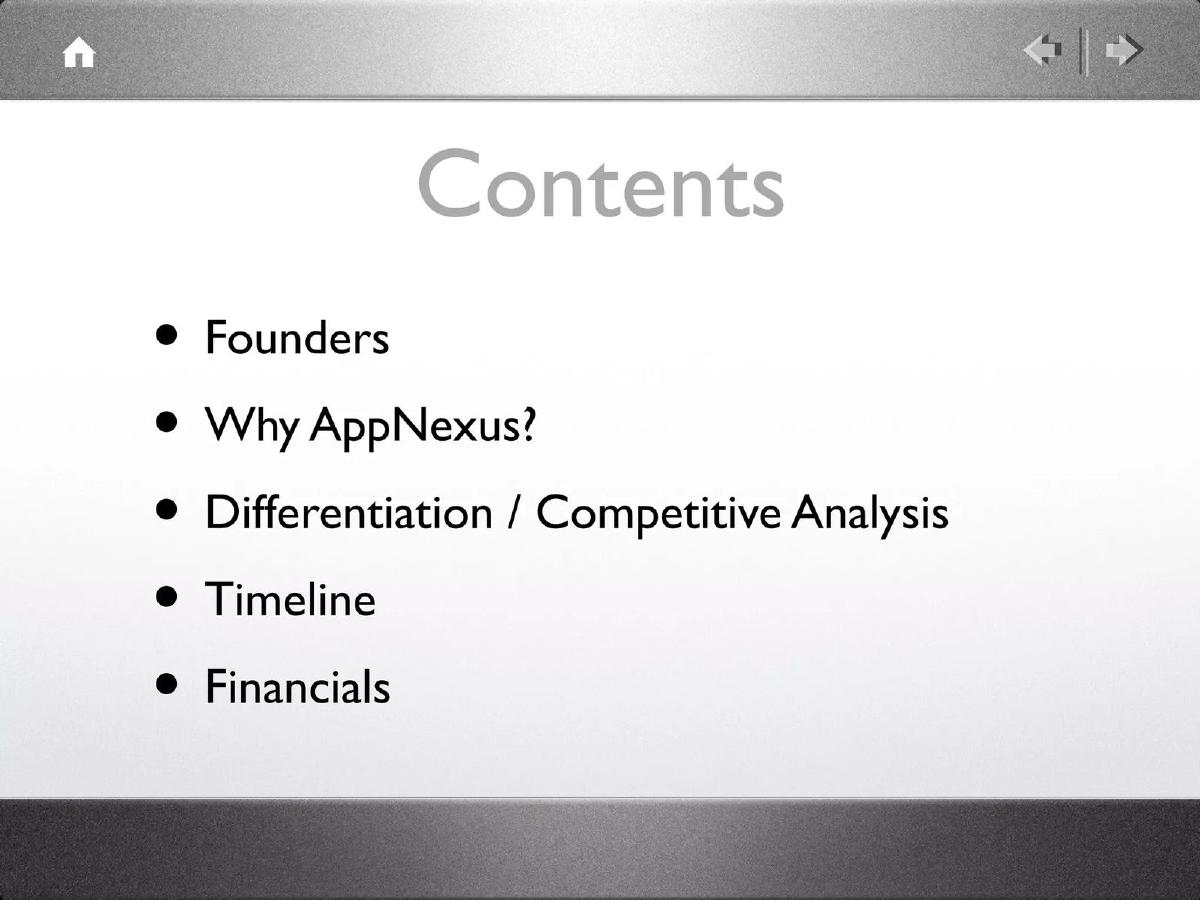
Technical Details: The deck is a strategic and visionary document, not a technical one. A slide titled "Cloud Architecture" is mentioned in the contents but doesn't appear in the provided text. There's no discussion of what makes their architecture unique or how they'll solve the 'tough problems' of building a global cloud. The pitch relies on investors trusting that 'Brian O'Kelley will figure it out.' · Financials: The 'Financials' slide is completely blank. There are no projections, no TAM analysis, and no unit economics. For a capital-intensive business, this is a glaring omission. Again, this only works because the founder credibility is off the charts. · Team Depth: Only the two co-founders are listed. Building a global infrastructure company from scratch requires a world-class team of engineers, operations experts, and sales leaders. The deck doesn't mention any key hires or advisors, putting the entire execution burden on the two founders.
Lessons for Founders Raising Today
Anchor Your Problem in a Personal Story. Don't just say 'the market for X is broken.' Tell investors how you personally experienced that brokenness at scale. AppNexus's use of 'Right Media challenges' is a perfect example of showing, not telling. · Sell a Vision, Not Just a Product. AppNexus wasn't just selling cheaper servers; they were selling the 'Nexus'—a defensible, high-margin marketplace. What is the network effect or data moat that turns your product into a long-term defensible business? · Create a Phased, Fundable Roadmap. Break your grand ambition into 2-3 distinct phases. Show investors what their capital will achieve in Phase 1 and how that success unlocks Phase 2. This makes a big idea feel concrete and de-risked. · Acknowledge Your Biggest Competitor Head-On. AppNexus naming Amazon as the 'biggest risk' built credibility. It showed they were clear-eyed and allowed them to frame their differentiation strategy on their own terms. Don't hide from your competition; define your advantage against them. · Credibility Can Compensate for Missing Details. The AppNexus founders' unparalleled experience allowed them to pitch a deck that was light on technical specs and financials. If you have true, 10x founder-market fit, make it the undeniable centerpiece of your story. · Name Your Target Customers. Even before you have signed deals, listing specific, relevant companies you're talking to makes your go-to-market plan feel real and validated. It shows you've moved beyond the idea stage.
Where Are They Now? The Pivot and The Payoff
The AppNexus story is a fascinating case study in strategic evolution. The deck promised to build a general-purpose cloud and PaaS marketplace to compete with Amazon. The reality was both different and, ultimately, incredibly successful.
AppNexus quickly realized that competing head-on with AWS across all verticals was a losing proposition. Instead, they executed a brilliant pivot: they narrowed their focus to the vertical they knew better than anyone else on Earth—advertising technology. They stopped trying to be a general-purpose 'Nexus' and instead used their powerful, high-performance infrastructure to build the world's leading independent ad exchange.
In a sense, the 'Nexus' vision came true, but in a verticalized form. The AppNexus platform became the central marketplace connecting hundreds of ad buyers (DSPs) and sellers (SSPs), processing trillions of transactions. The 'third-party services' from the pitch deck became data providers, ad verification vendors, and other ad-tech partners integrated into their exchange.
The infrastructure they built wasn't the product they sold to everyone, but it became their most powerful competitive advantage, allowing them to operate their exchange at a scale, speed, and cost that pure-play software companies couldn't match. The founders used their deep understanding of infrastructure pain to build a moat around their application-layer business.
In June 2018, this strategy culminated in a massive outcome: AT&T acquired AppNexus for a reported $1.6 billion. While the path was different from the one laid out in the 2007 seed deck, the core promise of building essential 'infrastructure for a connected world'—the world of digital advertising—was more than fulfilled.
Frequently asked questions
- Why did they succeed when so many other 'AWS-killers' failed?
- They didn't try to kill AWS. They quickly pivoted from a general-purpose cloud to a specialized, vertically-integrated solution for ad-tech, an industry they knew better than anyone. They used their infrastructure as a competitive advantage for their core application—the ad exchange—rather than selling the infrastructure itself as the primary product.
- Could this sparse, vision-only deck get funded today?
- It would be extremely difficult. The bar for seed-stage technical validation and early traction is much higher, and the complete lack of a financial slide would be a major red flag for most VCs. However, a founding team with this exact level of proven, C-suite experience from a massively scaled, relevant company (e.g., ex-CTO of Stripe or Databricks) could still command attention with a similar vision-led pitch.
- What's the most underrated slide in this deck?
- The 'Ping pong growth' slide. It's a simple but incredibly powerful visualization of their two-sided network strategy. It demonstrates a deep understanding of the flywheel dynamics required to build a marketplace from day one, which was the key to their long-term defensibility. It’s a masterclass in explaining a network effect.
- The deck asks for a $2-3M seed round. Wasn't that a huge amount for 2007?
- Yes, it was a very large seed round for the era. This reflects two things: the capital-intensive nature of the business (buying thousands of servers was part of the plan) and, more importantly, the extraordinary credibility of the founders. Investors were willing to place a larger-than-usual early bet because the team had already built and scaled something similar at the highest level.
- The deck sells the 'Nexus' as a general-purpose marketplace. Did they ever build that?
- Not in the broad, all-encompassing way described in the pitch. The 'Nexus' became the AppNexus ad exchange, a highly specialized marketplace for the digital advertising ecosystem. The strategy of being the central hub for applications and services was realized, but it was verticalized for ad-tech. This pivot from a horizontal to a vertical platform was key to their success.