AppNexus' first pitch deck, presented in 8 slides from a total of 24, introduces the company as an 'Infrastructure for a Connected World,' aiming to position itself as a central 'nexus' for cloud applications and services. The deck describes a robust cloud layer offering centralized directories, documentation, community, and billing. Revenue sources include renting high-end 4-core virtualized boxes at $10/core/day, database boxes, storage, bandwidth, backup, profit-sharing with service providers, and access fees. Long-term differentiators highlight network effects and tools to 'lock in' appli…
Key takeaways
- The deck presents AppNexus as 'Infrastructure for a Connected World' (Slide 1).
- AppNexus aims to create a 'nexus' where applications consume services, requiring a robust, reliable, and easy-to-use cloud layer (Slide 3).
- The company planned to offer a centralized directory, documentation, community, and billing for service providers (Slide 3).
- Revenue sources included renting high-end 4-core virtualized boxes for around $10/core/day, database boxes, storage, bandwidth, backup, profit-sharing, and access fees (Slide 4).
- Long-term differentiators focused on network effects and tools to 'lock in' applications (Slide 5).
- A 'ping pong' growth strategy involved using initial applications to recruit software providers, then co-marketing to attract more applications (Slide 6).
- The 'Phase I Pipeline' listed target sectors like Behavioral Marketing (Exelate, Blue Kai, Media Six Degrees), SaaS (Wide Orbit), Gaming (Garage Games), and Video CDN (Digital Fountain) (Slide 7).
- The ultimate 'Phase 3: Nexus' goal was to build network effects through key clients and critical mass, focusing on co-marketing with partners (Slide 8).
AppNexus First Pitch Deck Teardown: Early Cloud Infrastructure Vision
This teardown analyzes the initial pitch deck for AppNexus, a company that aimed to build infrastructure for a connected world. The analysis is based on 8 slides provided from what is indicated to be a larger 24-slide deck. The deck outlines AppNexus' early vision for cloud infrastructure, its proposed revenue models, and its strategy for market penetration and growth. The presentation focuses heavily on the technical and business model aspects of creating a central 'nexus' for cloud services and applications.
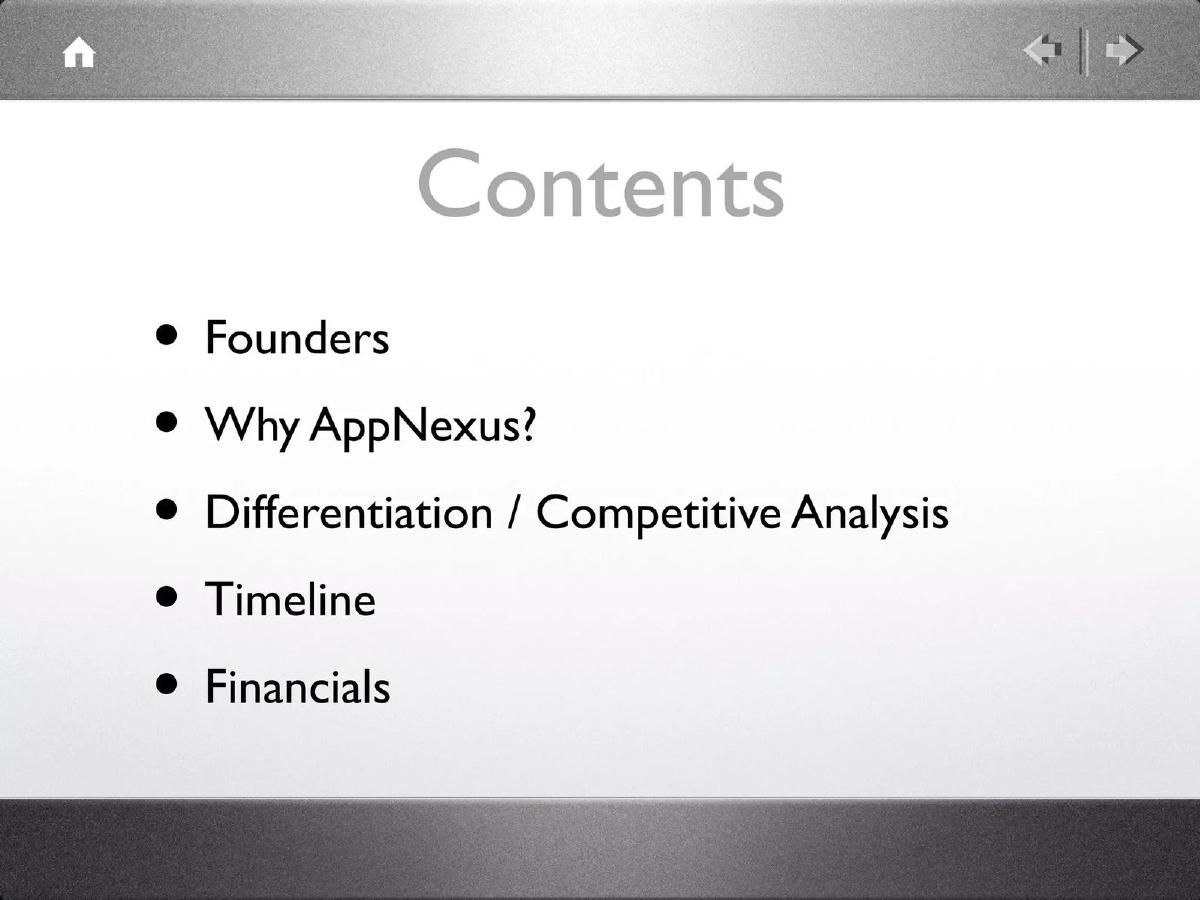
The deck's primary strength lies in its clear articulation of a complex technical vision and a multi-faceted revenue model. However, common elements expected in a fundraising pitch, such as detailed market sizing, competitive analysis, team introductions, and financial projections, are not present in these initial slides. This analysis will proceed slide-by-slide, detailing the content presented and highlighting what can be inferred about the company's early strategic thinking.
Slide 1: AppNexus - Infrastructure for a Connected World
The first slide serves as the title slide for the presentation. It prominently displays the company name, 'AppNexus,' in a large, grey font. Below the company name, a tagline reads: 'Infrastructure for a Connected World.' The slide features a minimalist design, set within a grey browser-like frame, suggesting a digital or internet-focused context. This slide immediately establishes the company's broad ambition and its core offering: foundational technology for interconnected digital systems.
Slide 2: Why AppNexus
Slide 2 is a transitional slide, presenting the heading 'Why AppNexus' in the same large, grey font as the company name on the title slide. This slide acts as an introduction to the problem or opportunity that AppNexus aims to address, signaling to the audience that the subsequent slides will elaborate on the company's purpose and value proposition. It is a common structural element in pitch decks, preparing the audience for deeper insights into the company's mission.
Slide 3: Cloud → Nexus
This slide begins to articulate the core concept behind AppNexus. The title, 'Cloud → Nexus,' indicates a progression or transformation of the cloud computing paradigm. The slide uses bullet points to explain this concept:
The cloud becomes a “nexus” where applications can consume services · Cloud layer needs to be robust, reliable, easy-to-use, etc to get adoption · Centralized directory, documentation, community, and billing for service providers
These points suggest AppNexus envisioned a platform that would not merely offer cloud resources but would also facilitate the interaction and consumption of services by applications, acting as a central hub or 'nexus.' The emphasis on robustness, reliability, and ease-of-use highlights the technical requirements for such a platform to achieve widespread adoption. Furthermore, the mention of a 'centralized directory, documentation, community, and billing' indicates an ambition to provide a comprehensive ecosystem for service providers, streamlining their operations and enhancing discoverability.
Slide 4: Revenue Sources
Slide 4 directly addresses how AppNexus planned to monetize its platform. Titled 'Revenue Sources,' this slide lists four distinct methods for generating income:
Rent high-end 4-core boxes for around $10/core/day (virtualized, of course) · Rent database boxes, storage, bandwidth, backup, and many other things too · Profit-sharing with service providers · Access fees
The first bullet point provides a specific pricing example: renting virtualized 4-core boxes at approximately $10 per core per day. This indicates a granular, usage-based pricing model for computational resources. The second point expands on this, listing other infrastructure components like database boxes, storage, bandwidth, and backup services as rentable assets. The inclusion of 'profit-sharing with service providers' suggests a partnership model where AppNexus would take a cut of the revenue generated by services hosted on its platform. Finally, 'Access fees' implies potential charges for API access, premium features, or general platform usage. This slide demonstrates a multi-pronged approach to revenue generation, combining direct infrastructure rental with platform-based monetization strategies.
Slide 5: Differentiators - Long Term
This slide focuses on the long-term competitive advantages AppNexus aimed to build. Titled 'Differentiators - Long Term,' it presents two key points:
With network effect (lots of services & lots of applications) will be difficult for a new cloud player to compete - will need to recruit the services to get the apps and will need to recruit the apps to get the services · Lots of tools - idea is to get applications “locked in” to the AppNexus way
The primary differentiator highlighted is the 'network effect.' AppNexus recognized that a platform with a high density of both services and applications would create a significant barrier to entry for competitors. The challenge of simultaneously attracting both sides of this two-sided market is explicitly acknowledged. The second differentiator emphasizes the development of 'lots of tools,' with the strategic goal of 'locking in' applications to the 'AppNexus way.' This suggests a proprietary ecosystem of development tools, APIs, and frameworks designed to make it difficult for applications to migrate to alternative platforms, thereby ensuring long-term customer retention and competitive insulation.
Slide 6: “Ping pong” growth
Slide 6 outlines AppNexus' strategy for achieving market growth, metaphorically termed '“Ping pong” growth.' This strategy describes an iterative process of attracting users and providers:
First applications sign up for the cloud · These clients become leverage to recruit software providers · Co-market with software providers to get more applications on board · Repeat...
This 'ping pong' analogy illustrates a cyclical growth model. It begins with attracting initial applications to the cloud platform. These early adopters then serve as a compelling use case or proof point to attract software providers to offer their services on AppNexus. Once software providers are on board, AppNexus plans to co-market with them to draw in even more applications, thus completing the cycle and initiating the next round of growth. This strategy highlights an understanding of the dynamics of a two-sided marketplace, where growth on one side fuels growth on the other.
Slide 7: Phase I Pipeline
This slide provides concrete examples of potential early clients or target sectors for AppNexus, labeled 'Phase I Pipeline.' It lists four categories with specific company examples:
Behavioral Marketing (Exelate, Blue Kai, Media Six Degrees) · SaaS (Wide Orbit) · Gaming (Garage Games) · Video CDN (Digital Fountain)
By naming specific companies within each sector, AppNexus demonstrates an initial understanding of its target market and potential early adopters. This list suggests that the company had already identified specific types of businesses that could benefit from its cloud infrastructure and 'nexus' approach. The inclusion of diverse sectors like behavioral marketing, SaaS, gaming, and video content delivery networks indicates a broad applicability of their platform, or at least an intention to explore multiple verticals in its initial phase.
Slide 8: Phase 3: Nexus
The final provided slide, 'Phase 3: Nexus,' projects the future state and ultimate goal of the AppNexus platform. This slide describes the culmination of their growth strategy:
With key clients and critical mass, network effect begins to build · Focus on comarketing with partners - help service providers recruit platforms & apps · Provide arms to both sides of a war that never ends...
This slide reiterates the importance of the network effect, stating that it will begin to build once 'key clients and critical mass' are achieved. The strategy for this phase emphasizes 'comarketing with partners' to assist service providers in recruiting both platforms and applications. The concluding metaphorical statement, 'Provide arms to both sides of a war that never ends...,' suggests that AppNexus aims to be a foundational, indispensable layer that supports ongoing competition and innovation within the digital ecosystem, without taking a side but rather enabling all participants. This positions AppNexus as a neutral, powerful enabler of the connected world.
What Works Well
The AppNexus pitch deck, even in its truncated form, demonstrates several strengths. Firstly, the core concept of 'Cloud → Nexus' (Slide 3) is clearly articulated, presenting a vision beyond simple cloud hosting to a more integrated, service-oriented platform. This foresight into the evolution of cloud computing, anticipating the need for robust service orchestration and discovery, is a strong point. The emphasis on a 'centralized directory, documentation, community, and billing' (Slide 3) shows an understanding of the ecosystem requirements for service providers, which is crucial for platform adoption.
Secondly, the revenue model outlined on Slide 4 is detailed and multi-faceted. Providing a specific pricing example like '$10/core/day' for virtualized boxes, alongside other infrastructure rentals, profit-sharing, and access fees, gives investors a concrete understanding of how the company planned to generate income. This level of detail, even at an early stage, can instill confidence in the business model's viability and potential for diverse revenue streams.
Thirdly, the 'Long Term Differentiators' (Slide 5) effectively highlight the strategic importance of network effects and proprietary tools. Recognizing that 'lots of services & lots of applications' would create a significant competitive barrier demonstrates a sophisticated understanding of platform economics. The explicit goal to 'lock in' applications through tools, while potentially aggressive, signals a clear strategy for long-term customer retention and market dominance. This forward-looking perspective on competitive advantage is valuable.
Finally, the '“Ping pong” growth' strategy (Slide 6) is a concise and intuitive explanation of how AppNexus intended to scale its two-sided marketplace. The iterative process of attracting applications, then providers, then more applications, is a logical and well-understood model for platform growth. The 'Phase I Pipeline' (Slide 7) further strengthens the pitch by providing specific, identifiable target companies and sectors, showing that the team had already done preliminary market research and identified potential early adopters. This demonstrates a practical approach to market entry and validation.
What Is Missing
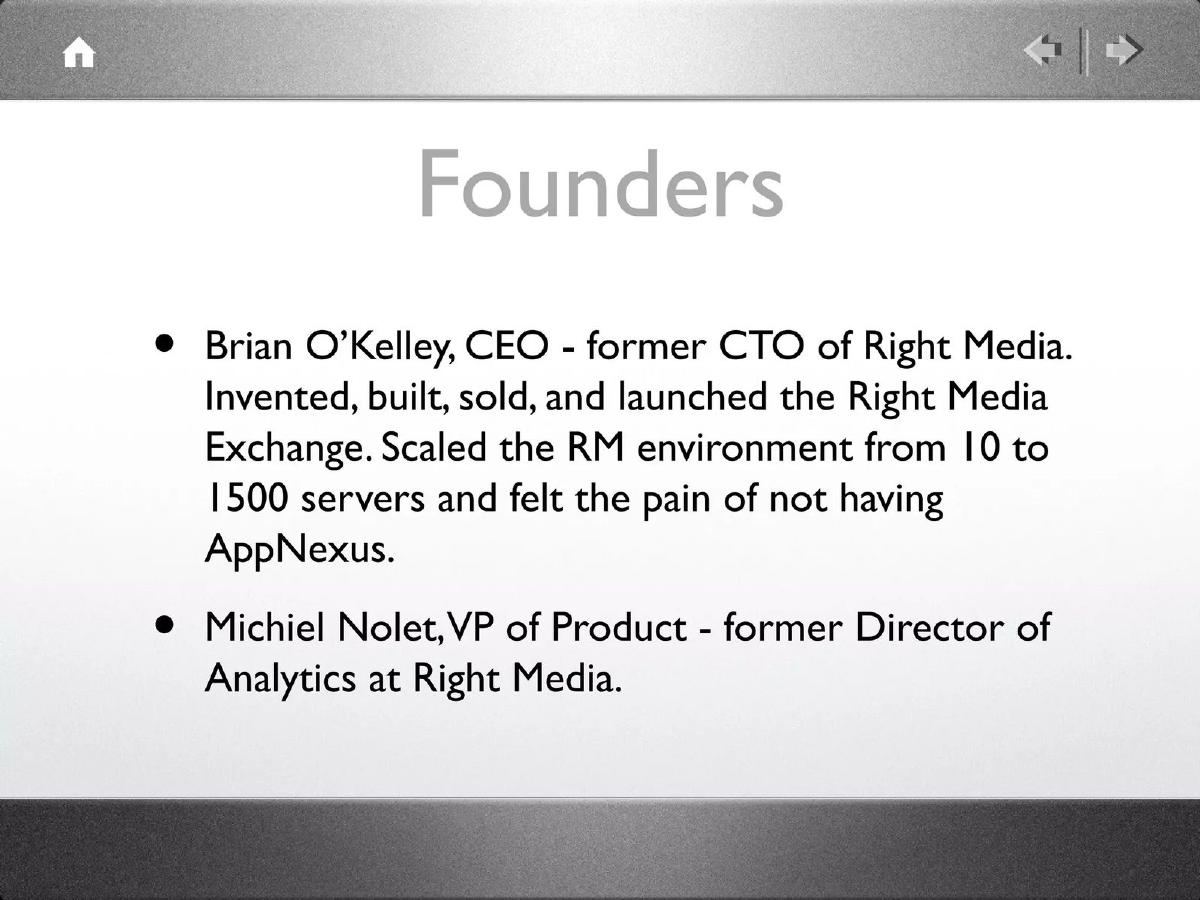
Despite the strengths, the provided 8 slides omit several critical components typically found in a comprehensive fundraising pitch deck. Most notably, there is no dedicated slide introducing the team. For an infrastructure-heavy, technically complex venture like AppNexus, the expertise and experience of the founding team are paramount for investor confidence. Without a team slide, investors cannot assess the human capital behind the vision.
A detailed market size and opportunity slide is also absent. While the 'Phase I Pipeline' (Slide 7) identifies target sectors, it does not quantify the total addressable market (TAM) or the specific market segments AppNexus aimed to capture. Understanding the scale of the opportunity is crucial for investors to gauge potential returns. Similarly, there is no explicit competition slide. While 'Differentiators - Long Term' (Slide 5) touches on competitive barriers, a direct comparison with existing or potential competitors would provide a clearer picture of AppNexus' unique position and advantages in the market.
Financial projections, including revenue forecasts, cost structures, and profitability timelines, are not presented in these slides. While revenue sources are listed (Slide 4), specific numbers or growth trajectories are missing. This makes it difficult for investors to evaluate the financial viability and scalability of the business model. Furthermore, a clear 'ask' slide, detailing the amount of funding sought, how it will be used, and the expected milestones, is not included. This is a fundamental component of any fundraising pitch, as it directly addresses the purpose of the presentation.
Finally, while the deck outlines a vision for a 'nexus,' it lacks specific details on the underlying technology or architecture beyond general terms like 'robust, reliable, easy-to-use' (Slide 3). For a company building 'Infrastructure for a Connected World,' a high-level overview of the technical approach or proprietary technology would be beneficial to demonstrate feasibility and innovation.
What a Founder Should Copy
Founders can draw several valuable lessons from the AppNexus deck. Firstly, the clear and concise articulation of a complex technical vision, such as 'Cloud → Nexus' (Slide 3), is highly commendable. Breaking down an abstract concept into understandable bullet points helps investors grasp the core innovation quickly. Founders should strive to simplify their complex ideas without oversimplifying their impact.
Secondly, the detailed and multi-faceted approach to 'Revenue Sources' (Slide 4) is an excellent model. Providing specific pricing examples, like '$10/core/day,' alongside other monetization strategies, demonstrates a well-thought-out business model. Founders should aim to present concrete revenue streams and, if possible, initial pricing structures to show a clear path to profitability.
Thirdly, the focus on 'Long Term Differentiators' (Slide 5), particularly the emphasis on network effects and customer lock-in through tools, is a strategic highlight. Founders should identify and clearly articulate their sustainable competitive advantages, especially those that create high barriers to entry for future competitors. This forward-thinking perspective on defensibility is crucial for long-term investor confidence.
Lastly, the '“Ping pong” growth' strategy (Slide 6) and the 'Phase I Pipeline' (Slide 7) offer a practical framework for market entry and scaling. Presenting a clear, iterative growth strategy, coupled with specific target customers or sectors, shows a grounded understanding of market dynamics and a clear plan for execution. Founders should develop and communicate a similarly actionable growth strategy, supported by identified early adopters or market segments.
Frequently asked questions
- What was the core vision for AppNexus presented in this deck?
- The core vision for AppNexus was to be 'Infrastructure for a Connected World' (Slide 1), specifically creating a 'nexus' where applications could consume services. This involved building a robust, reliable, and easy-to-use cloud layer with centralized directory, documentation, community, and billing for service providers (Slide 3).
- How did AppNexus plan to generate revenue according to this pitch deck?
- AppNexus planned to generate revenue through several streams (Slide 4): renting high-end 4-core virtualized boxes for around $10/core/day, renting database boxes, storage, bandwidth, and backup services, profit-sharing with service providers, and charging access fees.
- What was the proposed growth strategy for AppNexus?
- The proposed growth strategy was termed 'ping pong' growth (Slide 6). It involved first signing up applications for the cloud, then using these clients as leverage to recruit software providers. The company would then co-market with these software providers to attract more applications, repeating the cycle to build out the platform.
- What were the long-term differentiators highlighted in the deck?
- The long-term differentiators for AppNexus were centered on network effects and proprietary tools (Slide 5). The deck stated that with a network effect of many services and applications, it would be difficult for new cloud players to compete. The company also aimed to provide tools to get applications 'locked in' to the 'AppNexus way'.
- Which key slides are missing from the provided 8-slide excerpt?
- Based on standard pitch deck structure and the limited slides provided, key missing slides include a dedicated team slide, a market size or opportunity slide, a competition slide, financial projections, and a clear 'ask' or funding request slide. The full deck is noted as having 24 slides, so these elements may appear later.