Limetree’s 11-slide Seed deck addresses the fragmentation of childhood memories, which are often scattered across photos, videos, notes, and audio files. The company proposes a centralized solution to prevent the loss of these moments as children grow. Their market strategy is language-focused rather than purely geographic, targeting English, Spanish, and Portuguese speakers, which accounts for over 10 million births annually. The business model is notably diversified for an early-stage startup, encompassing B2B white-labeling, B2C premium subscriptions, and physical e-commerce through gift b…
Key takeaways
- The problem slide identifies four specific media types—photos, videos, notes, and sounds—that are currently difficult to manage together (Slide 2).
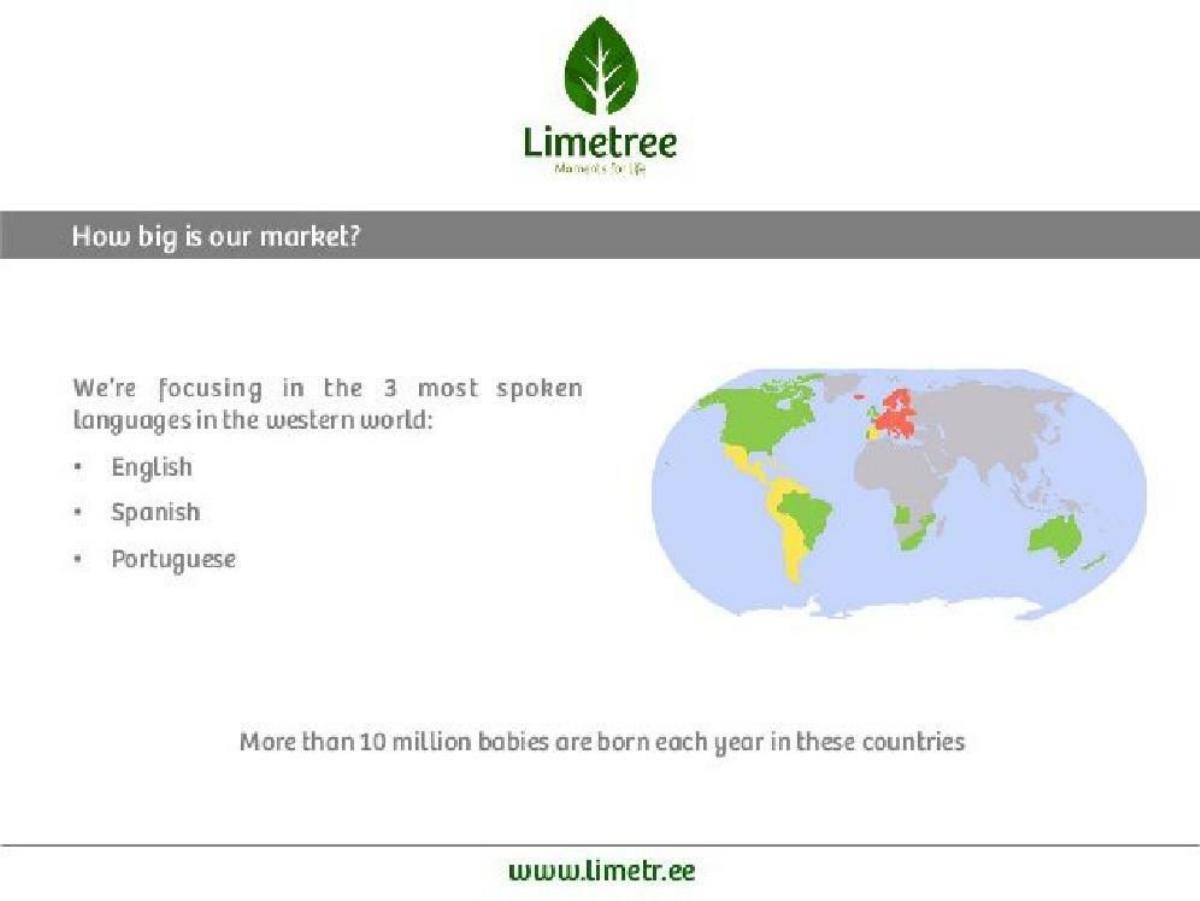
- Limetree focuses on the 'western world' market by targeting the three most spoken languages: English, Spanish, and Portuguese (Slide 5).
- The total addressable market is framed by birth rates, citing more than 10 million babies born each year in their target language regions (Slide 5).
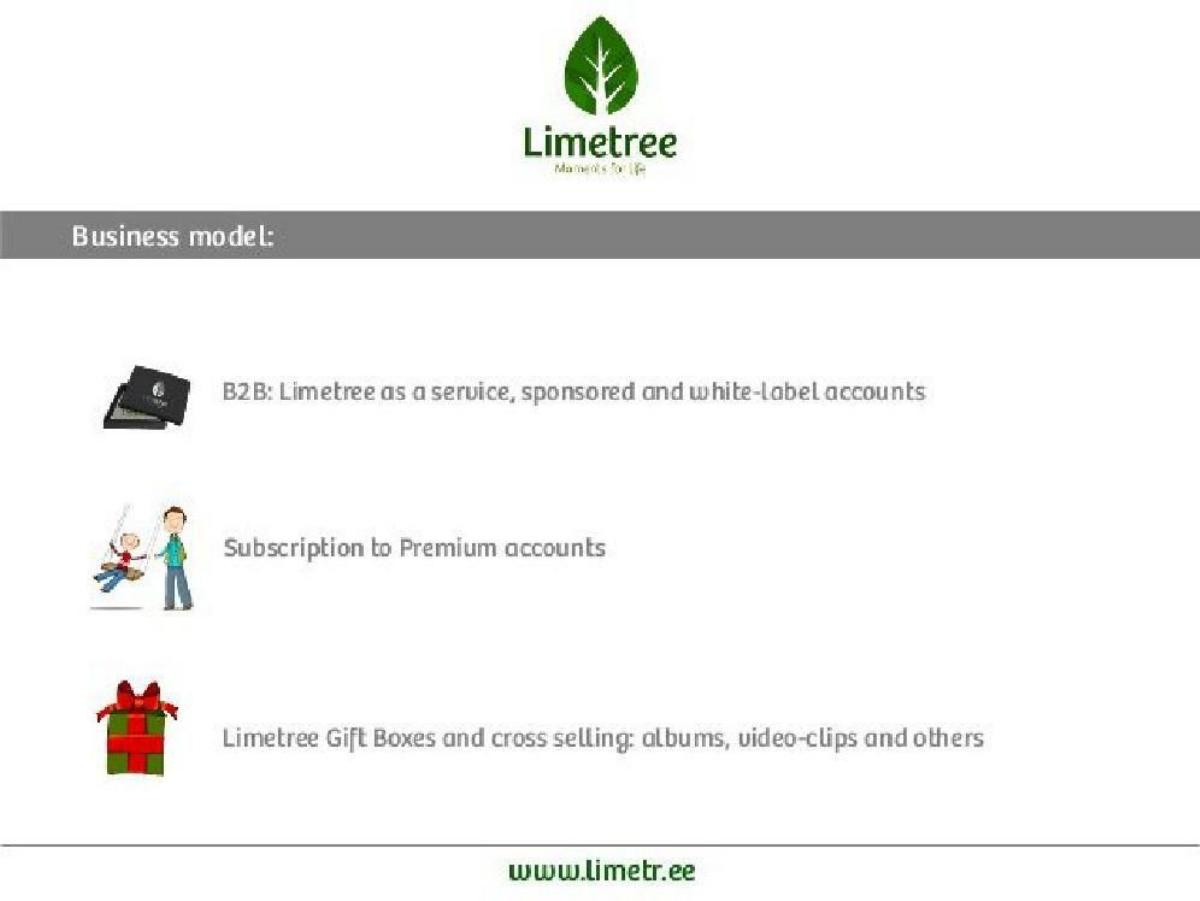
- The business model is three-pronged: B2B (white-label/sponsored), B2C (subscriptions), and physical goods (gift boxes/albums) (Slide 7).
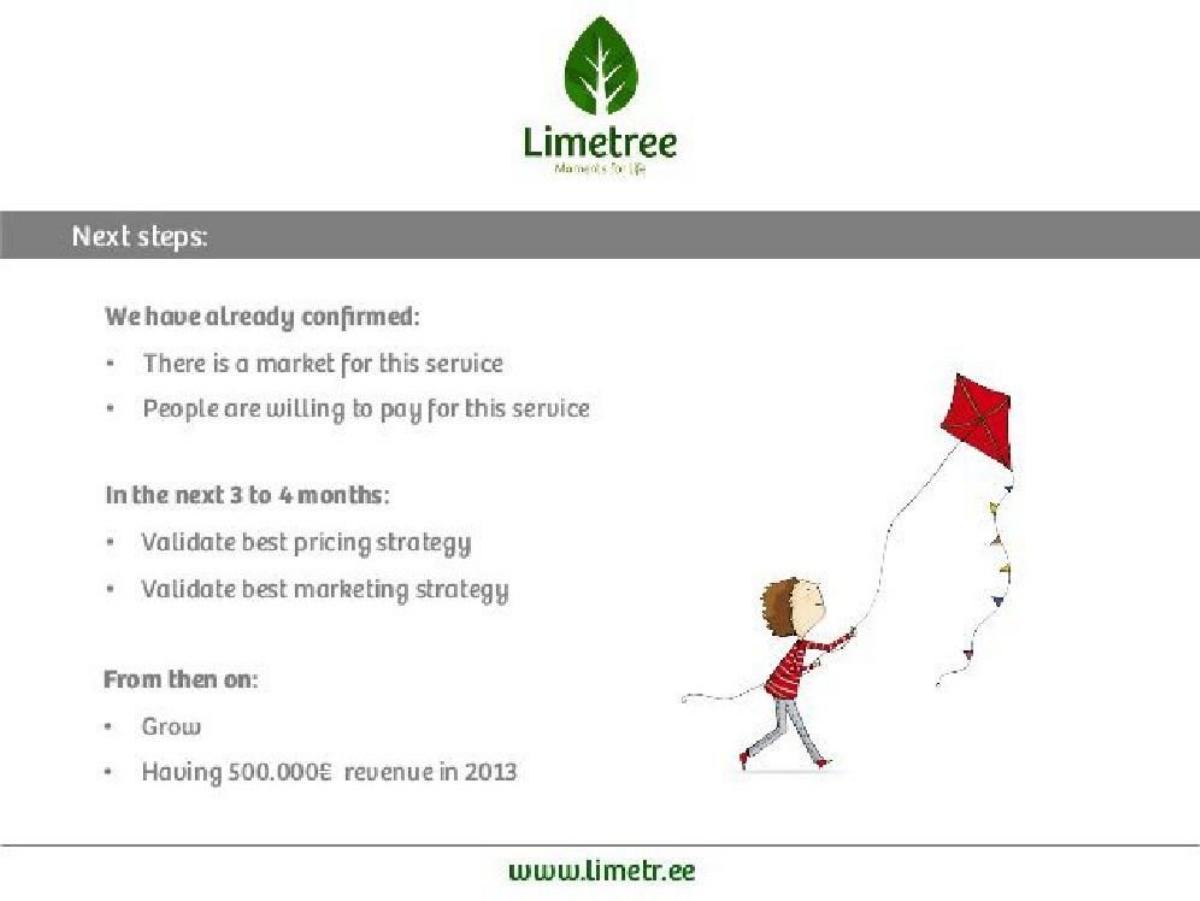
- The company claims to have already confirmed market demand and willingness to pay, though specific proof points are not detailed on the slide (Slide 9).
- Short-term goals (3-4 months) focus on validating pricing and marketing strategies rather than product development (Slide 9).
- The deck sets a specific financial milestone of achieving 500,000€ in revenue for the year 2013 (Slide 9).
- The final slide dates the presentation to December 2012 and identifies Pedro Veloso as the primary contact (Slide 11).
Limetree Pitch Deck Analysis
Limetree’s pitch deck is a concise 11-slide presentation that focuses on the emotional and practical challenges of modern parenting in the digital age. By positioning itself as a 'Moments for Life' company, Limetree attempts to bridge the gap between digital storage and sentimental preservation. The deck, dated December 2012, reflects a period when mobile photography was exploding, but centralized platforms for family-specific media were still in their infancy.
Slide 1: Cover
The cover slide is minimalist, featuring the Limetree logo—a green leaf with white veins resembling a tree—and the tagline 'Moments for Life.' It establishes a clean, nature-inspired brand identity that suggests growth and longevity, fitting for a company dealing with childhood memories.
Slide 2: The Problem
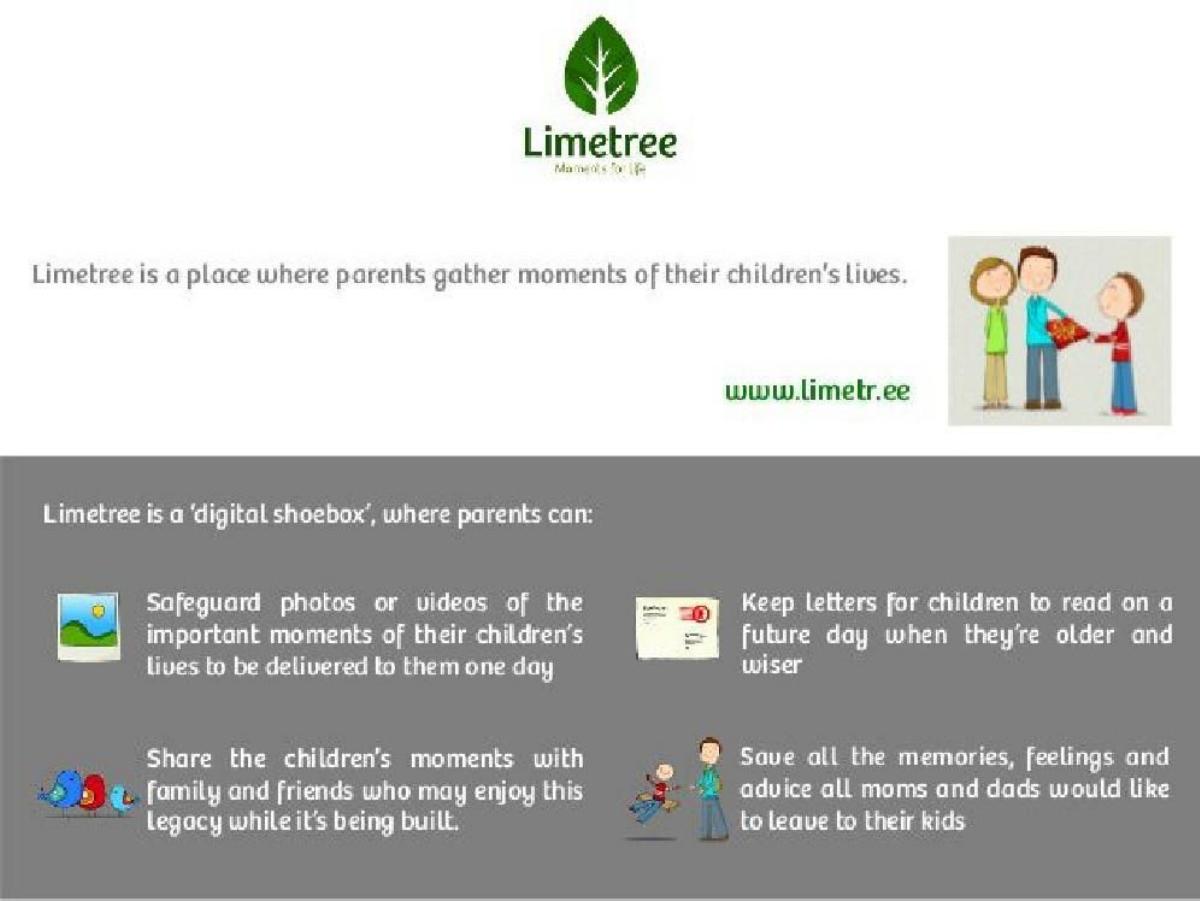
Slide 2 outlines the core pain points. It categorizes memories into four formats: photos, videos, notes, and sounds. The slide argues that managing these disparate formats is difficult and time-consuming. Most importantly, it touches on an emotional fear: 'We will lose at least part of our children's moments as time goes by.' The visual aid shows a cardboard box overflowing with digital icons, effectively illustrating the 'digital clutter' problem.
Slide 5: Market Size
Limetree takes an interesting approach to market sizing on Slide 5. Rather than focusing on a single country, they target the '3 most spoken languages in the western world': English, Spanish, and Portuguese. This linguistic strategy allows them to target a massive demographic across North America, South America, and Europe. They cite a figure of 'More than 10 million babies are born each year in these countries,' which serves as their primary market driver. This is a smart way to frame a global opportunity without needing to be 'everywhere' at once.
Slide 7: Business Model
The business model on Slide 7 is surprisingly robust for a Seed-stage company. It lists three distinct pillars:
B2B: Limetree as a service, offering sponsored and white-label accounts to corporate partners. · B2C Subscriptions: A recurring revenue model for 'Premium accounts.' · Physical Goods: E-commerce through 'Limetree Gift Boxes' and cross-selling of albums and video clips.
This diversification suggests the founders were thinking about multiple ways to monetize the same user base, reducing reliance on a single revenue stream.
Slide 9: Next Steps and Roadmap
Slide 9 provides a glimpse into the company's status and future goals. They claim to have already 'confirmed' that a market exists and that people are willing to pay. The next 3 to 4 months are dedicated to refining pricing and marketing strategies. The most significant metric provided is a revenue target: 'Having 500.000€ revenue in 2013.' This gives investors a clear benchmark for what the company considers a successful first full year of operation.
Slide 11: Contact and Conclusion
The final slide provides contact information for Pedro Veloso and includes the date 'December 2012.' This slide reinforces the brand and provides the necessary call to action for interested investors.
What Limetree Does Well
The deck excels at identifying a relatable, emotional problem. Every parent understands the fear of losing memories or the frustration of having photos scattered across multiple devices. By including 'notes and sounds' alongside photos and videos, Limetree shows a deeper understanding of what constitutes a 'memory' compared to a standard cloud storage provider like Dropbox or Google Photos.
The market slide is also a highlight. By grouping the market by language, Limetree demonstrates a sophisticated understanding of how digital products scale. It shows they are thinking about localization and cultural reach from day one, which is essential for a product centered on family and personal history.
Finally, the business model is well-balanced. Many startups in the 'memory' space fail because they rely solely on subscriptions. By adding B2B white-labeling and physical gift boxes, Limetree creates more touchpoints for revenue and potential partnerships with hospitals, insurance companies, or baby brands.
What is Missing from the Deck
The most glaring omission in the provided slides is a detailed 'Product' walkthrough. While Slide 2 is labeled as 'Product' in the index, the content is not shown, leaving the reader to guess exactly how the app or platform looks and functions. In a crowded space, the user interface (UI) and user experience (UX) are critical differentiators.
There is also a lack of hard traction data. While Slide 9 mentions that they have 'confirmed' market demand, it doesn't provide the numbers to back it up. How many beta users do they have? What is the current conversion rate? How much have they spent to acquire their initial users? Without these figures, the claim of 'confirmed' demand is just an assertion.
The 'Team' slide is also missing from the detailed content. For a Seed round, the team is often the most important factor. Investors need to know if the founders have the technical capability to build the platform and the marketing chops to reach the 10 million new parents they identified in the market slide.
Lessons for Founders
Founders can learn two major lessons from the Limetree deck. First, the power of linguistic market segmentation. If you are building a digital product, your borders aren't geographic; they are cultural and linguistic. Framing your TAM (Total Addressable Market) through language can make your startup look much larger and more strategically focused than simply saying 'We are launching in Portugal.'
Second, don't be afraid of a multi-pronged business model. While 'focus' is a common piece of advice for startups, having a secondary revenue stream (like physical goods or B2B partnerships) can provide a safety net if your primary model (subscriptions) takes longer to scale than expected. Limetree’s inclusion of physical gift boxes is a clever way to tap into the 'gifting' economy, which is huge in the parenting sector.
However, founders should also take note of the importance of proof. If you claim to have 'confirmed' a market, you must show the data—surveys, pre-orders, or active user growth—to make that claim credible to a professional investor.
Frequently asked questions
- What is the primary problem Limetree is solving?
- Limetree addresses the fragmentation and eventual loss of childhood memories. According to Slide 2, memories are scattered across various formats like photos, videos, notes, and sounds, making them difficult to organize. The company argues that without a central management system, parents will inevitably lose parts of their children's early moments as time passes.
- How does Limetree define its target market?
- Instead of a traditional geographic focus, Limetree targets linguistic demographics. Slide 5 shows they are focusing on the English, Spanish, and Portuguese-speaking 'western world.' They justify this by noting that over 10 million babies are born annually within these specific language groups, providing a large, recurring pool of new potential users.
- What are the different revenue streams mentioned in the deck?
- Limetree utilizes a hybrid business model shown on Slide 7. This includes B2B services (sponsored and white-label accounts), a direct-to-consumer B2C subscription model for premium accounts, and a physical product line involving 'Limetree Gift Boxes' and cross-selling of items like physical albums and video clips.
- What stage of development was Limetree in at the time of this deck?
- Based on Slide 9, the company was in a post-launch validation phase in December 2012. They stated they had already confirmed market demand and willingness to pay, but were still looking to validate their 'best pricing' and 'marketing' strategies over the following 3-4 months.
- Does the deck include a team slide or founder backgrounds?
- While the table of contents suggests a Team slide (Slide 10), the provided content only identifies Pedro Veloso on the final contact slide (Slide 11). There is no detailed information regarding the founders' professional history, technical expertise, or previous successes within the visible slides.