Lightpanda Inc's pitch deck outlines a plan to build a global game development studio targeting all major electronic platforms. The company seeks a $100k investment in exchange for 30% ownership, promising investors direct access to bank accounts and the ability to withdraw funds if unsatisfied. The team claims experience from companies like Apple and Electronic Arts, though a disclaimer notes names are 'subjected to be changed under condition.' The deck relies heavily on broad population statistics to project massive turnovers, such as $245 million based on 50% of the world's youth populatio…
Key takeaways
- The company seeks a $100k investment for 30% equity, citing Angry Birds as a valuation benchmark (Slide 7).
- Investors are offered 'financial security' through shared account passwords and the right to withdraw funds if unsatisfied (Slide 8).
- The team claims to include veterans from Apple, Electronic Arts, and Namco Bandai, though names are noted as subject to change (Slide 2).
- Revenue projections are based on capturing large percentages of the global population, such as 50% of the world's 15-35 age demographic (Slide 7).
- The technical strategy for iOS involves creating separate build targets for free and paid versions of the game (Slide 3).
- The deck lists a comprehensive suite of development software including Adobe Photoshop, Xcode, Blender, and Apple Logic Pro (Slide 6).
- Market data focuses on device install bases, showing Windows PC as the largest platform with over 1,000 million units (Slide 4).
- The 'Exit Strategy' is described as a trial-based global launch rather than a traditional liquidity event like an M&A or IPO (Slide 9).
Lightpanda Inc: A Pitch Deck Analysis
Lightpanda Inc presents a 18-slide pitch deck (9 slides provided for this analysis) that positions the company as a multi-platform game developer. The deck is characterized by extremely bold financial promises, a focus on high-level population statistics, and a highly unconventional approach to investor relations and corporate governance.
Slide 1: Market Need and Business Model
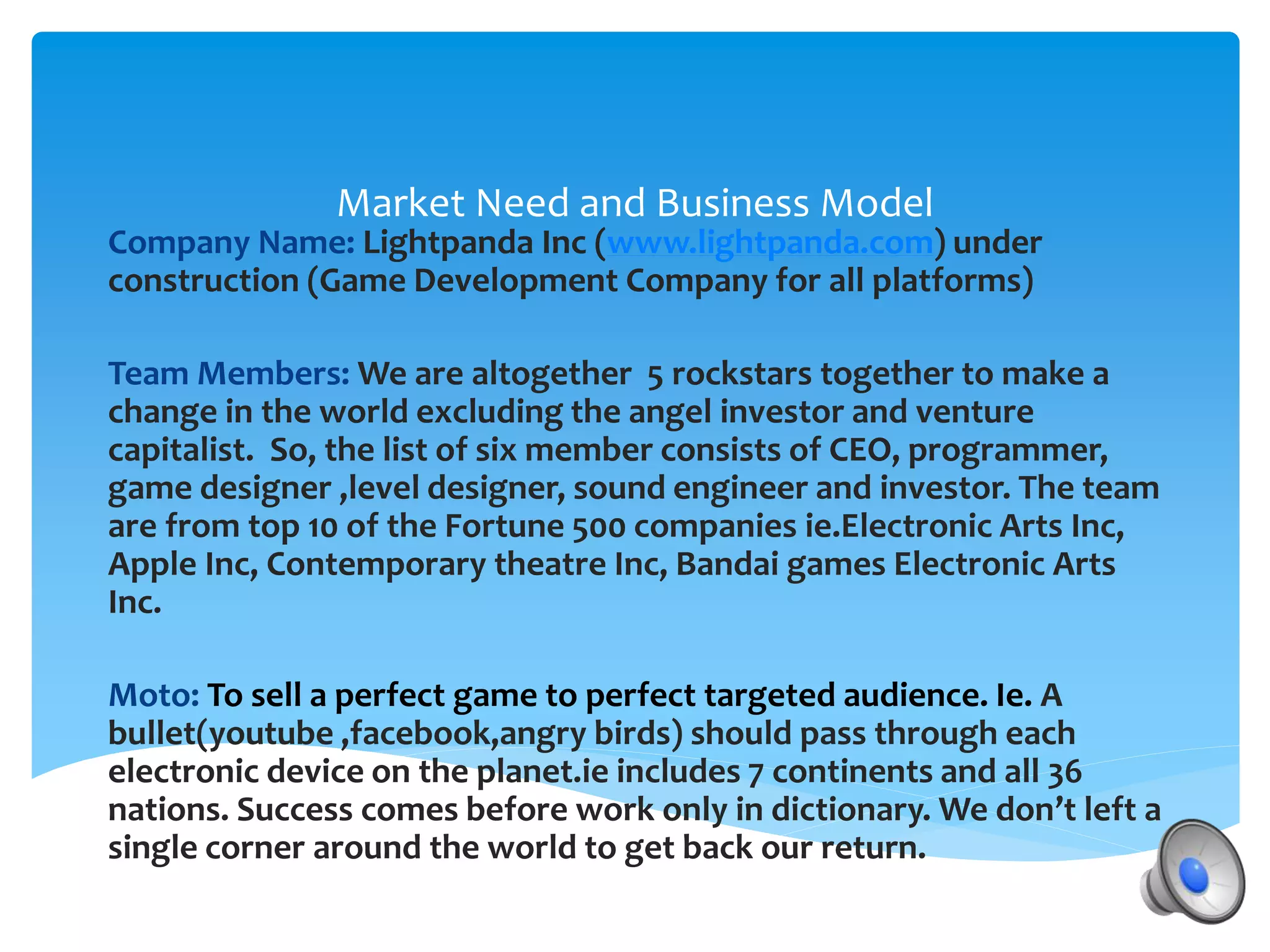
The opening slide introduces Lightpanda Inc as a 'Game Development Company for all platforms.' It lists a team of '5 rockstars' plus an investor, totaling six members. The slide claims the team hails from 'top 10 of the Fortune 500 companies,' specifically mentioning Electronic Arts Inc, Apple Inc, Contemporary Theatre Inc, and Bandai Games. The company's 'Moto' is to sell a 'perfect game to perfect targeted audience,' using a bullet metaphor to describe a product that reaches every electronic device across 7 continents and 36 nations. Notably, the slide mentions the website is 'under construction.'
Slide 2: Management Team
This slide provides specific names and backgrounds for the team. Raj Kumar Bhaumik is listed as CEO. The supporting cast includes individuals credited with experience at Electronic Arts, Apple, and Namco Bandai. However, a significant disclaimer is included: 'Names subjected to be changed under condition.' This suggests that the team listed may not be currently employed by or committed to the company, but rather represents a target hiring profile or a tentative group. The slide also mentions a 'Young team member with 200% energy,' which serves as a qualitative rather than professional descriptor.
Slide 3: iOS Business Strategy
Unlike the rest of the deck, which remains at a high level, Slide 3 dives into specific technical implementation details for iOS development. It explains a strategy for managing 'Free' and 'Paid' versions of a game within Xcode using targets and macros (#ifdefs). It details the process of duplicating Info.plist files and managing icon folders. While this demonstrates some technical knowledge of the iOS development environment, it is unusually granular for a general pitch deck and focuses on a standard development task rather than a unique strategic advantage.
Slide 4: Some Real Figures in Millions
This slide features a 3D bar chart titled 'Device Platform No.' It lists various platforms and their approximate user bases in millions. Windows PC is shown as the dominant platform (over 1,000 million), followed by Windows 7, Android Phones, and Android Devices. iPhones, iPads, and Mac users are shown with significantly smaller bars. The chart serves to illustrate the total addressable market (TAM) in terms of hardware units, though it does not provide sources for these figures or specify the year the data was collected.
Slide 5: Business Strategy
The business strategy slide reiterates the goal of reaching every electronic device on the planet. It lists the target platforms: iOS, Android, Windows, Mac, PCs, tablets, and iPads. The revenue model is split into 'Direct buying' and 'Advertising for free game use.' It lists specific ad networks the company intends to leverage, such as Admob and iAd. This slide confirms a standard 'freemium' or 'ad-supported' model common in the mobile gaming industry.
Slide 6: Game Development Process
This slide outlines a standard waterfall development lifecycle. It breaks the process into Preproduction (High Concept, Pitch, Concept), Game Design Document (Prototype, Production), Audio Production, Testing, Milestones (Alpha, Beta, Gold Master), and Post-Production. Below the process flow, it lists the software associated with development, including Adobe Photoshop, Game Maker, Xcode, Blender, Wings 3D, and Apple Logic Pro. This slide demonstrates an understanding of the steps required to bring a game to market but does not highlight any proprietary tools or unique workflows.
Slide 7: Financial Expectation
Slide 7 contains the most aggressive claims in the deck. It uses broad population data—such as the US population of 313.9 million and a world youth population of 490 million—to calculate potential turnover. The deck suggests that capturing 50% of the world population would result in a 'Turnover 245 million$.' It explicitly asks for a $100k investment for 30% ownership. It uses Angry Birds as a benchmark, noting it started with $180k and reached a $10 billion valuation. Most unusually, it promises that 30% of monthly profits will be deposited directly into the investor's account, allowing them to earn 'with no work or just sitting at home.'
Slide 8: Financial Security
This slide addresses investor risk in a highly non-traditional manner. To provide 'monetary security,' the CEO offers to hand over all identification documents, including his SSN. Furthermore, it states that the investor will be given the password to the company account so they can 'verify with correct use of funds.' The most striking claim is that the 'investor can take out funds anytime if unsatisfied with the project,' though it adds the caveat 'only after certain reason of dissatisfaction.' This level of direct access to corporate funds is extremely rare in professional venture capital or angel investing.
Slide 9: Exit Strategy
The final slide, titled 'Exit Strategy,' does not describe a traditional exit such as an acquisition or IPO. Instead, it describes a global launch strategy. It states the product will be launched on a 'trial basis' in all countries, and the company will then focus its marketing and development efforts on the regions that show the most 'outcome' (presumably engagement or revenue). The strategy is to target specific areas based on 'age, sex, location and demands.'
What Lightpanda Inc Does Well
The deck clearly identifies the massive scale of the global gaming market by highlighting the number of devices in use across various platforms. By listing a full suite of professional development software (Photoshop, Blender, Logic Pro), the founders demonstrate they are aware of the tools required for high-quality asset production. The inclusion of a technical slide regarding iOS build targets shows an attempt to prove technical competency, even if the placement is somewhat out of sync with a high-level business pitch.
What is Missing from the Lightpanda Inc Deck
The most significant omission is the product itself. There are no screenshots, concept art, descriptions of gameplay, or even a title for the game they intend to build. Investors are being asked to fund a studio without knowing what kind of games it will produce. Additionally, there is no competitive analysis; while the deck mentions 'Angry Birds' as a success story, it does not explain how Lightpanda will compete with existing giants in the space. The 'Exit Strategy' slide fails to address how an investor would actually realize a return through a liquidity event, focusing instead on a geographic rollout plan. Finally, the lack of a clear timeline or roadmap makes it difficult to assess when the $100k investment would be spent or when the first product might launch.
What a Founder Should Copy from This Deck
Founders can learn from the clear breakdown of the 'Game Development Process' on Slide 6. It provides a logical flow that helps non-technical investors understand the stages of production from concept to 'Gold Master.' The use of a platform-by-platform device count (Slide 4) is also a good way to visualize the Total Addressable Market, provided the data is sourced and current. However, most of the other elements—particularly the financial guarantees and the lack of product detail—should be avoided in a professional fundraising environment.
Critical Risks in the Lightpanda Inc Proposal
The proposal carries several red flags for professional investors. The promise to allow an investor to withdraw funds 'anytime if unsatisfied' creates a massive operational risk for the company, as it could lead to an immediate insolvency event based on a subjective disagreement. The disclaimer that team names are 'subjected to be changed' undermines the credibility of the management slide, which is usually the most important factor in early-stage deals. Furthermore, the financial projections are based on 'top-down' logic (e.g., 'if we get 50% of the world'), which is generally viewed as unrealistic by experienced investors who prefer 'bottom-up' projections based on specific user acquisition costs and conversion rates.
Conclusion
Lightpanda Inc's deck is an example of a 'vision-heavy' pitch that lacks the necessary operational and product-specific details to back up its claims. While the ambition to reach a global audience is clear, the unconventional financial promises and the absence of a concrete game concept make it a highly speculative proposal. A more effective version of this deck would lead with a compelling game prototype and replace the population-based projections with a detailed go-to-market strategy for a specific title.
Frequently asked questions
- What is the primary product of Lightpanda Inc?
- The deck does not name or describe a specific game. It describes Lightpanda Inc as a 'Game Development Company for all platforms' (Slide 1) and refers to the product metaphorically as 'the bullet' that should pass through every electronic device (Slide 5). No concept art, genre, or gameplay mechanics are provided for their initial project.
- What are the financial terms offered to investors?
- The company is looking for a $100k investment in exchange for 30% ownership. The deck claims that if the company reaches a $10 billion valuation, this investment would be worth $3 billion (Slide 7). It also promises that 30% of monthly profits will be deposited directly into the investor's account.
- How does the company plan to protect the investor's capital?
- Slide 8, titled 'Financial Security,' states that the CEO will provide the investor with the password to the company account. It explicitly claims the investor can 'take out funds anytime if unsatisfied with the project,' provided there is a 'certain reason of dissatisfaction.'
- Who is on the management team?
- The deck lists Raj Kumar Bhaumik as CEO. Other roles include Mike Sellars (Game Designer, ex-EA), Mike Laster (Senior iOS Developer, ex-Apple), Gerald Ligot (Senior Level Designer, ex-Namco Bandai), Rohan Gulati (Senior Game Tester, ex-EA), and Max Langley (Senior Sound Editor). However, Slide 2 includes a disclaimer that names are 'subjected to be changed under condition.'
- What is the company's revenue model?
- Lightpanda Inc plans to generate income through two primary methods: direct buying (paid apps) and advertising for free games. They list several advertising networks they intend to use, including iAd, Admob, BuySellAds.com, The Deck, and Fusion Ads for MAC (Slide 5).