WealthKernel’s 9-slide Series A deck is a masterclass in simplifying high-barrier fintech infrastructure. By positioning themselves as the 'AWS for investing,' they frame a complex mix of custody, trading, and regulatory 'umbrellas' as simple building blocks. The deck relies heavily on the pedigree of its founding team—boasting decades of experience at Barclays, Morgan Stanley, and BNP Paribas—to de-risk the massive technical and legal undertaking of cross-border wealth management. While the deck is light on specific financial traction or unit economics, it successfully highlights a massive m…
Key takeaways
- The company positions itself as 'AWS for investing infrastructure' to provide a familiar mental model for investors (Slide 5).
- The problem is defined by the high barriers to entry in Europe, specifically citing Robinhood's cancelled UK launch as evidence of market fragmentation (Slide 3).
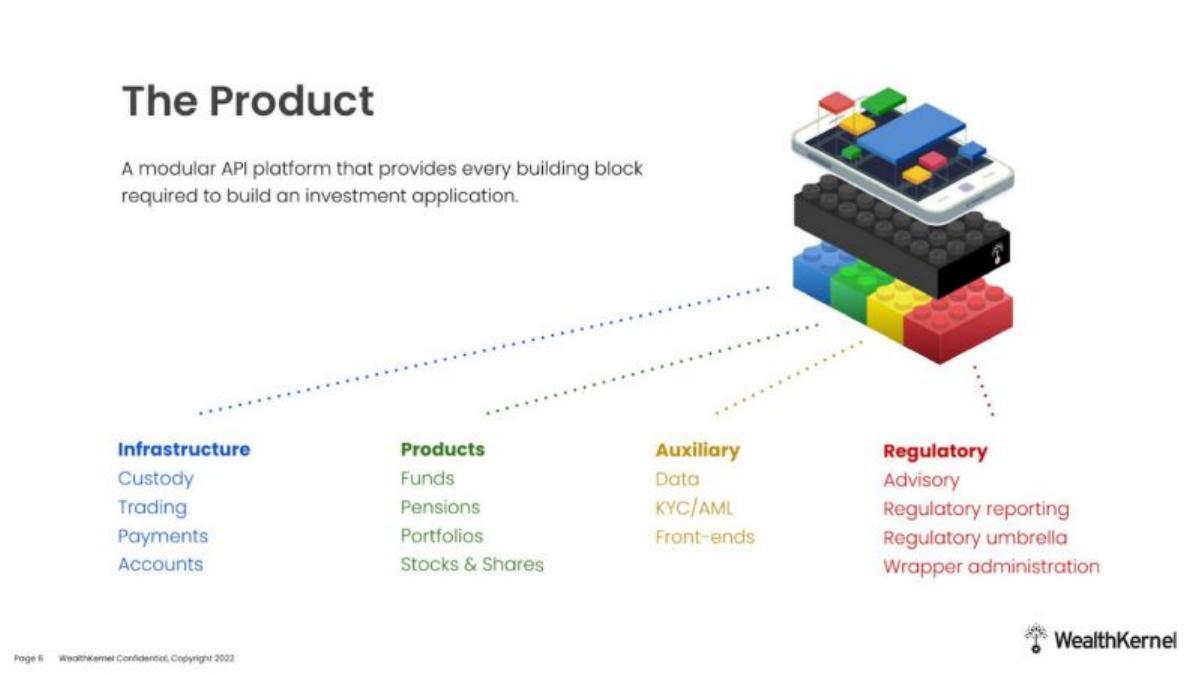
- The product is presented as a modular API platform covering four key areas: Infrastructure, Products, Auxiliary, and Regulatory (Slide 6).
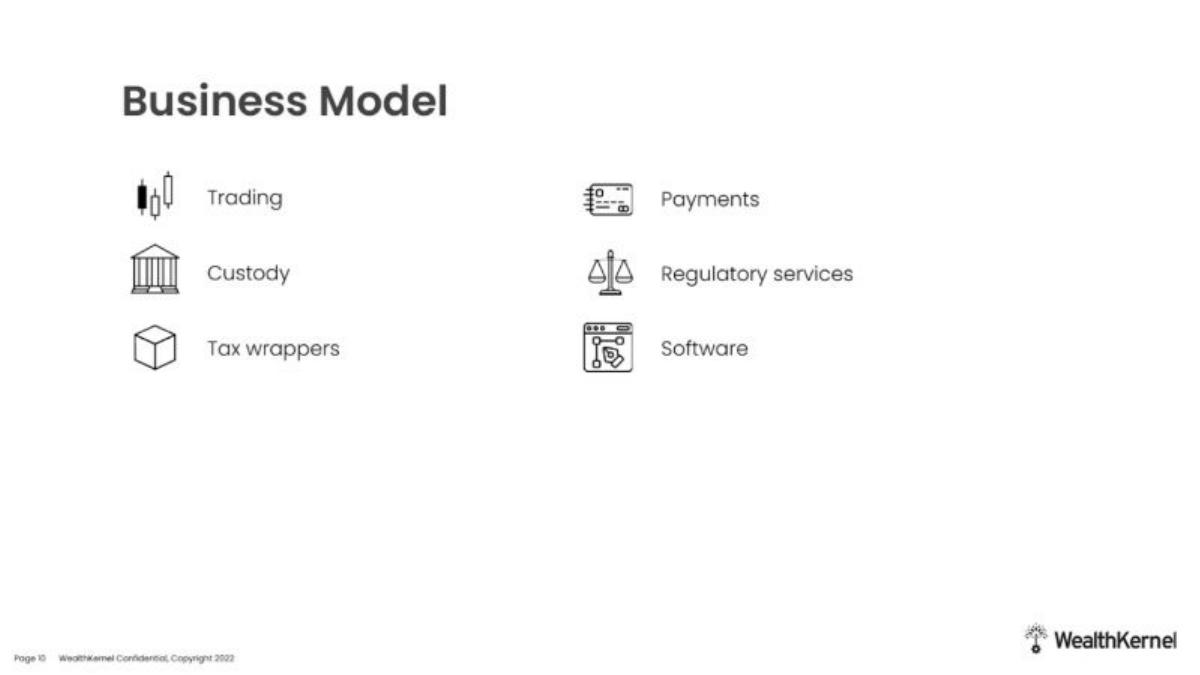
- The business model is diversified across six revenue streams including trading, custody, and regulatory services (Slide 10).
- The team slide emphasizes institutional experience, citing a combined 80+ years of experience and management of billions in assets (Slide 17).
- The fundraising ask is a range of $5-10m, specifically for European expansion and intraday trading API development (Slide 15).
- The deck highlights the 'Regulatory Umbrella' as a core product feature, solving the legal barrier that stops competitors (Slide 6).
- Existing investors ETFS Capital and Seedcamp are leveraged to show early institutional backing (Slide 15).
The Narrative: Infrastructure as a Lego Set
WealthKernel’s deck is a study in abstraction. Fintech infrastructure is notoriously difficult to explain because it involves the 'plumbing' of finance—clearing, custody, KYC, and regulatory reporting. WealthKernel avoids the weeds by using a consistent visual metaphor: Lego-style building blocks. From the title slide to the product breakdown, they reinforce the idea that building a complex investment app should be as simple as snapping blocks together.
Slide 1: Title and Positioning
The cover slide establishes the brand identity immediately. The tagline 'Investing as a Service' is a direct play on the SaaS (Software as a Service) and IaaS (Infrastructure as a Service) models that VCs already understand and love. The use of 3D isometric building blocks on the right side of the slide sets the stage for the 'modular' theme that carries through the entire presentation.
Slide 3: The Problem of Fragmentation
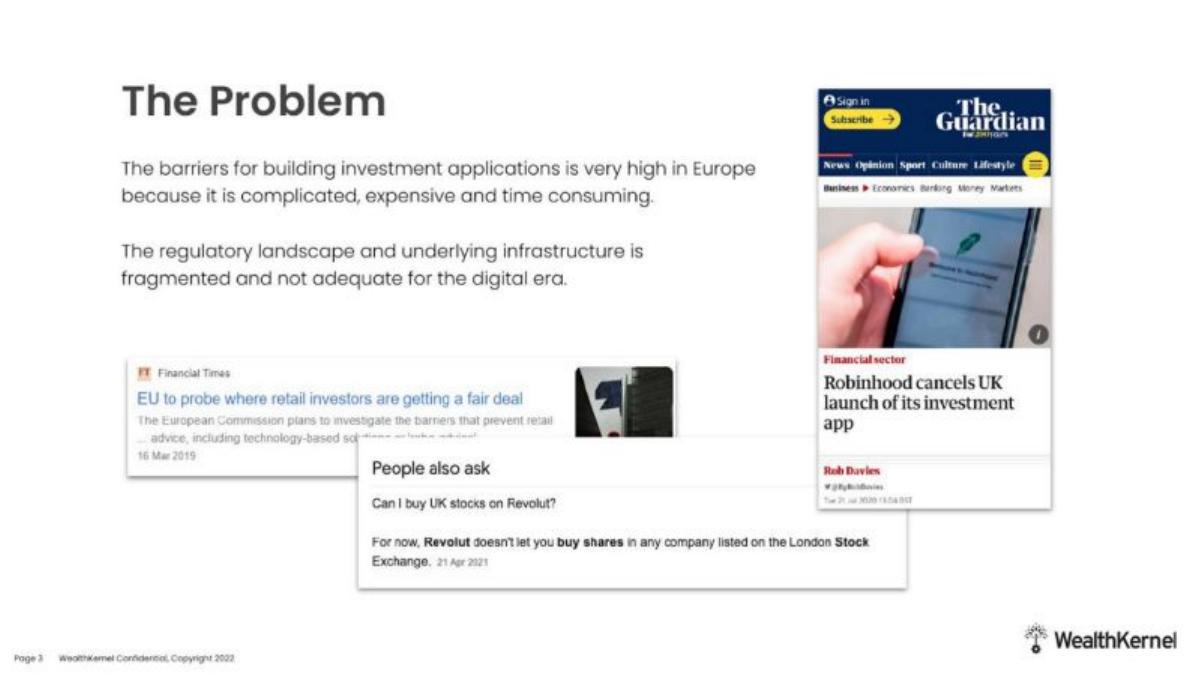
WealthKernel identifies a specific, high-pain problem: the difficulty of launching investment apps in Europe. They use 'social proof of failure' by including a headline from The Guardian: 'Robinhood cancels UK launch of its investment app.' This is a powerful move. If a multi-billion dollar giant like Robinhood can't crack the market, it proves the 'barriers for building investment applications' are indeed 'very high.' They characterize the current landscape as 'fragmented' and 'not adequate for the digital era,' positioning themselves as the modern alternative to legacy systems.
Slide 5: The Solution - The 'AWS' Mental Model
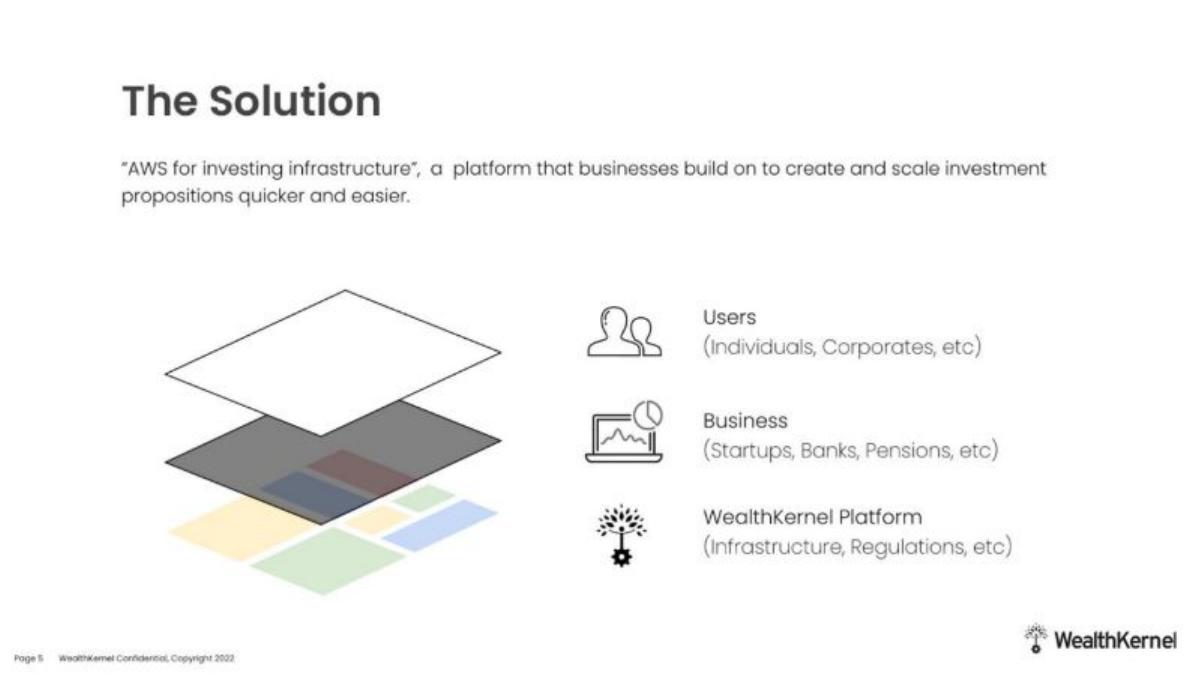
Slide 5 introduces the 'AWS for investing infrastructure' analogy. This is a classic pitch deck tactic: 'We are the [Successful Giant] for [Specific Niche].' It tells the investor that WealthKernel intends to be the invisible layer that everyone else builds upon. The diagram shows a three-tier stack: the WealthKernel Platform (Infrastructure/Regulations) at the bottom, the Business (Startups/Banks) in the middle, and the end Users at the top. This clearly defines their B2B2C (Business-to-Business-to-Consumer) nature.
Slide 6: The Product Breakdown
This is the most technical slide in the deck, yet it remains highly readable. They categorize their 'modular API platform' into four pillars: Infrastructure (Custody, Trading, Payments, Accounts), Products (Funds, Pensions, Portfolios, Stocks & Shares), Auxiliary (Data, KYC/AML, Front-ends), and Regulatory (Advisory, Reporting, Umbrella, Wrapper administration). By including 'Regulatory' as a product pillar, they signal that they aren't just a software company—they are a legal enabler. This is a critical distinction in fintech where the license is often a bigger hurdle than the code.
Slide 7: The Value Proposition
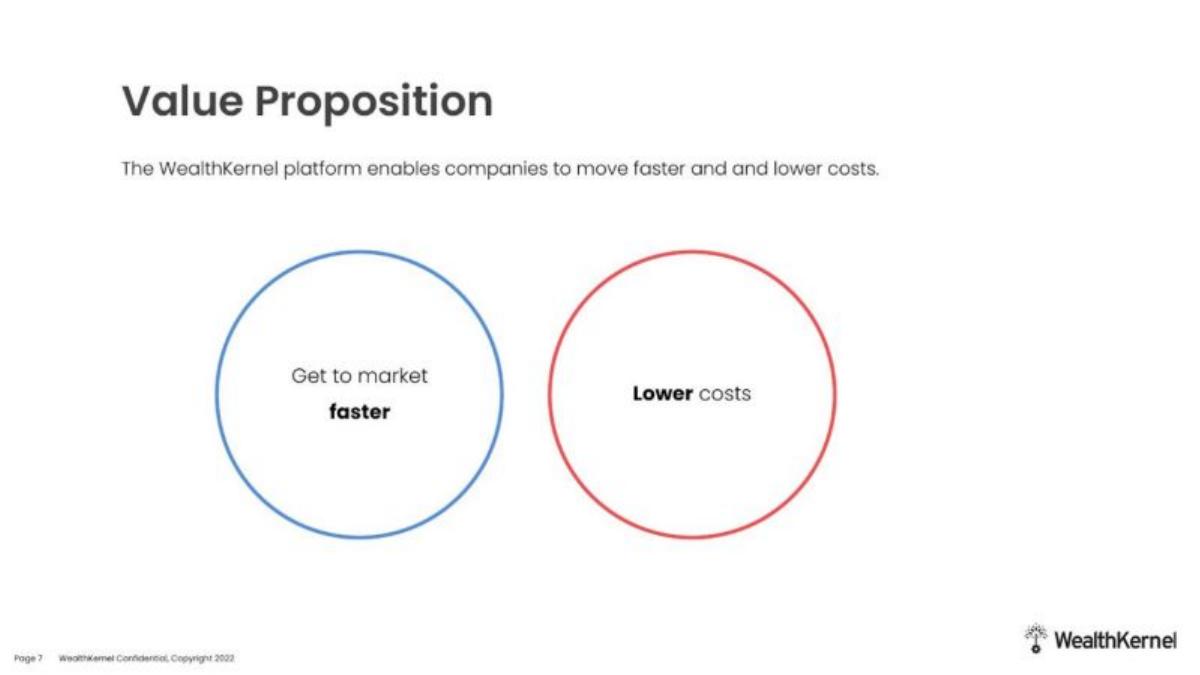
Slide 7 is perhaps too simple. It features two circles: 'Get to market faster' and 'Lower costs.' While these are the primary drivers for any B2B infrastructure play, the slide lacks data to back up these claims. A founder copying this deck should consider adding a 'Before vs. After' comparison here (e.g., '18 months to launch vs. 3 months with WealthKernel').
Slide 10: The Business Model
The business model slide lists six revenue streams: Trading, Custody, Tax wrappers, Payments, Regulatory services, and Software. This indicates a 'land and expand' strategy. A client might start by using WealthKernel for just trading APIs, but eventually migrate their custody and regulatory reporting to the platform as well. This diversification makes the business more resilient and increases the lifetime value (LTV) of each customer.
Slide 15: Fundraising and Use of Funds
WealthKernel states they are raising '$5-10m.' This is a wide range for a Series A, which usually suggests they are looking for a lead investor to set the price and terms. The use of funds is specific: 'Fund expansion in to Europe and build out intraday trading functionality over API.' They also list ETFS Capital and Seedcamp as existing investors, which provides a 'stamp of approval' from respected firms in the space.
Slide 17: The Team - The 'De-Risking' Factor
For an infrastructure play, the team is everything. WealthKernel leans heavily into institutional pedigree. CEO Karan Shanmugarajah managed $500m at Barclays. CTO Joe Campbell was a 'Basel III Architect' handling $3Tr at BNP Paribas. Head of Engineering Chris Wright spent 21 years at Morgan Stanley. This slide is designed to tell investors: 'We have seen the inside of the world's biggest banks and we know exactly how to rebuild their systems for the modern age.' The combined 80+ years of experience listed across the five executives is a massive competitive moat.
What WealthKernel Does Well
Simplification: They take a very 'dry' and complex subject (investment back-ends) and make it look like a consumer product. · Market Validation: Using the Robinhood failure as a case study for why their product needs to exist is brilliant. It turns a competitor's struggle into their own opportunity. · Pedigree: They don't just list names; they list specific metrics of their past success (e.g., '$3Tr' handled, '$500m' managed).
What is Missing from the Deck
Traction: This is the biggest omission. There is no mention of how many clients they have, what their current revenue is, or how much AUM is currently flowing through their APIs. For a Series A, investors usually expect a 'hockey stick' graph. · Competition: The deck ignores competitors like DriveWealth, Alpaca, or Currencycloud. Investors will want to know why WealthKernel's 'Regulatory Umbrella' is better than the competition's. · Unit Economics: While they list revenue streams, they don't explain the margins. Is the software high-margin while the trading is low-margin? This is key for valuation.
What Founders Should Copy
The 'Mental Model' Slide: If you are building something complex, use the 'AWS for X' or 'Stripe for Y' analogy early to anchor the investor's understanding. · The Modular Visual: If your product has many features, group them into 3-4 logical pillars as seen on Slide 6. It prevents the 'feature list' from becoming overwhelming. · The Pedigree Slide: If your team has institutional experience, quantify it. Don't just say 'Ex-Barclays'; say 'Managed $500m at Barclays.'
Frequently asked questions
- What is WealthKernel's primary value proposition?
- WealthKernel focuses on speed to market and cost reduction. By providing a modular API that includes not just technology but also the 'regulatory umbrella,' they allow startups, banks, and pension providers to launch investment products without building their own back-end infrastructure or obtaining their own full regulatory licenses from scratch.
- How does WealthKernel make money?
- According to slide 10, their business model is multi-faceted. They generate revenue from trading, custody services, tax wrappers, payments, regulatory services, and software fees. This suggests a mix of transactional volume-based fees and recurring SaaS-style revenue.
- Why is the European market specifically mentioned as a problem?
- Slide 3 notes that the European regulatory landscape and infrastructure are fragmented and 'not adequate for the digital era.' The deck uses the example of Robinhood cancelling its UK launch to prove that even well-funded US incumbents struggle with the complexity that WealthKernel aims to abstract away.
- What is missing from this pitch deck?
- The deck is notably missing a traction slide. There are no mentions of current Revenue, Assets Under Management (AUM), number of active clients, or growth percentages. It also lacks a competitive landscape slide, which is surprising given the crowded fintech infrastructure space.
- What is the 'Regulatory Umbrella' mentioned in the product slide?
- In the UK and Europe, firms can often operate as 'Appointed Representatives' under another firm's regulatory permissions. WealthKernel includes this as a 'building block' (Slide 6), meaning they likely provide the legal framework for clients to offer regulated investment services under WealthKernel's own licenses.