Wayward Strand’s pitch deck is a focused, aesthetically consistent presentation that prioritizes narrative innovation over traditional gaming metrics. The deck centers on a 'living narrative' mechanic where multiple stories play out simultaneously, independent of player action. By highlighting a custom toolset that manages these complex timelines, the developers demonstrate technical feasibility for a high-concept idea. The deck leans heavily into the 'cozy' and accessible gaming market, explicitly stating that the game is for all age groups and does not rely on 'gamer' dexterity. While the p…
Key takeaways
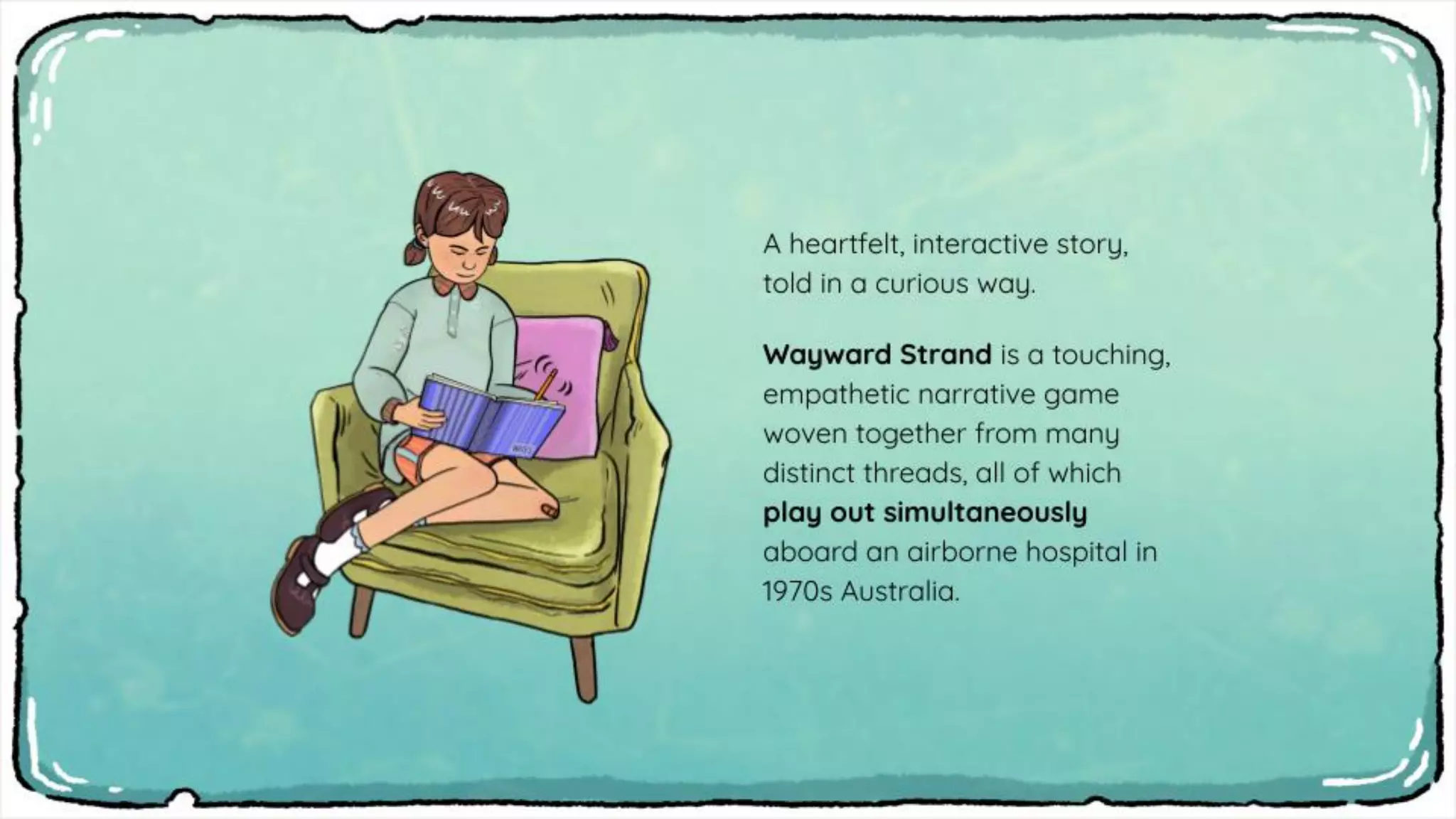
- The game is defined as a touching, empathetic narrative experience set in an airborne hospital in 1970s Australia (Slide 1).
- A core USP is that NPCs act independently of the player, possessing their own desires and schedules (Slide 2).
- Gameplay mechanics are limited to following, eavesdropping, or participating in conversations, emphasizing low-dexterity accessibility (Slide 4).
- The studio developed a unique toolset to manage simultaneous stories that play out over a three-day in-game period (Slide 6).
- Replayability is a key metric, with one playthrough taking 2-3 hours, but requiring a dozen or more to see all content (Slide 6).
- The target audience is broad, including adults, children, and grandparents, focusing on 'learning, empathy, and exploration' (Slide 7).
- The deck uses a consistent hand-drawn art style that mirrors the game's aesthetic, reinforcing the brand identity throughout (Slides 1-8).
- There is a total absence of market size data, competitor analysis, or financial requirements in the provided slides.
The Creative Vision: Setting the Scene
Wayward Strand’s pitch deck is a departure from the data-heavy presentations typical of Silicon Valley startups. Instead, it functions as a narrative manifesto. The deck uses the game's own art style—a soft, hand-drawn aesthetic—to immediately communicate the 'vibe' of the project. For an indie game, the art is often the first point of evaluation for a publisher or investor, and Wayward Strand leans into this strength immediately.
Slide 1: The Hook
The opening slide establishes the setting and the core emotional promise. It describes the game as a 'heartfelt, interactive story' set in an 'airborne hospital in 1970s Australia.' This is a highly specific and unique setting, which helps the game stand out in a crowded indie market. The character illustration of a young girl (Casey) reading a book sets a contemplative, quiet tone.
Slide 2: Character Autonomy
Slide 2 introduces the 'eclectic cast' and a major mechanical differentiator: characters do as they wish, 'completely independent of the player character.' This is a bold claim in game design, as it suggests a living world that doesn't revolve around the player's presence. The illustration of an elderly woman in a cockatoo-print sweater reinforces the Australian setting and the focus on elder characters, which is rare in gaming.
Slide 3 & 4: Gameplay Mechanics
Slide 3 is a simple transition slide titled 'Gameplay.' Slide 4 breaks down the player's agency. The mechanics are simple: follow, eavesdrop, or participate. By highlighting 'eavesdropping,' the deck emphasizes the voyeuristic, observational nature of the game. The screenshot provided shows a clear, 2D side-on perspective, giving the viewer an immediate understanding of the game's visual language and UI.
Slide 5 & 6: The Living Narrative and Technical Backend
Slide 5 acts as a thematic bridge to the most important technical slide in the deck. Slide 6, 'Simultaneous Stories,' is the 'meat' of the pitch. It explains that the story plays out over three days and uses a custom toolset to manage scenes. The inclusion of a screenshot of the scheduling tool is critical. It shows rows for characters and columns for time, proving that the developers have solved the logistical nightmare of tracking dozens of overlapping scripts. This slide also introduces the replayability factor: a 2-3 hour playthrough requires 'a dozen or more' attempts to see everything, which is a key selling point for value-conscious players and publishers.
Slide 7: Accessibility and Audience
Slide 7, 'Anyone can play,' is a strategic positioning move. By explicitly stating that the game is for 'adults, children, grandparents alike,' the developers are carving out a niche in the 'cozy gaming' or 'non-gamer' market. They emphasize that 'skill is not the focus,' which lowers the barrier to entry for a massive demographic that may be intimidated by traditional game controllers.
Slide 8: The Conclusion
The final slide is a 'Thank You' featuring a beautiful wide-angle piece of concept art showing the airborne hospital floating over a coastal town. It includes the website URL but, notably, lacks a call to action or contact information for a specific person. This suggests the deck may have been intended for a public showcase or as a follow-up to a meeting rather than a cold outreach tool.
What Works in the Wayward Strand Deck
1. Aesthetic Consistency: The deck feels like an extension of the game. Every slide uses the same color palette, borders, and font styles. This creates a professional, polished impression that suggests the team has a strong handle on their creative direction.
2. Solving the 'How': Many indie pitches promise complex narrative branching but fail to explain how they will build it. Slide 6’s visualization of the internal toolset is the most important part of the deck because it moves the project from 'ambitious idea' to 'executable plan.'
3. Clear USP: The deck doesn't try to be everything to everyone. It identifies its unique selling point—simultaneous, independent character stories—and hammers it home across multiple slides. The 'eavesdropping' mechanic is a fresh take on player interaction that feels distinct from the typical 'hero's journey.'
What is Missing from the Wayward Strand Deck
1. The Business Case: There is no mention of the 'Ask.' How much funding is required? Is this for a seed round, a publishing deal, or a grant? Without a slide detailing the budget and how it will be spent, this is a creative pitch, not a business pitch.
2. The Team: Investors invest in people. The absence of a team slide is a major oversight. Who are these developers? Have they shipped games before? What is their background in narrative design? In the indie space, a team's track record is often the deciding factor for funding.
3. Market Analysis: While the deck mentions a broad audience, it doesn't provide data. There are no 'Comps' (comparable titles). Mentioning successful narrative games like Firewatch or Oxenfree would help an investor understand the potential ROI and the existing market appetite for this genre.
4. Roadmap: There is no timeline. Is the game in pre-production, alpha, or nearing completion? A slide showing the development milestones and a projected release date is essential for any serious funding discussion.
What Founders Should Copy
1. Show the Tools: If your startup or game relies on a unique process or technology, show a screenshot of the 'guts.' It builds immense credibility to see the actual interface the team uses to solve a complex problem.
2. Define the Non-User: Wayward Strand does a great job of defining who the game is not for by stating it doesn't rely on 'gamer' experience. By narrowing the focus to 'learning, empathy, and exploration,' they make the pitch more attractive to the right kind of partner.
3. Visual Storytelling: Use high-quality art to do the heavy lifting. The text on these slides is sparse, which is a good thing. The art tells the story of the setting, the tone, and the characters, allowing the text to focus on the 'why' and the 'how.'
Frequently asked questions
- What is the primary gameplay hook of Wayward Strand?
- The primary hook is the 'Simultaneous Stories' mechanic. Unlike traditional RPGs where the world waits for the player, Wayward Strand’s characters follow their own schedules across an airborne hospital. The player must choose which threads to follow, meaning they will inevitably miss some events in a single playthrough, necessitating multiple runs to uncover the full narrative.
- How does the deck address technical risk?
- Slide 6 addresses technical risk by showcasing a 'unique toolset' developed by the team. It displays a complex scheduling interface where rows represent characters and columns represent time. By showing this backend logic, the founders prove they have a functional system to manage the complexity of overlapping, time-based scripts.
- Who is the target audience for this game according to the deck?
- The deck explicitly targets a non-traditional gaming audience. Slide 7 states the game is for 'any age group' and specifically mentions grandparents. It positions the game as an alternative to high-skill, high-dexterity titles, appealing instead to fans of fiction, cartoons, and character-driven storytelling.
- What is the setting and tone of the game?
- The game is set in 1970s Australia aboard a floating hospital. The tone is described as 'heartfelt,' 'empathetic,' and 'touching.' The visual style uses a soft, illustrated aesthetic that suggests a gentle, narrative-heavy experience rather than an action-oriented one.
- What critical business information is missing from this deck?
- The provided slides are purely creative and mechanical. Missing elements include the development timeline, the 'Ask' (how much money is needed), the team's pedigree, platform strategy (PC, Console, Mobile), and marketing plans. Without these, it functions more as a creative treatment than a full business investment pitch.