Paykind's 17-slide deck from 2013 presents a compelling case for digitizing aid and remittances in Africa. The company identifies a $42 billion annual market plagued by a 40% waste rate due to corruption, distribution costs, and overhead. Their solution is an e-voucher platform that allows donors to specify exactly what funds are spent on—such as food, healthcare, or education—delivered via mobile phones. With a successful pilot involving 2,000 people and $25,000 in transactions, the deck demonstrates early traction. However, the presentation lacks specific financial projections, a clear comp…
Key takeaways
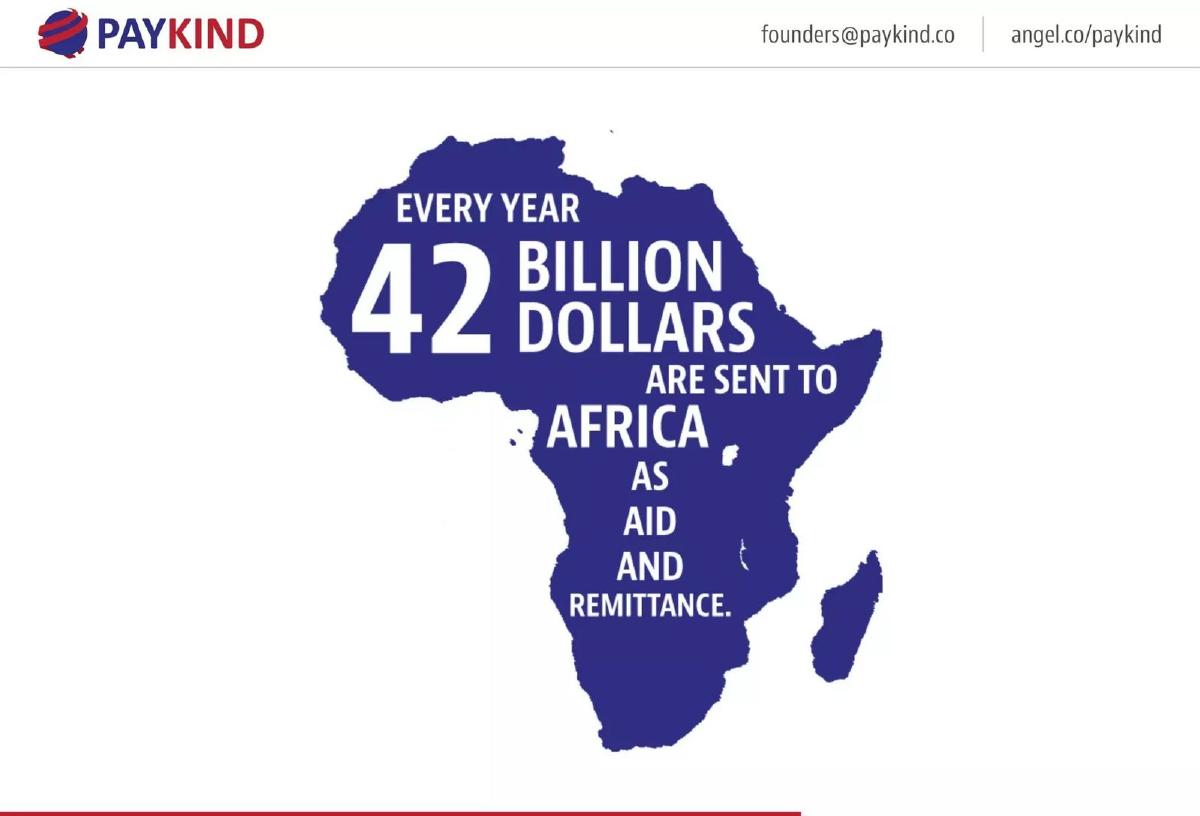
- The total annual market for aid and remittance to Africa is stated as $42 billion on slide 2.
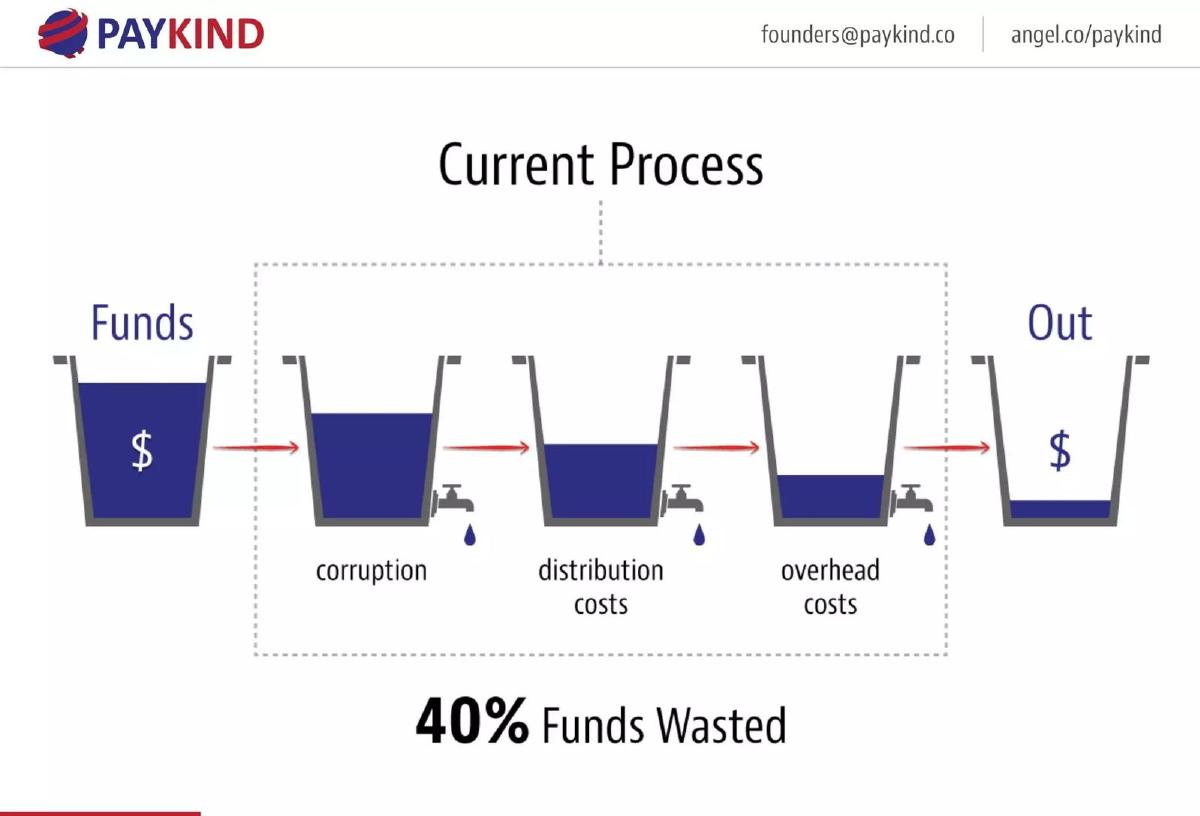
- Current aid processes result in 40% of funds being wasted through corruption, distribution, and overhead (slide 3).
- Paykind claims to achieve 0% funds wasted by bypassing traditional distribution leakage (slide 7).
- The product works across devices, including basic Nokia feature phones for recipients and a web dashboard for donors (slide 6).
- Vouchers are specifically restricted to categories like food, healthcare, and education (slide 12).
- The business model relies on two revenue streams: transactional commissions and monthly subscriptions (slide 14).
- A pilot program successfully reached 2,000 people across 2 organizations with $25,000 processed (slide 15).
- The founding team consists of a 2x entrepreneur with an engineering degree and a CTO with 3 years of dev experience (slide 16).
The Paykind Pitch Deck: A Direct Approach to Social Impact Fintech
Paykind's 2013 seed deck is a study in clear problem identification. Operating in the intersection of fintech and social impact, the company addresses one of the most persistent issues in global development: the inefficiency of capital transfer. By focusing on the African market, specifically the $42 billion flowing into the continent annually, Paykind positions itself as a transparency layer for both individual remitters and large-scale aid organizations.
The Hook: Quantifying the Inefficiency
The deck opens with a strong, minimalist title slide and immediately moves into the macro-opportunity. Slide 2 establishes the scale of the market: $42 billion sent to Africa every year as aid and remittance. This is a crucial starting point for any pitch, as it justifies the relevance of the venture.
Slide 3 is perhaps the most effective visual in the deck. It uses a 'leaky bucket' analogy to describe the 'Current Process.' It identifies three specific points of failure: corruption, distribution costs, and overhead costs . The slide concludes with a stark metric: 40% Funds Wasted . By quantifying the pain point so clearly, the founders make the need for a solution feel urgent and obvious.
The Vision and Social Proof
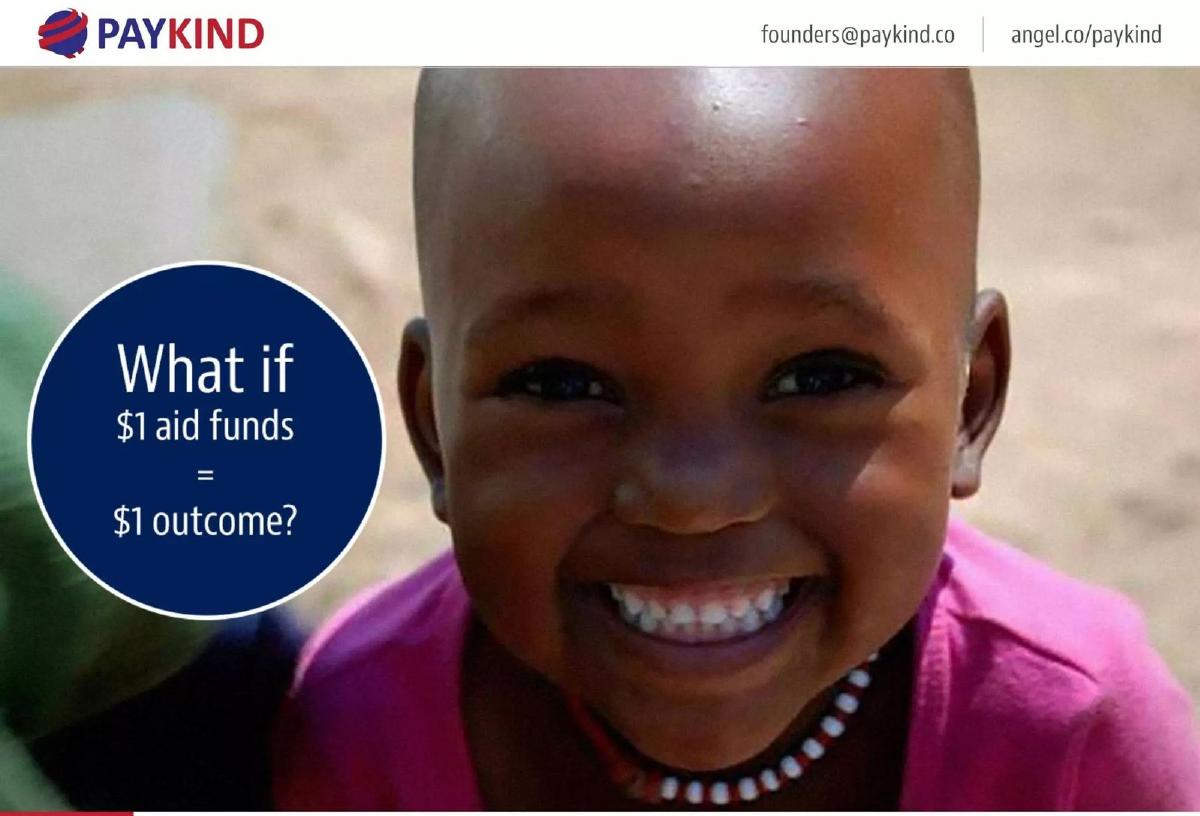
Slide 4 shifts the tone from data to human impact, showing a smiling child with the text, 'What if $1 aid funds = $1 outcome?' This slide serves to align the investor's interests with the social mission of the company. It is a classic emotional appeal that bridges the gap between the problem and the technical solution.
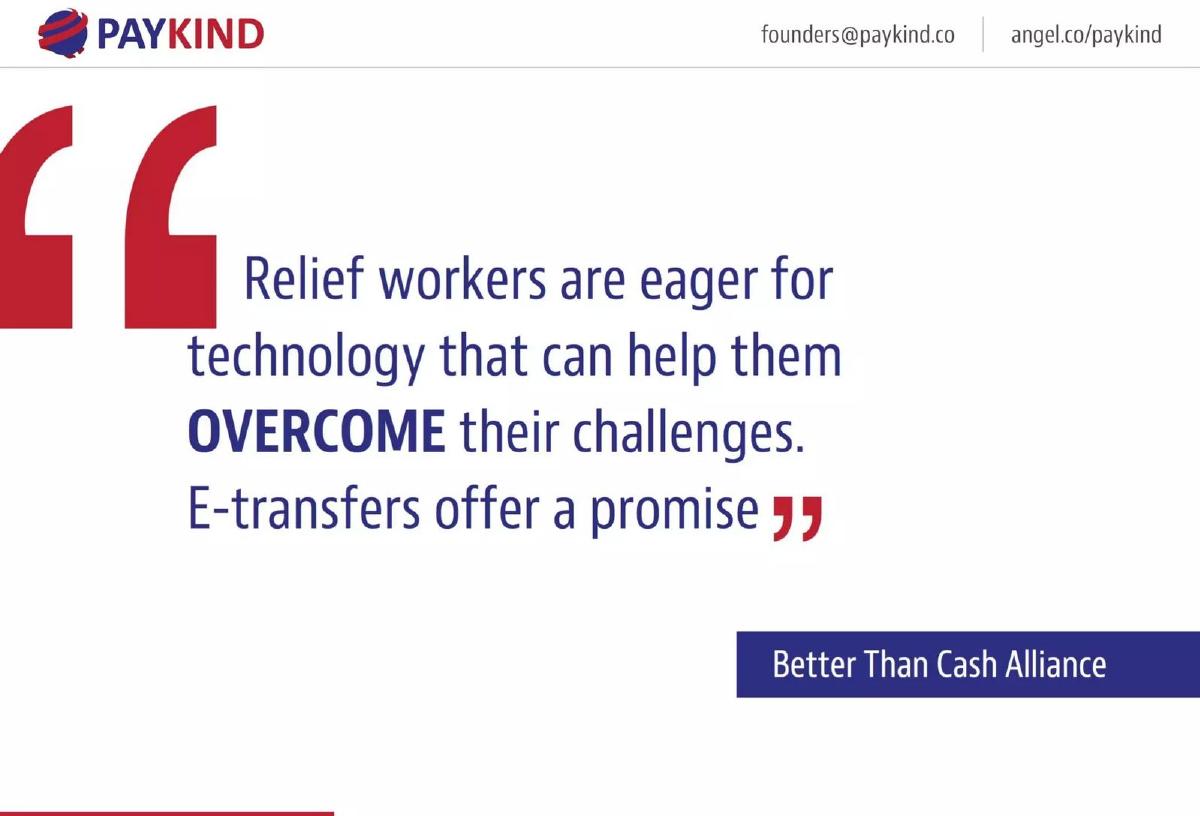
Slide 5 provides external validation via a quote from the 'Better Than Cash Alliance.' The quote notes that relief workers are 'eager for technology' to overcome challenges and that 'E-transfers offer a promise.' Using a third-party authority to validate the market's readiness for a digital shift helps mitigate the perceived risk of adoption in developing regions.
Product Mechanics and the 'Zero Waste' Promise
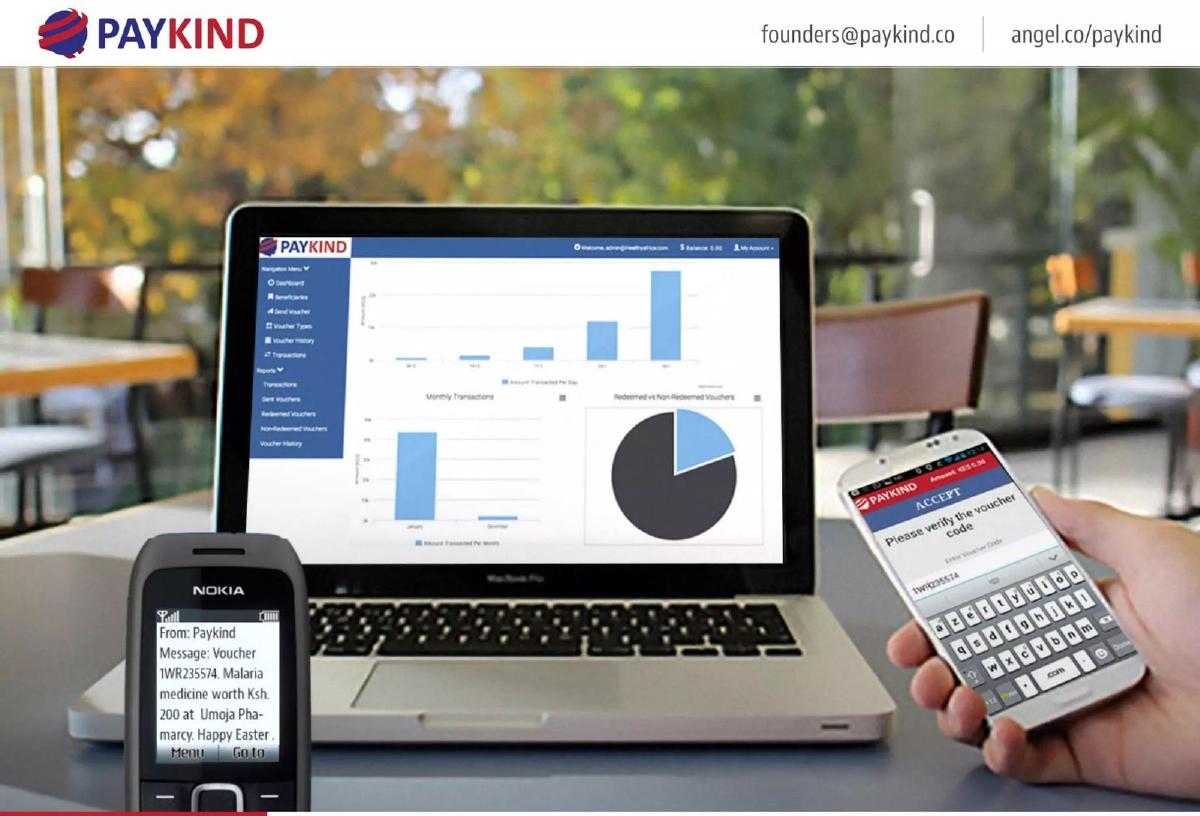
Slide 6 provides a visual overview of the ecosystem. It shows a laptop displaying a management dashboard with charts and pie graphs, a smartphone for merchant verification, and a basic Nokia feature phone receiving an SMS voucher. The SMS on the Nokia screen is specific: 'Voucher 1WR235574. Malaria medicine worth Ksh. 200 at Umoja Pharmacy.' This level of detail explains the product's core value proposition— specificity and trackability —without needing a wall of text.
Slide 7 returns to the bucket analogy from slide 3, but this time, a red arrow bypasses the middle buckets entirely, leading to the claim of 0% Funds Wasted . While '0%' is an ambitious marketing claim that likely ignores the company's own commissions, it effectively communicates the efficiency of a direct-to-digital model compared to traditional physical distribution chains.
The User Journey: How It Works
This section uses simple iconography to walk through the four-step process. Slide 9 identifies the customers: 'Individuals & Organizations want to donate.' Slide 10 shows them visiting the website. Slide 11 illustrates the delivery: 'One or many recipients receive a voucher on their mobile phone.' Finally, slide 12 shows the redemption categories: food, healthcare & education . The simplicity of these slides suggests a user-friendly interface, which is critical for a platform intended for wide-scale adoption.
Traction and Business Model
Slide 13 acts as a transition, stating 'We are translating efforts to results.' This leads into the business model on slide 14. Paykind identifies two revenue streams: Transactional Commissions and Monthly Subscriptions . This is a standard SaaS/Fintech hybrid model, providing both volume-based upside and predictable recurring revenue.
Slide 15 presents the 'Successful Pilot' data. The company reports working with 2 organisations , reaching 2000 people , and processing $25,000 . For a seed-stage company in 2013, these numbers represent a solid proof of concept. It shows that the founders have moved beyond the idea phase and have successfully navigated the logistical hurdles of the Kenyan market.
Team and Call to Action
The team slide (16) features CEO Rodgers Muhadi and CTO Samuel Masinde. Muhadi is described as a '2X Entrepreneur' with an Electronic Engineering degree, while Masinde has '3 Years Fulltime Application Development' experience and a Computer Science degree. The background in both entrepreneurship and technical development is a positive signal for a seed-stage startup.
The deck ends on slide 17 with a generic call to action: 'Do you want to be part of this revolution?'
What Works in This Deck
Clear Problem/Solution Fit: The 'leaky bucket' vs. 'direct arrow' comparison is a masterclass in visual storytelling. It makes a complex geopolitical and logistical problem easy to understand in seconds.
Device Agnostic Approach: By showing the Nokia feature phone alongside the smartphone and laptop, the deck demonstrates a deep understanding of the target market's infrastructure. They aren't building for an idealized version of Africa; they are building for the reality of 2013.
Specific Use Cases: The mention of 'Malaria medicine' and 'Ksh. 200' on the product slide makes the abstract concept of 'aid' feel tangible and manageable.
What Is Missing from This Deck
The Ask: This is the most glaring omission. There is no slide stating how much capital the company is looking to raise, the terms of the round, or what the specific milestones are for the next 12-18 months. According to catalogue facts, they raised $125,000, but that information is not in the deck.
Financial Projections: While the $42 billion market is mentioned, there is no breakdown of how Paykind expects to capture a percentage of that market or what their projected revenue looks like over the next few years.
Competitive Landscape: The deck operates as if Paykind is the only player in the space. In 2013, M-Pesa was already a dominant force in Kenya, and other NGOs were experimenting with digital transfers. A slide explaining why Paykind's e-voucher system is superior to a direct M-Pesa cash transfer would have been valuable.
Unit Economics: The deck mentions commissions and subscriptions but doesn't provide the actual percentages or dollar amounts. Investors need to know if the cost of acquiring an organization (CAC) is sustainable relative to the lifetime value (LTV) of those commissions.
What a Founder Should Copy
The 'Leaky Bucket' Visual: If your startup solves an efficiency problem, find a way to visualize the 'waste' in the current system as clearly as Paykind did on slide 3. It creates an immediate emotional and logical buy-in.
Minimalist Design: The deck uses a consistent color palette (blue and red) and avoids cluttered slides. This keeps the focus on the core message rather than distracting graphics.
Traction Benchmarks: Even if your pilot is small, presenting it with clear icons and bold numbers (as seen on slide 15) gives the impression of professional execution and momentum.
Final Thoughts
Paykind's deck is an excellent example of a 'Problem-First' pitch. It identifies a massive, quantifiable inefficiency and proposes a logical, tech-driven solution. While it lacks the financial rigor and competitive analysis typically required for larger rounds, its clarity and focus on the 'why' likely played a significant role in securing their initial $125,000 seed funding. For founders in the social impact space, this deck serves as a reminder that showing the 'outcome' (slide 4) is just as important as showing the 'code' (slide 6).
Frequently asked questions
- What is the core problem Paykind is solving?
- Paykind targets the 'leakage' in the aid and remittance industry. According to slide 3, the current process involves funds passing through multiple stages where corruption, distribution costs, and overhead consume 40% of the total value. Paykind aims to replace this leaky bucket system with a direct digital transfer that ensures the intended recipient receives the full value for specific needs.
- How does the technology work for the end user?
- The system is designed for the technological reality of Africa in 2013. Slide 6 shows that while donors use a web-based dashboard, recipients can receive a voucher code via a simple SMS on a basic feature phone (like a Nokia). Merchants or aid workers then verify this code using a smartphone app to complete the transaction for specific goods.
- What evidence of traction does the deck provide?
- Paykind includes a 'Successful Pilot' slide (slide 15) to prove their concept. They report working with 2 organizations to reach 2,000 people, processing a total of $25,000. This demonstrates that the technology functions in the field and that there is demand from organizational donors to use their e-voucher system.
- What is the revenue model for the platform?
- As shown on slide 14, Paykind employs a dual-revenue strategy. They charge transactional commissions on the funds sent through the platform and offer a monthly subscription model. This suggests they are targeting both high-volume individual remitters and long-term organizational partners who require consistent access to the dashboard and reporting tools.
- What important information is missing from this pitch deck?
- The deck is missing several standard investment components. There is no 'Ask' slide specifying how much money they are raising, no financial projections showing how the $42 billion market translates to company revenue, and no competitive landscape analysis. Additionally, it lacks a roadmap or timeline for future expansion beyond the initial pilot phase.