Pave's Series C deck is a highly effective example of a 'show, don't tell' fundraising strategy. By focusing on a specific, painful problem—siloed and outdated compensation data—Pave positions itself as the modern infrastructure for fair pay. The deck highlights a powerful flywheel where their planning and communication tools feed a proprietary benchmarking database, which in turn attracts more customers. With a reported $100M raised in 2022, the deck relies heavily on visual evidence of product-market fit, including a chart showing ARR growth that significantly outpaced initial projections.…
Key takeaways
- The problem is framed as four distinct failures of current systems: siloed data, unauthenticated market data, opaque spreadsheets, and employee confusion (Slide 2).
- Pave defines its 'How' through two core product pillars: visual offer letters for communication and real-time benchmarking for salary and equity (Slides 3-4).
- The business model relies on a flywheel where 1,600 companies contribute data to a benchmarking moat that powers planning and communication tools (Slide 5).
- The deck presents an 'explosive ARR growth' chart showing consistent month-over-month increases from July to December (Slide 6).
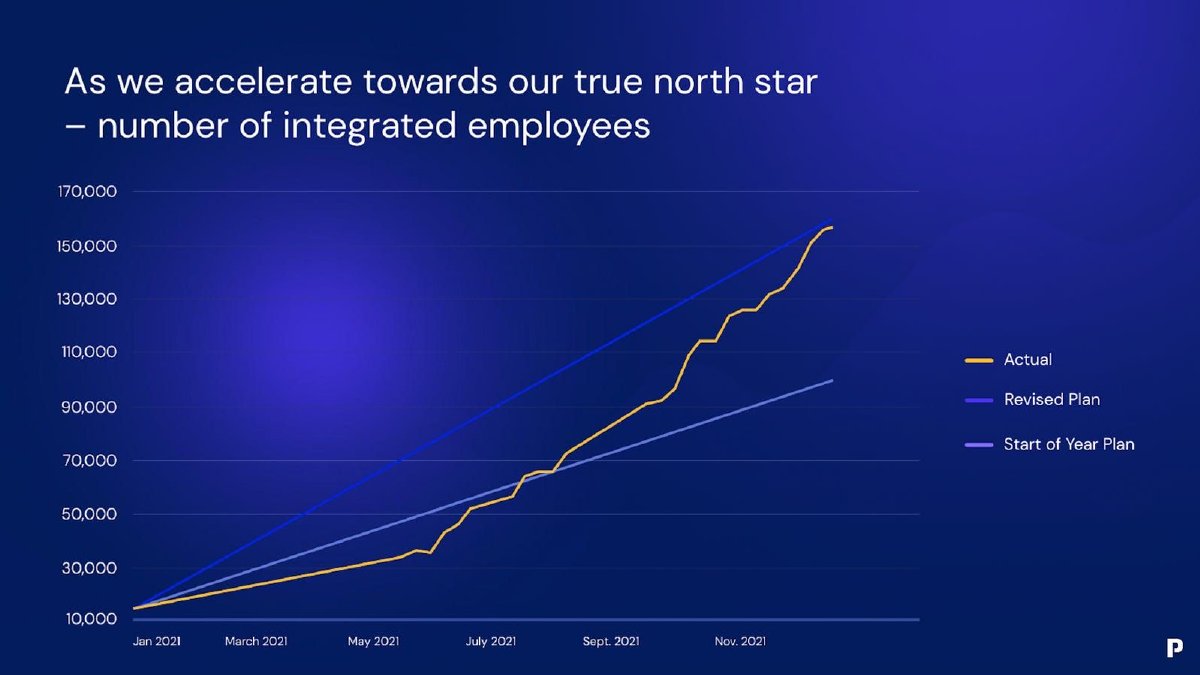
- A 'North Star' metric of 'integrated employees' shows the company scaling from approximately 10,000 to over 150,000 in a single year (Slide 7).
- The company outperformed its 'Start of Year Plan,' leading to a 'Revised Plan' that it also eventually exceeded (Slide 7).
- The team slide emphasizes relevant experience from high-growth tech companies like Facebook, Carta, Newfront, and Segment (Slide 8).
- Pave explicitly targets multiple buyers across the enterprise, including C-Suite, HR, Recruiting, and Finance (Slide 4).
The Pave Series C Teardown
Pave, a compensation benchmarking and visualization startup, raised $100M in a Series C round in 2022, as reported by Business Insider. Based in North America, the company entered a crowded HR tech market with a specific angle: real-time, authenticated data. This teardown examines the 16-slide deck used to secure that funding, focusing on how they articulated a 'boring' problem into a high-scale venture opportunity.
Slide 1-2: The Mission and the Problem Why
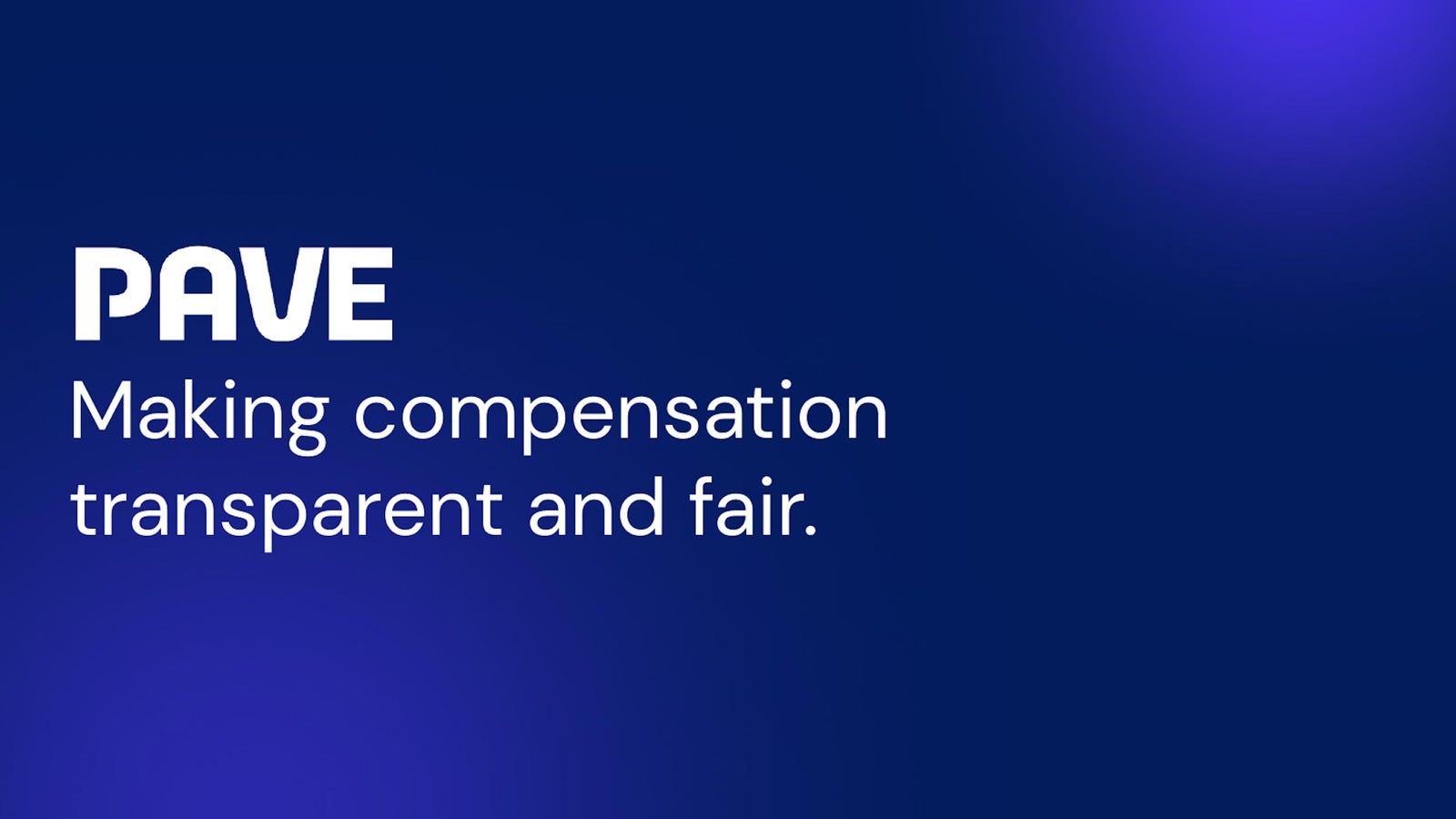
Slide 1 opens with a simple, bold brand statement: "Making compensation transparent and fair." This sets a moral and social tone for the business, which is immediately grounded in technical reality on Slide 2.
Slide 2, titled "Problem Why?" , breaks the market pain into four numbered points. First, it identifies that compensation data is siloed in separate systems. Second, it attacks the status quo—consultants—by stating their data is "not authenticated and is out of date." Third, it highlights the operational inefficiency of "opaque spreadsheets." Finally, it addresses the human element: employees don't understand their own benefits. This slide is effective because it targets both the buyer (HR/Finance) and the end-user (Employee), while discrediting the existing manual solutions.
Slide 3-4: The Product 'How'
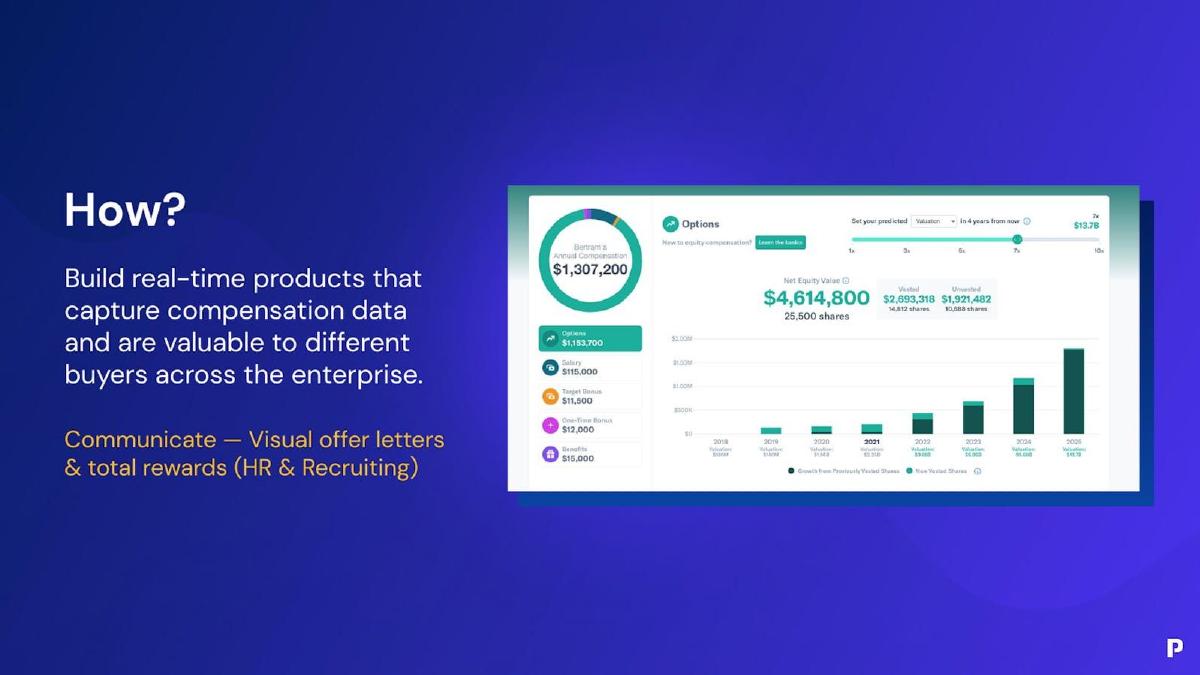
Slides 3 and 4 answer the "How?" by showcasing the product interface. Slide 3 focuses on the "Communicate" aspect, showing a visual dashboard for an employee's annual compensation (totaling $1,307,200 in the example). It breaks down salary, bonuses, and equity into digestible charts. The slide notes this is valuable for "HR & Recruiting."
Slide 4 shifts to "Benchmark." It shows a UI where a user can filter by job family (e.g., Software Engineer), level, and location to see real-time salary and equity percentiles. A key detail here is the label "Highly relevant data sample," which reinforces the claim that Pave's data is superior to traditional surveys. This slide expands the buyer list to include the "C-Suite" and "Finance," signaling that Pave is a strategic tool, not just an administrative one.
Slide 5: The Flywheel and Data Moat
This is arguably the most important slide in the deck. It explains the business logic: "This creates a flywheel between our products and our data moat." The diagram shows a circular flow between "Plan" (Comp Planner), "Communicate" (Total Rewards), and "Benchmarking" (Data).
The slide notes that "1600 Companies" are currently feeding into the Benchmarking node. It also outlines a three-stage evolution: "Today" (Network Driven Product), "Next" (Intelligent platform), and "Future" (Global data network). By framing the company as a network rather than just a software tool, Pave justifies a higher valuation multiple typical of data-network businesses.
Slide 6-7: Traction and the North Star
Slide 6 provides visual evidence of "explosive ARR growth." While specific dollar amounts are omitted from the Y-axis, the bar chart shows a clear, steep upward trajectory from July to December. The bars are color-coded to show "New," "Upsell," "Start," "Churned," "Expansion," and "Contraction." The red "Churned" segments are nearly invisible, suggesting extremely high retention and a healthy SaaS engine.
Slide 7 introduces their "true north star – number of integrated employees." This metric tracks the total number of individual employee records Pave has access to. The chart shows they started 2021 with roughly 10,000 employees and ended the year above 150,000. Crucially, the "Actual" growth line (yellow) significantly outperformed both the "Start of Year Plan" and the "Revised Plan." This is a powerful signal to investors that the team consistently underestimates their own speed and that market demand is outstripping their projections.
Slide 8: The Team
The final slide in this set introduces the leadership. The headline acknowledges the niche nature of the business: "We’ve built a world-class, mission-driven team excited to pursue what most perceive to be a boring problem." This self-awareness is refreshing. The team includes Matthew Schulman (CEO, ex-Facebook), Armand Farrokh (VP Sales, ex-Carta), Nitin Gupta (Head of Benchmarking, ex-Newfront), and Hareem Mannan (VP Product, ex-Segment). The logos of these former companies carry significant weight, suggesting the team has experience scaling high-growth platforms.
What Pave Does Well
Pave’s deck is a masterclass in narrative momentum . It starts with a broad social mission (fairness) and quickly narrows down to a specific technical solution (integrated data). The use of the word "authenticated" is a subtle but powerful jab at incumbents like Radford or Mercer, who rely on self-reported or manual surveys.
The Flywheel Slide (Slide 5) is the strategic heart of the deck. It explains why Pave is not just another HR tool that will be replaced in three years. By building a data moat, they create a 'switching cost' and a 'network effect'—the more companies join, the better the data becomes, making the product more valuable for the next company. This is the exact type of defensibility that Series C investors look for.
Finally, the North Star Metric (Slide 7) is brilliantly chosen. While ARR is important, "integrated employees" represents the raw material of their data moat. Showing that they are beating their own revised plans suggests a company that has found true product-market fit and is now just a matter of pouring fuel on the fire.
What is Missing from the Deck
While the deck is highly effective, there are several standard components missing from these 16 slides (or at least the 8 provided):
Unit Economics: There is no mention of Customer Acquisition Cost (CAC), Lifetime Value (LTV), or Payback Period. For a Series C, investors usually want to see that the sales engine is not just fast, but efficient. · Market Size (TAM): The deck assumes the investor already understands that compensation is a massive market. It doesn't explicitly state the Total Addressable Market or how they plan to expand into adjacent HR categories. · The Ask: The specific amount being raised and the intended use of funds are not listed on these slides. While reported as $100M, the deck itself doesn't detail how that capital will be deployed (e.g., international expansion, new product lines). · Competitor Matrix: Aside from a general swipe at "consultants," the deck doesn't address other modern competitors in the real-time comp space.
Founder Takeaways
1. Own the 'Boring' Label: Pave leans into the fact that compensation is a "boring problem." If you are solving a back-office or infrastructure issue, don't try to make it sound like a consumer social app. Acknowledge the complexity and the lack of glamour; investors appreciate founders who are willing to do the hard, un-sexy work.
2. Visualize the Flywheel: If your business gets stronger as it scales, you must visualize that mechanism. Pave’s Slide 5 clearly shows how their different product modules interact to build a proprietary data set. This turns a simple SaaS story into a platform story.
3. Use a 'North Star' Beyond Revenue: Revenue is a lagging indicator. Pave’s use of "integrated employees" shows the growth of their underlying asset. Find the metric that represents the 'health' of your ecosystem and track it against your plans to show momentum.
4. Target Multiple Buyers: Slide 4 is a great example of how to show enterprise depth. By listing C-Suite, HR, Recruiting, and Finance, Pave shows that their tool is 'sticky' across the entire organization, reducing the risk of a single department cutting the budget.
Frequently asked questions
- What is Pave's primary competitive advantage according to the deck?
- Pave’s primary advantage is its 'data moat,' described on Slide 5. Unlike traditional consultants who use unauthenticated or outdated data, Pave builds a real-time flywheel. By integrating with 1,600+ companies, they capture live compensation data that powers their benchmarking and planning tools, creating a network effect that is difficult for manual competitors to replicate.
- How does Pave measure its growth success?
- Pave uses two primary metrics: ARR growth and 'integrated employees.' Slide 6 shows a bar chart of 'explosive ARR growth' with minimal churn, while Slide 7 tracks their 'North Star' metric—the number of employees whose data is integrated into the platform—which surpassed 150,000 by the end of 2021.
- Who are the target users for Pave's platform?
- The deck identifies multiple stakeholders across the enterprise. Slide 3 focuses on HR and Recruiting for visual offer letters. Slide 4 expands this to include the C-Suite and Finance for salary and equity benchmarking. Finally, Slide 2 notes that the end-user—the employee—benefits from better understanding their own compensation.
- What specific problems does Pave solve for HR departments?
- According to Slide 2, Pave solves the problem of compensation data being siloed in separate systems and the reliance on 'opaque spreadsheets.' By providing authenticated, real-time market data, Pave allows HR to make decisions based on facts rather than outdated consultant reports, while also improving the clarity of offer letters to candidates.
- What is the long-term vision for the company?
- As detailed on Slide 5, Pave intends to move beyond being a 'Network Driven Product' or an 'Intelligent platform.' Their ultimate goal is to become a 'Global data network accessible by all constituents,' implying a shift from a B2B tool to a broader market infrastructure for compensation transparency.