Patient21’s Series C deck is a masterclass in brevity for a complex business model. By positioning themselves as a 'digi-physical' ecosystem rather than just a software provider or a clinic chain, they address the scalability concerns of traditional healthcare. The deck highlights their ownership of 50+ clinics and a proprietary software stack that manages the entire patient journey—from SEO-driven acquisition to AI-supported diagnosis. With 25,000 monthly patient visits and a 4.9/5.0 satisfaction rating, the narrative focuses on proven operational excellence and a massive €363bn European mar…
Key takeaways
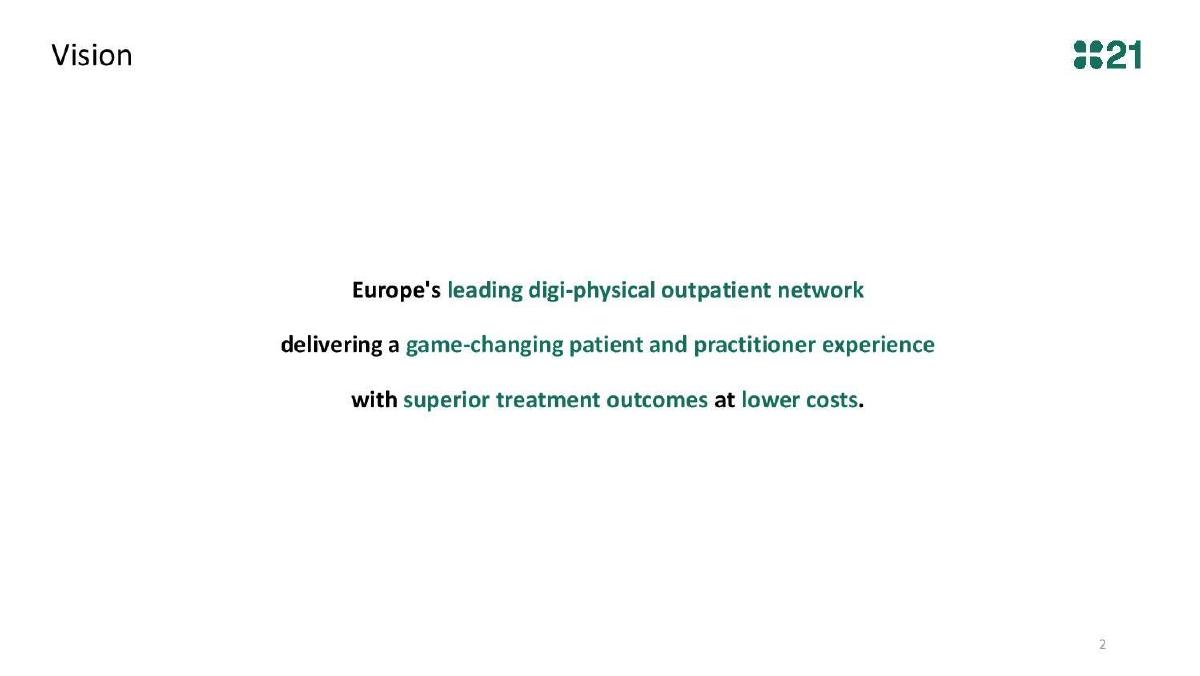
- The company defines itself as a 'digi-physical outpatient network' to bridge the gap between pure tech and traditional brick-and-mortar (Slide 2).
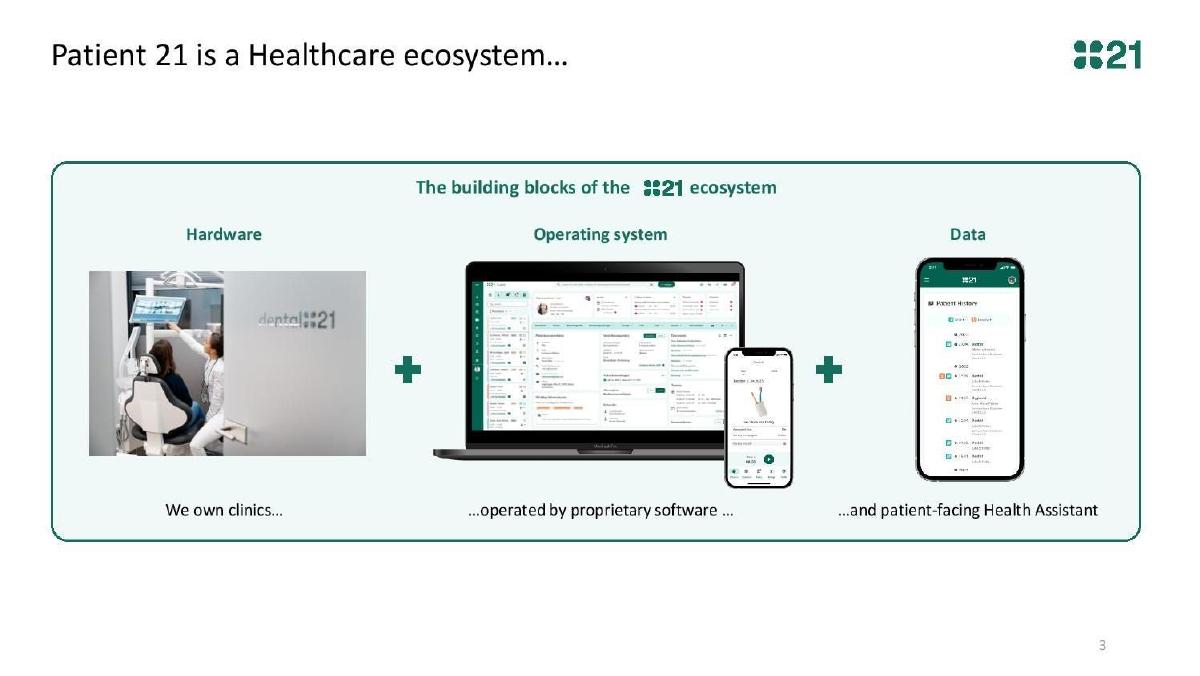
- The business model relies on three pillars: owned clinics (hardware), proprietary software (operating system), and a patient-facing health assistant (data) (Slide 3).
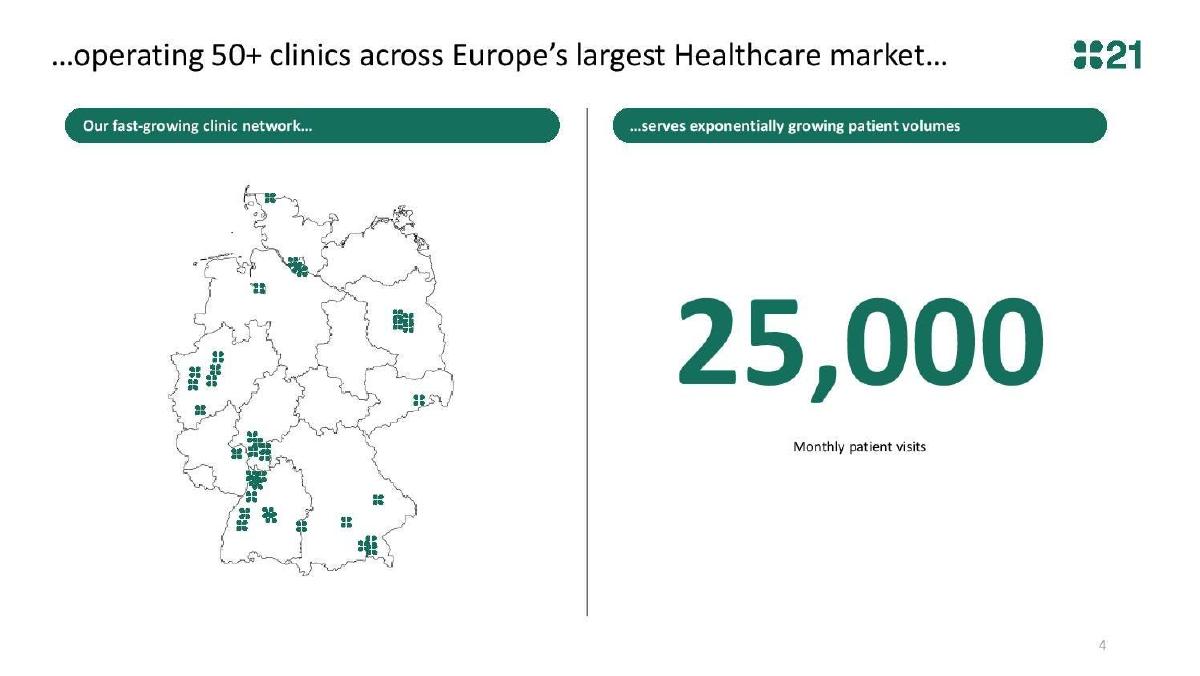
- Traction is demonstrated by 50+ clinics in Germany and 25,000 monthly patient visits (Slide 4).
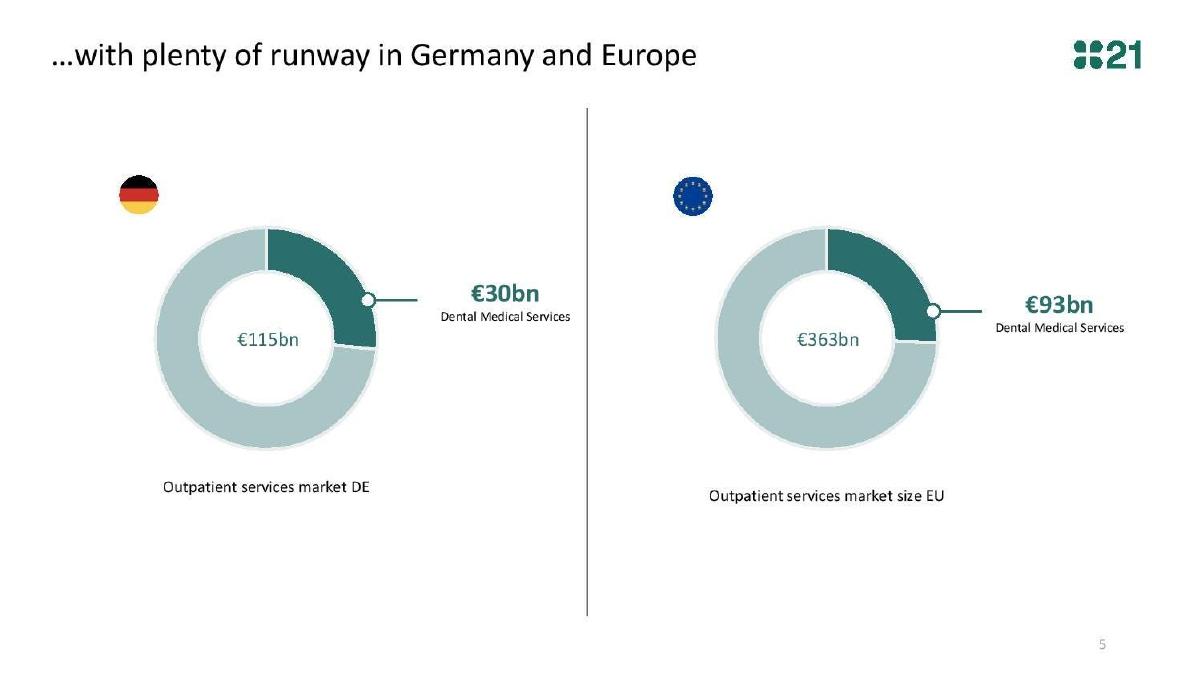
- The market size for outpatient services in the EU is valued at €363bn, with dental services representing a €93bn subset (Slide 5).
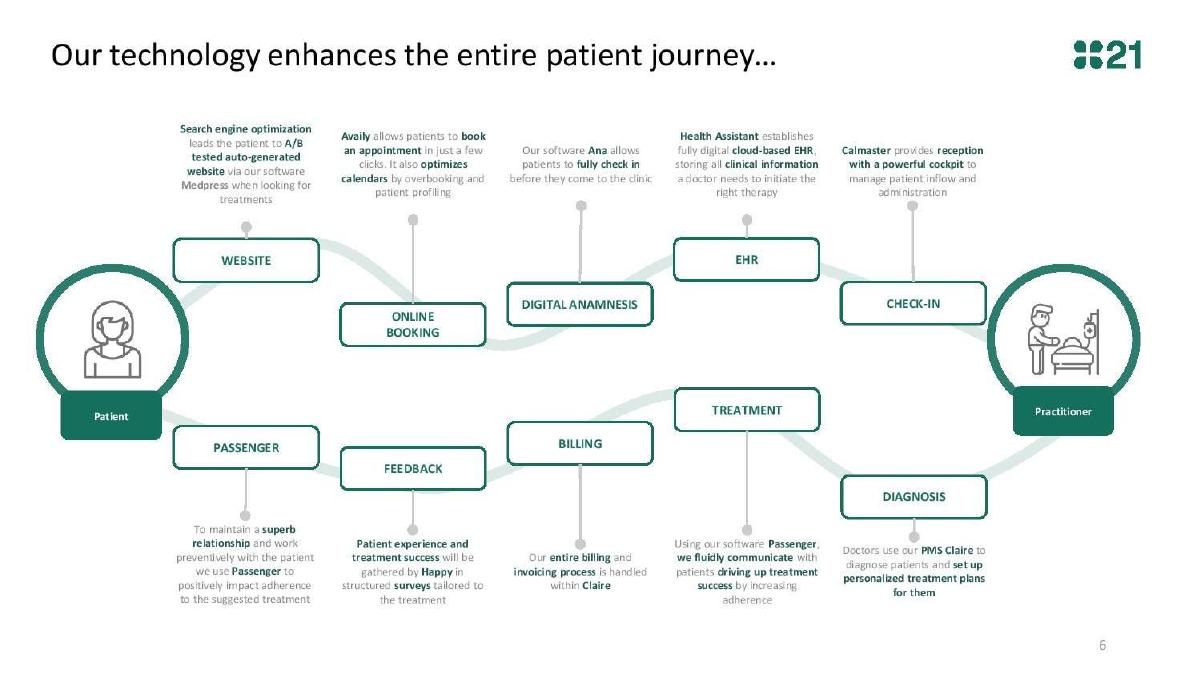
- The proprietary software suite includes specific modules like 'Availy' for booking, 'Ana' for check-in, 'Claire' for treatment plans, and 'Passenger' for patient communication (Slide 6).
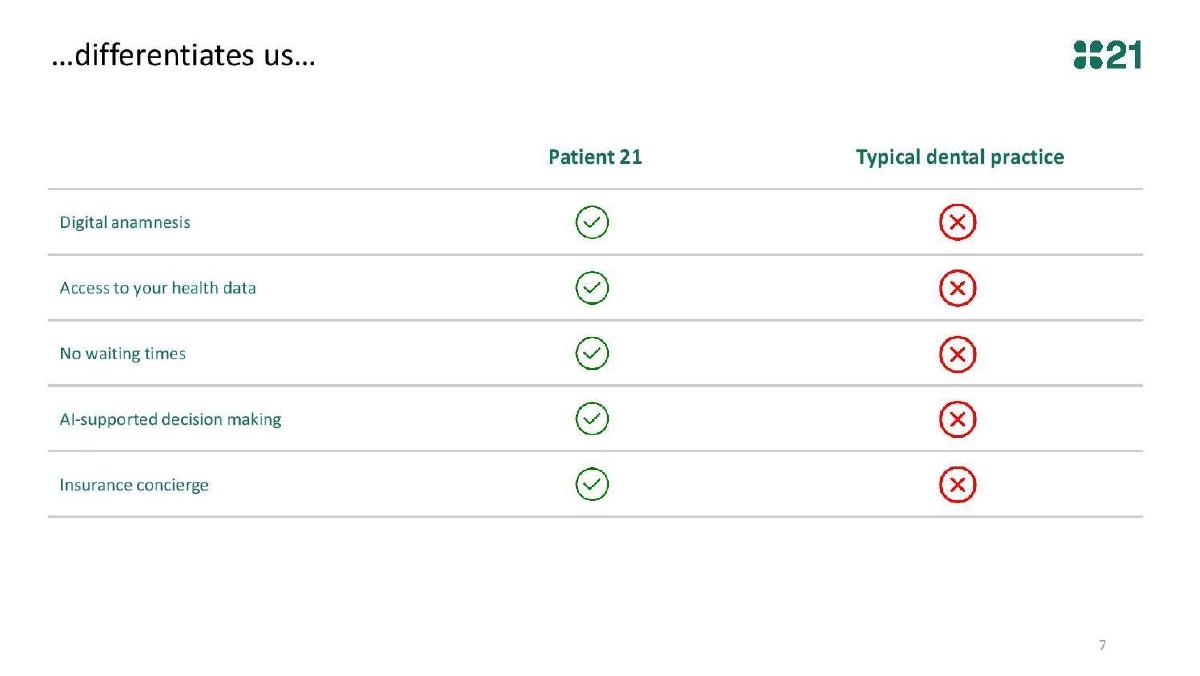
- Competitive differentiation is framed against a 'Typical dental practice,' highlighting 'No waiting times' and 'AI-supported decision making' (Slide 7).
- Patient satisfaction is exceptionally high, with a 4.9 out of 5.0 average NPS across all doctors (Slide 8).
- Referral-based growth is significant, with 25% of visits originating from patient referrals (Slide 8).
The Digi-Physical Strategy: A Series C Teardown
Patient21’s Series C deck, used to raise $108M in 2024 as reported by Business Insider, is a study in vertical integration. In an era where 'software is eating the world,' Patient21 argues that software isn't enough to fix healthcare—you have to own the clinics too. This 8-slide presentation moves quickly from vision to operational reality, focusing on the synergy between physical assets and digital efficiency.
Slide 1: Title Slide
The deck opens with a minimalist title slide featuring the 'p21' logo and the date 'May 2023.' It establishes a clean, professional brand identity without unnecessary clutter. The use of 'Patient 21 SE' indicates the company's European legal structure (Societas Europaea), signaling its cross-border ambitions from the outset.
Slide 2: The Vision
Slide 2 defines the company's North Star: 'Europe's leading digi-physical outpatient network.' The terminology here is critical. By coining 'digi-physical,' Patient21 avoids being pigeonholed as a mere clinic aggregator or a SaaS provider. They claim to deliver a 'game-changing' experience for both patients and practitioners, with the ultimate goal of 'superior treatment outcomes at lower costs.' This addresses the classic healthcare 'triple aim'—better care, better experience, lower cost.
Slide 3: The Building Blocks
This slide is the core of the business model. It breaks the 'p21 ecosystem' into three distinct pillars: Hardware (owned clinics), Operating System (proprietary software), and Data (patient-facing Health Assistant). By labeling clinics as 'Hardware,' they adopt a tech-first vocabulary that appeals to venture capital investors. The visual depicts a dental clinic, a laptop showing a complex dashboard, and a smartphone app, illustrating how these three components interact to form a unified service.
Slide 4: Operational Traction
Slide 4 provides the 'proof of life.' It shows a map of Germany dotted with clinic locations, stating they operate '50+ clinics across Europe’s largest Healthcare market.' The right side of the slide features a large, bold figure: 25,000 monthly patient visits. This slide effectively transitions the deck from a theoretical 'vision' to a proven, scaling business. The mention of Germany as the 'largest Healthcare market' justifies the initial geographic focus while setting the stage for broader European expansion.
Slide 5: Market Opportunity
The market slide uses a 'concentric circle' approach to show the 'runway' remaining. In Germany, they identify a €115bn outpatient services market, with €30bn specifically in dental medical services. They then scale this to the EU level, showing a total addressable market (TAM) of €363bn, with a €93bn dental opportunity. This slide serves two purposes: it shows that their current niche (dental) is massive, and it hints at the potential to expand into other outpatient specialties using the same 'digi-physical' model.
Slide 6: The Integrated Patient Journey
This is the most detailed slide in the deck, mapping out the entire patient journey from 'Website' to 'Feedback.' It highlights specific proprietary software modules:
Medpress: Auto-generated websites for SEO-driven patient acquisition. · Availy: Online booking and calendar optimization. · Ana: Digital anamnesis (check-in) software. · Health Assistant: A cloud-based EHR (Electronic Health Record). · Calmaster: A reception cockpit for managing inflow. · Claire: A PMS (Practice Management System) for diagnosis and treatment plans. · Passenger: A communication tool to drive treatment adherence. · Happy: A patient experience and feedback tool.
This slide demonstrates that Patient21 isn't just using off-the-shelf software; they have built a bespoke vertical SaaS stack that covers every touchpoint of the clinic operation.
Slide 7: Competitive Differentiation
Slide 7 uses a classic 'Checkmark vs. X' table to compare Patient21 against a 'Typical dental practice.' The differentiators listed are: Digital anamnesis, Access to health data, No waiting times, AI-supported decision making, and Insurance concierge. By checking every box for Patient21 and none for the competition, they emphasize the antiquated nature of current healthcare providers and the modernization their platform provides.
Slide 8: Patient Satisfaction and Growth
The final slide focuses on outcomes. It highlights a 4.9 out of 5.0 average NPS (Net Promoter Score) across all doctors. High NPS is notoriously difficult to achieve in healthcare, making this a powerful metric. Furthermore, it states that 25% of visits are based on patient referrals. This is a key efficiency metric; it proves that the 'digi-physical' experience is so superior that patients are actively marketing the service to their peers, lowering the long-term cost of acquisition.
What Patient21 Does Well
The deck excels at framing . By positioning clinics as 'hardware' and their software as an 'operating system,' they bridge the gap between high-multiple tech companies and low-multiple service companies. This framing is essential for a $108M Series C round, where investors need to see a path to tech-like scalability.
The granularity of the tech stack on Slide 6 is also a major strength. It proves that the company has deeply considered the operational bottlenecks of a clinic and built specific solutions for each one. This isn't just a 'booking app'; it's a comprehensive infrastructure play.
What Is Missing from the Deck
Despite the successful raise, the deck has several notable omissions:
Team Slide: There is no mention of the founders or the executive team. While their track record may be known to Series C investors, a deck teardown must note the absence of the human element. · Financials: There are no revenue figures, EBITDA margins, or unit economics (e.g., CAC/LTV). For a Series C, these are usually the most important metrics. · The Ask: The deck does not specify how much they are raising or how the funds will be used. · Competitors: While they compare themselves to a 'typical' practice, they do not mention other venture-backed consolidators or tech-enabled clinic chains.
Founder Takeaways: What to Copy
Use 'Ecosystem' Language: If you are building a hybrid business, don't let investors categorize you as just one or the other. Use terms like 'digi-physical' or 'integrated ecosystem' to define your own category. Show the Full Stack: If your value proposition is efficiency, don't just say 'we have an app.' Map out the entire process as Patient21 did on Slide 6 to show exactly where your technology creates value. Leverage Social Proof: In service industries, NPS and referral rates are the ultimate indicators of product-market fit. If your numbers are as high as 4.9/5.0, make them the climax of your presentation.
Frequently asked questions
- Why is the Patient21 deck so short for a Series C round?
- At the Series C stage, investors are often already familiar with the company's core metrics through data rooms. This 8-slide deck likely served as a high-level executive summary to frame the narrative of 'digi-physical' dominance before diving into deeper due diligence. It focuses on the 'why' and 'how' rather than exhaustive data.
- What does 'digi-physical' actually mean in this context?
- It refers to Patient21's strategy of vertically integrating the healthcare experience. Unlike Zocdoc (which is just a marketplace) or a traditional dentist (which is just a clinic), Patient21 owns the physical clinics and the software that runs them. This allows them to control the data and the patient experience from end to end.
- How does Patient21 justify its valuation in a low-margin clinic business?
- By emphasizing their proprietary 'Operating System' (Slide 3) and 'AI-supported decision making' (Slide 7). They are positioning the clinics as the 'hardware' that runs their high-margin software, suggesting that their tech stack makes these clinics significantly more efficient and profitable than traditional practices.
- What is the significance of the 25% referral rate?
- In healthcare, customer acquisition costs (CAC) can be high. A 25% referral rate (Slide 8) indicates strong organic growth and high brand trust. For investors, this suggests that the business can scale more efficiently than competitors who rely solely on paid marketing.
- Is the lack of a team slide a red flag?
- In a Series C deck, the 'team' is often proven by the results (50+ clinics, 25k visits). While unusual for an early-stage deck, at this level, the founders' reputations and the company's scale often speak for themselves, though a team slide is still recommended for most decks.