Pawprint’s 2014 pitch deck is characterized by its extreme minimalism and heavy reliance on visual metaphors. With only 14 slides, the deck identifies a clear pain point: the archaic, paper-based nature of pet medical records. The narrative leverages the scale of the pet market—citing 185 million pets in the U.S.—and contrasts the digital transformation of human healthcare with the stagnation of veterinary record-keeping. While the deck is light on financial projections and specific unit economics, it successfully communicates a distribution strategy through veterinarians and demonstrates ear…
Key takeaways
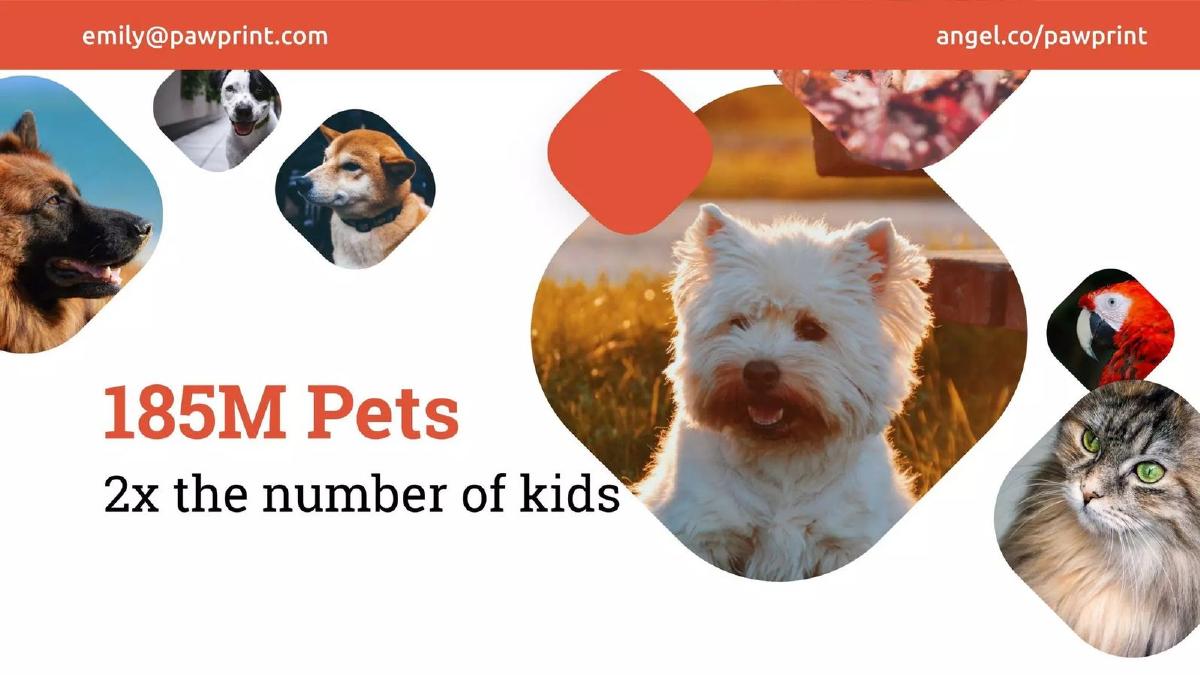
- The deck identifies a massive market of 185 million pets, which is stated to be 2x the number of human children on slide 4.
- It highlights a regulatory advantage, noting on slide 9 that there is 'No HIPAA for pets,' simplifying data portability.
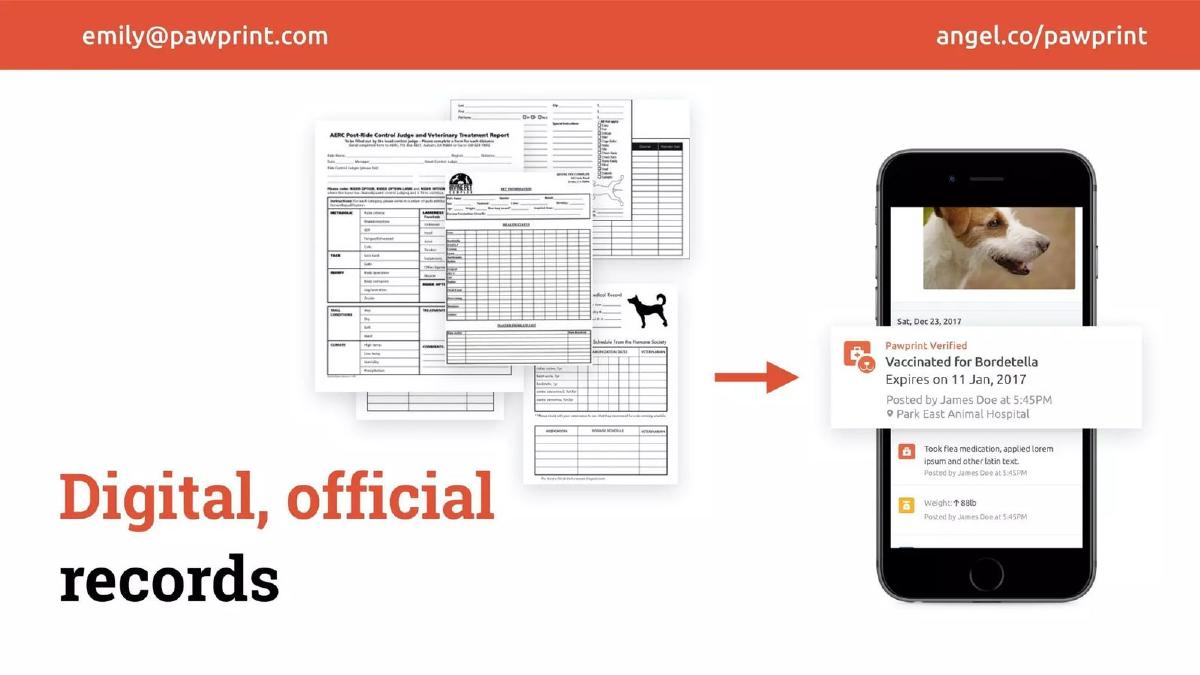
- The core product value proposition is the conversion of physical, paper-based vet records into digital, verified mobile records as shown on slide 6.
- Traction is demonstrated through a sourced medical records map on slide 12, claiming coverage from 4,600 of 30,000 US vets (15%).
- The deck uses a minimalist aesthetic with very few words per slide, forcing the audience to focus on key metrics like the 400 million vet/grooming/boarding visits mentioned on slide 8.
- Organic growth is presented as a visual trend line from October 2014 to January 2017 on slide 10, though specific user numbers are omitted.
- The team slide (slide 13) leverages logos from 500 Startups, Stanford University, and Y Combinator to establish pedigree.
- The deck completely omits a business model slide, financial forecasts, and a specific 'Ask' for the funding round.
The Pawprint Pitch Deck: A Visual Case for Digitizing Pet Care
Pawprint’s 2014 pitch deck is a classic example of the 'less is more' philosophy. In an era where many founders were still cramming 50 lines of text onto a single slide, Pawprint opted for high-resolution photography and bold, single-sentence claims. The deck, which helped secure $1.2 million in funding, focuses almost entirely on the scale of the opportunity and the simplicity of the solution. It avoids the clutter of deep technical explanations, choosing instead to highlight the friction of the status quo.
Slides 1-2: The Hook and Product Identity
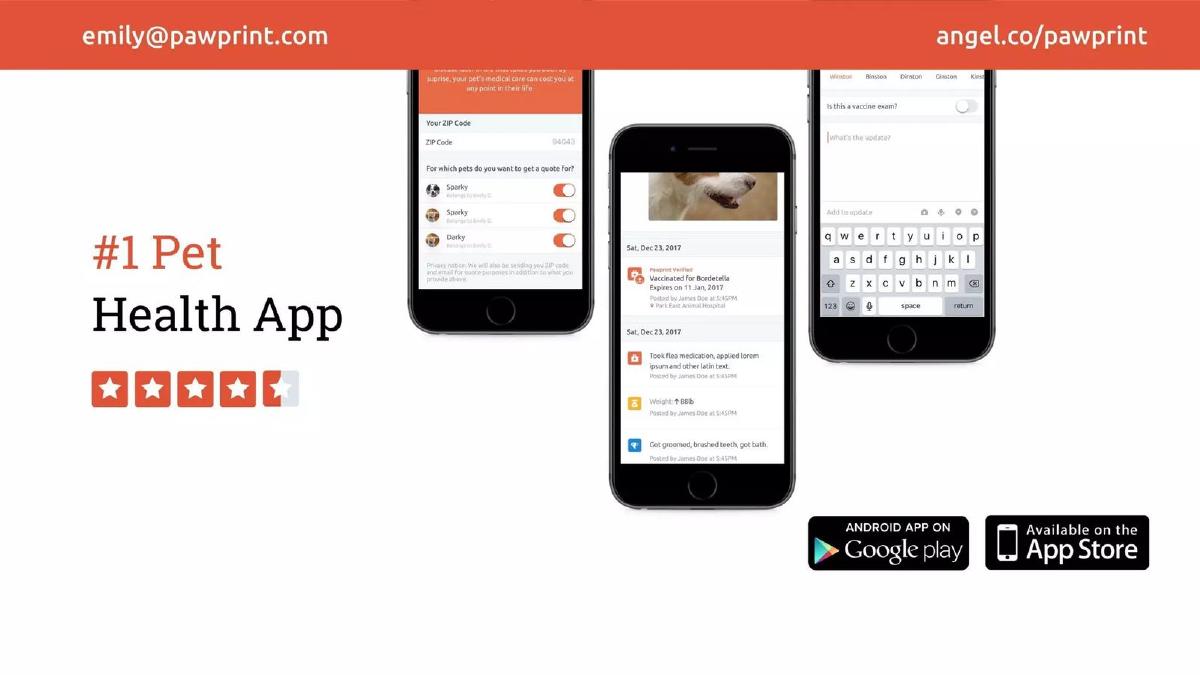
Slide 1 introduces the company with the tagline 'The Official Pet Medical Record.' The branding is clean, using a friendly orange palette and a simple paw-in-a-circle logo. Slide 2 immediately establishes social proof and product readiness. It labels Pawprint as the '#1 Pet Health App' accompanied by a 4.5-star rating graphic. The slide features three smartphone mockups showing the user interface: a zip code entry for quotes, a verified vaccination record for 'Bordetella,' and a timeline of pet events like weight checks and grooming. This slide tells the investor that the product is live, well-received, and functional on both iOS and Android.
Slides 3-5: Market Context and the Problem
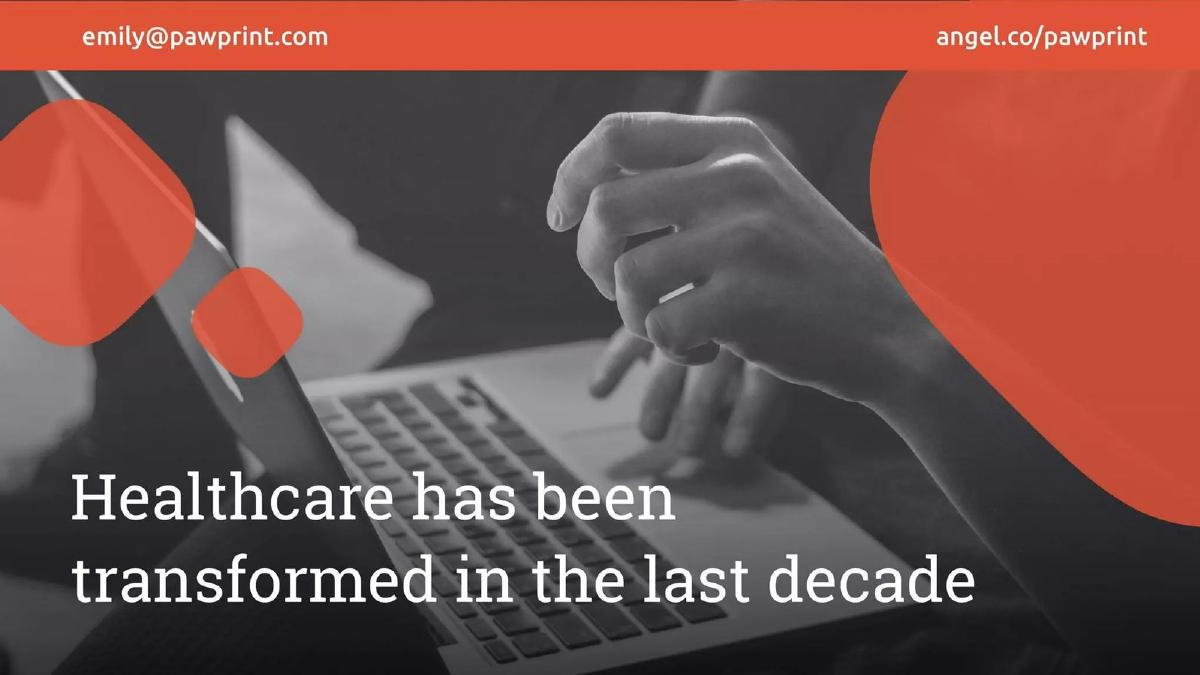
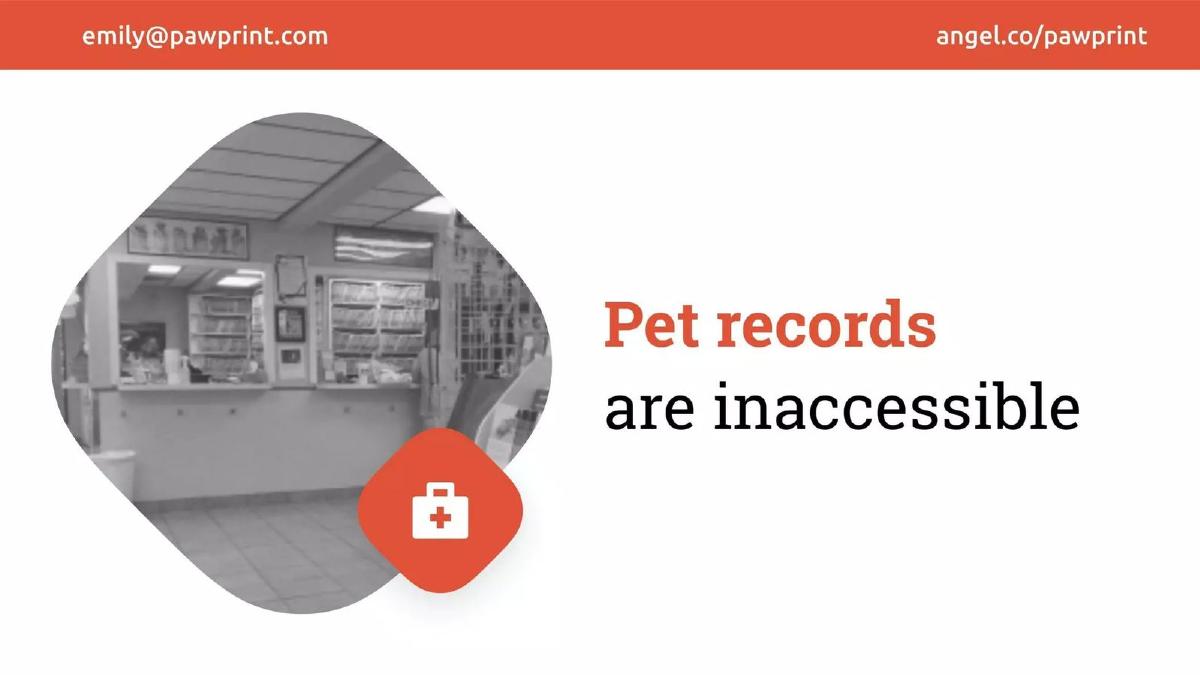
Slide 3 sets a broad stage with the text 'Healthcare has been transformed in the last decade,' implying that veterinary medicine is lagging behind. Slide 4 provides the 'Why Now' and market size: '185M Pets,' which the deck claims is '2x the number of kids.' This is a powerful framing device that elevates the pet industry from a niche hobbyist market to a primary household concern. Slide 5 identifies the core pain point: 'Pet records are inaccessible.' The visual is a grainy, black-and-white photo of a cluttered vet reception desk, emphasizing the archaic nature of the current system.
Slides 6-9: The Solution and Regulatory Landscape
Slide 6 illustrates the digital transformation. It shows a stack of messy paper forms being converted into a clean, 'Pawprint Verified' digital notification on a smartphone. This is the 'Aha!' moment of the deck. Slide 7 reinforces the necessity of the product, stating 'Proof of vaccination required,' accompanied by a photo of a puppy receiving a shot. Slide 8 quantifies the frequency of this need, citing '400M vet/grooming/boarding' visits and '200M vet visits.' This suggests a high-frequency use case. Slide 9 is perhaps the most strategically important for a sophisticated investor: 'No HIPAA for pets.' This three-word slide removes a major perceived barrier to entry, suggesting that data portability in this sector is a matter of execution, not regulation.
Slides 10-12: Traction and Distribution
Slide 10 shows a graph of 'Organic growth.' While the Y-axis is unlabeled (a common tactic to show momentum without revealing exact numbers), the X-axis shows a steady climb from October 2014 to January 2017. Slide 11 outlines the growth strategy: 'Distribution through veterinarians.' Slide 12 backs this up with a map of the U.S., claiming the company has 'Sourced medical records from 4,600 of 30,000 US vets,' which equates to '15% of US Vets.' This is a strong traction metric that proves the company has already solved the hardest part of the equation: data acquisition.
Slides 13-14: The Team and Closing
Slide 13 introduces the team. It includes Emily (Founder), Apple (Mascot), Dr. Levine (Vet Advisor), Luke (Engineer), and Patryk (Designer). The slide is light on bios but heavy on logos, featuring 500 Startups, Stanford University, and Y Combinator, along with industry-specific logos like Park East Animal Hospital and BluePearl. This provides the necessary institutional credibility. Slide 14 is a simple contact slide with the founder's email and an AngelList URL.
What Works in the Pawprint Deck
Clarity of Vision: The deck never wavers from its core message: pet records are currently paper-based and hard to access, and Pawprint makes them digital and verified. By focusing on this one specific friction point, the founders avoid the 'feature creep' that often plagues early-stage decks.
Market Framing: Comparing the number of pets to the number of children (Slide 4) is a brilliant way to communicate market scale to investors who might not be pet owners themselves. It immediately contextualizes the spend and emotional investment of the target demographic.
Regulatory De-risking: The 'No HIPAA' slide is a masterstroke. It addresses a primary concern for health-tech investors—compliance costs—before it can even be asked. It frames the pet space as a 'blue ocean' for data aggregation.
What is Missing from the Pawprint Deck
Business Model: There is no mention of how Pawprint intends to generate revenue. Is it a SaaS model for vets? A subscription for pet owners? A lead-gen tool for insurance? The deck is silent on monetization, which is a significant gap for a $1.2M raise.
Competitive Landscape: The deck assumes Pawprint is the only player in the space. There is no mention of existing vet practice management software or other pet health apps. Investors generally want to see how a startup differentiates itself from incumbents.
The Ask: The deck does not state how much money is being raised or what the milestones for the next 18 months will be. While this information is often shared in a separate document or during the pitch, its absence in the deck makes the narrative feel somewhat incomplete.
Unit Economics: There is no data on customer acquisition cost (CAC) or lifetime value (LTV). While the growth is 'organic,' understanding the cost of sourcing records from 4,600 vets would be critical for evaluating the scalability of the business.
What a Founder Should Copy
Visual Storytelling: Founders should emulate the way Pawprint uses imagery to evoke the 'pain' of the problem. The contrast between the cluttered vet desk on Slide 5 and the clean app interface on Slide 6 is more effective than a thousand words of text.
Pedigree by Association: If you have attended a top-tier university or accelerator, use the logos prominently. Pawprint does this effectively on the team slide, which helps offset the lack of detailed professional histories for the individual team members.
Simplified Traction: The map on Slide 12 is an excellent way to show market penetration. Instead of just saying 'we have 4,600 vets,' showing them as dots across the country provides a sense of scale and geographic reach that a simple bullet point cannot achieve.
Focus on the 'Why Now': By mentioning the digital transformation of human healthcare, Pawprint creates a sense of inevitability. Founders should always look for a parallel industry that has already been disrupted to justify why their own industry is next in line for a tech overhaul.
Frequently asked questions
- How does Pawprint plan to make money?
- The pitch deck does not explicitly state a business model or revenue streams. While it mentions 400 million visits to vets, groomers, and boarding facilities, it does not detail whether the company plans to charge pet owners, veterinarians, or service providers for access to the verified records. This is a significant omission typical of early-stage 'growth-first' mobile app decks from this era.
- What is the primary problem Pawprint is solving?
- According to slides 5 and 7, pet records are currently 'inaccessible' and paper-based. The deck argues that because proof of vaccination is required for essential services like boarding and grooming, the lack of a digital, portable record creates friction for pet owners. Pawprint solves this by digitizing and verifying these records directly from the vet.
- What traction did Pawprint have at the time of this deck?
- Slide 12 indicates that Pawprint had already sourced medical records from 4,600 veterinarians, representing 15% of the 30,000 vets in the United States. Additionally, slide 10 shows an 'Organic growth' chart spanning over two years, indicating a steady upward trajectory in user or record acquisition since late 2014.
- Who is the target audience for the Pawprint app?
- The deck focuses on pet owners who need to provide 'Proof of vaccination' (slide 7) for the 400 million annual visits to service providers. By positioning the app as the '#1 Pet Health App' on slide 2, they are targeting the 'pet parent' demographic that manages care for the 185 million pets in the U.S.
- Why is the 'No HIPAA for pets' slide important?
- Slide 9 is a strategic highlight for investors. In human healthcare, HIPAA regulations create massive legal and technical barriers to sharing medical data. By stating there is 'No HIPAA for pets,' Pawprint signals to investors that they can scale their data aggregation and sharing platform much faster and with less legal overhead than a human-centric health tech startup.