Pathrise’s 12-slide deck is a lean, metric-heavy presentation that focuses on the efficacy of its Income Share Agreement (ISA) model. Eschewing complex design, the deck relies on raw traction data, such as a 94% hire rate within nine months (Slide 5) and a waitlist of over 1,000 prospects (Slide 6). The company positions itself as a career accelerator rather than a technical bootcamp, charging 9% of a fellow's first-year income only after they are hired (Slide 4). With a clear $3M ask to solve a capacity bottleneck (Slide 12), the deck successfully argues that their primary challenge is not d…
Key takeaways
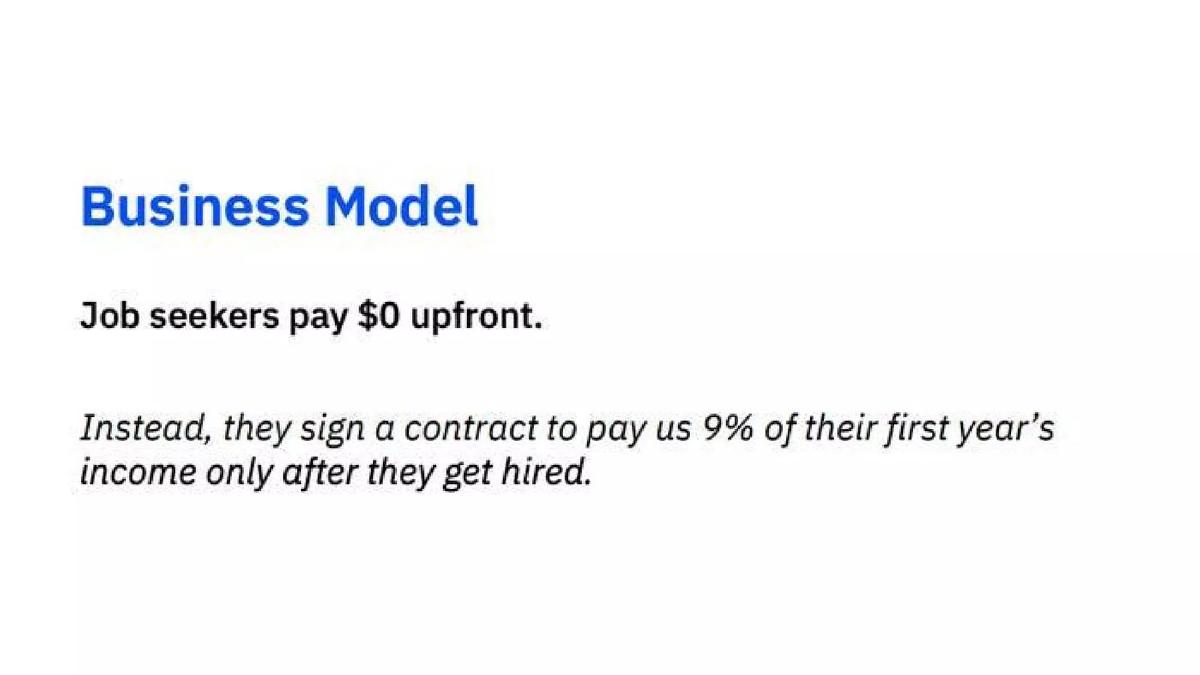
- The business model is built on a 9% income share agreement with $0 upfront cost for job seekers (Slide 4).
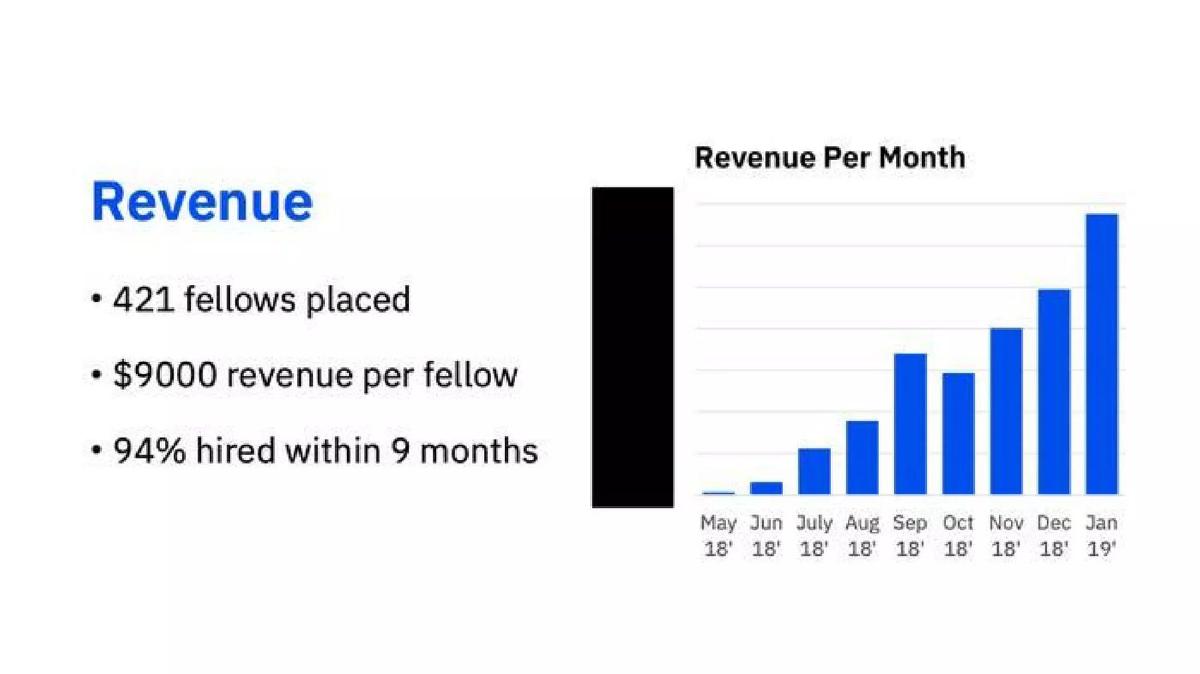
- Pathrise reported a high success rate with 94% of fellows hired within nine months of the program (Slide 5).
- The company generates an average of $9,000 in revenue per fellow placed (Slide 5).
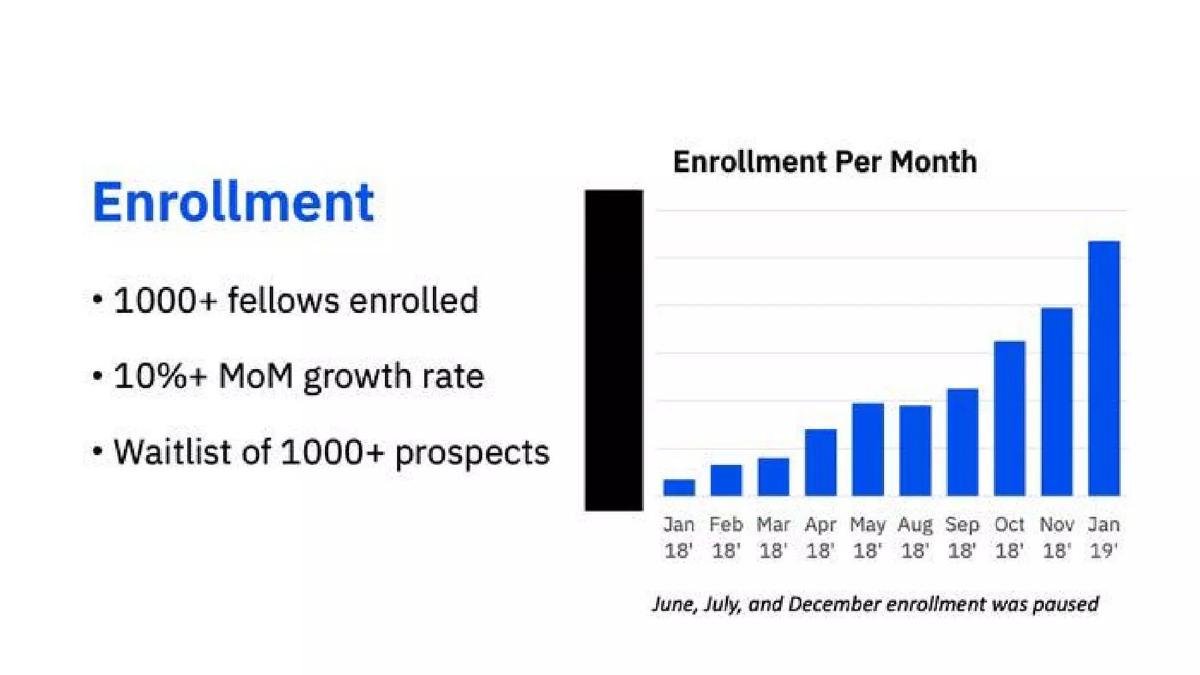
- Demand significantly outpaced capacity, evidenced by a waitlist of 1,000+ prospects (Slide 6).
- The program is not a technical bootcamp; it focuses specifically on job search optimization (Slide 3).
- Market size is calculated at $20.7B based on 3.2M new graduates and 1.4M early-career switchers (Slide 8).
- The founders leverage direct experience from Yelp and Facebook to establish domain authority (Slide 11).
- The $3M fundraising ask was specifically earmarked for hiring advisors to meet unmet demand (Slide 12).
The Pathrise Pitch Deck: Scaling Mentorship via ISAs
Pathrise entered the EdTech space with a provocative value proposition: we only get paid if you get a job. This 12-slide deck, used during their earlier stages, is a study in simplicity and metric-driven persuasion. By 2017, the company was already demonstrating that the Income Share Agreement (ISA) model could be applied effectively to career coaching, not just technical training. The deck focuses heavily on the 'Outcomes' and 'Revenue' generated by this model, providing a clear window into how they scaled to a $27.2M total raise.
The Hook: Problem and Solution (Slides 1-3)
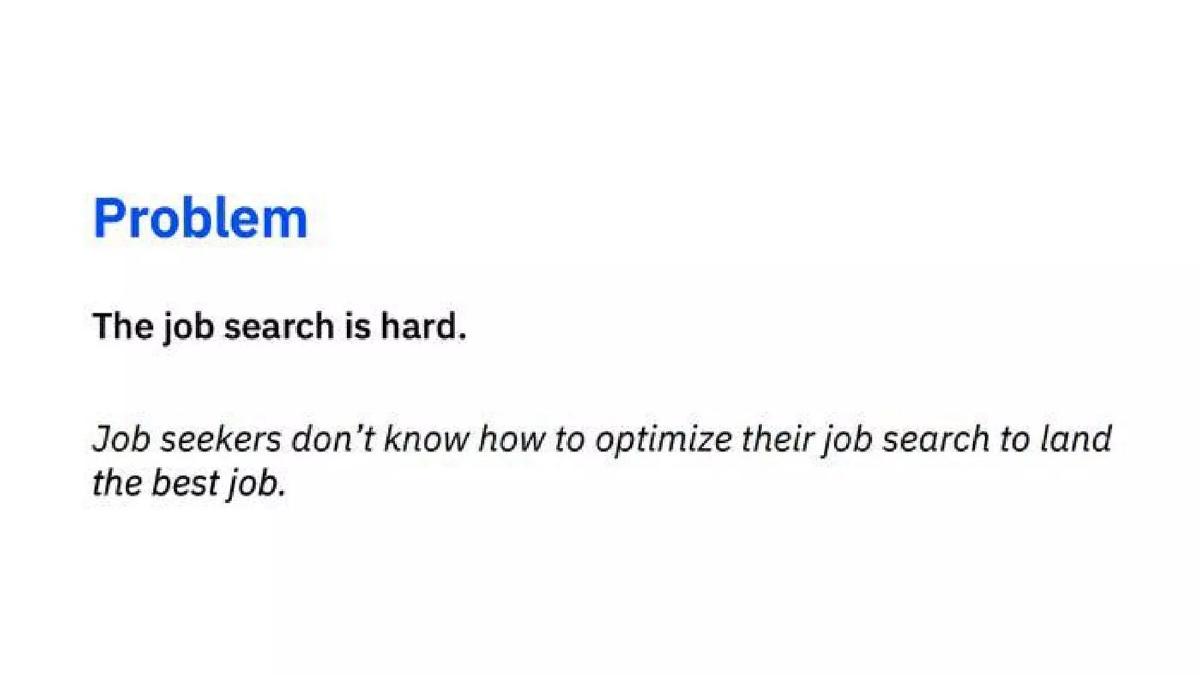
Slide 1 is a standard title slide featuring the logo and the tagline "Land your dream job." It is clean and minimalist, setting a professional tone. Slide 2 defines the problem with extreme brevity: "The job search is hard." It notes that job seekers lack the knowledge to optimize their search for the "best" jobs. This is a universal pain point for the 3.2M annual graduates mentioned later in the deck.
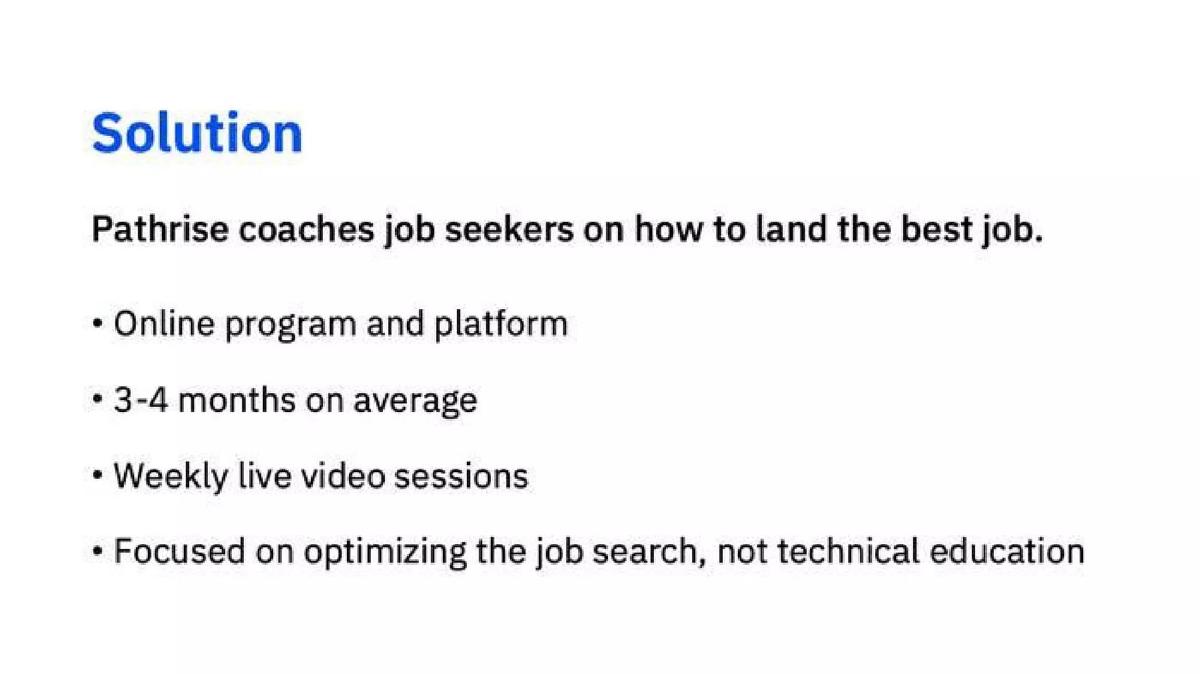
Slide 3 introduces the solution. Pathrise is described as an online program and platform lasting 3-4 months on average. Crucially, the final bullet point distinguishes Pathrise from the crowded bootcamp market: "Focused on optimizing the job search, not technical education." This positioning allows Pathrise to sit on top of the existing education ecosystem rather than competing with it. They aren't teaching you how to code; they are teaching you how to get hired as a coder.
The Engine: Business Model and Revenue (Slides 4-5)
Slide 4 details the Business Model, which is the core of the Pathrise pitch. By offering a "$0 upfront" cost, they remove the primary barrier to entry for recent graduates. The 9% income share for the first year is a high-margin take rate compared to traditional placement agencies, especially given the $9,000 average revenue per fellow cited on the next slide.
Slide 5, titled "Revenue," is the most important slide in the deck. It lists 421 fellows placed and a staggering 94% hire rate within nine months. The bar chart shows "Revenue Per Month" from May 2018 to January 2019. While the Y-axis values are redacted (blacked out), the visual trend is one of aggressive, consistent growth. This slide proves that the ISA model isn't just a theory; it is a functioning revenue engine with high success rates.
Growth and Projections (Slides 6-7)
Slide 6 covers "Enrollment." It mirrors the revenue slide but focuses on the top of the funnel. With 1,000+ fellows enrolled and a 10%+ MoM growth rate, the demand is clear. The most compelling data point here is the "Waitlist of 1000+ prospects." A footnote mentions that enrollment was paused in June, July, and December, which signals to investors that the company has more demand than it can currently handle—a classic "good problem" to have.
Slide 7 provides "Projections." The company conservatively estimates that if they grow at only half their current rate in 2019, they will reach 2,300 risers enrolled. This "under-promise and over-deliver" framing is a smart way to build credibility with investors while still showing a path to doubling their user base.
Market Opportunity and Social Proof (Slides 8-10)
Slide 8 breaks down the "Market." Pathrise calculates a $20.7B market opportunity. They use a conservative $50k salary as the basis for their 9% income share calculation, despite noting that their current average is actually $100k (2x the estimate). This conservative math makes the $20.7B figure feel more attainable and grounded in reality.
Slide 9, "Outcomes," is a logo wall of Tier-1 tech companies including Facebook, Google, Yelp, Microsoft, Amazon, Apple, Uber, and Salesforce. This slide serves as the ultimate validation of their coaching quality. If Pathrise fellows are getting into these highly competitive firms, the curriculum is clearly working.
Slide 10 discusses "Network Effects." Pathrise argues that each new "riser" adds value by building a P2P community, providing exclusive data on hiring processes, and eventually becoming a hiring manager or advisor who can pull the next generation of Pathrise students into the workforce. This suggests that the business becomes more efficient and defensible as it grows.
The Team and the Ask (Slides 11-12)
Slide 11 introduces the founders: Kevin Wu (CEO, ex-Yelp) and Derrick Mar (CTO, ex-Facebook). The team is small but has direct experience at the very companies their students want to join. This "founder-market fit" is essential for a mentorship-based business.
Slide 12 concludes with "Fundraising." The company was seeking $3M to hire advisors faster and develop their software/data advantage. The ask is directly tied to the bottleneck identified on Slide 6 (the waitlist). By framing the investment as a way to unlock existing, dormant demand, Pathrise makes the $3M round feel like a low-risk expansion play rather than a speculative bet.
What Works in the Pathrise Deck
1. The 94% Success Rate: In EdTech, outcomes are everything. By leading with a 94% placement rate, Pathrise immediately silences doubts about the efficacy of their coaching. This metric is the foundation upon which the rest of the deck is built.
2. Conservative Market Modeling: By using a $50k salary for their TAM calculation while stating their actual average is $100k, they demonstrate financial maturity. Investors appreciate founders who don't inflate their numbers to the point of absurdity.
3. Identifying the Bottleneck: The mention of pausing enrollment and the 1,000+ person waitlist creates a sense of urgency. It tells the investor that the product is already a hit and the capital is needed only to scale the operations to meet that demand.
What is Missing from the Pathrise Deck
1. Unit Economics (CAC/LTV): While we see the $9,000 revenue per fellow, the deck does not disclose the Cost Per Acquisition (CAC) or the cost of the advisors. For a human-capital-intensive business, understanding the margins after paying the mentors is critical.
2. Competitive Landscape: The deck does not mention other career accelerators or the career services departments of major universities. A slide addressing why job seekers choose Pathrise over a traditional recruiter or a university career center would have added depth.
3. Curriculum Detail: There is very little information on what the "coaching" actually entails. While they mention "weekly live video sessions," the specific pillars of their optimization strategy are left to the imagination.
What a Founder Should Copy
1. The 'Outcomes' Slide: If you are in a B2C service or education space, your value is measured by the success of your users. A clean logo wall of where your users end up is the most powerful social proof you can provide.
2. The 'Ask' Alignment: Don't just ask for money; explain exactly what bottleneck that money will break. Pathrise's ask for $3M to "hire advisors faster" is a direct response to their waitlist problem, making the investment feel logical and necessary.
3. Minimalist Design: This deck uses a simple blue and white palette with standard fonts. It doesn't rely on flashy graphics because the data (10% MoM growth, 94% placement) is strong enough to stand on its own. If your metrics are good, you don't need a designer to hide them.
Frequently asked questions
- What is the core revenue driver for Pathrise according to the deck?
- Pathrise operates on an Income Share Agreement (ISA) model. As stated on Slide 4, job seekers pay $0 upfront. Once hired, they pay 9% of their first year's income. Slide 5 clarifies that this results in an average revenue of $9,000 per fellow, aligning the company's financial success directly with the employment outcomes of its users.
- How does Pathrise differentiate itself from a coding bootcamp?
- Slide 3 explicitly states that the program is 'Focused on optimizing the job search, not technical education.' While bootcamps teach skills like coding or data science, Pathrise acts as a finishing school or mentorship layer that coaches professionals on how to navigate the hiring process, interview, and negotiate offers.
- What evidence of product-market fit is presented?
- The deck provides three major signals of product-market fit: a 94% placement rate (Slide 5), a consistent 10%+ month-over-month enrollment growth rate (Slide 6), and a waitlist of over 1,000 prospects (Slide 6). The fact that they had to pause enrollment in June, July, and December suggests demand was higher than their operational capacity.
- How does the company calculate its Total Addressable Market (TAM)?
- On Slide 8, Pathrise defines its market as $20.7B. This is derived from 3.2M new graduates and 1.4M white-collar workers in their early 20s looking to switch jobs. They apply their 9% income share to a baseline $50k salary, though they note their actual average salary at the time was double that figure ($100k).
- What was the specific purpose of the $3M fundraising round?
- According to Slide 12, the $3M was intended to 'Fill unmet demand by hiring advisors faster' and to 'Further develop software and data advantage.' The deck frames the investment as a way to unlock a bottleneck in their human-capital-heavy coaching model.